
AI SEO vs Traditional SEO: How Algorithm Shifts Are Reshaping Search
How AI-powered search is rewriting SEO rules, why traditional tactics are losing ground, and what forward-thinking teams are doing now.

When someone searches for information today, they’re more likely to receive an AI-generated answer than ever before — often without leaving the results page. By early 2026, zero-click searches had climbed to roughly 65% of all Google queries, and AI Overviews were triggering on a wide swath of informational and commercial intent searches. The volume of attention migrating from blue links to AI answer panels isn’t theoretical; it’s measurable and accelerating. For teams responsible for organic visibility, this shift feels disorienting. You’ve spent years building ranking positions and click-through rates, only to watch a language model summarize your work without sending a visitor.
That frustration is valid, but it also points toward a strategic opening. Google’s leadership has consistently stated that the same core ranking systems power both traditional search results and AI-driven features like AI Mode and AI Overviews. The ranking signals haven’t been replaced; they’ve been exposed through a second, more aggressive consumption layer. This deep‑dive explains how the algorithm mechanisms work underneath both surfaces, where traditional SEO foundations still carry the weight, and what practical adjustments marketing leaders need to make so their content wins on every part of the search results page — including the part that doesn’t generate a click.
How Google’s Ranking Core Powers Every Search Surface
Google’s search engine periodically rolls out broad, system‑wide improvements called core updates. These aren’t targeted at individual sites; they recalibrate how Google evaluates content quality, relevance, and authority across the entire web. According to the Google Search Central documentation, core updates are “designed to ensure that overall, we're delivering on our mission to present helpful and reliable results for searchers.” When a site experiences a ranking shift around the time of a core update, Google recommends verifying the rollout period in Search Console and then assessing whether content improvements are warranted — not rebuilding the technical stack.
The same underlying infrastructure now feeds AI‑powered features. In a June 2026 statement, Brendon Kraham, Google’s VP of Search and Commerce, confirmed that AI Mode and AI Overviews run on the same core ranking systems as the traditional search results. Consequently, visibility in AI summaries isn’t a separate optimization channel; it’s a byproduct of the same quality signals. Google’s June 2026 documentation update reinforced this: the FAQ rich result feature had been removed, guidance on third‑party SEO tools was added, and llms.txt files were explicitly noted as not being a ranking signal — each a concrete signal that the technical foundation remains unchanged.
Spam prevention, too, is unified. Google’s spam updates system, an AI‑based spam‑detection engine, receives periodic improvements to catch new manipulation tactics. Sites that violate spam policies can lose visibility across all search surfaces — the classic blue links and the AI‑generated answers alike. Manipulative tactics that might have survived older filters are now detected by models that serve as a single enforcement layer.
For practitioners, the implication is that the binary thinking separating “AI SEO” from “traditional SEO” is a surface‑level artifact. Underneath, the ranking apparatus applies the same signals to determine helpfulness, expertise, authority, and trust, regardless of how the answer is displayed. The modern discipline requires understanding how those signals are interpreted in an answer‑rich environment, a perspective we explore further in semantic SEO in AI search 2026.
The Unshakable Foundation: What Traditional SEO Still Gets Right
Despite the interest in generative engine optimization (GEO), the fundamentals of technical SEO remain non‑negotiable. Keyword research, crawl budget management, internal linking architecture, page speed, mobile usability, and backlink profiles all feed the same core ranking systems that determine whether a page appears at all — in any format. Google’s official guide to optimizing for generative AI features, updated in June 2026, states unequivocally that “optimizing for generative AI search is optimizing for the search experience, and thus still SEO.” The guide explicitly calls out tactics that don’t matter: special schema beyond standard structured data, dedicated llms.txt files, content chunking strategies, and AI‑specific writing styles are either unnecessary or discouraged.
What does matter is demanding but straightforward: unique, indexable content; a clean technical base; and snippet eligibility. These are the same capacities that have anchored search performance for years. The difference now is that a failure to execute them well costs visibility in two places simultaneously. A site with uneven crawl budget allocation, for example, might not only rank lower in the traditional SERP but also fail to appear in AI Overview citations simply because Google’s indexing pipeline couldn’t process the relevant pages fast enough.
Content structure carries more weight than many teams realize. Organizing pages so that key definitions, statistics, and conclusions are positioned close to headings, early in paragraphs, and within clearly bounded sections makes them more extractable by AI systems. This discipline helps both human skimmers and language models locate the core contribution of a page. The AI search ready content structure guide outlines the formatting patterns that satisfy both judgment layers without resorting to machine‑first writing.
Structured data implementation remains a standard SEO practice, but its role has expanded. Schema that clarifies article authorship, organizational identity, and factual assertions helps Google’s systems verify and surface information for AI summaries. A well‑formed JSON‑LD block that tags the article’s author, publisher, and date published makes the page more citable. Here’s a minimal example:
{ "@context": "https://schema.org", "@type": "Article", "headline": "AI SEO vs Traditional SEO", "author": { "@type": "Person", "name": "Content Team Lead" }, "publisher": { "@type": "Organization", "name": "SiaSEO", "url": "https://siaseo.com" }, "datePublished": "2026-06-24", "dateModified": "2026-06-24" }
Adding production‑ready markup along these lines — and ensuring it’s free of errors — reinforces the signals that both traditional ranking algorithms and AI citation models rely on. This technical‑plus‑structural convergence is covered in depth in our piece on structured data for AI search visibility.
The AI‑Search Layer: Visibility When the Click Never Arrives
Even as the ranking foundation stays unified, the presentation layer of search has changed enough to demand new optimization priorities. AI Overviews and AI Mode answer a large fraction of queries directly, meaning a user’s interaction with your content may never progress beyond the AI panel. When a click does occur, it often goes to the sources the AI system already cited — making brand visibility inside the AI answer a separate funnel stage from conventional organic click‑through.
Securing that visibility requires purposefully structuring content for extraction. The same on‑page elements that help a human reader understand the page quickly — descriptive headings, blockquotes for key claims, labeled data points — also help language models isolate citable material. It isn’t about writing for machines; it’s about writing so that the most valuable parts of the page are unmistakable.
Real‑world example: A B2B SaaS content team noticed that while their comparison guide ranked third for “best project management tool,” it never appeared in the AI Overview. The problem wasn’t the ranking — it was that the page opened with a 250‑word anecdote before stating any factual assertion. Google’s extraction system couldn’t pull a clear answer from the first scan. After restructuring the guide to place a concise comparison summary in the first 100 words, using bulleted differentiators, the page began appearing in AI Overview citations for that query within three weeks. No other SEO changes were made.
“We had to confront the uncomfortable truth that our top‑ranking content was invisible to two‑thirds of the people who could benefit from it. The fix was editorial, not technical.” — Content Operations Lead, mid‑market SaaS
For teams producing content at scale, tools that integrate brand‑context analysis before generating articles can shorten this feedback loop. Platforms that read a website’s existing topical coverage, brand language, and audience signals can produce drafts that align with both traditional quality expectations and AI‑extraction patterns from the first version. That alignment reduces the number of pieces that rank but remain invisible in AI answers — a common failure mode as the answer‑engine surface grows.
The operational relationship between tooling and strategy is examined in the AI SEO platforms versus traditional suites comparison, which maps how different generation and optimization approaches affect both ranking and citation performance.
Redefining Success: Metrics for an Answer‑Engine World
Traditional SEO measurement has been dominated by ranking position and organic click‑through rate. In a search environment where zero‑click rates exceed 40–65% for broad informational queries, those metrics become incomplete. A brand can hold steady at position two for a high‑volume keyword and still see traffic decline by a third if an AI Overview absorbs the clicks.
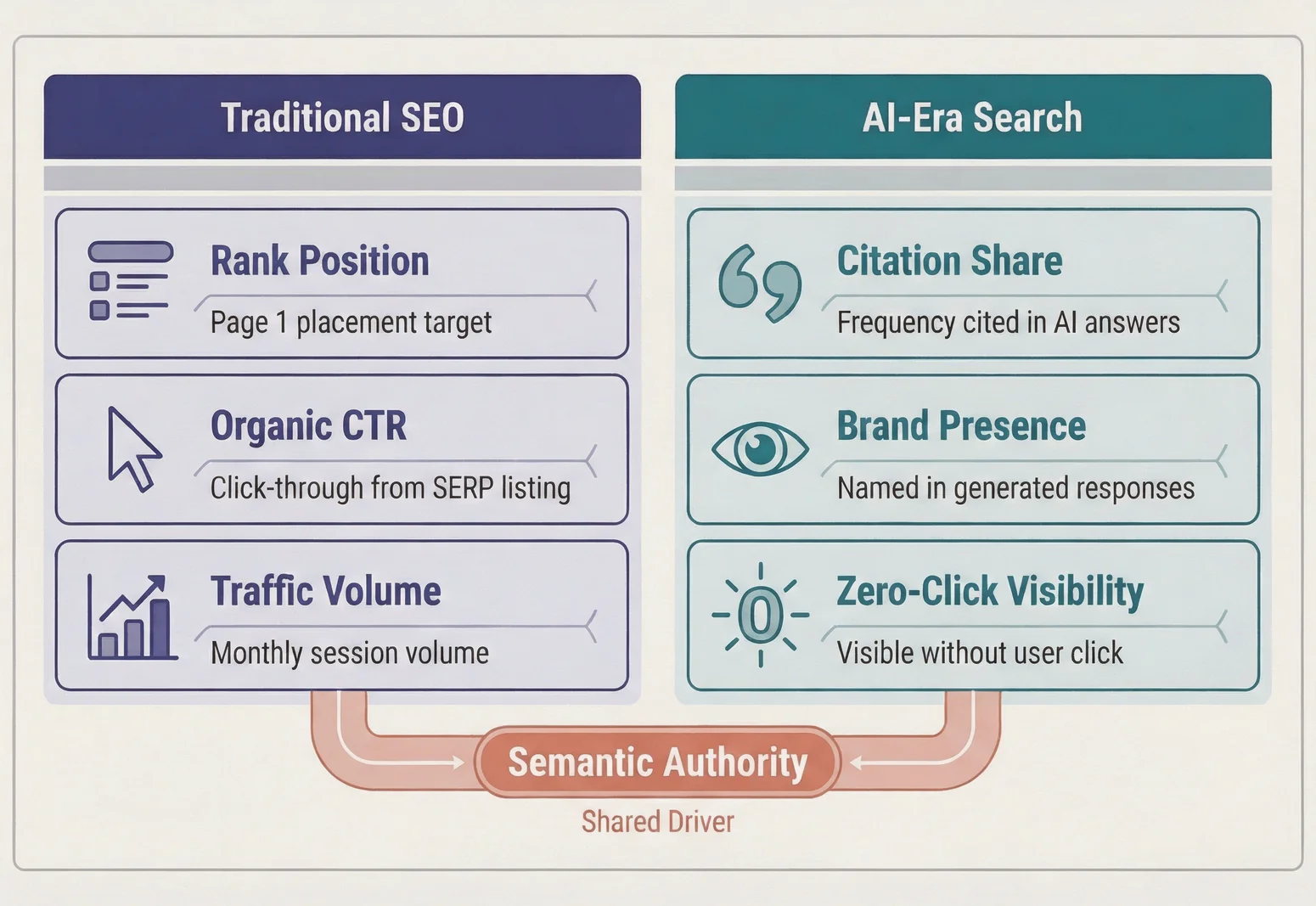
The emerging performance framework adds two layers: visibility inside AI answers (citation share) and brand presence within generated responses. Tracking both alongside conventional rankings reveals whether the content strategy captures audience attention or merely occupies a slot on a page fewer people click.
Google has begun providing partial tooling for this. Search Console now includes generative AI performance reports, though they currently show only impression data — not clicks. Monitoring these impression trends alongside manual checks of AI Overview citation patterns for priority queries helps teams gauge whether their content is surfacing where it matters.
The concept of “visibility versus traffic” becomes a new north star. A page that consistently appears in AI answers but generates fewer clicks may still deliver downstream value through brand reinforcement and preference formation. Conversely, a page that attracts clicks by winning the information‑snippet battle may need to evolve into a deeper resource to sustain that performance as AI summaries become more complete. The shifting relationship is laid out in detail in our analysis of search intent after AI Overviews.
The Operational Shift: Steps Leaders Can Take Now
Translating the strategic picture into a doable sequence helps teams move without unnecessary friction.
Audit existing content for AI‑search readiness. Assess whether top‑performing pages state their main assertions early, support them with citable evidence, and carry clean technical markup. A pre‑publish checklist that catches extractability gaps prevents new content from launching invisible to AI answers.
Strengthen expertise signals across the site. Well‑built author pages, transparent editorial policies, and source of truth pages AI search reinforce the human‑led credibility that core updates increasingly reward. These pages also function as citable reference points that AI systems can link to when synthesizing answers.
Rethink keyword research with intent‑shift in mind. Queries that once led to clicks on how‑to articles may now be resolved entirely within an AI Overview. Prioritize topics where the AI answer serves as a gateway — a summary that leads the searcher to a deeper exploration — rather than a terminal answer. Allocating content investment toward commercial‑investigation and comparison queries, where a click still has high value, protects against traffic erosion while building citation presence on broader informational terms.
Create a unified measurement dashboard. Combine rank tracking, GSC generative AI impressions, and external AI citation monitoring into one view. Assign ownership for monitoring brand representation in AI answers — what the AI says about your company matters as much as where you rank. The risk of brand misrepresentation inside AI summaries is real, and actively monitoring it prevents small errors from hardening into persistent misperceptions.
Embrace iterative content refinement. Updating old posts that have lost traffic to AI Overviews is often more efficient than creating from scratch. Refreshing existing content with clearer structure, updated data, and improved extractability can restore visibility in both ranking and citation contexts. Our detailed framework for this process can be found in the practical AI search visibility playbook.
Scale responsibly with AI‑native tooling. Platforms that automate site‑context ingestion, content calendar generation, and multi‑step quality scoring reduce the manual overhead of maintaining alignment across a large content inventory. Tools that produce content with explicit AI‑search readiness scores give teams a transparent signal about a piece’s likely performance before publication — a level of feedback that legacy SEO suites haven’t yet integrated.
Consider the case of an agency content director managing 14 client sites. Before adopting a platform that scored every article for AI‑readiness pre‑publication, her team spent roughly eight hours per week manually reviewing top‑performing pieces for extractability gaps. After integrating the scoring layer into their publishing workflow, they cut that review time in half and saw client AI Overview citations increase by 22% over the following quarter — not because they wrote more content, but because the percentage of content that was structurally ready for AI extraction rose sharply.
Straight Answers for Teams Navigating the Pivot
Is traditional SEO obsolete? No. Google’s own documentation and executive statements confirm that the same core ranking systems serve all search surfaces. Abandoning technical health, on‑page fundamentals, or authority building will damage visibility in both traditional results and AI features. The traditional SEO skillset is the base; AI visibility is an additional consumption layer on top of that base.
Does my team need a separate GEO budget or strategy? According to Google’s VP of Search, there is no separate generative engine optimization channel. The same content investment should be measured across both organic ranking metrics and AI visibility dashboards. Creating a parallel content track for “AI content” is unnecessary and often dilutes the signal quality.
How do I measure success when clicks decline? Combine rank tracking with AI citation impression data from Google Search Console and third‑party AI visibility tools. Look at citation share — how often your domain appears in AI Overview citations for priority queries — as a leading indicator. Treat “visibility” as the primary metric, with traffic as a lagging, secondary indicator.
Should I stop using traditional SEO platforms? Not necessarily. Traditional suites continue to excel at technical audits, rank tracking, and backlink analysis. However, if your content operations involve significant volume, consider supplementing with tools that address AI‑specific dimensions: brand‑context‑aware content generation, structured data validation at scale, and pre‑publication AI‑readiness scoring. The right mix often includes both categories.
How quickly do I need to act? The AI‑search surface is expanding rapidly; Google AI Mode now reaches over 200 million users and triggers on nearly half of tracked queries. Delaying adaptation means conceding citation ground to competitors who are already optimizing the same fundamentals. Start with an audit of your top‑performing pages this quarter, and extend the new practices to all content produced from this point forward.
Learn more about how SiaSEO provides the operating system for structured SEO content production.