Free AI Blog Post Generators: The Hidden Cost Model
A whitepaper on the total cost of free AI blog post generators, covering editing, QA, publishing, and hidden review time.

A free AI blog post generator shows up as a zero-cost line item. The invoice is accurate as far as it goes. What it excludes is the labor that lands after generation: fact-checking, structural repair, brand alignment, metadata cleanup, CMS formatting, and the approval cycle that decides whether a draft ships. This paper builds a cost model for ai blog generation that prices those steps explicitly, so a content lead can compare a free generator against a paid pipeline on cost per published article rather than on subscription price. The model draws on documented tool behavior, published search guidance, and clearly labeled scenario arithmetic. Where evidence is thin, the paper says so.
The research question and why the free tier is the wrong unit of comparison
The question this paper answers: at what volume does a free AI blog post generator cost more than a paid system, once review labor is priced at a real hourly rate?
Most evaluations never reach that question. They compare sticker prices. Free AI Blog Writer advertises 380+ models, no sign-up, no watermark, and markdown or .docx export, which is a capable feature set at a zero price point. QuillBot, TinyWow, SEOTooler, HubSpot, and Grammarly occupy the same results page for the query "ai blog post generator free," and each leads with the absence of a fee. None leads with the hours a reviewer will spend making the output publishable.
That gap is the research problem. A generator's price is observable. Its downstream cost is not, because the downstream cost is paid in salary, contractor time, or a marketing manager's evening, and it never appears on the same invoice as the tool.
Scope and what this paper does not cover
This model covers English-language B2B and SaaS blog production in the 10-to-200-articles-per-month range, which is where the audience for this paper operates. It excludes regulated content such as medical, legal, or financial advice, where review cost is dominated by compliance rather than editing and the arithmetic changes by an order of magnitude. It also excludes pure programmatic SEO at thousands of pages per month, where the constraint is indexation policy rather than editorial labor.
The paper does not argue that free tools are bad. Several are competent first-draft engines. The claim is narrower: the free tier is a component, not a pipeline, and the difference between those two things is where the money goes.
The evidence standard applied here
Three tiers of evidence appear in this paper, labeled throughout.
Documented behavior comes from vendor-published descriptions and official search guidance. Modeled cost comes from explicit assumptions about hourly rates and task durations, stated in the open so a reader can substitute their own numbers. Unverified claims are excluded. No statistic appears here without a source or an explicit assumption marker, because a cost model built on invented benchmarks is worse than no model.
What the free tier actually delivers
Before pricing the gaps, it helps to be precise about what a free generator produces, because the output format determines the repair work.
Free.ai's published description is unusually specific: a full markdown post with one H1 containing the keyword, H2 sections every 250–350 words, short paragraphs, an optional table of contents, an optional four-question FAQ block, and optional YAML frontmatter with a meta title under 60 characters and a meta description under 155 characters. Export targets include WordPress, Ghost, Medium, Webflow, Notion, and static site generators.
That is a well-specified artifact. It is also a generic one. The structure is fixed by the tool, not derived from the query, the site's existing content graph, or the reader's stage in a buying process. A keyword plus a post angle goes in; a template-shaped post comes out.
The four repair categories
Every free-generator draft that reaches publication passes through some subset of four repair categories. Naming them separately matters because they carry different costs and different failure modes.
- Factual repair. Claims that are wrong, unsourced, or unverifiable. Highest cost per instance, lowest frequency in low-stakes topics, highest in anything touching numbers, dates, prices, or vendor capabilities.
- Structural repair. Headings that miss search intent, sections in the wrong order, missing decision criteria, duplicated points across H2s.
- Brand repair. Voice drift, terminology that contradicts the product's own vocabulary, claims the legal or product team will not sign off on.
- Mechanical repair. Metadata length, slug, internal link insertion, image alt text, CMS field mapping, heading hierarchy violations.
Mechanical repair is the cheapest per unit and the most reliably present. Factual repair is the most expensive and the most variable. A cost model that averages them into one "editing" line hides the variance that drives budget.
Pricing the review loop
The core of this model is a per-article labor estimate. The numbers below are assumptions, stated so they can be replaced. They are not measurements from a controlled study, and this paper does not present them as such.
Assume a mid-market B2B content operation with a reviewer whose fully loaded cost is €45 per hour, working on a 1,200-word draft from a free generator.
| Repair category | Typical duration | Loaded cost | Notes |
|---|---|---|---|
| Factual verification | 20–45 min | €15–€34 | Scales with claim density, not word count |
| Structural rewrite | 15–40 min | €11–€30 | Highest when intent mismatch is severe |
| Brand and voice pass | 10–25 min | €8–€19 | Lower if a style guide exists and is enforced |
| Mechanical cleanup | 10–20 min | €8–€15 | Metadata, links, CMS fields, alt text |
| Approval and scheduling | 5–15 min | €4–€11 | Includes at least one revision round |
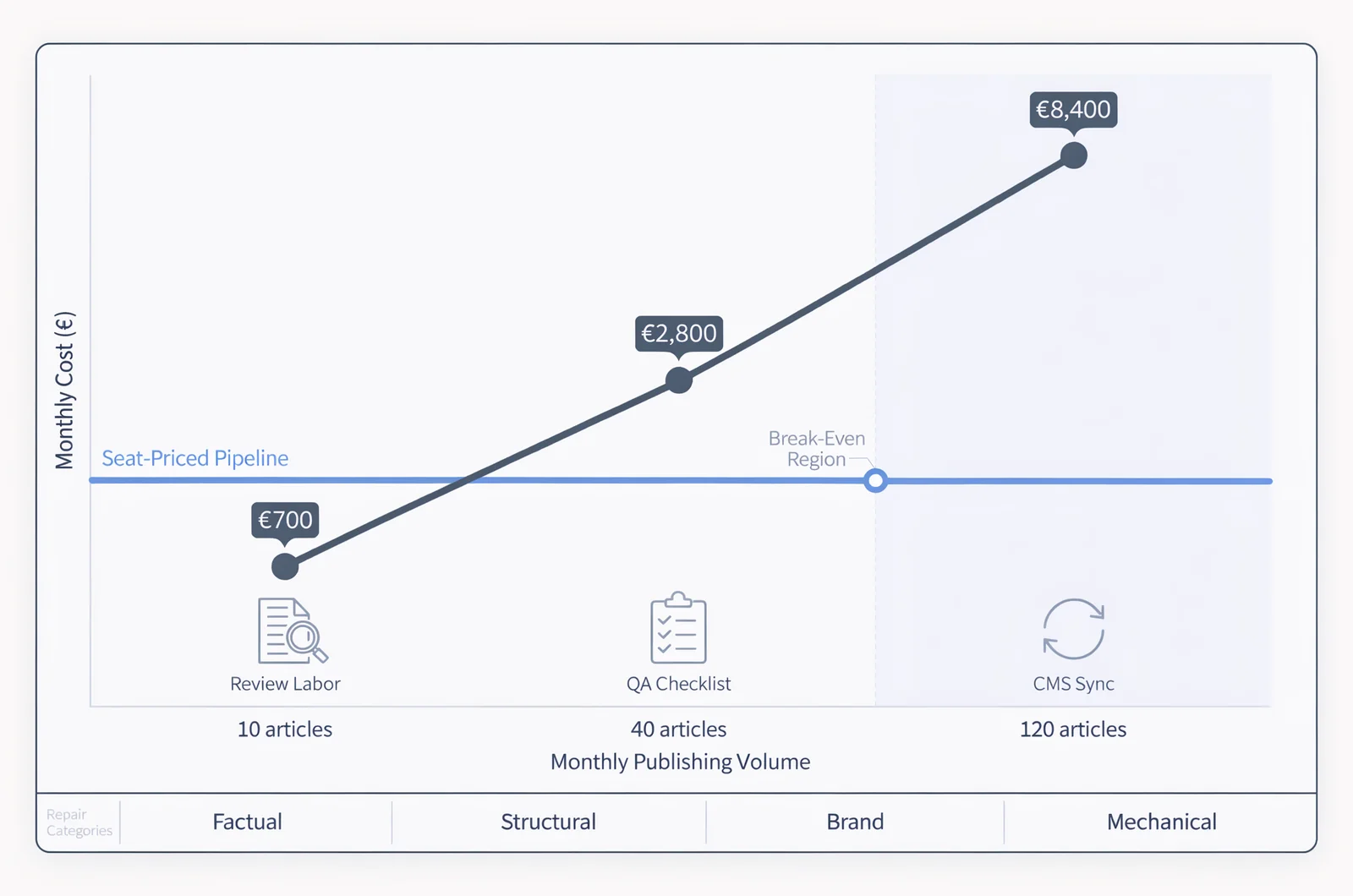
The midpoint total runs roughly €46 to €109 per article, with a central estimate near €70. At 40 articles per month, that is €2,800 in review labor against a €0 tool bill.
Two features of this table deserve attention. The ranges are wide because the underlying variable is claim density, not length. A 1,500-word post about a well-documented process may verify in 15 minutes; a 900-word post citing three statistics may take an hour. And the approval line is not optional in most organizations. Even a fully automated draft needs a named human who accepts responsibility for it, and that acceptance has a cost.
Why the second draft costs less than the first
Review cost is not linear in volume. The first ten articles from a new generator carry a discovery tax: the reviewer is learning the tool's failure patterns, building a checklist, and deciding which categories can be skipped. By article thirty, the reviewer knows that this tool reliably invents vendor pricing and reliably gets heading hierarchy right, so verification narrows to the categories that actually fail.
That efficiency is real, and it is also a trap. It comes from the reviewer's accumulated knowledge, which lives in one person's head. If that person leaves, the discovery tax returns in full. A cost model that assumes declining review time should also assume a documentation cost to make the decline durable.
The scaled-content constraint
There is a ceiling on how far volume can substitute for quality, and it is a policy ceiling rather than a labor one. Google Search's Guidance on Generative AI content states that using generative AI tools to generate many pages without adding value for users may violate its spam policy on scaled content abuse, and directs publishers to the Search Essentials and spam policies. The same guidance points to the Search Quality Raters guidelines sections on scaled content abuse and on main content created with little to no effort, originality, or added value.
The practical translation: a free generator plus zero review is not a low-cost content strategy. It is a policy risk with a labor cost of zero and an expected cost that is hard to bound. Any honest model carries that line, even though it cannot be priced precisely.
Where the free tier stops being free
The break-even point is where review labor plus risk exposure exceeds the cost of a system that reduces both. That threshold depends on volume and on the value of a published article, so it differs for every operation. Four conditions tend to mark it.
When review time exceeds drafting time. If a reviewer spends more minutes repairing a draft than the generator spent producing it, the generator is a net negative on throughput. This is common in technical topics where the model has thin training coverage.
When a factual error has asymmetric cost. A wrong statistic in a top-of-funnel explainer is annoying. A wrong claim about a competitor's pricing, a regulatory requirement, or a security property is a liability. The higher the asymmetry, the less a zero-cost generator is worth, because the review burden concentrates exactly where it is most expensive.
When the content graph matters. Free generators write one post at a time with no model of what the site already covers. At 20 published articles, that is manageable. At 200, the site accumulates near-duplicate sections, contradictory terminology, and cannibalized queries, and the cleanup becomes a project rather than a task.
When publishing is the bottleneck, not writing. If drafts sit in a queue waiting for someone to paste them into a CMS, map fields, and set metadata, the constraint is operational. A generator that ends at "download markdown" has not touched that constraint.
A worked comparison at three volumes
The table below applies the midpoint review estimate of €70 per article and compares it against a modeled paid-pipeline cost. The paid figures are illustrative placeholders, not quoted prices from any vendor, and should be replaced with real quotes before any decision.
| Monthly volume | Free generator: review labor | Free generator: risk and cleanup | Modeled paid pipeline | Break-even signal |
|---|---|---|---|---|
| 10 articles | €700 | Low, absorbed by one reviewer | Depends on seat pricing | Free tier often defensible |
| 40 articles | €2,800 | Rising; duplicate-topic cleanup begins | Scales with seats, not articles | Depends on seat math |
| 120 articles | €8,400 | High; content graph maintenance becomes a role | Seat cost amortizes further | Paid pipeline usually wins |
The pattern is not that free tools fail at scale. It is that their cost curve is linear in articles while their benefit curve is flat, because the output does not improve with volume. Paid systems are typically priced per seat or per workspace, so their cost curve is flatter than the labor curve they displace. That difference, not the subscription fee, is what moves the break-even point.
What a reviewable pipeline looks like
If the cost driver is review labor, the design goal is to reduce the number of repair categories a human has to touch, and to make the remaining ones cheaper. That is a systems problem, and it has identifiable components.
Site context before generation. A generator that reads the target site first can match existing terminology, avoid re-covering published topics, and inherit the site's structural conventions. This removes most brand repair and a meaningful share of structural repair. SiaSEO's approach starts from a URL-level site analysis, which is the mechanism that makes this category of repair smaller rather than faster.
Explicit quality scoring. A numeric score per draft turns review from a full read into a triage. Drafts above a threshold get a spot check; drafts below it get a rewrite. The value is not the score's precision but the routing decision it enables, and the routing decision is where the hours are saved.
Semantic drift tracking. Over months, a content program drifts: terminology shifts, positioning moves, older articles contradict newer ones. Tracking that drift is a maintenance task no per-article generator performs, because it requires memory across the corpus.
Publishing as a pipeline stage, not an export. Direct CMS sync with field mapping removes the mechanical category entirely. This is the cheapest repair category to eliminate and the one most often left in place.
A useful internal tool for a team adopting any of this: a review-cost estimator that takes article count, average claim density, and loaded hourly rate, and returns a monthly labor figure alongside a break-even volume. Teams that run that number before choosing a tool tend to argue about the right things.
Decision criteria for choosing between tiers
Five criteria separate a defensible free-tier deployment from an expensive one.
- Claim density per article. Low-density, opinion-led content tolerates free generation. Number-heavy content does not.
- Reviewer availability and cost. A senior specialist reviewing free drafts is the most expensive configuration available.
- Corpus size. Under roughly 50 published articles, content-graph maintenance is negligible. Above it, it is a line item.
- Publishing integration. Manual CMS entry is a fixed per-article tax that automation removes outright.
- Error asymmetry. The cost of the worst plausible factual error, multiplied by its rough probability, belongs in the model even when it cannot be measured.
Limitations of this model
The labor estimates here are assumptions, not measurements. They are stated in ranges precisely because a single point estimate would imply a precision the underlying evidence does not support. A team applying this model should replace the hourly rate, the duration ranges, and the volume tiers with its own observed numbers after one month of tracked review time.
The paid-pipeline figures in the comparison table are placeholders. No vendor pricing is quoted in this paper because pricing changes and because seat-based models price differently across team sizes. Treat that column as a slot to fill.
The model also cannot price the scaled-content risk. Google's guidance establishes that mass-generated pages without added value may violate spam policy, but it publishes no threshold, and the Search Quality Raters guidelines state that rater ratings do not directly influence ranking. The honest position is that the risk is real, directional, and unquantified.
Finally, the model treats review labor as the dominant cost. In organizations with strong editorial leadership and weak tooling, that holds. In organizations with the reverse, the dominant cost may be opportunity cost from slow publishing, which this model does not capture.
Questions this model tends to raise
Does a free AI blog post generator ever make sense? Yes, under specific conditions: low claim density, a reviewer whose time is genuinely available, a corpus under roughly 50 articles, and no publishing integration requirement. Outside those conditions, review labor dominates the tool's price advantage.
Is the review cost really that high? It depends entirely on claim density and on whether a style guide exists. The ranges in this paper are wide on purpose. Track your own review minutes for twenty articles and the model becomes specific to your operation.
What changes the arithmetic fastest? Publishing integration and site-aware generation. Both remove whole repair categories rather than shortening them, and category removal compounds across volume in a way that per-article speedups do not.
How does AI search visibility affect the calculation? Content that is structurally clean, factually sourced, and consistent across a corpus is easier for retrieval systems to select and cite. Drafts that pass a human skim may still fail extraction, which adds a cost this model does not attempt to price.
Should the model include the cost of not publishing? Yes, if publishing velocity is a competitive variable in your market. A free generator that produces drafts nobody ships has a total cost equal to the labor spent on drafts nobody ships.
Building the review dataset that settles the argument
The model above is only as good as the inputs a team puts into it, and the inputs come from one source: tracked review time. A spreadsheet with four columns (article, repair category, minutes, reviewer) is enough. After twenty articles, the averages replace the assumptions in this paper, and the break-even calculation becomes specific to the operation rather than illustrative.
Two measurement rules make that dataset trustworthy. Log minutes at the moment of repair, not at the end of the week, because reconstruction inflates estimates. And separate factual verification from every other category, because it is the one line that varies by an order of magnitude and the one most likely to be underreported.
Once the dataset exists, the comparison stops being about tools and starts being about capacity. A team with 40 hours of monthly review capacity and a €70 average repair cost can publish roughly 34 articles before the constraint binds. Whether those hours go to repairing free drafts or to editing drafts that arrive closer to publishable is the actual decision, and it is a capacity decision, not a pricing one. The free tier's price is real and its output is usable; what the model shows is that the price sits on the wrong line. A generator that costs nothing to run and €70 per article to make publishable is a labor-financed tool with an invisible invoice.
References
- Web Content Guidelines — DGOV - Web Content Guidelines for UAE Government ... The Web Content Guidelines for UAE Government outlines the criteria and best practices in content creation and development