
GEO vs SEO: Generative Engine Optimization Difference Explained
Understand the key differences between GEO and SEO, and discover which optimization strategies you need to rank in AI-powered search engines.

If you’ve opened a Google Search result this year and found the answer already written in an AI-generated paragraph before you clicked anything, you’ve already met the shift that makes the separation between generative engine optimization and traditional search optimization something every content team has to confront. The discipline of ranking blue links hasn’t vanished, but it no longer covers the full footprint where discovery happens. Leaders who treat the AI citation surface as “search, but with a different label” usually spend budget on the wrong signals. The teams getting it right run two editorial programs in parallel, and they can tell you exactly where the tactics diverge. This Q&A walks through the definitions, the operational gaps, and the prioritization questions marketing directors are asking mid-2026.
What exactly is generative engine optimization?
Generative engine optimization — GEO — is the discipline of designing and structuring content so that AI-powered answer systems cite or synthesize it when they produce a response. The target surfaces include Google AI Overviews, Google AI Mode, ChatGPT, Claude, Perplexity, and Gemini. The output you optimize for isn’t a click on a blue link; it’s a footnote, an expandable source card, or an inline citation inside a generated paragraph.
The term didn’t begin inside the SEO industry. It comes from a 2023 joint paper by Princeton, Georgia Tech, and the Allen Institute for AI that tested how to raise the likelihood a source gets cited during AI answer generation. The levers they examined — adding statistics, quoting named entities, structuring answers directly — mapped remarkably well onto later field tests. In practice, GEO means doing the things that raise the probability a generative engine treats your page as the best source to pull from when it answers a question.
You’ll see it called AEO (answer engine optimization), LLMO, or AI SEO depending on who is selling it to you, but by 2026 the industry has largely settled on GEO as the umbrella term. Our own breakdown of answer engine optimization basics goes deeper into the mechanics, but the quick test is simple: if the optimization target is an AI-generated summary rather than a ranked results page, you’re doing GEO.
What does traditional SEO mean in 2026?
Traditional SEO — search engine optimization — remains the practice of improving a page’s visibility in the organic listings of a search engine like Google or Bing. The core feedback loop hasn’t changed: crawl → index → rank → click. Every familiar lever (title tags, internal linking architecture, backlink authority, page speed, schema markup) still matters.
Even with generative AI features layered on top of search results, the fundamental infrastructure is unchanged. Google’s own documentation states directly that “our generative AI features on Google Search are rooted in our core Search ranking and quality systems,” and the systems that decide what appears in AI Overviews rely on the same ranking infrastructure that determines the organic ten blue links. The Google Search Central guide reinforces that point with explicit advice for site owners.
When someone says “traditional SEO,” they don’t mean outdated. They mean the discipline that originally built the infrastructure GEO depends on.
How do GEO and SEO differ in practice?
They solve adjacent problems but reward different content shapes. SEO optimizes for positioning inside a list of results; GEO optimizes for being the source an AI references when it writes an answer. That difference shows up in five concrete layers.
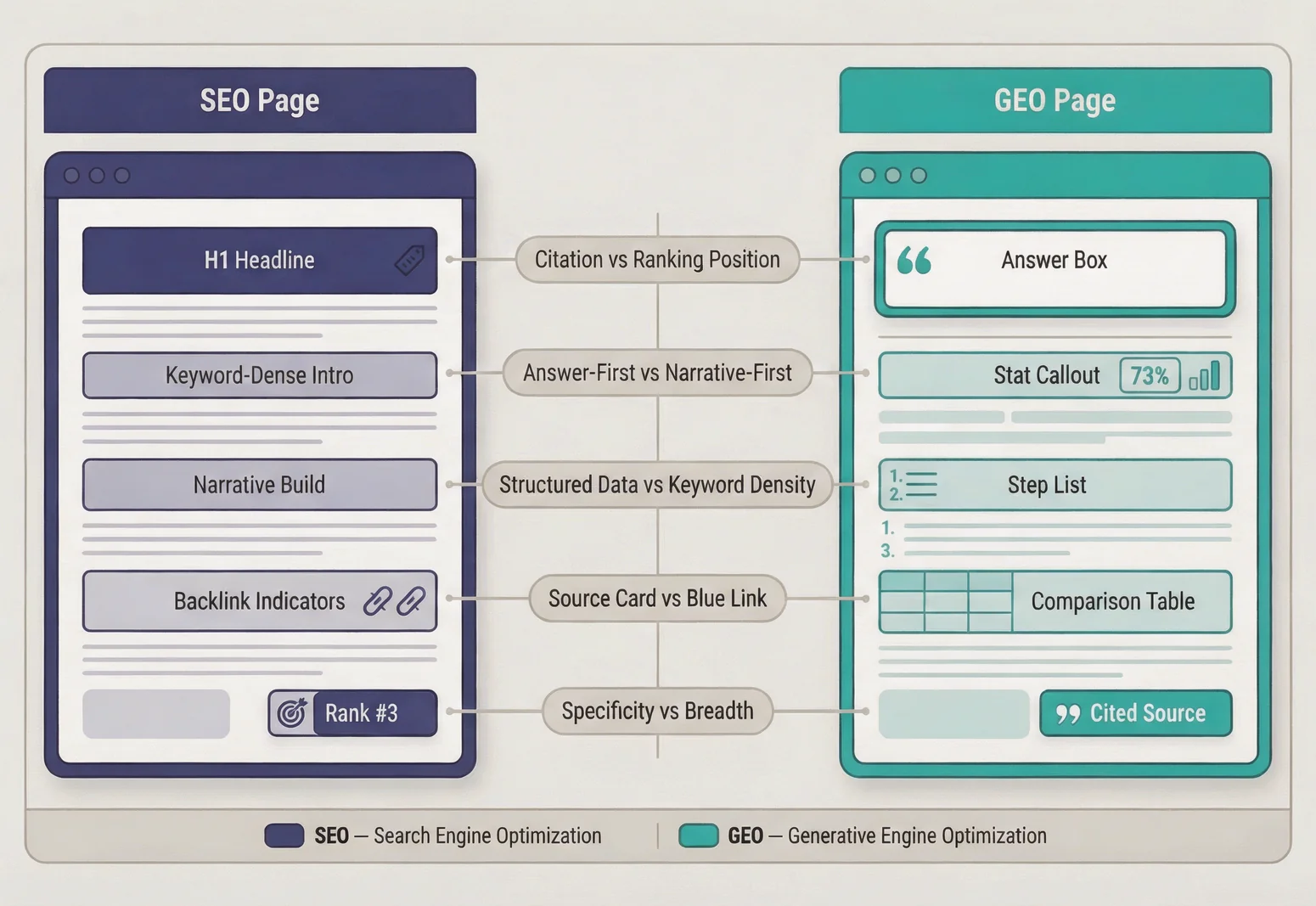
Citation takes priority over ranking position. In a May 2026 analysis of US SERPs by Aristral, 80% of informational queries in the AI‑SEO category triggered a Google AI Overview, and the URL that got cited was not necessarily the top‑ranked organic page — it was the page whose structure matched the question the engine was trying to answer. That breaks a decade‑old rule of chasing position one.
Content architecture matters more than keyword placement. A high‑ranking SEO page might place its primary term in the H1, several subheadings, and at target densities. A high‑citation GEO page, by contrast, tends to answer one sharp question in the first 100 words, use sub‑headings to break out related questions, and place statistics and named‑entity references early. The shift from keywords‑first to entities‑first is real, and it aligns with the approach described in this keywords to entities workflow.
Maya, a content lead at a mid‑market B2B SaaS firm, saw this firsthand. Her team’s competitor‑comparison page ranked third for a traditional organic keyword but never appeared in AI Overviews. After they restructured the page to open with a direct definition, placed three named‑entity references in the first two paragraphs, and broke the rest into labeled comparison rows, AI citation presence jumped from zero to appearing in six of eight tracked queries within a month — without the organic rank shifting at all.
Measurement cadences diverge. SEO is measured in clicks, impressions, average position, and conversions from organic landing pages. GEO is measured in citation frequency, share of AI answer presence, and — increasingly — “citation CTR,” which tracks whether a brand’s mention inside an AI Overview results in a downstream visit. There’s a detailed breakdown of that metric tension in our visibility versus traffic metrics post.
The audience relationship changes. In SEO you earn the visit, then the brand experience, then the conversion. In GEO the brand experience often happens inside someone else’s interface: your name and one sentence appear in a generated summary, and the reader might never visit your page. That changes how you think about authority building.
Baseline SEO remains a prerequisite. AI answer engines overwhelmingly pull citations from pages that already rank in the top organic positions. GEO without SEO creates content with nothing to cite. The two disciplines share a technical foundation even though the editorial layer splits in two.
Has Google acknowledged generative engine optimization?
Yes, but with an important qualifier. In its official guide for website owners, Google acknowledges the terms “AEO” and “GEO” and addresses them directly. The document advises site owners to “carefully evaluate any advice” that claims to be separate from standard search fundamentals, and it states that trustworthy advice either grounds itself in official Google Search documentation or clearly labels claims as opinion based on data or experience. The Google Search’s Guidance on Third‑Party SEO page is the direct source for that warning.
The practical takeaway: Google won’t tell you to build a separate GEO strategy, but it did publish a dedicated AI optimization guide for features like AI Overviews and AI Mode — and that guide describes content qualities (authoritative sourcing, clear question‑answer structure, specific statistics) that look a lot like the GEO playbook. So while the brand name “GEO” is industry‑invented, the optimization surface is first‑party.
Does SEO still matter for AI‑driven search?
Yes — and not just as a legacy safeguard. The scale imbalance makes this clear: even with generative search growing rapidly, Google’s classic organic search remains roughly 373 times larger by query volume than ChatGPT, as WordStream noted in its June 2026 generative engine optimization guide. That’s a lopsided picture, but it captures the reality that most search traffic still moves through the blue‑link infrastructure.
Where the edge softens is on informational queries with clear, extractable answers. In sectors where AI Overviews trigger frequently, click‑through rates on the underlying organic results have been dropping, according to Search Engine Journal data cited in the same guide. So the investment question isn’t “should we keep doing SEO?” — it’s “on queries where AI answers now dominate, are we measuring the right outcome?”
At the execution level, SEO remains the engine that powers GEO citation eligibility. If your pages don’t rank, they won’t get cited by AI Overviews, and they won’t appear in ChatGPT’s browsing mode either. It’s less a competition than a supply chain.
Which content formats win AI citations?
Multiple mid‑2026 data sets converge on a consistent answer. The RankScope State of GEO 2026 report identified five content formats that dominate AI Overview citations: structured definitions with immediate answers, numbered step lists, comparison tables with clear headers, FAQ‑styled question‑answer pairs, and data‑rich explainers that include named statistics and expert quotes early.
That last format — the data‑rich explainer — contradicts a common SEO instinct. Many SEO pages tuck statistics into the middle or end of an article to support a broader narrative. Generative engines appear to reward early‑placement specificity: the stat, the expert name, and the answer in the first two paragraphs outperform the same facts placed lower on the page.
The mechanism is straightforward. AI systems pull from pages that signal direct, extractable answers. A page that opens with “What is generative engine optimization? GEO is…” performs better for citation than a page that opens with a three‑paragraph historical introduction and answers the question in section three. This is also why specific examples in AI search tend to increase citation rates — they create an extractable concrete point the model can reference directly instead of rewriting a vaguer claim.
One caution: the citation advantage doesn’t mean turning every article into a formatted FAQ. A list of 40 disconnected questions will look thin to a human reader and perform worse in classic organic rank. The winning shape in 2026 is a content piece that answers one core question immediately, then expands with evidence, related questions, and caveats — the structure you might recognize from the semantic SEO for AI search approach.
How should you track GEO results compared to SEO?
For SEO, the standard dashboard still applies: organic sessions, keyword positions, click‑through rate from SERPs, and goal completions attributed to organic landing pages. That hasn’t gone away.
For GEO, you need an additional reporting layer that rarely comes out of the box. The three metrics that matter most are:
- Citation presence rate: What percentage of tracked keywords trigger an AI‑generated answer, and what percentage of those answers cite your domain? The State of GEO 2026 data from RankScope showed that the top 10 domains capture 54% of all AI Overview citations, and roughly 26% of brands have zero mentions at all. Citation presence rate tells you whether you’re in the game.
- Answer position within the citation: Not all citations are equal. An expandable “sources” link at the bottom of an AI Overview carries less downstream traffic than a named inline reference in the answer text itself. Track which tier your mentions land in.
- Citation‑attributed traffic: This is harder to instrument, but it’s the metric that connects GEO to business outcomes. It measures downstream sessions that originate from a user clicking a footnote link inside an AI‑generated answer. Some enterprise platforms are starting to offer this as a GEO‑specific KPI.
The core measurement error many teams make is conflating visibility with traffic. A domain can show up in 40% of AI Overviews for a query set but generate barely any referral traffic because the answer summary satisfies the user on the spot. That’s not a reason to pull back on GEO; it’s a reason to track both citation presence and attributable traffic, and to tie GEO efforts to informational queries where the answer doesn’t close the loop — queries where a user still needs to visit a site for evaluation, comparison, or purchase.
When is it smart to prioritize GEO over SEO?
The operational decision is less dramatic than the LinkedIn debate suggests. Here is the rule of thumb that field data from Automaton’s 60‑day parallel test and the broader industry reports support:
- Prioritize SEO when your primary query set is transactional or local (“buy X,” “hire Y near me,” “pricing for Z”). These queries still overwhelmingly route through classic SERP links, and AI Overviews appear less frequently. SEO fundamentals — technical health, local signals, backlink authority — remain the strongest levers.
- Prioritize GEO when your primary query set is informational and high‑intent (“what is X,” “how to choose Y,” “X vs Y comparison”). These are the queries where AI Overviews trigger on 80%+ of US SERPs and where being cited means being the first source a prospect sees. GEO design (question‑first structure, specific statistics, named authority references) moves the needle here.
- Run both when you serve enterprise or mid‑market B2B audiences who move through a long consideration cycle. Those buyers search for informational answers early, then switch to transactional queries late in the journey. You need SEO to capture the late‑stage clicks and GEO to build authority at the early stage, and the two feed each other.
Fewer than 15% of marketing teams had a formal GEO program in early 2026, according to the Presenc AI annual report, while more than 60% named AI search visibility as a top‑three priority. The gap between recognition and execution is still wide, which means there is meaningful advantage to starting a structured GEO program now rather than waiting for it to become table stakes.
One tactical note: if you run a blog on a platform that allows structured schema, entity markup, and clean HTML, you already have more of the infrastructure in place than you might think. The heavy lift isn’t technical — it’s editorial. The shift from “write for the algorithm’s comprehension” to “write for an AI’s extraction behavior” requires different briefs, different quality checks, and a different relationship with data.
What mistakes damage a new GEO initiative?
The data shows three patterns that reliably undercut early GEO efforts.
The first is treating GEO as SEO with an AI wrapper. Teams copy an existing blog post into a slightly altered template, add a few more subheadings, and label it “optimized for AI.” That misses the core insight: generative engines reward specificity and answer‑first structure, not adjusted keyword placement. If a page still buries the answer behind three paragraphs of context, the AI will look elsewhere.
The second is ignoring measurement from day one. Without at least a manual citation presence audit, you cannot tell whether the editorial time you’re spending is producing anything beyond the organic traffic you were already getting. A lean version is to track a fixed set of 20–30 informational queries every two weeks and record whether your domain appears in the AI Overview, AI Mode, or ChatGPT answer. That simple habit often reveals where the content’s structure is falling short before a full tool deployment happens.
The third is leaving the SEO foundation to decay while chasing GEO. AI answer engines overwhelmingly pull from the top organic pages. When a team redirects its entire editorial budget toward GEO‑specific content yet stops refreshing the existing pages that built domain authority, the citation pipeline dries up. The competitive window closes faster when your most‑cited pages start slipping in rank, and the generative engines drop them without hesitation.
The antidote is to think about GEO as a layer on top of a healthy SEO program, not a replacement. The teams with the highest citation presence rates in 2026 are the ones that kept their technical SEO sharp while building a separate editorial brief that treats an AI answer as a first‑class publishing surface.
What else to explore in generative engine optimization and SEO
Review SiaSEO as the operating system for structured SEO content production. — Get started