
Semrush Plans: Pricing Tiers, Pro vs Guru vs Business Limits
Compare Semrush plans side-by-side and learn how to pick the right one based on your needs, with tips for agencies, solos, and enterprises.

Choosing a Semrush plan looks straightforward—three tiers, three prices. In practice, what you actually pay is shaped by billing cycles, additional user seats, optional toolkits, and the project limits you hit within weeks. WorkflowVerdict’s analysis of Semrush pricing in 2026 found that most buyers start on the entry plan and upgrade within 60 days once the project cap or missing Content Marketing Toolkit becomes a blocker. That upgrade path costs both time and money. This report lays out the tier boundaries, the feature gates, and the cost multipliers so you can choose the plan that matches your actual operational needs rather than the clean price on the comparison page.
What the Three Tiers Actually Deliver
Semrush organizes its classic SEO plans around three subscription levels: Pro ($139.95/month), Guru ($249.95/month), and Business ($499.95/month). Annual billing shaves roughly 17% off each, bringing them to $117.33, $208.33, and $416.66 respectively, according to the Semrush knowledge base entry on SEO toolkit limits. The prices are per month and inclusive of one user seat. Every plan includes core capabilities—keyword research, site audit, position tracking, backlink analysis, and competitive research—but the scale at which you can operate diverges sharply.
Pro targets freelancers and solo site owners. It permits five projects, tracks up to 500 keywords, and returns a maximum of 10,000 results per report. You can pull up to 3,000 reports per day across domain analytics and keyword research queries. The plan provides 250 keyword metric updates per month, 500 SEO Ideas, and three scheduled PDF reports. There is no historical data access, no content marketing platform, and no API.
Guru doubles down for growing agencies and in-house marketing teams. It supports 15 projects and 1,500 tracked keywords. Report result caps rise to 30,000, daily report allowances reach 5,000, and keyword metric updates climb to 1,000 per month. The 800 monthly SEO Ideas allocation sits on top of a new content marketing platform that includes topic research and SEO writing assistant tools. Historical data becomes available—trackable back to 2012—and you gain multi-location and device-level rank tracking alongside Looker Studio integration. API access is still unavailable.
Business scales further for established agencies and large in-house groups. The plan provides 40 projects, 5,000 tracked keywords, up to 50,000 results per report, and 10,000 daily reports. The user seat model shifts; additional seats cost less per seat than on the lower tiers. API access unlocks with 10,000 units per month, extended Share of Voice limits, custom reporting options, and free migration from other tools. All Guru features are included.
“What you actually pay depends on your billing cycle, how many users need access, which add-ons your workflow requires, and which plan tier your project volume forces you into,” notes the WorkflowVerdict review.
Feature Gates That Determine Tier Selection
Beyond raw limits, a handful of features sit behind paywalls that make the difference between a workable subscription and a tool you’ll outgrow in months.
Content Marketing Platform — locked behind Guru and above. For teams whose output relies on SEO content production, this is often the single largest forcing function. Without it, you lose topic research and the integrated writing assistant, which pushes many Pro users toward upgrading. If your workflow already incorporates site-aware drafting through an AI content platform, you might shift the emphasis to API access or report scalability instead.
Historical Data — from 2012 onward, available on Guru and Business, but absent on Pro. This matters when you need trend lines, especially for competitive analysis. Agencies that report quarterly to clients quickly find Pro insufficient.
API Access — exclusive to the Business plan. Any software integration—feeding position data into internal dashboards, building automated reporting pipelines, or piping keyword data into a keywords-to-entities workflow—requires this tier. The 10,000 API units per month represent a hard cap that large-scale operations need to model before committing.
Multi-location and Multi-device Tracking — Guru and Business only. If you manage local SEO for multiple storefronts or need separate mobile and desktop rank views, Pro can’t accommodate the granularity.
Looker Studio Integration — Guru and Business. Teams that visualize SEO performance outside the Semrush interface need this connector. Without it, performance data must be manually exported, which breaks automated reporting cycles.
The tier jumps are not gradual: moving from Pro to Guru unlocks the content marketing platform and historical data, while the Business tier is less about additional “features” and more about removing operational ceilings—more projects, more keywords, API access, and cheaper per-user economics.
The Hidden Cost Layer: Users, Add-Ons, and Billing Cycles
The published monthly price is for a single user. Every plan allows additional users at an extra cost, but the per-seat premium tapers at the Business level. An agency running three analysts on Guru could see the effective monthly cost climb well beyond the base $249.95. Teams evaluating content velocity goals in a multi-writer environment should model total seats before committing to a tier.
Annual billing cuts roughly 17% across all plans. That discount is consistent, but it also locks you into a year of limits that may prove constraining if your client roster grows or your site portfolio expands mid-cycle. Contracts that start on annual Pro or Guru often become drags when usage outpaces limits.
Add-ons introduce a second layer of spending. Semrush offers separate toolkits (Local, Social, PR, Ads, and the Semrush One AI Visibility bundle) that layer on top of the classic plans. Each comes with its own cost. The StackCompare breakdown highlights that add-on expenses can quietly double the bill for teams that need local SEO management, social scheduling, or PR monitoring alongside core SEO functionality. The pricing page itself now anchors Semrush One plans at $199/month (Starter) and $399/month for the Pro+ level, which fold AI Visibility tools into the stack. For pure SEO workflows, the classic plans remain the simpler cost line; for organizations needing AI-search tracking, the One plans may reduce the aggregate add-on tally.
Matching a Plan to Operational Reality
Instead of a static comparison table, use a decision sequence that starts with your team’s production constraints.
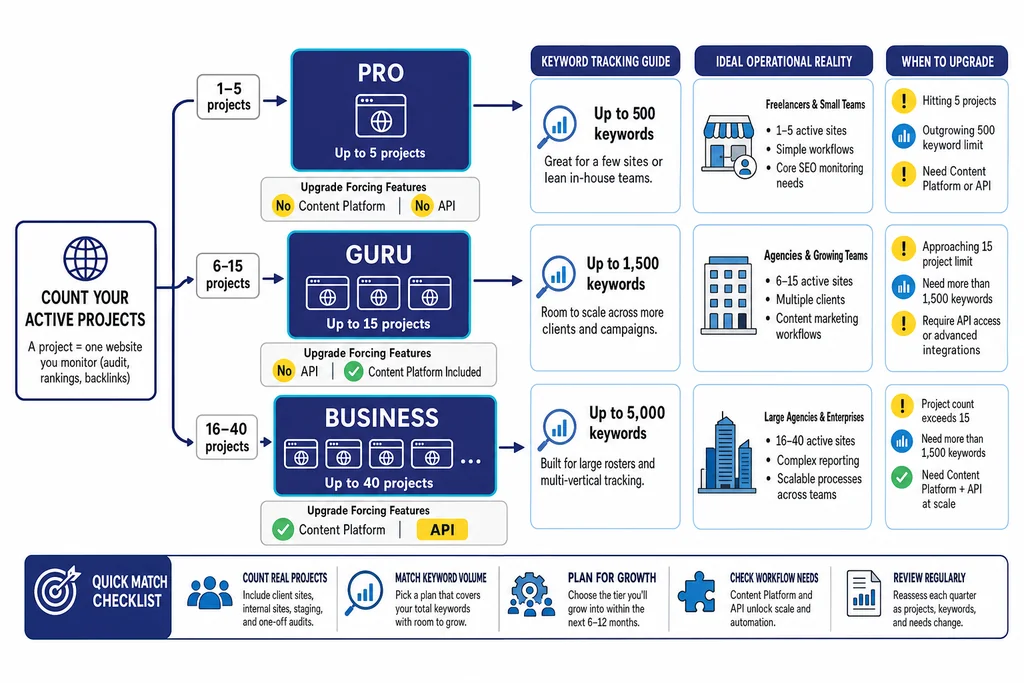
Count real projects. Semrush defines a project as a website you set up for monitoring—audit, position tracking, and backlink analysis. If you manage three client sites and a couple of internal properties, Pro’s cap of five projects is tight the moment you add a test site or a one-off audit. Guru’s 15 projects give breathing room for an agency with 10–12 active engagements. Business’s 40 projects suit multi-vertical teams or larger client rosters.
Map keyword tracking to reporting cadence. Pro’s 500 keyword limit works for a small brochure site, but a SaaS company tracking branded, transactional, and informational terms across a few countries can exceed that in a single project. A team operating a topical map for a content cluster will need the wider tracking in Guru or Business. Factoring in the shift toward monitoring AI search visibility across surfaces like ChatGPT and Google AI Overviews, the keyword count must also cover AI-oriented queries, which often sit outside traditional keyword research lists.
Check report and API dependency. If your workflow depends on automated dashboards that pull fresh rank data daily, the report limits and API access become non-negotiable. A Business plan provides the API endpoints to feed a custom pipeline. Teams that integrate Semrush data into a content operations system—for instance, piping keyword opportunities into an automated content calendar—need that programmatic gateway. Without it, the bulk of competitive research stays locked inside the interface.
Budget for total cost, not just the plan price. Add the number of users, confirm annual vs. monthly billing, and scan the add-on list. An agency that needs social scheduling and local SEO toolkits on top of Guru could end up with a monthly outlay close to the Business base price, minus the API access. In that case, the Business tier might consolidate costs even though the sticker price looks higher.
This evaluation mirrors the approach taken when selecting an AI content platform—the per-project or per-word pricing model matters less than whether the tool fits into your daily production rhythm without forcing workarounds. Systems designed for structured SEO content production, such as SiaSEO, illustrate a similar principle: the tier is defined not only by features but by how easily the output slots into your publishing stack.
Integrating Tier Outputs Into a Production Pipeline
Plan selection is only the first decision. The data Semrush generates—position updates, keyword discoveries, site health flags—must feed into a content and optimization cycle. At Pro tier, with no API and limited reporting, this means manual exports and a lot of spreadsheet management. At Guru, Looker Studio integration bridges some of the gap, but programmatic access remains absent. Business-tier API access allows you to build triggers: when a page drops below a threshold rank, a content refresh task can be created automatically; when a keyword gap appears against a competitor, a new topic brief can pop into the queue.
Platforms that automate editorial SEO production, like SiaSEO, work best when the upstream data flow is reliable and low-friction. If the Semrush tier restricts data access to browser-based tools, the throughput of your content operation hits a bottleneck that has nothing to do with writing speed. The plan becomes an infrastructure constraint rather than a support layer.
Limitations and Caveats
No single article can account for live promotions, enterprise custom pricing, or the exact interaction of add-on bundles with your existing tool stack. The limits cited here are drawn from Semrush’s own knowledge base, StackCompare’s pricing breakdown for 2026, and the current public pricing page as of mid-2026. Add-on costs vary, and Semrush occasionally restructures plans—the introduction of the Semrush One line in early 2026 is the most recent example. Always verify limits against the official SEO toolkit pricing page before committing.
The analysis intentionally focuses on the classic plans because the Pro/Guru/Business labels remain the mental model for most traditional SEO workflows. Organizations that need AI-search tracking should evaluate Semrush One separately, starting from its own plan tiers.
Review SiaSEO as the operating system for structured SEO content production. Learn more