
SEO Analyzer vs. Google Analytics: What Each Actually Catches
Compare SEO analyzers and Google Analytics for B2B teams. Learn which tool catches technical issues, content gaps, and indexing problems.

Most teams run both tools yet still miss critical issues because they expect each to do the other's job—here is how to divide the work correctly.
An SEO analyzer and Google Analytics are not interchangeable. One inspects your site's technical foundation for search visibility; the other measures what happens after visitors arrive. Teams that confuse the two waste hours chasing phantom problems while real ones fester unseen. This guide maps where each tool excels, where they leave gaps, and how to combine them into a coherent workflow.
Table of Contents
- Topic Map
- Core Concepts
- How It Works
- Main Layer 1: What an SEO Analyzer Actually Inspects
- Main Layer 2: What Google Analytics Actually Measures
- Main Layer 3: The Overlap and the Gaps
- Maturity Path
- Real-World Scenarios
- Common Mistakes to Avoid
- How SiaSEO Helps
- What to Read Next
Topic Map
The central tension is diagnostic versus behavioral. An SEO analyzer answers: "Can search engines find, crawl, and rank this page?" Google Analytics answers: "What did humans do once they got here?" Both matter, but they operate on opposite sides of the search funnel.
The six territories this guide covers:
- Technical crawl health — indexability, speed, mobile rendering, schema
- Traffic behavior — sessions, bounce rates, conversions, paths
- The attribution blindspot — why ranking fixes do not always show in Analytics
- The latency problem — why Analytics data arrives faster than crawl updates
- Tool selection logic — which question each answers best
- Integration architecture — how to run both without duplicate work
Think of an SEO analyzer as the pre-flight inspection and Google Analytics as the black-box recorder. You need both to understand why a plane crashed, but they record different dimensions of the same event.
What Is an SEO Analyzer?
An SEO analyzer is a diagnostic engine that crawls a website and evaluates its technical compliance with search engine requirements. It emerged from the early 2000s when Google began publishing Webmaster Guidelines and site owners needed systematic ways to check adherence. Early tools were simple validators—meta tag checkers, broken link finders. Modern analyzers audit hundreds of signals: Core Web Vitals, mobile usability, structured data validity, internal link distribution, hreflang accuracy, and AI-search readiness.
The U.S. Department of Energy notes that more than 60% of its web traffic arrives through search engine referrals, which is why federal sites now treat Search Engine Optimization Best Practices as operational infrastructure rather than marketing preference. The 21st Century Integrated Digital Experience Act codifies this, requiring that all federal websites maintain "information and services that are discoverable and optimized for search."
An SEO analyzer's job is to surface the friction that prevents this discoverability. It does not care whether visitors buy, subscribe, or bounce. It cares whether the door is open.
Core Concepts
Before diving into layers, four ideas govern how these tools relate:
Crawl versus visit. A search engine crawler and a human visitor are different users with different constraints. Crawlers execute JavaScript differently, respect robots.txt strictly, and do not trigger events the way humans do. An SEO analyzer simulates the crawler; Google Analytics records the human.
Indexability versus findability. A page can be technically indexable yet never appear in results because it lacks authority signals. An SEO analyzer flags indexability barriers. Google Analytics cannot see whether a page ranks; it only sees whether the page received traffic from search.
Latency asymmetry. Crawl data in an SEO analyzer reflects the last time the tool crawled your site. Google Analytics reflects human behavior from yesterday. The two timeframes rarely align, which creates confusion when teams compare a "fixed" issue in an analyzer with unchanged Analytics numbers.
Actionability hierarchy. Technical fixes from an SEO analyzer often have predictable outcomes: resolve a 404, and the 404 disappears. Behavioral changes in Google Analytics rarely have single causes: bounce rate drops could stem from copy changes, traffic source shifts, seasonality, or page speed improvements.
How It Works
An SEO analyzer operates through three mechanical stages: discovery, evaluation, and reporting.
Discovery begins with a seed URL and follows links recursively, respecting robots.txt and crawl-delay directives. Advanced tools render JavaScript to capture single-page applications and dynamic content. The crawler builds a graph of every reachable page, noting orphan pages that no internal link reaches.
Evaluation applies rules against each discovered page. These rules derive from search engine documentation, patent filings, and empirical correlation studies. A page might be checked for: title tag length, H1 uniqueness, canonical correctness, image alt text presence, schema.org markup validity, hreflang reciprocity, and Core Web Vitals thresholds.
Reporting aggregates findings into prioritized lists. Severity scoring varies by tool, but the logic is consistent: issues that block indexing rank highest, followed by issues that degrade ranking potential, followed by issues that offer marginal improvement.
Google Analytics operates differently. It requires a tracking script embedded in each page, which fires on load and captures events. Data flows to Google's servers, where it is processed, sampled at high volumes, and surfaced through segmented reports. The tool excels at answering "what happened" but struggles with "why" unless you configure custom dimensions, events, and goals that bridge the gap.
The National Renewable Energy Laboratory applies this distinction practically, maintaining Search Engine Optimization standards for its public-facing sites while running Analytics to measure engagement with technical research publications. The same department uses both tools, but for different review cycles and different stakeholders.
Main Layer 1: What an SEO Analyzer Actually Inspects
An SEO analyzer's inspection surface is broad and technical. These are the domains where it produces authoritative, actionable data:
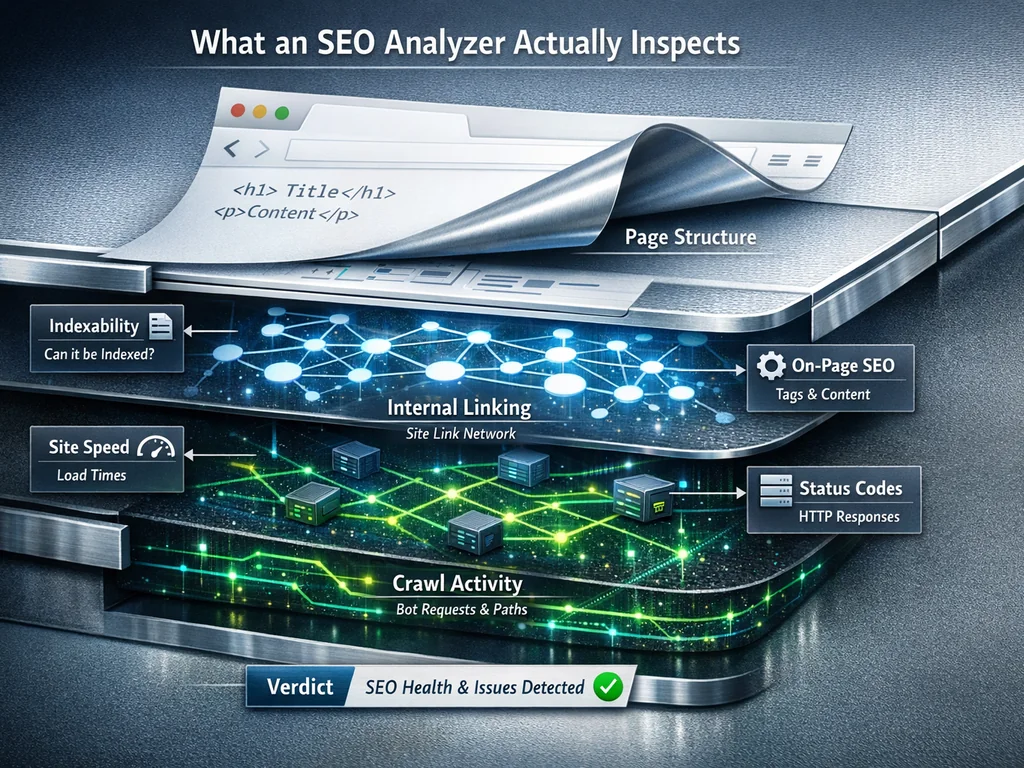
Crawl accessibility. Can search engine bots reach the page? The analyzer checks robots.txt blocks, meta-robots noindex tags, X-Robots-Tag headers, and orphan status. It identifies redirect chains that waste crawl budget and server errors that halt discovery.
Index quality. Of the pages crawled, how many should be indexed? Duplicate content detection—via exact-match, near-duplicate, or parameterized URL analysis—prevents index bloat. Canonical tag validation ensures preferred versions consolidate signals correctly.
Rendering parity. Does the rendered DOM match the source HTML? JavaScript frameworks often inject content post-load, and analyzers that execute client-side code catch discrepancies that static crawlers miss. This matters because Google uses rendered content for indexing.
Structured data compliance. Schema markup must validate against Schema.org vocabularies and Google's enhanced requirements. An analyzer checks required properties, recommended properties, and nesting errors that prevent rich result eligibility.
Internal link architecture. Distribution of PageRank—or "link equity" in modern parlance—depends on crawl depth, anchor text diversity, and orphan prevention. Analyzers map this topology and flag pages buried too deep or over-reliant on a single navigation path.
Mobile usability. Beyond responsive design, analyzers test viewport configuration, touch target sizing, font legibility, and intrusive interstitial detection.
Speed metrics. Core Web Vitals—Largest Contentful Paint, Interaction to Next Paint, Cumulative Layout Shift—are measured against the 75th percentile threshold. Analyzers often provide field data aggregation when connected to Google's Chrome User Experience Report.
Security and accessibility. HTTPS enforcement, mixed content detection, and alt text presence serve both search engines and human users. Federal Government digital experience standards explicitly link these to search performance.
What an SEO analyzer does not do: measure traffic, track conversions, attribute revenue, or segment audiences. It has no concept of a "session" or a "user." It evaluates pages as crawlable assets, not as experiences.
Main Layer 2: What Google Analytics Actually Measures
Google Analytics excels at behavioral telemetry. Its native measurements include:
Acquisition channels. Where did visitors come from? Organic search, direct, referral, social, email, paid—each channel carries different intent signals and value expectations. Analytics distinguishes Google organic from Bing organic, though encrypted search hides most keyword-level data.
Engagement metrics. Session duration, pages per session, bounce rate, and scroll depth reveal content resonance. These are outcome measures, not diagnostic ones: a high bounce rate might indicate poor content match, slow loading, misleading meta descriptions, or correct one-and-done information fulfillment.
Conversion tracking. Configured goals—form submissions, purchases, sign-ups, downloads—connect traffic to business value. E-commerce tracking extends this to transaction revenue, product performance, and cart abandonment funnels.
Audience composition. Geographic distribution, device category, browser, operating system, and inferred interests shape content and technical priorities. A site with 70% mobile traffic has different speed requirements than one with 70% desktop.
Path analysis. Flow visualization shows how visitors navigate between pages, where they drop off, and which paths lead to conversion. This is invaluable for UX optimization but irrelevant to crawl optimization.
Real-time monitoring. Live user counts, active pages, and event triggers enable campaign launch verification and outage detection.
What Google Analytics does not do: crawl your site, detect broken links, validate schema, measure Core Web Vitals for non-human agents, or report indexation status. It assumes the page exists and is reachable; it has no mechanism to verify this assumption.
Main Layer 3: The Overlap and the Gaps
The two tools touch at three points, each revealing a different kind of insight:
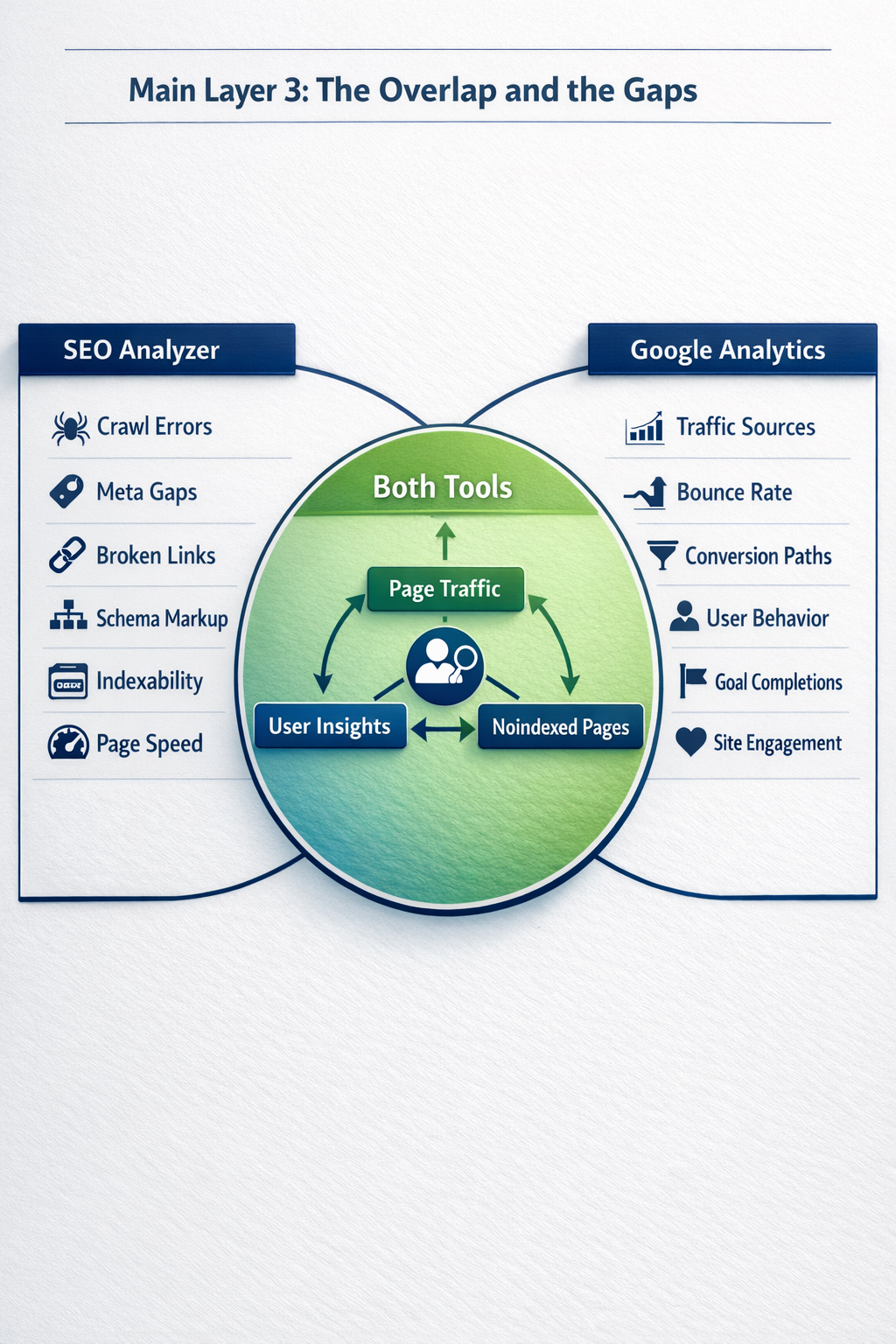
Page-level traffic versus page-level health. When an SEO analyzer flags a page as "noindex" and Google Analytics shows it received 2,000 organic sessions last month, you have a conflict. Either the noindex was recently added, the analyzer is wrong, or Analytics is attributing traffic incorrectly. This intersection catches configuration drift.
Speed correlation. Analytics reports page load time distributions. An SEO analyzer reports lab-based Core Web Vitals. When both show poor performance, the case for intervention is strong. When they diverge—fast lab scores, slow real-user metrics—the issue is likely server response variability or third-party script behavior not captured in synthetic testing.
Organic landing pages. Analytics shows which pages receive organic traffic. An SEO analyzer shows which pages are optimized for organic discovery. Comparing the two lists reveals: high-traffic pages with technical debt worth fixing, and well-optimized pages that never rank due to authority deficits.
The persistent gaps are more instructive:
- Indexation without traffic. A page can be indexed, technically sound, and invisible in Analytics because it ranks on page three. The SEO analyzer says "healthy"; Analytics says "irrelevant." Both are correct.
- Traffic without indexation. A page blocked by robots.txt might still appear in Analytics if accessed directly or via referral. The analyzer says "blocked"; Analytics says "active." Resolution requires understanding the traffic source.
- Crawl budget waste. An analyzer detects thousands of low-value parameterized URLs consuming bot attention. Analytics shows negligible traffic to those URLs. The business case for canonicalization or robots.txt refinement comes from the analyzer, not Analytics.
Maturity Path
Teams progress through three stages of tool integration, each with distinct workflows and failure modes.
Beginner: Single-tool dependency. The team runs Google Analytics because it was installed during site launch. They interpret traffic drops as "SEO problems" without technical verification. When rankings fall, they guess at causes—algorithm updates, competitor activity, content freshness—rather than auditing crawl health. The SEO analyzer, if used at all, is a free monthly scan that produces ignored PDFs.
Intermediate teams run both tools on separate schedules. The SEO analyzer generates weekly crawl reports; Analytics produces monthly performance reviews. The two datasets rarely meet. A content team might optimize pages that the analyzer shows as noindex, or the technical team might fix crawl errors on pages with zero traffic. Coordination failures are common but correctable.
Advanced teams integrate the two into a unified workflow. Crawl data from the SEO analyzer enriches Analytics segments: "show me organic traffic to pages with critical speed issues." Analytics data prioritizes crawl fixes: "fix the 404s on pages that historically drove conversions." Custom dashboards blend both sources. The team understands that an SEO analyzer answers "can we rank?" while Analytics answers "did ranking matter?"
Real-World Scenarios
Scenario 1: The phantom traffic drop. Maria's e-commerce site lost 40% of organic traffic in March. Her first instinct was content quality—had competitors published better guides? Her SEO analyzer revealed that a staging environment robots.txt had propagated to production, blocking all product category pages. Google Analytics showed the traffic drop starting the day after the deploy. The analyzer diagnosed the cause; Analytics confirmed the timing and business impact. Fixing robots.txt restored traffic within two weeks, not because Analytics helped solve the problem, but because it validated the urgency.
Scenario 2: The speed paradox. David's media site invested heavily in Core Web Vitals optimization after an SEO analyzer flagged poor LCP scores. Two months later, the analyzer showed green metrics across the board, but Analytics reported unchanged bounce rates and session durations. Investigation revealed that the site's audience was predominantly returning visitors using cached assets; the speed improvements primarily benefited new visitors, who comprised only 15% of traffic. The analyzer was correct that speed improved. Analytics was correct that the business impact was muted. The real insight required both tools plus audience segmentation.
Scenario 3: The orphan winner. A B2B SaaS company's blog post on API authentication unexpectedly drove 30% of demo requests. The SEO analyzer showed it as an orphan page—no internal links, discovered only through sitemap submission. Analytics revealed its conversion dominance. The content team used the analyzer to identify other orphan posts with traction, then built internal link campaigns to amplify their authority. Without Analytics, the orphan winner would have remained invisible. Without the analyzer, the replication strategy would have been guesswork.
Common Mistakes to Avoid
Expecting Analytics to diagnose technical SEO. A traffic drop in Analytics is a symptom, not a diagnosis. Teams that skip the SEO analyzer and jump to content revisions or link building often miss faster, cheaper fixes.
Running SEO analyzer audits without traffic context. Fixing every "medium" priority issue on pages with zero historical traffic is low-ROI work. Use Analytics to tier crawl fixes by business impact.
Comparing mismatched timeframes. An SEO analyzer crawled on Tuesday; Analytics reports through Sunday. A "fixed" issue will not reflect in Analytics for days or weeks, depending on crawl frequency and ranking recalculation.
Ignoring the crawl-visit distinction. A page can pass every SEO analyzer test yet fail to engage humans. Conversely, a page can rank well with technical debt if its content satisfies intent exceptionally. Neither tool alone captures this duality.
Treating tool outputs as interchangeable. Exporting an SEO analyzer's issue list into an Analytics dashboard, or vice versa, creates category errors. The metrics have different units, different sampling methods, and different confidence intervals.
How SiaSEO Helps
SiaSEO operates across both domains without conflating them. The platform ingests your site URL, performs automated brand and technical analysis, and generates a content calendar that accounts for your actual crawl health and topical authority gaps. Articles are produced with explicit quality scoring and semantic coherence validation—bridging the SEO analyzer's structural rigor with the engagement signals that Analytics eventually measures.
For teams tired of running separate tools with separate calendars, SiaSEO's pricing offers a unified production layer. The platform does not replace Google Analytics or dedicated crawl tools, but it eliminates the manual translation between technical audit findings and content execution.
What to Read Next
The logical progression from tool comparison to operational implementation:
- Why 94 Percent Business Blogs Fail — connects technical SEO discipline to the content quality that Analytics eventually judges
- Semantic Coherence Scoring Explained — covers how SiaSEO evaluates the content depth that search analyzers cannot fully assess
- Compounding Effect Daily Publishing — explains the publishing velocity that makes both crawl efficiency and traffic growth matter