
What to Look For in an LA SEO Company in 2026
Choosing the right LA SEO company requires more than price comparisons. Here's a practical framework for evaluating agencies in 2026.

The search for a reliable SEO partner in Los Angeles used to be straightforward: find an agency, sign a retainer, wait for rankings. In 2026, the decision is more complicated. Google's March 2026 core update reshuffled results across verticals. AI Overviews now reach 2 billion monthly users. LLM bots outcrawl Googlebot on most content sites. The agencies that adapted to these changes will grow your business. The ones still selling 2021 tactics will cost you a year.
This guide covers the criteria that matter when you're evaluating an LA SEO company, from proof of results to pricing structure to AI content workflows. Use it to build a shortlist, send the right questions, and avoid the partnerships that look good on a pitch deck but collapse inside six months.
Industry expertise and local proof
The first question for any agency: can they show results from your market, in your time frame, for a business like yours?
The LA search landscape has specific characteristics. Local intent queries like "pest control Sherman Oaks" or "personal injury lawyer downtown LA" follow different patterns than national SEO. Google's Ask Maps feature, which launched in March 2026, now uses Gemini-powered AI to surface local businesses in conversational search results. An agency that doesn't understand how this reshapes local visibility will miss the surface where your next customer is looking.
Ask for three things during the initial call. First, a case study from an LA-area campaign in the past 12 months, not a five-year-old example from a different city. Second, a before-and-after revenue story with a real client willing to be a reference. Third, an explanation of which surfaces they optimize for: traditional blue links, AI Overviews, local pack, Google Maps, or voice search. If they can only talk about rankings, their mental model is outdated.
When Rachel was evaluating agencies for her mid-market SaaS in Culver City, she asked five firms for a single-page summary of their biggest LA win in the past year. Two couldn't produce one. Two sent generic decks with no client names. One sent a reference she could actually call. That narrowed her list faster than any feature comparison.
Transparency in reporting and communication
The reporting structure tells you everything about how an agency operates. If the answer to "how will I know this is working?" is a PDF at the end of each month, you're paying for opacity.
Look for a live dashboard showing what's working, current keyword rankings with direction (up, down, flat), lead and revenue attribution, and backlink acquisition progress. Monthly calls should include a strategy discussion, not just a recap of deliverables. The content team behind your account should be identifiable. You should know who's writing, editing, and publishing under your brand.
Vague deliverables are a warning sign. So are agencies that only show traffic without connecting it to business outcomes. The goal of SEO isn't traffic for its own sake; it's traffic that turns into revenue. Your agency should be able to draw that line clearly.
An agency's own blog is a useful test. If their site publishes thin content, has indexing issues, or hasn't been updated in months, that's the standard they'll apply to yours. Check their organic presence before trusting them with yours. Why 94% of business blogs fail comes down to this exact issue: lack of publishing discipline and quality control.
Pricing models that match your budget and stage
LA agencies charge across a wide range. Retainers for mid-market companies typically fall between $2,000 and $5,000 per month. National or multi-location campaigns run $5,000 to $15,000. Enterprise engagements can exceed $30,000. Those numbers are meaningless without knowing what's included.
Ask for a breakdown of how your fee is allocated: what percentage goes to content creation, link acquisition, technical work, and reporting. Agencies that charge under $1,500 per month for full-service SEO are likely cutting corners. Thin content, automated link schemes, or minimal technical work are the most common shortcuts.
The contract structure matters as much as the monthly rate. Lock-in contracts with unclear termination terms are a problem. So are vague explanations of deliverables, upfront "setup" fees without a clear scope, and overpromises about timelines or rankings. Per Google Search Central's guidance, no one can guarantee a #1 ranking on Google. Any agency making that claim either doesn't understand how search works or is willing to mislead you.
Look for clear monthly deliverables with specific numbers: how many articles, what link targets, which technical fixes. Revenue-based or ROI-based pricing with a base fee plus performance bonuses aligns incentives better than flat retainers. Contracts should give you ownership of all work product. If you leave the agency, you keep the content, the links they built to your site, and the technical fixes they implemented.
Before signing with any agency, get quotes from three firms for the same scope and compare not just the total cost but the breakdown. If one agency charges $3,000 and another charges $4,500, but the cheaper one allocates 20% to technical SEO while the expensive one allocates 40%, you're comparing different services. Transparent pricing structures that itemize deliverables make these comparisons possible.
AI content workflow and quality controls
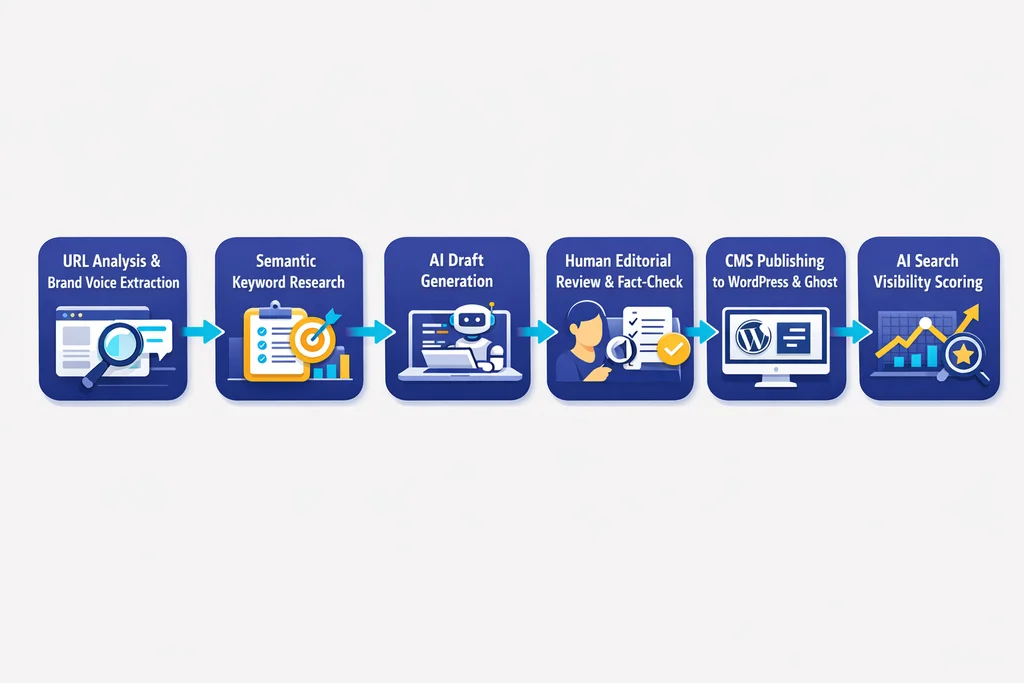
The rise of AI content tools has split the agency market. Some firms use AI to produce content at scale with minimal human oversight. Others have built hybrid workflows where AI handles structure and first drafts while humans add original research, editorial judgment, and brand-specific nuance. The difference shows up in results.
Google's Helpful Content Update series eliminated thousands of sites that built traffic on volume rather than substance. According to Semrush, roughly 60% of searches now yield no clicks, which means AI-generated summaries and answer surfaces are absorbing the traffic that content was supposed to capture. Agencies that treat content as a volume play are publishing into a wall.
When evaluating an agency's AI content workflow, ask these questions directly. Do they use AI tools? (They should say yes; agencies that claim pure human writing at scale are likely not being honest.) How do they edit AI-generated content before publishing? Is there a quality scoring system beyond word count and grammar checks? What's their semantic coherence process for ensuring articles stay on topic?
The best agencies in 2026 treat semantic coherence scoring as a baseline quality metric, not a nice-to-have. They can show you how their articles score on topical relevance before they publish. They have a defined editorial pass where a human reviews AI output for accuracy, voice consistency, and originality. They track whether their published content actually indexes and ranks, not just whether it was published.
Mike runs a B2B logistics company in the Arts District. His first agency delivered 12 blog posts per month. After four months, zero of them had generated a single organic lead. The problem wasn't volume; it was that none of the articles targeted search intent his audience actually had. He switched to an agency that started with search intent mapping before writing a single word. Within two months, three articles were driving demo requests. The content volume was lower, but the quality and targeting were substantially better.
This is also where AI-powered content platforms have changed the economics. Tools that analyze your website URL to build brand voice, generate search-intent-aligned article templates, and score output for semantic quality before publishing give marketing teams a middle path. You're not paying an agency $5,000/month for content you could produce with better tooling, and you're not publishing unreviewed AI output that damages your domain.
Technical SEO capability
Content without technical SEO is a car without an engine. The best articles in the world won't rank if your site has crawl errors, missing schema, slow load times, or broken internal linking.
Per the technical SEO checklist published by Los Angeles SEO Inc., the foundation includes crawlability, indexation, site speed, mobile experience, and structured data. But in 2026, technical SEO goes further. An LA agency working in the current environment needs to understand how LLM bots crawl your site differently from Googlebot. They need to know your robots.txt and sitemap.xml configuration, your Core Web Vitals scores, and how your internal linking structure distributes authority across pages.
The best technical SEO agencies treat their audit as a conversation, not a deliverable. They walk you through their findings and explain what matters and what doesn't. They prioritize fixes by impact, not by quantity. They implement changes, not just recommend them.
Ask for a sample monthly report. It should show crawl health metrics, Core Web Vitals trends, indexing status, and technical issues ranked by severity. If the report is just a list of keyword positions, the agency is treating technical SEO as an afterthought.
A strong technical foundation is what separates agencies that deliver lasting results from those that ride a single algorithm update. Content velocity also matters: publishing consistently compounds over time, but only when the technical base supports it. A site with broken internal linking and orphaned pages will waste even the strongest content strategy.
How to compare your options before signing
You've narrowed your shortlist to two or three firms. Before you make the final call, run this comparison.
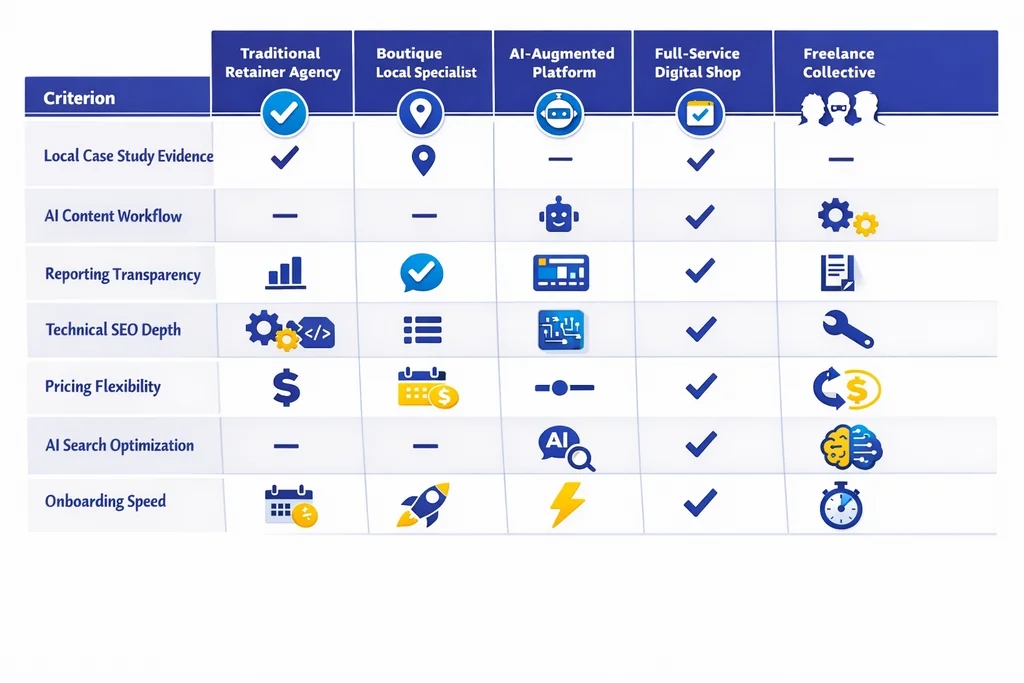
Criteria | What to verify |
|---|---|
Case studies | Real LA clients from the past 12 months |
Reporting | Live dashboard access, not just monthly PDFs |
AI workflow | Defined editorial process, quality scoring |
Technical audit | Walk-through with prioritized fix list |
Pricing | Itemized breakdown with clear deliverables |
Contract | Month-to-month or short pilot, with work-product ownership |
References | At least one client you can contact directly |
Ask each agency the same set of questions and compare their answers side by side. The differences will be obvious. One firm will talk about revenue impact; another will talk about traffic. One will explain their AI workflow in detail; another will dodge the question. One will offer a three-month pilot with clear KPIs; another will push a 12-month lock-in.
Trust the pattern. The agencies that answer clearly, show their work, and put specific numbers behind their claims are the ones worth hiring.
If none of the agencies on your shortlist feel right, consider a hybrid approach. Some marketing teams now run SEO in-house using structured content production tools that handle research, drafting, quality scoring, and publishing workflow. This works best when you have a team member who understands SEO fundamentals and can manage the editorial review layer. It doesn't replace an agency for complex technical audits or enterprise-scale link building, but it covers the content and on-page side at a fraction of the cost.
Learn more about structured SEO content production →
FAQ
How much does an LA SEO company charge in 2026? Most LA agencies charge $2,000 to $5,000 per month for mid-market campaigns. National or enterprise work ranges from $5,000 to $30,000+. The price should include itemized deliverables for content, technical fixes, and link building, not a single lump sum with vague promises.
How long before SEO results show up? Expect meaningful traffic and lead improvements in 4 to 6 months. Rankings for competitive terms may take longer. Any agency promising results in 30 days is either misunderstanding your market or misrepresenting their capabilities.
Should I choose a local LA agency or a remote one? Local agencies understand LA-specific search patterns, local pack dynamics, and regional competitors. Remote agencies may offer lower rates or broader expertise. The best choice depends on whether your business serves a local or national audience. If local visibility matters, an LA-based firm has an edge.
What's the difference between traditional SEO and AI search optimization? Traditional SEO targets blue-link rankings. AI search optimization also targets visibility in AI Overviews, answer engines, and assistant recommendations. In 2026, agencies that only optimize for traditional rankings are leaving traffic on the table.
Can I do SEO myself instead of hiring an agency? Yes, especially if your market has low-to-moderate competition. Start with a technical audit, on-page optimization, and consistent content publishing. Tools that automate content workflows and quality scoring make self-service SEO more viable than it was a few years ago. If your budget is tight, begin with foundational work and bring in an agency when you're ready to scale.
How do I know if an agency is using AI responsibly? Ask them directly. Responsible AI use means human editorial oversight, quality scoring before publication, and a focus on search intent rather than volume. Agencies that hide their AI usage or claim to write everything by hand are either inefficient or not being transparent. Nearly 70% of businesses report higher ROI from using AI in SEO, but only when the workflow includes meaningful human review.