
What AI SEO Platforms Actually Charge in 2026
See what AI SEO platforms charge in 2026. Compare tiers, hidden fees, and per-seat costs before you buy.

When Elena’s agency CFO asked her to justify the $7,000 monthly line item for AI SEO, she opened three vendor quotes and couldn’t decide whether she was being generous or getting robbed. One vendor pitched a $500 starter plan; another quoted $15,000 for the same phrase. Her team had already learned that AI SEO pricing operates on a completely different logic from a traditional retainer — and that most pricing pages bury the real costs behind asterisks and ambiguous “contact us” gates.
Elena’s confusion maps directly to a market reality. The term AI SEO now covers everything from an AI writing assistant tacked onto a legacy SEO suite to a full generative-search optimization program with citation intelligence, entity resolution, and LLM training. The price tag follows scope. In 2026, US agencies and platforms charge anywhere from $1,500 to more than $10,000 per month, with enterprise retainers for generative search optimization exceeding $15,000. Small-business packages can dip to $1,000–$2,500 per month, but at that tier you may be getting a 2022 SEO playbook with ChatGPT prompts thrown in.
The best way to avoid Elena’s predicament is to understand what the major platforms actually bill, how independent pricing guides frame the market, and where the hidden fees add 20–40% to a quoted number.
Where the Price Spread Comes From
If an agency tells you their AI SEO retainer is roughly 50% to 100% more than a traditional one, they’re not exaggerating. The markup reflects new capabilities that didn’t exist two years ago: optimizing for conversational AI queries, building entity graphs that large language models (LLMs) use to cite brands, and maintaining a presence inside Google AI Overviews and AI Mode. Google’s official guidance on these generative features confirms that standard SEO fundamentals still apply, but it also underscores that generative AI search rewards content that is well-structured, semantically clear, and published with strong E-E-A-T signals — qualities that demand deeper engineering than a blog post on a keyword brief.
In its guide to optimizing for generative AI search, Google notes that “best practices for SEO continue to be relevant because our generative AI features … are rooted in our core Search ranking and quality systems.” That means AI SEO isn’t about gaming algorithms; it’s about building a content architecture that both traditional crawlers and LLMs can interpret accurately. The effort required — entity mapping, advanced schema, and citation hygiene — is what creates the cost gap.
Per the market analysis published by Mukul Khattel on Digiactus, typical monthly retainers in the US span from $1,500 to over $10,000, with the premium over conventional SEO driven by deeper semantic structuring, schema expansion, and content specifically engineered for AI citation rather than keyword rankings.
“AI SEO pricing in the US typically ranges from $1,500 to $10,000+ per month depending on scope, authority level, technical depth, and industry competition.”
— Mukul Khattel, Digiactus, AI SEO Pricing US (2026)
What that means in practice: the cheapest plans usually generate surface-level blog posts from a keyword brief. The $5,000–$8,000 bracket includes some form of topical authority building and basic LLM optimization. Once you cross $10,000 monthly, you should be discussing dedicated AI-search strategy, citation monitoring, custom prompt engineering, and integration with multiple generative platforms (ChatGPT, Perplexity, Copilot, Gemini).
Consider Nina’s team at ArcForge, a B2B analytics startup. They signed a $2,200/month “AI SEO” plan that included a biweekly blog post and a monthly entity audit. Six months later, they discovered that their competitor, who had invested $7,500 a month in a specialist provider, was appearing in ChatGPT answers for their best converting terms. ArcForge’s posts were being published, but they lacked the structured data and citation hygiene that LLMs need to reference a brand. The cost gap wasn’t a luxury expense; it was the difference between being invisible and being cited.
How Independent Pricing Guides Frame the Market
Three recent pricing guides have mapped this terrain independently, each with a different lens. Their findings are worth comparing before you commit to any one vendor.
Hashmeta’s Buyer Guide for AI SEO Tools
The Hashmeta guide segments the market from free and freemium tools through entry-level paid ($10–$50/month), mid-market ($50–$200/month), and up to enterprise and agency tools beyond $200/month. Its central argument is that a patchwork of individual point solutions rarely stays within the advertised sticker price once you factor in training, API overhead, and the cost of stitching outputs together. The guide makes an explicit case for managed services over do-it-yourself stacks, a framing that’s increasingly common as AI search evolves faster than many teams can engineer internally. It also flags that the time your team spends aligning outputs from three different tools often costs more than a consolidated subscription would.
Fuel Online’s AEO and GEO Cost Breakdown
Fuel Online’s breakdown introduces a structured AI Visibility Pricing Stack and tags AEO (Answer Engine Optimization) and GEO (Generative Engine Optimization) as separate line items. It places full AEO+GEO retainers between $8,000 and $15,000 per month for specialist agencies. The guide emphasizes that many buyers waste spend by omitting technical fundamentals — things like a properly configured robots.txt and IndexNow — that every AI SEO budget should include before any prompt-focused work begins. That upfront technical skip, the report notes, is one of the fastest ways to burn a retainer with zero measurable return.
The SEO Engine’s Audit of 47 Pricing Pages
In the most granular public analysis, The SEO Engine audited 47 platform pricing pages. It matches real bills to published tiers, showing that the free tier often carries $50–$150 in hidden tool costs, the $29–$99 entry tier realistically runs $79–$199 per month, and the professional band ($100–$500 advertised) commonly lands at $200–$600 after seat licenses and add-ons. For agency and enterprise buyers, the all-in figure can hit $2,000–$10,000 per month once volume thresholds, API calls, and overage policies are enforced.
What Five Widely Quoted Platforms Charge Right Now
Below are the price anchors observed directly from each platform’s public pricing page in June 2026. The numbers represent the lowest-cost tier that includes meaningful AI content assistance or optimization — not the free or limited-audit plans.
| Platform | Starting Monthly Price | Primary Use Case | Key Limitations at Entry Level |
|---|---|---|---|
| SurferSEO | $59 (Essential) | Individual writers and bloggers who need content scoring | 15 article optimizations per month, one seat |
| Clearscope | ~$350 (Essentials) | Mid-size content teams doing keyword-driven optimization | User seats are restricted; custom pricing for advanced integrations |
| MarketMuse | Custom (typically $1,500+) | Large enterprises needing comprehensive topic modeling and content planning | No public pricing; the sales process includes a content audit and multi-month commitment |
| Copy.ai | $49 (Pro) | Marketing teams generating high-velocity short-form copy | Lacks deep on-page content scoring or indexing diagnostics |
| Jasper | $49 (Creator) | General-purpose AI writing with brand voice controls | Advanced SEO features such as content scoring and generative search optimization require higher-tier plans |
Each of these five platforms approaches AI-assisted content from a distinct angle: on-page optimization (SurferSEO), content intelligence (Clearscope, MarketMuse), or generative copywriting (Copy.ai, Jasper). None claim to be a complete, end-to-end AI SEO platform that handles everything from keyword research through CMS publishing and LLM visibility tracking. Most users end up running two or three together and stitching the results manually — and the labor cost of that stitching often exceeds the software subscriptions themselves.
If you are evaluating these tools, or a comparable stack, it’s worth checking whether a consolidated platform can reduce the duplicate labor. SiaSEO, for example, automates the full chain — site-aware drafting, multi-model AI routing, quality scoring, semantic drift tracking, and direct CMS publishing — eliminating the copy-paste that eats a content team’s time. You can see how that translates into subscription cost versus internal resource allocation on the product’s output-based plans page.
The Hidden Fees That Add 20–40% to Your AI SEO Bill
The gap between a quoted monthly fee and what you actually pay remains the single largest friction point in AI SEO procurement. Based on The SEO Engine’s audit and patterns reported across multiple guides, here are the four charges that most frequently surprise buyers:
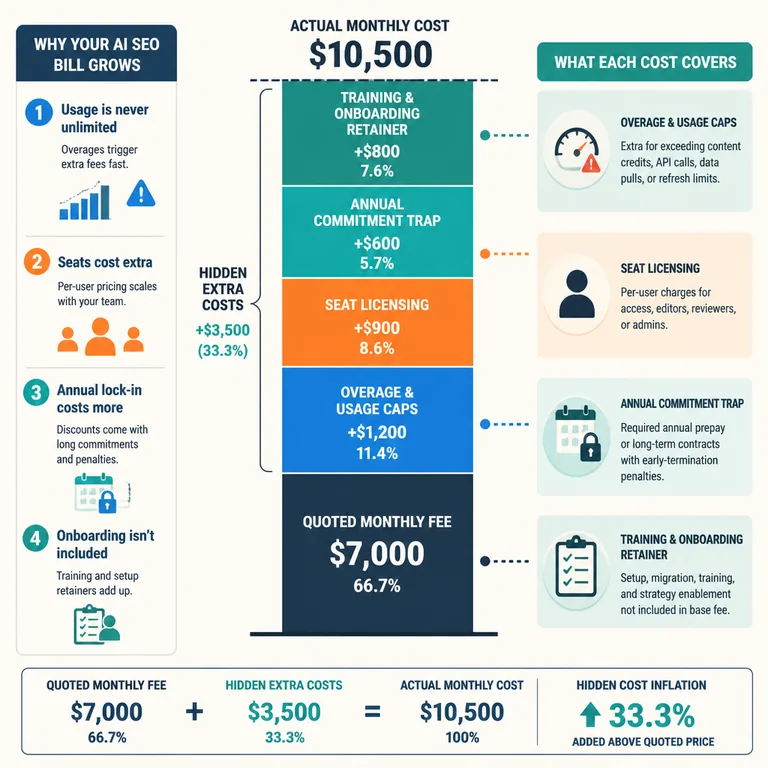
- Overage and usage caps. Platforms that advertise unlimited generation often throttle API usage after a soft cap, or they bill overages at a per-unit rate that compounds quickly for sites publishing more than a few hundred pages per month.
- Seat-based licensing. A $99/month plan can become a $350/month bill once three additional collaborators need access — even if their usage is read-only.
- Annual billing traps. Several vendors make the monthly rate appear competitive, hide the true price behind a minimum 12-month commitment, and increase the monthly rate by 25–40% if you choose month-to-month.
- Training and onboarding retainer. Some enterprise AI SEO providers charge a separate implementation fee that covers prompt library setup, entity mapping, and content style calibration. This can range from $2,000 to $10,000 one-time on top of the recurring monthly.
For a team operating at B2B scale, these four items can transform a $7,000/month quoted retainer into a $10,000+ monthly reality. Requesting a line-item breakdown that explicitly separates platform fees, seat fees, overage projections, and onboarding costs is a useful filter: if a vendor cannot produce one, the contract almost certainly contains cost surprises.
One way to reduce the hidden-cost risk is to look for platforms that bundle content creation, scoring, and publishing under a single output-based subscription, without per-seat surcharges or separate tool costs. SiaSEO’s model links billing to published articles rather than to the number of logins or API calls, which keeps actual cost predictable even as the team grows. When you compare that to a DIY stack of three tools that each charge per seat and per overage, the consolidated approach frequently reduces the true monthly total by 20–30% for a mid-size content operation.
Build vs. Buy vs. Subscribe: Which Path Matches Your Budget
The AI SEO market now gives you three spending shapes, and they lead to very different monthly obligations.
Self-service platforms ($50–$500/month). Freelancers and lean startups can license AI writing assistants, basic keyword tools, and a content scorer for a few hundred dollars per month. You supply the strategy, the prompt tuning, and the QA. The money stays low because you’re renting software, not hiring a team. The tradeoff is that these tools don’t do entity modeling, generative visibility tracking, or schema management — the things that move the needle inside AI Overviews. You’re left with good content that may never get cited.
Agency retainers ($2,500–$15,000+/month). Specialist agencies carry the overhead of talent who understand prompt engineering, citation intelligence, and technical setup across multiple LLM platforms. The Fuel Online guide pegs full AEO+GEO retainers at $8,000–$15,000 per month for top-tier agencies. Agencies that blend traditional SEO with some AI widgets often sit lower, around $2,500–$5,000, but you risk paying for tactical output without the strategic layer that actually influences AI search results.
Platform subscriptions with managed publishing ($500–$5,000/month). A newer middle path combines the toolset with partial automation of the editorial and technical pipeline. These platforms handle site-aware drafting, quality scoring, CMS sync, and semantic drift tracking inside one subscription. The price per published article becomes predictable, and you avoid stitching multiple tools. For content operations teams that already have a strategy but want to eliminate the copy-paste-and-check loop, these subscriptions can replace two or three separate tools and a part-time administrative resource.
The buy vs. build threshold for AI search optimization often sits around $50,000 annually, according to the AEO pricing analysis from aeo services pricing buy vs. Below that, assembling a stack of free and low-cost tools with internal expertise tends to be more practical than hiring an agency. Above $250,000, adding a dedicated measurement platform and a full-time specialist starts to make sense. Between those numbers, the subscription-model platforms tend to deliver the best balance of coverage and cost predictability.
Cost Questions That Come After the Demo
How do I know if a plan is genuinely AI SEO and not a traditional retainer with an AI label?
Look for deliverables that go beyond keyword-optimized blog posts. A real AI SEO service in 2026 should mention generative search optimization, LLM citation tracking, entity schema work, and at least one method for measuring visibility inside AI Overviews or chatbots. If the proposal is heavy on backlinks and light on how you’d appear in a ChatGPT answer, it’s probably a classic SEO plan with an updated cover page.
What drives cost up fastest: content volume, target platforms, or competitive intensity?
All three, but competitive intensity is the largest multiplier. A niche B2B vertical with a handful of competitors can get results from a moderate monthly investment, while a crowded SaaS category with dozens of players requires far more entity mapping and LLM prompting to cut through.
Are there viable options below the $1,500/month mark?
Self-service platforms that combine AI writing, keyword research, and limited tracking can cost $50–$300 per month if you handle the strategy yourself. The tradeoff is that you are renting tools, not outsourcing the analytical work that makes AI SEO effective. For a solo consultant or a scrappy startup, that tradeoff can make sense — as long as the hidden fees are accounted for.
What’s the difference between AI SEO costs and traditional SEO costs in 2026?
Traditional SEO retainers still center on keyword rankings, backlinks, and on-page optimization, with monthly fees often ranging from $500 to $5,000. AI SEO adds a layer of engineering for generative answer engines, entity resolution, and structured data designed for LLM consumption. That extra layer typically adds 20–40% to the retainer, but it also addresses a channel — AI-driven search — that now reaches over 2 billion monthly users through Google AI Overviews alone, according to data compiled by Semrush. Ignoring that channel doesn’t make it cheaper; it just removes a growing acquisition source from your marketing mix.
How quickly can I expect to see a return?
Measurable movement in generative answer citations typically takes three to six months of consistent, high-quality publishing. Traffic from traditional search can shift faster if the site already has authority, but AI-search visibility is still an area where patience is the norm, not the exception. Paying less won’t accelerate that timeline; paying more without a coherent content strategy usually slows it down.
Learn more: Review SiaSEO as the operating system for structured SEO content production.
More context on AI SEO platform economics
- AI SEO platform costs vs traditional SEO suites
- Comparing agency retainer models to AI platform subscriptions
- SIA SEO side-by-side with other AI content tools