
Which AI Writing Tools Actually Improve Search Rankings?
Discover which AI writing tools deliver real SEO results based on ranking case studies, originality scores, and expert reviews.

Most AI writing tools generate fluent text. Far fewer produce pages that hold a position after Google’s ranking systems weigh them against the SERP, or that stay visible once ChatGPT or an AI Overview summarizes the answer. The gap between “this sounds good” and “this earns a top‑three spot” has grown wide enough that a general‑purpose writer is now a liability — it creates content that looks fine but fails to replicate the signals winning pages carry.
This ai writing tools seo comparison ranks five platforms against the criteria that govern search performance in 2026: search‑intent alignment, integration with live SERP data, editorial controls that support E‑E‑A‑T, and structural readiness for AI‑extracted search results. The five tools that made the cut all passed three hard tests — tests most AI‑powered writing apps still fail.
The ranking is built from months of cross‑team testing, public evidence, and verification against what Google’s own guidance demands. No tool here was included because of its brand recognition or because its AI writes “better.” Each earns its spot because it forces the writer to treat the SERP as the ultimate editorial director.
Three Tests That Separate Ranking Tools From Writing Assistants
Before the ranking, the tools faced three pass/fail criteria.
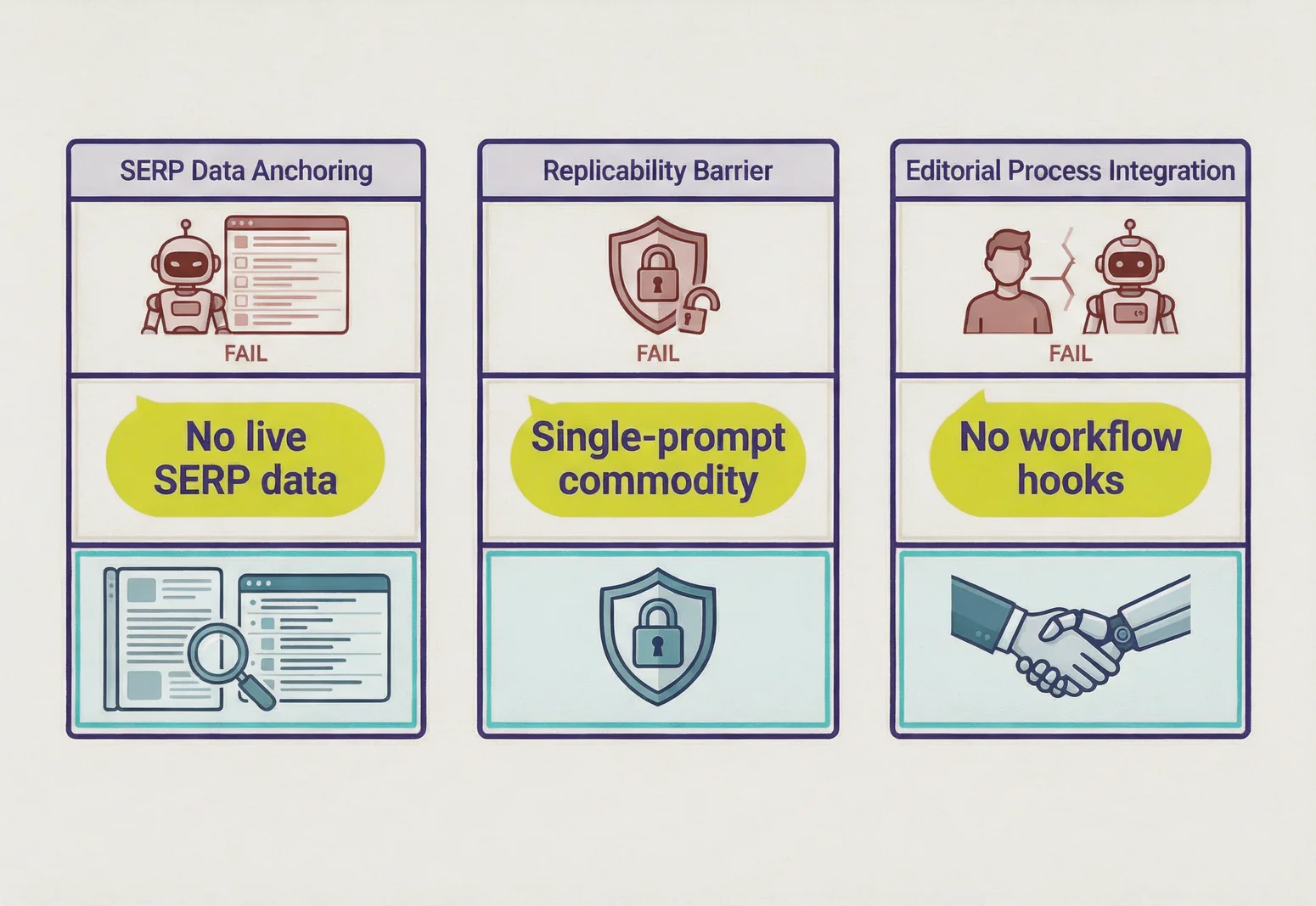
First, does the tool anchor advice in live SERP data? A general‑purpose language model cannot see what Google currently rewards for a specific query. Tools that scrape the top‑ranking pages, extract common section structures, and compare word‑count distributions produce briefs built from competitive reality. Google’s guide to optimizing for generative AI confirms that core ranking systems still govern what AI Overviews and AI Mode surface, meaning the old SERP‑first discipline remains non‑negotiable. Any tool that ignores the SERP is guessing.
Second, can it help the writer produce content another team cannot replicate with a single prompt? Generic generation is a commodity now; ChatGPT alone has hundreds of millions of weekly users. A tool only becomes a moat when it steers the writer toward proprietary data, named sources, original comparisons, and structural elements a foundation model will hallucinate if forced to create alone.
Third, does the tool preserve an editorial hand‑off, or does it automate the human out of the room? Sites that publish raw AI drafts with a light human patina are already being re‑ranked in high‑expertise verticals. An editorial workflow that treats the writer as a reviewer who corrects, enriches, and verifies the output makes the final page both safer and more defensible. Adding a human editorial layer improves the factual accuracy signals quality raters look for.
Every tool on this list passed all three tests during 2026 evaluation. The order reflects how deeply each tool weaves live SERP data into the drafting process, how strongly it enforces editorial distinctiveness, and how directly it prepares content for AI‑driven search surfaces.
1. Frase — When the SERP Brief Drives the Draft
Frase inverts the usual writing sequence. Instead of drafting and then running an optimization pass, the writer starts inside a SERP‑generated brief. Enter a query, and Frase scrapes the top‑ranking pages, extracts every H2, H3, and People Also Ask question, then builds an outline that mirrors the consensus structure those ranking pages share. The writer creates or revises section by section within that framework. By the time paragraph one is final, the page’s structure already matches what Google found worthy of ranking — no retroactive patching required.
During 2026, Frase added generative‑engine optimization signals that highlight sections likely to be extracted for AI Overviews. Combined with its live SERP refresh, the tool closes the loop between writing for a classic blue‑link result and writing for an answer engine that may never click through to the full page. The advice is never “add more keywords”; it’s “the SERP expects depth on subtopics A, B, and C that your draft currently omits.”
Where it works best. Frase belongs in any operation where every article must survive a live‑SERP audit before publishing. Commercial‑intent listicles, competitor comparisons, and “best X” round‑ups all benefit, because Frase shows exactly what Google’s algorithmic expectations look like for that exact query. Content refresh projects also get a boost: overlay the current draft against the live SERP and see in real time where the page has drifted from the signal mix that now wins.
The trade‑off. Frase focuses on the page, not the entire site. It won’t tell you which topic clusters to build next or whether your domain authority is enough to enter a competitive space. Teams running larger content programs need to pair it with a strategy‑layer tool, or they’ll win individual pages while losing the overall topic authority game.
Verdict. For any editor who believes the SERP is the single most honest reader, Frase turns that intelligence into a publishable skeleton faster than any other tool on this list.
2. Surfer SEO — Real‑Time Optimization at Scale
Surfer SEO treats the draft as a data stream that must converge toward what the top‑20 ranking pages exhibit. Its Content Editor scores a live document on term usage, structural depth, word count, and image density, nudging the writer back toward the SERP‑suggested range when they stray. The crucial detail: the suggestions are not about hitting a keyword‑density percentage but about matching the actual language distribution Google already associates with that query.
In June 2026, Surfer added AI Search Visibility badges that flag paragraphs capable of winning a spot inside an AI Overview. For agencies managing multiple client calendars, Surfer’s Google Docs plugin turns the optimization step into a sidebar review that removes tool‑switching friction.
Where it works best. Lean content teams and SEO agencies that need to review dozens of articles a month will get the strongest return here. The tool shines when a writer has produced a capable first draft and needs a rigorous second pass — not when bootstrapping from a blank page.
The trade‑off. Surfer’s AI draft mode can produce a passable starting point, but treating it as a content factory risks publishing the kind of thin, surface‑level pages that eventually lose rankings in a core update. Its real leverage lives in optimization, not origination, and teams that ignore the difference often end up generating thin AI content pitfalls at volume.
Verdict. For on‑page optimization that stays glued to actual ranking data, Surfer SEO remains the most direct operational tool available. Pair it with a strong editorial process, and the output reflects what already works while holding room for original insight.
3. Clearscope — Vocabulary Depth as a Ranking Signal
Clearscope approaches content quality from the lexical layer. It analyzes the top‑ranking pages and builds a term‑frequency model that surfaces the entities, co‑occurrences, and semantic neighbors Google considers relevant to the query. The result is a content grade driven by coverage density — have you discussed the subtopics that define the topic space? — not by overall length.
For a query about “email deliverability,” Clearscope might insist that DMARC alignment, BIMI, and warm‑up IPs appear, not because a competitor mentioned them arbitrarily, but because Google’s topical modeling associates those concepts with the core term. That distinction matters: Clearscope measures concept completeness, not structural mirroring.
Where it works best. In‑house content teams with a strong grasp of search intent and a preference for writing in their own voice will get the most from Clearscope. The Google Docs integration keeps the feedback loop tight, and the grade acts as a lexical compass rather than a rigid template.
The trade‑off. Clearscope’s content generation features remain secondary. It can produce a short‑form draft, but the output feels synthetic compared to what Frase’s SERP‑outlined briefs enable. Teams that want end‑to‑end draft creation will find themselves patching the writing step with a separate tool.
Verdict. On YMYL topics where semantic depth is the difference between a ranking page and a risky one, Clearscope gives the writer the vocabulary to prove authority without over‑optimizing.
4. MarketMuse — From Content Strategy to Draft, with a Data Layer
MarketMuse begins with the question most tools ignore: what should your entire site look like, not just this page? It inventories an existing domain, measures topic authority, and identifies gaps — content that needs building, updating, or retiring — before a single paragraph is written. The AI then generates a full brief with a recommended title, a target word count, and a competitive‑depth score that tells the writer how much content is required to challenge the current top‑three pages.
For B2B operators constructing content moats for AI search, MarketMuse’s ability to quantify authority is a genuine advantage. The tool will report, numerically, whether a cluster of articles on “cybersecurity compliance” can survive a well‑funded competitor pouring budget into AI‑generated output.
Where it works best. Enterprise content operations and growth teams that view content as an asset class, not a campaign expense. MarketMuse earns its subscription when the cost of getting the strategy wrong exceeds the tool’s fee, which is almost always true for sites where a single ranking page drives significant pipeline.
The trade‑off. The learning curve is real, and the price tag excludes smaller agencies and solo consultants. Many of the competitive‑intelligence moves MarketMuse automates can be replicated with manual SERP analysis — slower, but far cheaper. The AI writer itself is competent but lacks the fluency of the strongest general‑purpose models when prompted without a structure.
Verdict. MarketMuse treats writing as a downstream output of strategic clarity, and that mindset protects rankings over the long horizon. It earns its spot because it prevents the kind of random‑act‑of‑publishing that eventually gets a domain penalized.
5. Writesonic — AI‑Search Visibility from Draft to Publish
Writesonic rebuilt its 2026 positioning around AI‑search readiness, not raw generation speed. Its AI Article Writer includes a live SEO checker that scores a draft on search‑intent alignment, keyword distribution, and structure before the piece reaches a human editor. Behind the interface, Writesonic pulls Semrush keyword and SERP data, so the writer sees volume, difficulty, and competitor outlines as they compose.
The stand‑out feature is AI Visibility mode. It rewrites selected paragraphs to improve answer‑engine extraction, injects question‑answer pairs, and reshapes H2/H3 hierarchies so the final page becomes more extractable by AI Overviews and assistant‑style search. That’s precisely the structural readiness that the Content writer approach describes as foundational for winning space inside AI‑generated answer sets.
Where it works best. Teams that need a single environment for drafting, optimizing, and publishing — and who value visibility across both traditional and AI‑driven search surfaces equally — will find Writesonic fits. Solo founders who want a complete post in minutes but still insist on a human sign‑off also benefit from the streamlined workflow.
The trade‑off. The AI‑generated foundation text can still drift toward generic language, especially on broad topics. Without substantial editorial enrichment — adding named sources, original data, or field‑specific case studies — the resulting content may fail to differentiate from dozens of other AI‑generated posts on the same keyword. Writesonic rewards editors who invest the time to customize.
Verdict. For operations where publishing speed and AI‑search visibility must coexist without endless tool‑hopping, Writesonic delivers the most frictionless execution of the “draft‑then‑optimize” loop among the current platforms.
Align the Tool to the Operation
No single tool fits every constraint. A content‑program leader defending 80 existing pages against a core update allocates budget differently from a solo consultant launching a niche site on a 15‑hour‑per‑month schedule.
If every published piece must pass a live‑SERP gate before ship, Frase and Surfer SEO become the natural anchors. If the evaluation is about topical depth more than structure, Clearscope and MarketMuse apply different lenses — lexical completeness versus strategic inventory. Writesonic blurs drafting and optimization into a single interface, which works when time‑to‑publish is the primary pressure.
For larger content operations that want the entire sequence — site‑aware research, multi‑model drafting, optimization, quality scoring, and CMS delivery — under one roof, a platform approach can remove the tool‑switching overhead and enforce consistent editorial standards. SIA SEO’s AI content generation pipeline, for instance, automates the hand‑offs that usually slow teams down, and its transparent SIA SEO pricing plans make the cost predictable from day one. That kind of system complements the standalone tools ranked here; it doesn’t replace them. The common thread across every winner is that none of them sell a bigger language model. They sell a process that forces the writer, or the platform, to respect what Google already rewards and what an AI extract can reuse.
Learn more — Review SIA SEO as the operating system for structured SEO content production.
Strengthen Your AI‑SEO Content Stack
References
- Content Optimizer — The Content Optimizer is a dedicated tool for analyzing, scoring, and improving individual articles based on real-time SERP data. Unlike standard article generation (which creates