
Your Biggest Questions About AI and Keyword Research, Answered
How does AI impact keyword research? Get direct answers to common questions on automation, reliability, and the future of SEO strategy.

Search has shifted more in the last three years than the previous twenty, and you aren’t losing your touch—the rules that govern which pages earn visibility changed underneath you. This article answers the most persistent questions about what AI does and doesn’t do for search term discovery, so you can stop chasing trend noise and start validating opportunities with the right mix of automation and human judgment. Each response is self-contained, but read them in order if you’re building or rebuilding a modern term planning process.
Why does search term research still matter when AI overviews supply instant answers?
The AI snapshot that appears above the organic results is built from pages that match the query’s entity language precisely. If your content doesn’t rank in the top few organic slots, it rarely shows up inside that snapshot. The Department of Energy sees more than 60% of its CMEI web traffic coming from search engine referrals, and its content teams start every project with formal Search Engine Optimization Best Practices that make term selection a first deliberate step. Visibility still flows through positions one through five; the summary panel just changes what format your answer must take.
Dr. Pete Meyers crystallized the shift at Brighton SEO when he observed that “search has shifted more in the last three years than in the previous twenty. The way we think about keywords hasn’t kept up.” That doesn’t retire term research. It forces richer query modeling. A legal-tech marketer who dropped the broad head term “compliance audit software” after an AI overview swallowed the definitional query noticed that comparative long-tail variants like “compliance audit software vs manual SOC 2 checklist” still returned full organic results with strong time-on-page. She rebuilt her traffic by orienting discovery around decision-stage phrases. The category didn’t vanish; the demand shape changed, and your demand map has to follow.
How is AI changing the way we find search terms?
AI shifts discovery from string-matching to clustering topics, entity relationships, and natural phrasing at a scope a human team would take weeks to cover. A person might brainstorm twenty variants of “project management software”; a large language model trained on the web can surface hundreds, including niche-industry comparisons and question forms that match how users actually speak. The output isn’t just more volume—it’s the ability to group ideas by buyer stage and informational depth without days of manual tagging.
The structural change in user language accelerates this. Where traditional queries averaged a handful of words, AI-assisted searchers now type full scenario strings: “What should I look for when choosing a cloud ERP for a 45-person manufacturing firm in Ohio that integrates with QuickBooks?” That shift means you need discovery processes that uncover conversational clusters, not just head terms. Single-phrase lists leave entire buyer journeys invisible.
A productive workflow seeds a topic into a model, asks for 50 related user questions, then validates those questions against actual query data from your analytics or a search ads dataset. The approach often surfaces phrasing that conventional suites miss because those suites lean on pre-existing seed terms. Aligning the output with an entity first keyword research framework further improves the signal: you map the real objects, processes, and relationships your audience cares about before generating any string, which typically doubles the count of high-intent candidates a spreadsheet-first method would overlook.
Can AI tools produce reliable volume and competition numbers?
They produce ideas reliably. The volume and difficulty figures they attach to those ideas are often imaginary unless the model has been connected to a live authenticated data source. A language model running in a chat window has no intrinsic access to real query logs; it will confidently output a monthly search figure that collapses the moment you cross-check it with an ads platform or a third-party rank tracker.
That’s why experienced operators enforce a strict rule: let the model act as an ideation engine, then run every surviving candidate through Google’s own Keyword Planner or an equivalent tool that taps actual search behavior. The aim is a list ordered by observable buyer intent, not by a hallucinated popularity score.
A secondary hazard is trusting one AI tool for volume and competition simultaneously. Different index sources cover different slices of the tail, and their coverage varies by language and region. Pair a broad-spectrum dataset like the global ad inventory behind Keyword Planner with a narrower SERP-scraped source to detect discrepancies before you assign pages.
A marketing director evaluating a new content automation platform demonstrated the trap clearly. Her LLM returned a monthly volume of 4,400 for “structured SEO content production.” The actual Google Ads figure for that exact phrase was zero, with all real demand sitting in related variants like “AI SEO workflow” and “automated content creation platform.” Running the AI-generated list through Keyword Planner and then auditing the SERP for each term that passed her volume floor eliminated 80% of the candidates before any writing began. That one discipline prevented an entire quarterly calendar from resting on invented numbers.
What happens to search intent when AI suggests terms?
A model often misreads ambiguous queries. “How to set up a payroll account” can look informational, but for a small business owner racing toward a filing deadline the underlying intent is transactional—she wants a service that does the setup for her. Without manual review, those misclassifications end up on editorial calendars, and your team writes a tutorial when the searcher needed a comparison landing page.
The appearance of AI overviews has also reshuffled intent at scale. Queries that once reliably sent traffic to blog posts now resolve entirely inside an in-line answer, pulling click-through down to near zero. A term list filtered by traditional intent labels alone becomes a map of where traffic used to be, not where it currently flows. Layer live SERP feature data over each candidate—does the query trigger an AI snapshot, a rich snippet, or a local pack?—to understand whether a ranking page will actually receive visitors. Start by reading how search intent after AI overviews alters the path from query to conversion for the types of terms you track.
The most reliable lightweight annotation is a “likely click‑through risk” column in your keyword worksheet, backed by a manual skim of the top three organic results. AI can accelerate the initial sort; human judgment corrects the edge cases. It’s also worth following search journey maps that trace how AI-synthesized answers often collapse journeys that once spanned a blog post, a product page, and a demo request into a single no-click touchpoint. That structural change directly influences which intent categories deserve your heaviest content investment.
How do I validate an AI-generated term before assigning a page?
Run every candidate through a consistent four‑check gate. First, confirm that the term has measurable demand using Keyword Planner or your analytics suite. A phrase that falls below your internal volume floor rarely earns a standalone page unless it unlocks a higher-value cluster. Second, inspect the live SERP. Does the query still return a full set of organic blue links, or has it become a zero‑click AI panel that leaves no room for a second source? If the layout is a closed panel and the topic isn’t part of a nurturing sequence, lower its priority.
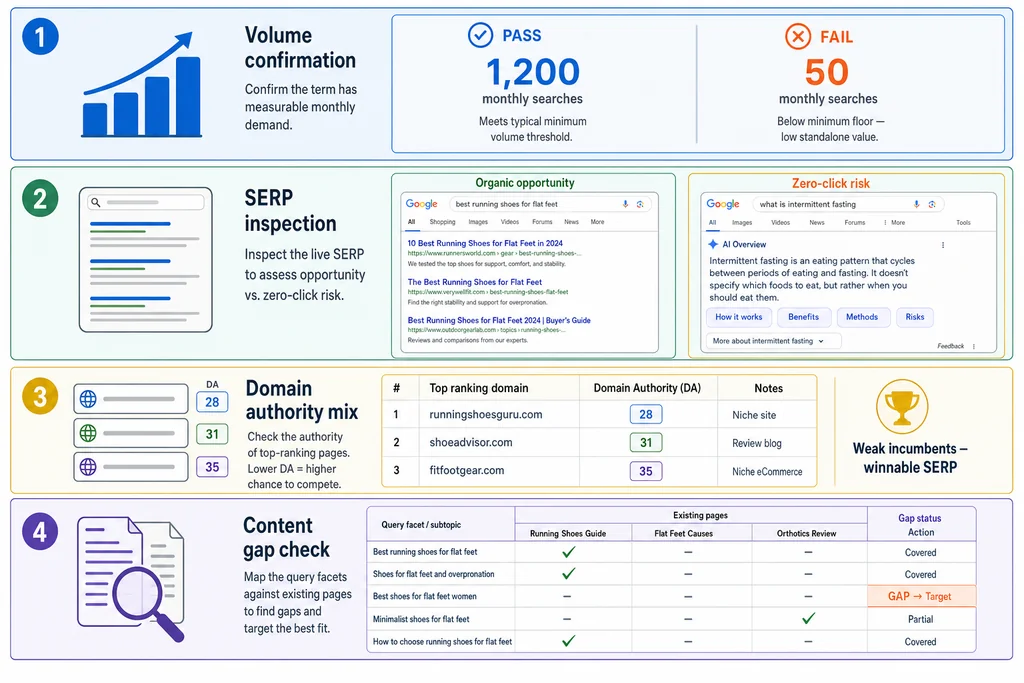
Third, check the authority of the ranking pages. If every top‑five result belongs to a government or .edu domain and your site competes commercially, the cost to compete often exceeds the realistic return. Finally, apply one qualitative test: read the top three existing pieces. Do they fully satisfy the searcher’s unspoken question, or are they surface‑level listicles a stronger article could displace? If you spot a genuine gap—missing data, outdated statistics, thin implementation guidance—document it. That gap signals that the term deserves investment even if the raw volume number looks modest.
| Validation Check | Weight | Passes When |
|---|---|---|
| Confirmed volume meets floor | 3 | ≥100 searches/month from an authenticated source |
| Organic links still present | 2 | At least three traditional text results visible |
| Domain authority reachable | 1 | Top‑5 not entirely .gov or .edu |
| Content gap detectable | 2 | Top articles miss a major decision need or operational detail |
Terms clearing all four checks with a weighted score above roughly 15 earn a green light; anything below 10 needs a stronger justification before you commit editorial resources. Over months, the scores also reveal which AI prompt strategies produce the best signal purity.
Do traditional search volume metrics still hold weight?
Volume is useful, but only as one signal among several. Monthly search volume tells you that people are asking; it doesn’t tell you whether anyone clicks. A term with 10,000 monthly searches that is fully answered inside an AI snapshot can deliver a fraction of the site traffic of a 900‑search term where users still scroll and compare. The same DOE optimization practices that require keyword inclusion also emphasize that every page needs a unique title and a targeted summary, underscoring that volume helps you prioritize, not guarantee outcomes.
A more accurate demand signal is volume multiplied by an estimated click‑through rate for the observed SERP layout. For many industries, that adjusted number replaces raw volume as the primary filter. Combine it with your business objective weight—a transactional phrase with lower volume often drives more pipeline than a high‑volume informational phrase—and you get a scoring model that reflects real commercial impact. The Homeland Security digital guidance on Keywording reinforces the point: it requires building keyword taxonomies from actual search query data and avoiding “jargon or unnecessary buzzwords.” That standard applies just as firmly to commercial content. Volume without behavioral context is noise, and the taxonomy must reflect what users genuinely type, not what internal teams wish they typed.
How can I stop AI-generated content from cannibalizing my existing pages?
Cannibalization happens when multiple pages on the same domain target near-identical search intent, splitting authority to the point that the search engine picks the wrong page—or shows neither consistently. AI accelerates the risk because it can produce large volumes of topically similar articles before anyone cross‑checks the overlap.
Controlling it demands two habits: a running topical inventory and a publishing threshold that checks every new assignment against what your domain already ranks for. Before you commission a page for an AI‑suggested term, verify whether your site already earns impressions for that query or a close semantic sibling. If it does, prioritize refreshing and expanding the existing page rather than adding a separate one. A site‑aware system like the SIA SEO platform automates that check by analyzing your domain’s existing topical footprint before drafting, so each new piece extends authority instead of splintering it. Even without automation, a quarterly audit that searches your domain alongside each key term and reviews top‑10 domains per query catches most dangerous drift. Understanding the mechanics in full—content cannibalization in AI publishing—gives you the framework to prevent it before it erodes your traffic.
What is the likely shape of term planning two years from now?
Term planning becomes a continuous mapping exercise between your content inventory, the entity graph search engines maintain, and the moving conversational patterns of real users. Instead of periodic hunts that produce a static spreadsheet, mature teams will run living pipelines that pull query data from search consoles, customer support logs, and AI chat interfaces, then cluster and prioritize automatically. The human role shifts toward calibration: deciding which clusters deserve a new pillar page, which existing pages need refreshing, and when to retire thin assets before they cause internal competition.
The infinite tail, already visible in platforms that surface thousands of long‑tail variations, means a single well‑structured article can rank for dozens of semantically related phrases. That collapses the old practice of spinning a separate post for every minor word variation, rewarding deep, entity‑rich writing over volume publishing. DHS keywording philosophy, which requires that keywords align with “major agency initiatives, policies, programs, and trending topics” and not be appended where the content only mentions a term in passing, points toward the likely editorial standard for commercial SEO as well. The future isn’t about finding more candidate strings; it’s about picking the precise entity clusters that match what your audience actually cares about and covering them with content clear enough to get cited.
Learn more → — Review SIA SEO as the operating system for structured SEO content production.