
AI Blog Writing for Agencies: Automating Client Content in 2026
Learn how AI blog writing for agencies can automate client content in 2026. Watch our video tutorial on scaling output without losing trust.

Every SEO agency I talk to is caught in the same bind. Clients expect more posts, on more keywords, published more often — but retainers have stayed flat or even shrunk. Writing manually can’t keep pace, and low-effort AI output gets caught in client review, flagged as generic, or worse, dropped from the index. This squeeze has turned ai blog writing for agencies from a niche experiment into a strategic necessity. The question isn’t whether to adopt automation, but how to build a system that produces differentiated, client-ready content without leaving a trail of editor fatigue and deindexed pages.
This article anchors on a recent case study from WealthWalkPath, who published a video breaking down how he built an AI SEO agency system that generates around $10,000 per month. We’ll summarize what the video demonstrates, fact-check its claims, and then layer on the infrastructure, quality gates, and research-backed practices that separate a repeatable client engine from a one-off experiment.
Video: AI SEO Agency: How I Get Paid to Write Blogs with AI ($10k/mo Case Study)
Why manual content pipelines break at scale
The traditional agency model was built on expertise, not volume. A senior strategist would outline, a writer would draft, and an editor would polish before the piece went live. That pipeline worked when a client expected four or eight posts a month. Today many retainers demand twelve, sixteen, or more — often across multiple service pages and local markets.
The math becomes brutal. According to Forrester’s 2026 report on the state of AI inside US marketing agencies, nine in 10 agencies now use generative AI, and half run agentic workflows for execution. The same report warns that an industrywide fixation on cost efficiency is eroding creativity and brand differentiation. That’s the exact hazard: speed without editorial control produces the kind of content that gets agencies fired — posts that read like a reworded first page of Google, signifying nothing.
Agencies that solve this don’t just automate writing. They automate the surrounding operations — topic selection, briefing, quality scoring, and approval routing — while keeping a lean human editorial layer that applies client-specific judgment. The shift from one‑shot prompts to site‑aware production is what separates an agency with a few AI scripts from a business that can take on five more clients without adding headcount. It’s the difference between building a content system that compounds over time versus running an undifferentiated content calendar that stalls out after two months.
A real-world blueprint: the $10k/mo AI SEO case study
WealthWalkPath’s video, published in June 2026, walks through a live agency setup that uses AI to write client blog posts while preserving margins. The creator demonstrates a stack built around LLMs for drafting, SEO tools for keyword and structure mapping, and a CRM‑like delivery platform. The headline number — $10,000 per month — comes from charging clients $1,500 to $2,000 monthly retainers for a defined content output across multiple accounts.
The most instructive part isn’t the tool list; it’s the process layer. The video outlines a five‑stage workflow:
- Intent mapping. Identify buyer‑intent keywords the client isn’t ranking for, pulling from Google Search Console and competitor gap analysis. The creator emphasizes queries where the reader has a clear next step — booking a demo, downloading a lead magnet — because those generate measurable client ROI faster than broad informational topics.
- Structured briefs. Before any AI writes a word, the operator builds a brief that includes the target keyword, search intent, competitor structure patterns, and internal link targets. That specificity stops the model from drifting into vague summaries. Our own internal approach relies on semantic content briefs to give the AI the same context a human strategist would get.
- Draft generation via LLM. The video uses ChatGPT and Claude as drafting engines, but the key is the context window: each model receives the brand’s existing site content, the brief, and a brand-voice snippet so the output inherits tone rather than defaulting to generic phrasing.
- Human editorial pass. Every AI draft goes through a reviewer who does not rewrite from scratch. The goal is a 10‑ to 15‑minute edit focused on fact‑checking, sharpening hooks, and removing anything that echoes the top three competitors. This human editorial layer is what keeps the output client‑ready.
- Client delivery and iteration. Content is delivered through a client portal with revision cycles built into the retainer. The operator tracks which posts move the needle on traffic and leads, feeding that data back into the next keyword selection round.
The creator makes a critical point: he sells the client outcome, not the tool. The AI handles drafting, but the agency’s value resides in intent selection, editorial discernment, and a feedback loop that improves content performance over time. That’s what lets the system sustain $10,000 per month without ballooning headcount. You can watch the full AI SEO agency case study on his channel to see the dashboard and workflow in action.
The four components that turn scattered prompts into a repeatable pipeline
Scaling agency content requires more than a good LLM prompt. You need a production chain that can intake a client’s site, pass structured context to a model, apply quality checks, and publish — all without breaking when you add the next account. Platforms that embed content generation directly inside existing tools help solve the context‑switching problem; a tutorial on GoHighLevel’s AI blog builder shows how brand boards and SEO inputs feed straight into the post generator.
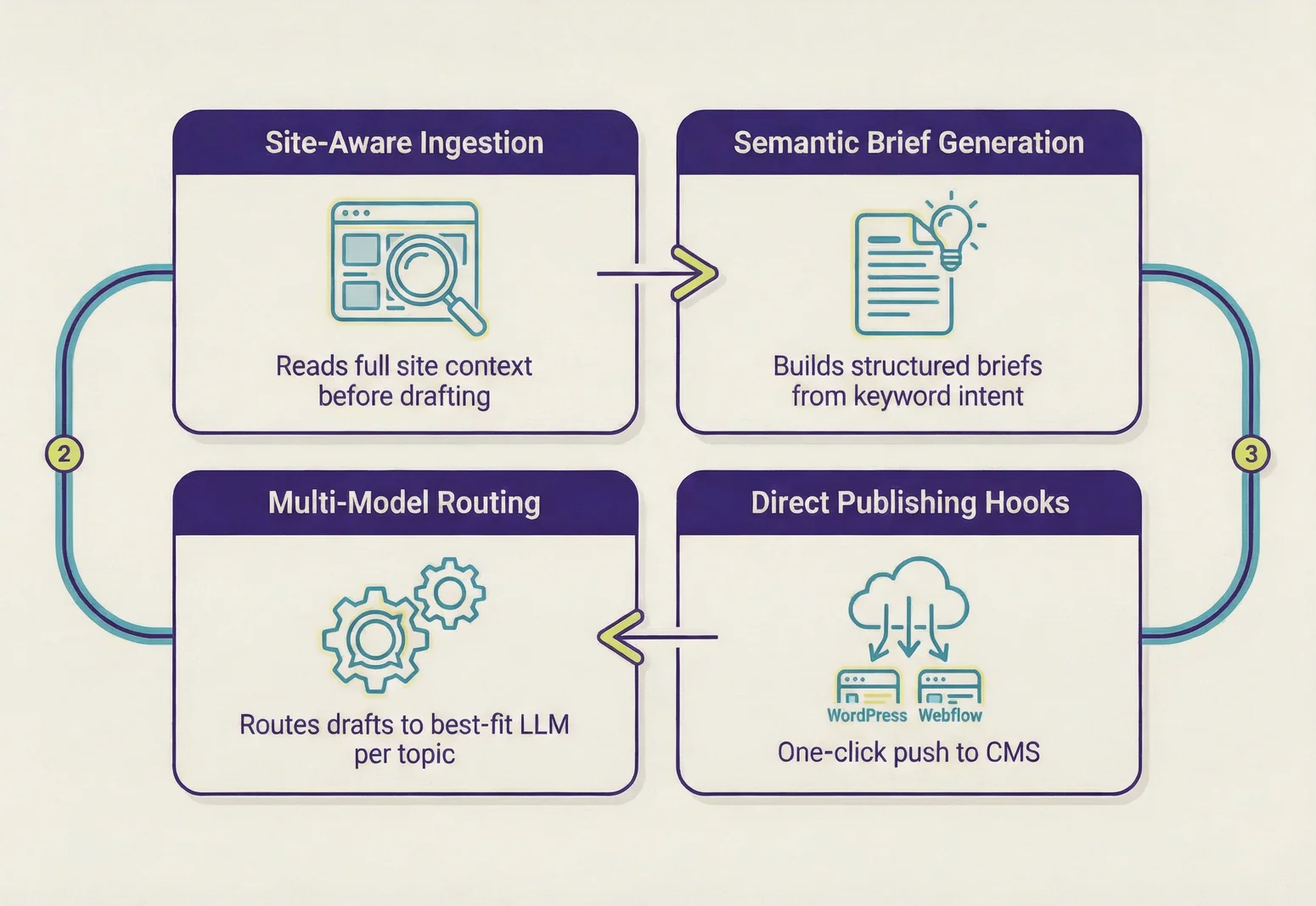
Regardless of the stack, four components reappear across successful agency implementations:
- Site‑aware ingestion. The system must read the client’s existing site — its page structure, service categories, and internal link map — before it writes a single word. Without that, you get disconnected posts that don’t reinforce topical authority. The SIA SEO content generation pipeline starts with a full site crawl to inform every draft, rather than relying on blind prompts.
- Semantic brief generation. A brief limited to a keyword is almost useless for an LLM. Effective briefs include search intent, recommended H2 structure, the questions the article must answer, and specific competitor gaps. Building briefs before drafting measurably cuts editing time on the back end and keeps the AI from recycling thin, generic content that search engines ignore.
- Multi‑model routing. Not every article type performs equally well with every model. A technical explainer for a B2B client might draft well with Claude; a local service comparison may need a different model’s attention to geo‑specific details. Routing the right prompt to the right model automatically keeps output consistent without forcing every piece through a single inference engine.
- Direct publishing hooks. Agencies lose hours when content lives in a Google Doc, moves to a CMS, and gets formatted a third time. The pipeline should write directly into the client’s CMS — WordPress, Webflow, or a custom stack — as a draft, preserving heading hierarchy, meta data, and internal links in place. An integrated environment like the SIA SEO platform unifies analysis, generation, and publishing so the mechanical steps disappear.
A system wired around these four components removes the assembly‑line work while keeping the agency in control of strategy, voice, and the approval workflow that gives clients confidence.
Quality gates that keep clients from walking away
The most dangerous assumption agencies make is that client‑side readers can’t tell AI content from human‑written content. They can — not always because of obvious tells, but because generic AI drafts lack a discernible point of view, fail to cite relevant industry data, and sound like a high‑school summary of the first three search results.
The fix isn’t to hide the AI. It’s to build quality gates that catch common failure modes before the client sees a draft.
Gate 1: Content quality scoring. An automated scoring layer should check for thin paragraphs, keyword stuffing, missing subheadings, and unsupported factual claims. Running this before a human editor touches the piece catches the 80% of issues that otherwise consume review time. Many agencies anchor their scoring on a perfect SEO post anatomy checklist, which gives both the AI and the reviewer a shared quality benchmark. Systems that bake scoring into the pipeline produce the kind of content quality in the AI era that clients renew over.
Gate 2: Human editorial checkpoints. The editor shifts from writer to quality controller. Instead of rewriting for two hours, they spend fifteen minutes verifying claims, tightening hooks, and injecting client‑specific examples. When the AI draft already respects the client’s tone and the target intent, the editor’s time goes to high‑value discernment, not drudgery. This is the human editorial layer in practice.
Gate 3: Brand voice fidelity. Every client has a distinct voice — short, punchy sentences for one; consultative, data‑heavy paragraphs for another. Storing and applying a brand‑voice profile per client prevents the “all clients sound the same” problem. That matters even more now because AI‑generated answers in search reward content with a distinguishable point of view. A consistent brand voice for AI is no longer a luxury; it’s a differentiation lever.
Gate 4: Deindexing and policy insurance. Google’s stance on AI content in 2026 no longer treats the tool as a binary signal. The risk is thin, repetitive content — whether human or AI — that fails to demonstrate expertise. A quality gate that checks for originality, sufficient depth, and proper E‑E‑A‑T signals reduces the probability that a new batch of posts vanishes in the next core update. The WealthWalkPath video itself cautions that publishing shallow, generic copy is the fastest way to get an agency relationship terminated. Pairing velocity with quality means you can scale without falling into the content velocity vs spam trap.
What the video leaves out and where the industry is actually moving
The WealthWalkPath video is a tight operator’s guide, but it skims over a few structural shifts agencies need to confront in the back half of 2026.
Search intent is splitting. Traditional organic results now compete with AI‑generated answers inside Google’s overviews, ChatGPT, Gemini, and Perplexity. A recent analysis argues that automation must move beyond volume‑first strategies and adopt “modular content architecture” that repurposes core assets across multiple channels. The pieces you write for a client’s blog also need to be structured so they get cited in AI‑generated answers — a discipline often called Answer Engine Optimization. That means publishing clear definitions, buyer‑focused pages, and proof points that AI models can extract and reference. Winning in this split environment demands both a practical playbook for AI search visibility and a commitment to proof‑driven content that resists summarization.
Second, most marketers use AI, but few get meaningful results. Data from the 2026 State of AI Content Marketing indicates that 88% of marketers use AI tools, yet only 25% report meaningful outcomes. The gap traces back to treating AI as a writing tool rather than integrating it into a full content operation — one that pairs drafting with intentional site architecture, internal linking, and a research‑backed briefing process. The agencies that close this gap are the ones that see AI as an engine that needs tuning, not a magic wand.
Third, the industry‑wide rush to cut costs with AI is actively undermining marketing effectiveness. The Forrester report calls on agencies and CMOs to redirect focus from AI‑driven cost savings toward preserving creativity and differentiation. The practical middle ground is what the video implicitly endorses when it shows the operator spending most of the time on intent selection and editing, not on generating text. An agentic SEO content demo from RankUp Academy illustrates how a well‑defined knowledge base fed to AI agents can keep the output grounded, but even that system still relies on a practitioner who curates the input and reviews the output. The pattern is consistent: automate the mechanical, protect the strategic.
A five‑point operational checklist for getting started
It’s tempting to read a case study and copy the tool stack exactly: ChatGPT here, a keyword tool there, a CRM for delivery. That misses the point. The system works because the output is predictable, not because the stack is unique. An agency that can’t articulate how it maintains quality at scale will eventually lose trust — either from clients or from search engines.
A practical checklist for agencies starting down this path:
- Input hygiene. For each client, document: the core service pages, the top 20 ranking keywords, a brand voice profile, and the internal link architecture. Feed these into the pipeline before the first draft.
- Brief discipline. Every article gets a brief that includes intent, competitor H2 structure, 3–5 required questions, and at least one concrete data point. Vague briefs produce vague output.
- Draft review time box. Limit initial editorial review to 20 minutes per 2,000 words. If the piece needs more than that, the briefing step needs improvement — the AI isn’t the bottleneck.
- Publishing cadence. Start with one batch of 8–12 posts per client, measured across a 90‑day window, before increasing velocity. This prevents content bloat that triggers quality flags and avoids the consequences of thin AI content at scale.
- Retro loops. After 90 days, identify which posts generated conversions or ranking improvements and double down on that content type and intent category. The feedback loop is what turns a one‑time experiment into a sustainable system.
Common questions from agencies evaluating automation
Does Google penalize AI‑written content in 2026?
Google evaluates content against E‑E‑A‑T signals — expertise, experience, authoritativeness, trustworthiness — not the method of production. AI‑written pieces that demonstrate deep subject knowledge, cite original sources, and answer the user’s intent thoroughly perform comparably to human‑written work. The risk is publishing surface‑level summaries that add nothing new.
Can one operator really run a five‑figure AI content agency?
The WealthWalkPath case study suggests yes, but it depends on the service packaging. If the agency bundles a full content strategy — keyword research, briefs, drafts, editing, and reporting — one operator can support 6–10 clients with the right automation. The constraint becomes client communication and strategic direction, not content production.
How do you keep multiple clients from sounding identical?
Maintain a separate brand voice profile per client that captures sentence length, forbidden words, industry terminology, and tone calibration. Feed that profile into every draft. Generic output almost always traces back to an absent or underfed brand profile. Tools that store and enforce voice rules — rather than just suggesting them — prevent the generic AI trap.
What’s the minimum viable stack to get started?
Three things: a site‑aware content generator (custom‑built or an integrated platform), a keyword and intent research source, and a structured quality scoring or checklist process. Start with one client’s site, run the pipeline end‑to‑end twice, measure the editing time, and adjust the briefs until drafts require less than 15 minutes of human review.
At what point does client content volume actually hurt rankings?
When the velocity outpaces the site’s authority signals. Publishing 50 posts in a month on a site with 10 referring domains and no established topical authority is a red flag for both manual reviewers and algorithmic classifiers. A safer rule: spend the first 90 days building a core of 20–30 high‑quality, well‑interlinked posts before ramping the weekly cadence. The operator in the agentic SEO demo demonstrates exactly that pacing — enough to prove the system, not so much that the site looks spammy.
Dig deeper into agency content automation
- The best AI SEO tools for agencies scaling content in 2026
- Content quality systems in the AI era
- Building AI content approval workflows that clients trust
Review SiaSEO as the operating system for structured SEO content production. — Get started