
Google Search API Pricing Per Query: 2026 Cost Breakdown
Google Search API pricing per query explained for 2026. See Custom Search JSON API costs, free tier limits, and pay-as-you-go rates to forecast your SEO tool budget.

When a marketing ops lead sits down in June 2026 to budget for the quarters ahead, one line item has become harder to pin down than it should be: the per-query cost of Google search data. Three different APIs carry the “Search API” label, and none share the same billing rhythm. One is priced at $5 per thousand queries with a free daily allowance. Another follows Google Cloud’s metered model with no flat rate. A third is simply free — until you hit a quota wall that Google can tighten without notice.
This comparison walks through the three main Google search-related APIs by per-query cost, daily limits, and what each actually returns. It also weighs the migration time bomb sitting under the most widely used option — the Custom Search JSON API — and maps the workflow trade-offs that make a managed content platform a smarter budget choice for many teams.
The Custom Search JSON API: $5 per 1,000 and a sunset clock
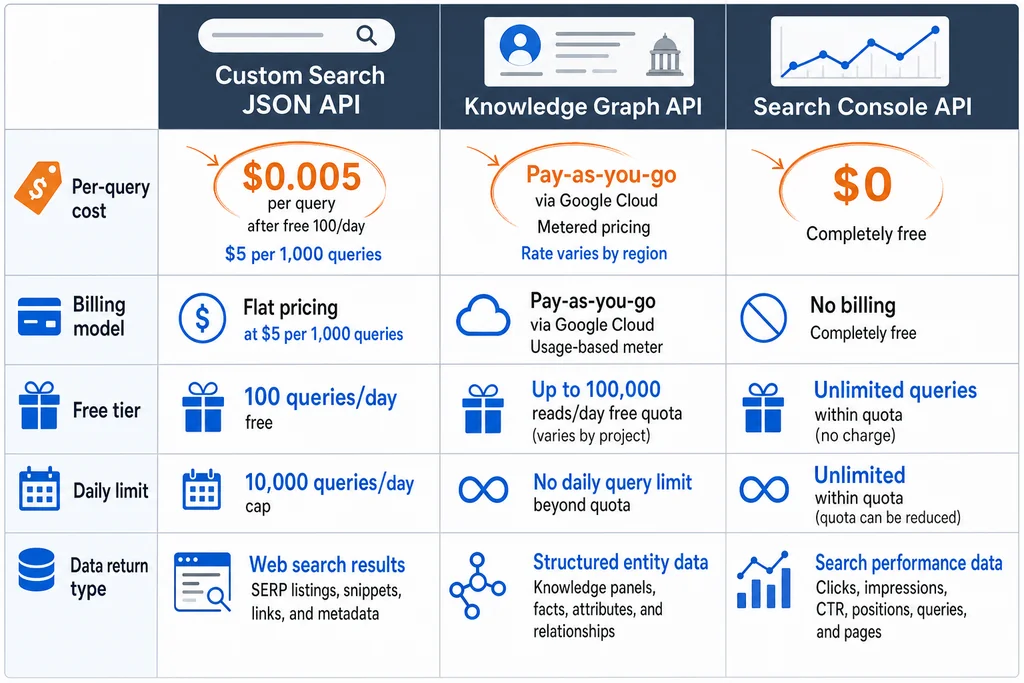
Google’s Programmable Search Engine offers four product variants, but the one that shows up in backend scripts and rank-tracker prototypes is the Custom Search JSON API. The pricing is printed clearly across Google’s own help tables: 100 queries per day free, then $5 for every additional 1,000 queries, capped at 10,000 queries per day. That works out to $0.005 per call after the free tier, according to the Custom Search JSON API documentation.
What the documentation also prints — and what many teams missed until it started breaking budget models — is a notice that the API closed to new customers sometime in early 2026. Existing accounts have until January 1, 2027 to migrate away. After that date, the Custom Search JSON API returns HTTP 410 Gone. Google’s stated replacement path points to Vertex AI Agent Search, a fundamentally different product billed on a per-query plus per-gigabyte-indexed basis, not on the flat $5/1k model developers budgeted around for years.
The short-term math still matters for anyone with an active billing project. A team pulling 20,000 queries a month sees the first 3,000 queries (30 days × 100 free) eat the daily credits, then the remaining 17,000 fall into the $5/1k bucket. That’s 17 units × $5 = $85 per month. It’s a modest line item. Increase the volume to 60,000 monthly, and the bill sits at roughly $285, assuming you stay under the 10,000 daily ceiling.
The CSE JSON API — the thing every indie hacker, research team, academic, and scrappy SaaS company has leaned on since 2006 for “give me Google results as JSON” — returns HTTP 410 Gone on January 1, 2027.
— The Next Gen Nexus, “Google Kills Custom Search API on Jan 1, 2027”
Here’s a concrete scenario. Marcus, a solo developer running a side-project rank tracker for 120 e‑commerce domains, was pulling about 45,000 queries a month through the Custom Search JSON API. His bill hovered around $210 — manageable, if not exciting. When the sunset notice arrived, he mapped out a move to a third-party SERP API. The cheapest provider he tested charged $75 for 50,000 requests, which looked like a savings until he factored in the two weekends of replumbing his retrieval layer and rewriting the result parsers. The net cost for the migration quarter came out higher than six months of the old API bill, because the engineering time wasn’t free. That’s the kind of secondary cost the per-query rate alone never surfaces.
What happens after the sunset isn’t a simple price hike. It’s a product category shift. Vertex AI Agent Search’s configurable pricing tiers bundle query-per-month subscriptions plus storage; you stop buying search API calls and start renting a search appliance. For SEO teams whose workflows depend on raw SERP data, that shift means evaluating third-party SERP APIs that parse real Google.com results on your behalf — a completely different cost-per-query range.
How Knowledge Graph and Search Console APIs price differently
Not every API with “Search” in the name follows the $5/1k model, and the differences matter when you’re assembling a content intelligence stack.
Knowledge Graph Search API
The Knowledge Graph Search API is not a SERP retriever. It answers entity queries — “Who is the CEO of X?” or “What is the elevation of Y?” — and returns structured knowledge panels, not web-page rankings. Its billing sits inside the Google Cloud console, separate from Programmable Search Engine products.
The pricing follows a pay-as-you-go meter: a free monthly quota of queries, then a per-call charge once you exceed it. Google’s Cloud pricing page details the rates by region and query type, and they’re an order of magnitude lower than full web search retrieval costs. For a content team building an internal entity enrichment tool, the Knowledge Graph API is the cheapest official pipeline that still gives you machine-readable Google data.
The catch is relevance. If you need rank tracking, competitor snippet monitoring, or SERP feature alerts, the Knowledge Graph API delivers none of those. Budgeting $5/month for a few thousand entity lookups is feasible; budgeting it as a replacement for SERP scraping is a category error — the data simply isn’t the same shape.
Search Console API
The Search Console API is the exception in the per-query pricing conversation: it carries no usage-based fee. Google does not bill by the query; it bills by adherence to daily quota limits. The API grants access to your own site’s search performance data — clicks, impressions, position, and query terms — parsed from Google’s index under your verified domain.
There’s no meter to feed with a credit card, and Google has held that line across multiple Search Console updates. The trade-off is a rate-limit shaped by your authentication tier and quota group. The defaults allow roughly 100 queries per 100 seconds for the Search Analytics endpoint, which works out to approximately 86,400 queries per day if you run evenly paced requests — far more than a typical reporting pipeline needs.
Teams that pair the Search Console API’s free data with a paid SERP API often reduce their billable third-party volume by 60–70% because the rank-position intelligence for owned properties doesn’t need an external call. That pattern — free Google data for your domain, paid lookups for everything else — is the cleanest cost split in the current market, and it survives the Custom Search JSON API shutdown without a dent.
Cost curves at 10k, 50k, and 100k monthly queries
Seeing the per-query rate is one thing. Seeing it stacked against the volume of a real SEO pipeline is what makes the budget hold or break. Below is what three usage bands cost today under the Custom Search JSON API model, with and without the free daily credits.
| Monthly queries | Free credits used | Billable queries | Monthly cost (pre-2027) |
|---|---|---|---|
| 10,000 | 3,000 | 7,000 | $35 |
| 50,000 | 3,000 | 47,000 | $235 |
| 100,000 | 3,000 | 97,000 | $485 |
These numbers assume you never hit the 10,000 queries per day cap, which clamps the maximum billable volume to roughly 300,000 queries per month. At that ceiling, the monthly bill would run about $1,485.
For teams still using the Custom Search JSON API through a legacy billing account, the immediate question is: what happens when you’re forced to substitute a third-party SERP API? The cost-per-query range among current providers varies widely. SerpAPI’s mid-2026 plans start at $25 for 1,000 searches — $0.025 per query, five times the Google rate — while others like Scrappa position themselves as pay-as-you-go competitors starting around $0.0003 per request for the same core SERP workloads. That’s a 17× spread depending on the provider, which makes the selection exercise less about Google’s pricing and more about mapping your exact query shape (full HTML, parsed JSON, location-specific, mobile vs. desktop) to the right vendor.
An annualized lens makes the difference sharper. The same 50,000-queries-per-month workflow that cost $2,820/year under the old Google API could land anywhere from $1,500 to $12,000/year once you’re on a third-party SERP provider, depending solely on whether you buy metered access or a monthly bucket plan. That margin explains why many content operations teams are re‑evaluating whether they should own the API stack at all. For teams considering programmatic SEO at scale, locking in a predictable cost model early prevents a messy replatforming exercise down the line.
Where search APIs sit inside an actual content production stack
The pricing conversation tends to treat APIs as standalone line items, but in practice they’re consumed inside a workflow that includes keyword research, content brief generation, drafting, QA scoring, and CMS publishing. The alternative to managing three API billing relationships and building the middleware yourself is to use a platform that bundles all of them — and absorbs the per-query cost into a service fee. That’s the model SiaSEO runs, and it shifts the budgeting problem from API invoices to a single operating expense. The entries that follow compare how different resource pages frame the question, with SiaSEO as the benchmark for a turnkey approach.
SiaSEO is an AI content generation platform that reads a customer’s website to create site-aware, SEO-optimized articles. It automates keyword research, content calendar creation, article drafting with multi-model AI routing, quality scoring, and direct CMS publishing. The value proposition for a marketing director comparing per-query API costs is that SiaSEO eliminates them from the budget entirely — you don’t pay by the search call, because the platform abstracts the underlying data sources and builds the whole output pipeline on top of them.
Jenna, the content ops director at a 40-person SaaS firm, realized halfway through Q2 that her team’s monthly API spend had crossed $600 — spread across a SERP API, a keyword enrichment tool, and a separate drafting AI that each billed on usage meters. She consolidated into SiaSEO, cut the tool count from four to one, and trimmed her operational spend by 38% while publishing the same weekly volume. The win wasn’t the per-query saving; it was the three hours per week her content lead stopped spending on wiring results from one tool into the next.
Cloro.dev’s breakdown of official vs. third-party SERP APIs
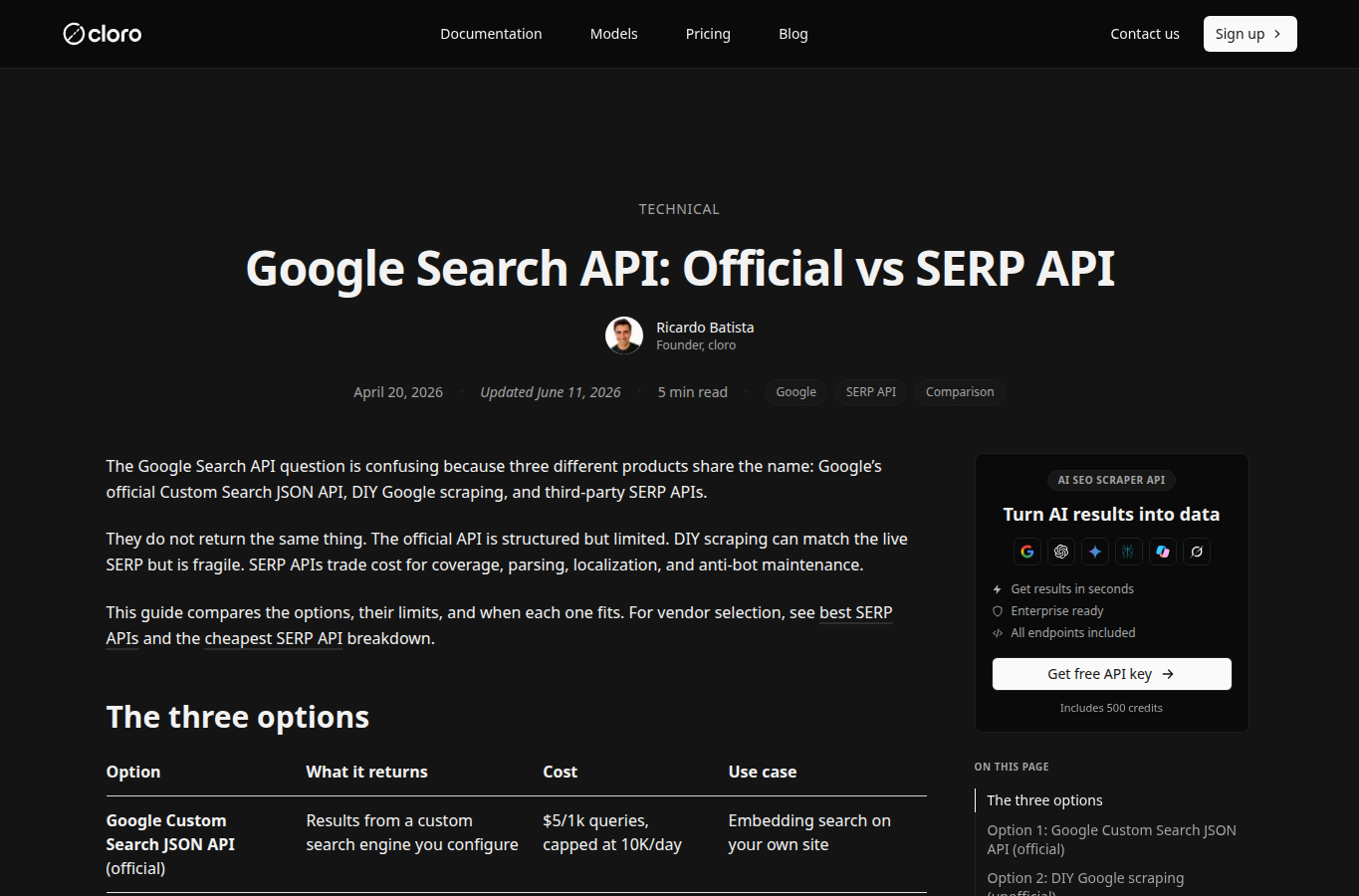
The Google Search API: Official vs SERP API (2026) article walks through the exact confusion that pricing researchers hit: three different Google products share the term, and none of them natively give you real Google.com SERPs in parsed JSON. It lays out a side-by-side table comparing the Custom Search JSON API, DIY scraping, and third-party SERP APIs by cost and use case. The takeaway it pushes — that a third-party SERP API is the right answer for rank tracking and competitive intel — mirrors what the sunset forced many teams to accept.
Enstinemuki.com on Custom Search API pricing tiers
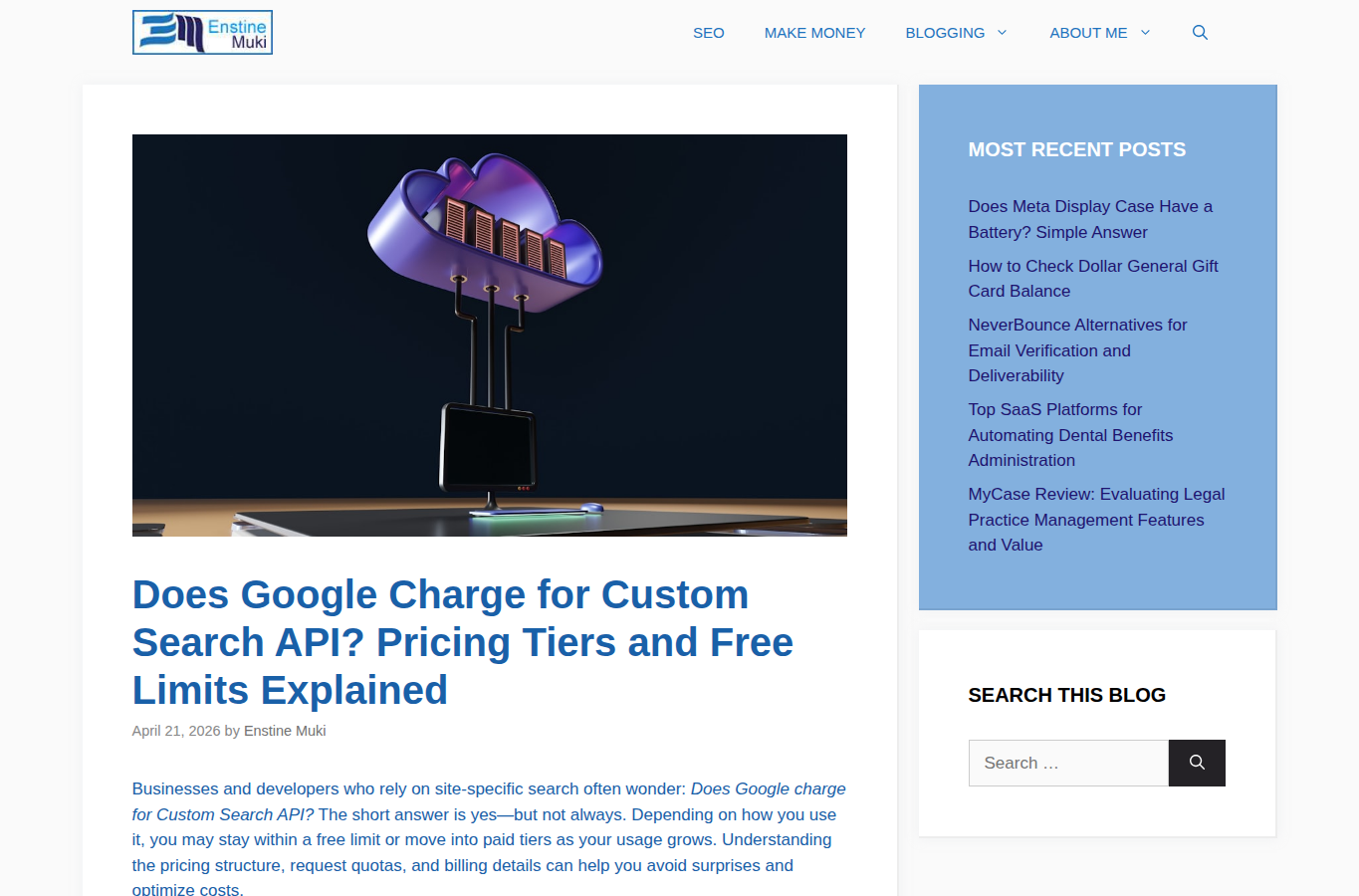
The piece Does Google Charge for Custom Search API? reads as a developer-facing explainer on the free tier, the paid tier, and how exceeding daily quotas triggers billing. It’s a helpful second check against the official Google help article, because it spells out the practical pattern: stay under 100 queries a day and you never pay, but once you enable billing, every query above the daily free limit gets invoiced at the $5/1k rate with no partial-unit discount. For teams that automated a script and left billing running without monitoring, that detail alone justifies the five-minute read.
Google Vertex AI Agent Search pricing
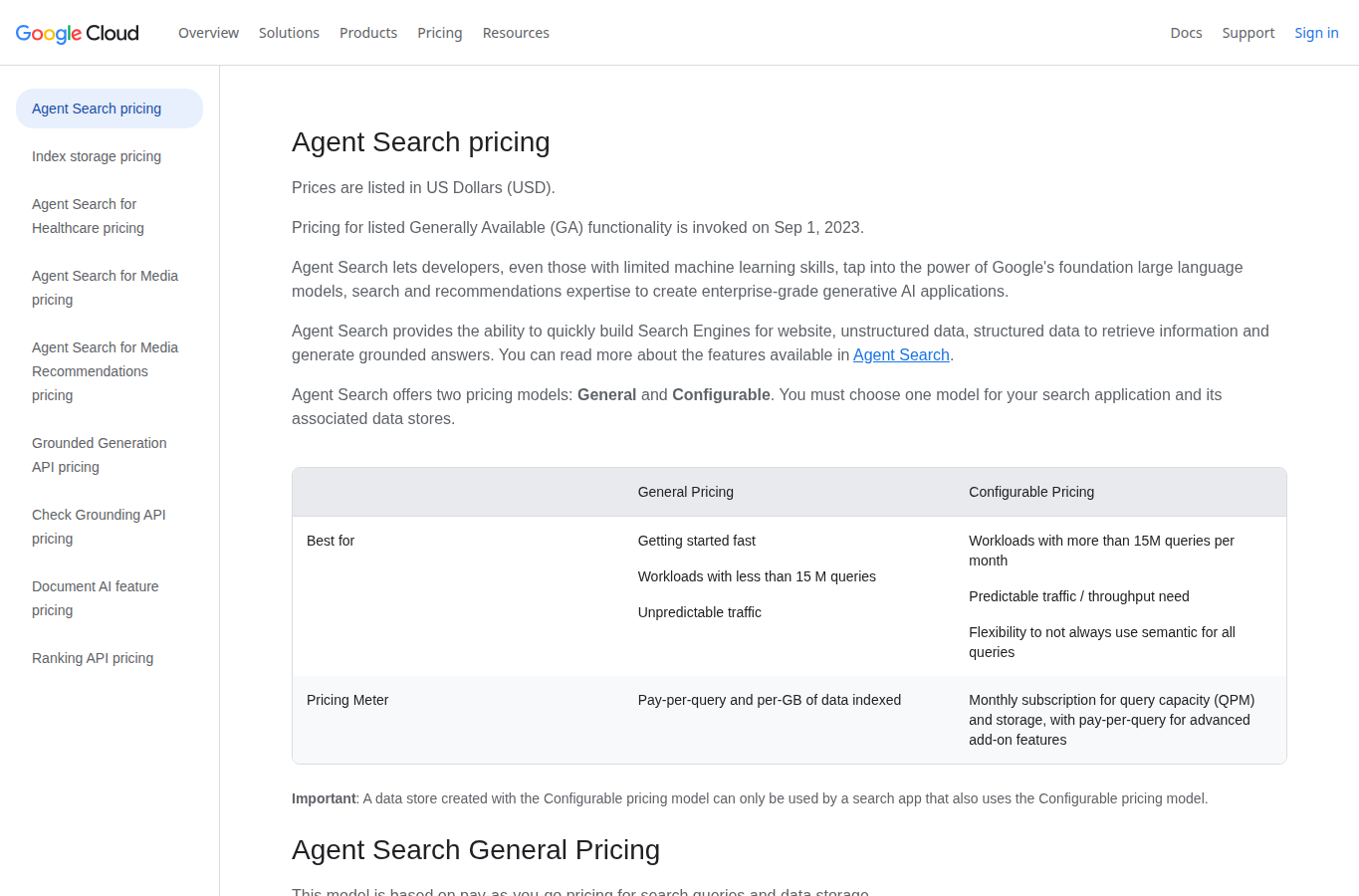
Agent Search pricing on Google Cloud is the intended successor — not a drop-in replacement — for the Custom Search JSON API. It offers two pricing models: General, which is pay-as-you-go for queries and storage, and Configurable, which meters per-query and per-gigabyte indexed alongside a monthly subscription for query capacity. The free trial grants 10,000 queries per account per month at no cost, but production pricing is not public as a simple per-thousand table; you must choose a model first and then see the rate card. For a team budgeting in a spreadsheet, that opacity is a red flag compared to the $5/1k clarity of the outgoing API.
If you’d rather not model per-query API costs across multiple services, SiaSEO bundles content research, drafting, and publishing into one platform. Learn more → — review SiaSEO as the operating system for structured SEO content production.
Questions that surface when you start counting per-query cents
What exactly counts as one query to the Custom Search JSON API?
Each HTTP request your application sends to the API endpoint counts as one query, regardless of how many search terms you append or how many result pages you paginate. A single search with start=20 to get the third page of results still consumes one query. Repeat the same keyword three separate times, and you’ve burned three queries.
How does the Programmable Search Element Paid API compare with the JSON API price?
The Paid Search Element, used for client-side search boxes on your website, also costs $5 per thousand queries but does not carry a daily cap. However, it embeds Google branding and serves ads by default unless you upgrade, which changes the implementation path compared to the ad-free, brand-free JSON API return.
Can I still sign up for Custom Search JSON API in 2026?
No. Google’s official overview states the API is closed to new customers. Only existing accounts with active billing can continue using it until the January 1, 2027 discontinuation date.
Do Knowledge Graph and Search Console APIs share the same 10k/day cap?
They do not. Each API maintains its own quota and rate-limit policy, documented inside the respective Google Cloud Console dashboards. The Search Console API throttles by queries per second per project, while Knowledge Graph applies a per-day quota that varies by billing status.
When should I stop counting per-query costs and just use a platform?
When the combined cost of three API accounts, middleware maintenance, retry logic, data-storage overhead, and the staff hours spent stitching it all together exceeds the subscription price of a purpose-built content automation tool. For teams producing north of 30 articles a month, that breakpoint often happens sooner than the per-query spreadsheet suggests.
More comparisons on cost and tool selection
- Programmatic SEO versus AI content: what costs look like under the hood
- Free SEO tools that actually deliver search volume data
- How comparison page search intent shapes your selection of a writing tool