Long Tail Keyword Examples Built for AI Search Results
A ranked list of long tail keyword examples by intent, with notes on which formats earn AI search visibility.

Long tail keywords used to be the quiet workhorse of SEO: low volume, low competition, steady trickle of qualified visitors. That trade has changed. Google's AI Mode rollout shifted impression share away from 1–2 word queries, which fell from 42% to 24% between January 2025 and August 2026, while 3–4 word queries climbed from 33% to 48%, according to Search Engine Land's long-tail keyword guide. The same specificity that once made these phrases a niche play now makes them the primary currency of AI-generated answers.
That creates a practical problem for anyone building a content calendar. A list of keyword examples is not useful on its own. What matters is whether a query is worth a page, what format that page should take, and whether the phrase is likely to surface inside an AI answer or get absorbed by one. The list below ranks examples by those criteria, not by search volume.
How These Examples Were Ranked
Three filters decided the order.
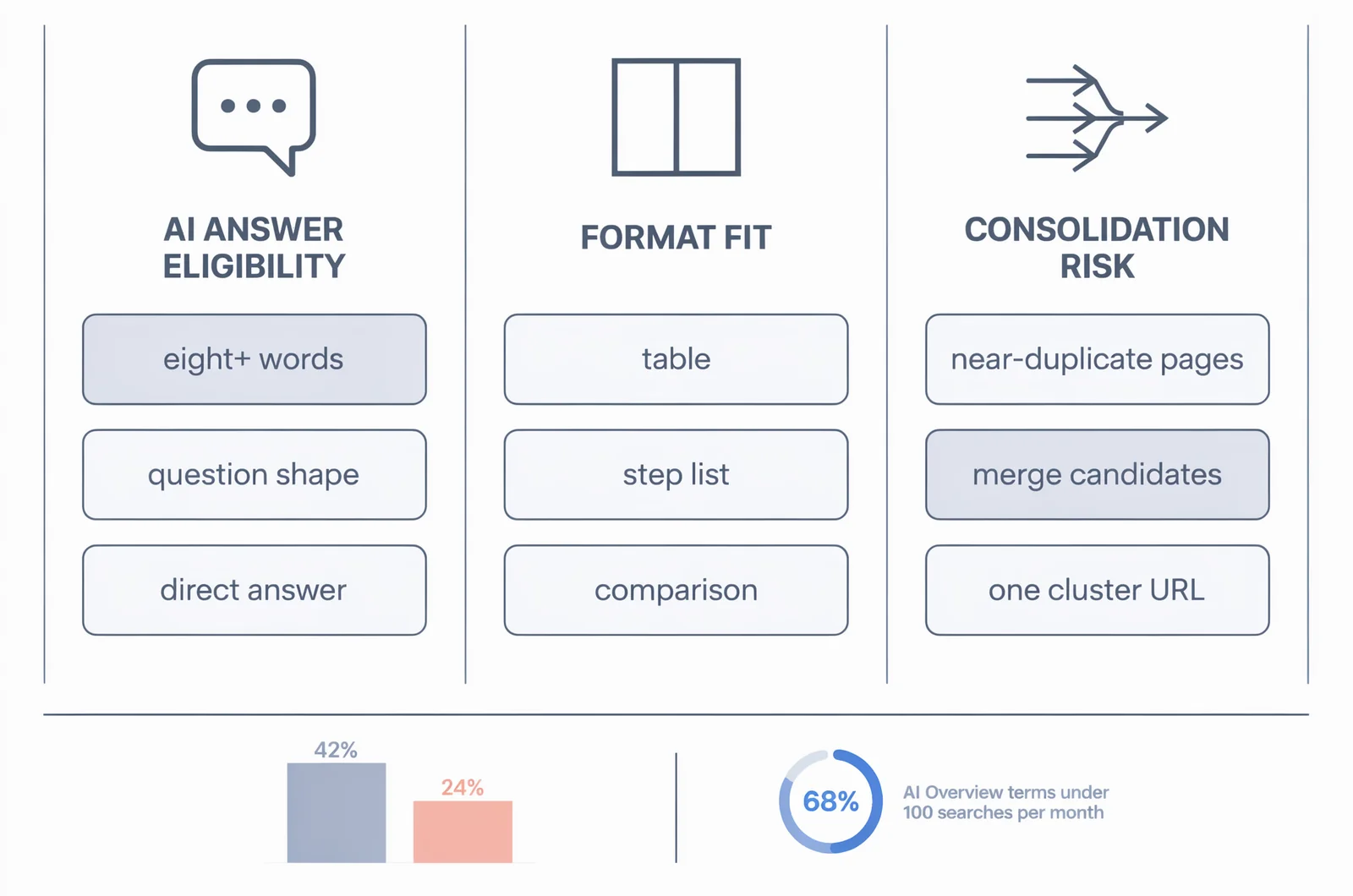
AI answer eligibility. Queries of eight or more words are seven times more likely to trigger a Google AI Overview than shorter queries, per BrightEdge data cited by Sydekar's analysis of long-tail search. Roughly 68% of terms that trigger AI Overviews get 100 or fewer monthly searches, and almost 80% sit in the 0–40% keyword difficulty range, per Semrush's AI SEO statistics. Low volume is not a disqualifier anymore. It is closer to a signal.
Format fit. A comparison query needs a table. A troubleshooting query needs numbered steps. A "what is" query needs a definition in the first 60 words. Mismatched format is the most common reason a page ranks but never gets cited.
Consolidation risk. Twenty pages targeting twenty near-identical variations now compete with each other and dilute domain authority. The examples below are grouped so one page can own a cluster instead of fragmenting it.
One caveat before the list: volume figures vary by tool and by month. Treat any single number as directional.
Decision-Stage Queries With Hard Constraints
These are the highest-value entries because the searcher has already narrowed the field. They know what they want and are checking whether a specific option exists. RankYak's long tail keyword examples collection lists several in this shape, including "best noise-canceling headphones under $100" and "lightweight running shoes for flat feet women."
1. "best [category] for [specific constraint]"
Pattern: best + product + for + physical or situational constraint
Examples worth building around:
- best running shoes for flat feet women
- best standing desk for small home office
- best noise-canceling headphones under $100
- best CRM for a two-person sales team
Why it ranks: the constraint does the qualifying work. Someone searching "best running shoes" wants a category overview. Someone adding "for flat feet women" wants a shortlist they can act on today.
Format that fits: a comparison table with three to five options, each row carrying the constraint-specific attribute (arch support, footprint in square feet, battery hours). Add a short paragraph per option explaining who it suits.
Limitation: these queries attract affiliate competition and paid placements. If you cannot add a genuine testing signal, a spec breakdown, or a service-area angle, the page will struggle against sites with stronger commercial intent signals.
Verdict: build these first if you sell or service the category. Skip them if you only write informational content.
2. "[product] that fits [unexpected constraint]"
Pattern: product + that + fits/works with + non-obvious requirement
Examples:
- reusable water bottle that fits cup holder
- non-toxic cookware set for induction stove
- wireless earbuds for small ears with long battery
This pattern is underused because the constraint is discovered through customer support tickets, not keyword tools. The person searching has already tried a product that failed. That is a strong buying signal.
Format that fits: a spec-led list with the constraint named in the H2, plus a short "what to check before you buy" block. Measurements beat adjectives here.
Limitation: search volume is often in the low tens. You will not build a traffic channel on one of these. You build a cluster of fifteen and let them compound.
Verdict: excellent for e-commerce and product-led sites with a support-ticket backlog to mine. Weak for pure service businesses.
Question-Shaped Queries That Feed AI Answers
Question-format queries make up 57.9% of the queries that trigger AI Overviews, and 46% of those are long-tail, per Digital Applied's AI search statistics roundup. That combination is the strongest structural argument for building question pages right now.
3. "what's the best [thing] for [narrow personal situation]"
Pattern: what's the best + category + for someone who + condition
Example: "What's the best type of meditation for someone who struggles to sit still and has about ten minutes in the morning?"
Ahrefs uses this exact query in its guide to long-tail keywords to illustrate a specific problem: it is a real expression of demand, but no two people will phrase it identically, so it will never accumulate enough repetitions to register in a traditional keyword database.
That is the point. The query is invisible to volume tools and visible to AI systems, which match on meaning rather than exact string.
Format that fits: a direct answer in the first two sentences, then the reasoning, then two or three alternative scenarios. Do not bury the answer under a definition.
Limitation: you cannot track rank for a query nobody types the same way twice. Measure these pages by AI citation, assisted conversions, and branded search lift instead of position.
Verdict: the highest-leverage category on this list for anyone with a genuine point of view. Also the hardest to justify to a stakeholder who wants a rank-tracking column.
4. "how do I [task] when [obstacle]"
Pattern: how do I + action + when/without + blocker
Examples:
- how do I clean cast iron without stripping the seasoning
- how do I run a content calendar without a dedicated ops hire
- how do I migrate a WordPress site without losing rankings
The obstacle clause is what separates this from a generic how-to. It also tells you exactly which objection to address in the opening paragraph.
Format that fits: numbered steps, with the obstacle named in step one rather than saved for a caveat at the end. Include what to do if the standard method fails.
Limitation: if your answer requires a product purchase, the page reads as a sales pitch and loses the citation. Keep the method complete without the product, then mention the product as one option.
Verdict: strong for SaaS and services. These pages also convert well because the reader is mid-task and looking for a resolution.
5. "[thing] vs [thing] for [use case]"
Pattern: option A vs option B + for + specific scenario
Examples:
- Surfer vs Clearscope for a two-person content team
- static site vs CMS for a documentation-heavy product
- in-house vs agency SEO for a pre-seed startup
Comparison queries carry commercial-investigation intent, which the SERP data for this topic confirms at roughly 28% of the intent mix. The "for [use case]" tail is what keeps the page out of the generic head-term fight.
Format that fits: a table comparing at least three attributes that matter to the stated use case, then a paragraph per option covering cost structure, onboarding time, and where it breaks down. Name what you cannot verify.
Limitation: comparison pages age fast. Pricing changes, features ship. Date the page and note when the comparison was last checked.
Verdict: high commercial value, high maintenance. Budget for quarterly refreshes.
Topical and Conversational Queries Most Teams Miss
Ahrefs separates long-tail queries into three types: supporting long-tail (specific product or feature searches), topical long-tail (adjacent subject matter), and conversational long-tail (natural-language questions). The third type is where most content calendars have a gap.
6. "[symptom] on [specific context]"
Pattern: problem + on/in + narrow context
Example: "fly bites on dogs ears."
This is a topical query. It does not mention a product, a brand, or a solution. It describes a situation. The searcher wants to know what it is and what to do.
Format that fits: identification first (photo, description, distinguishing features), then causes, then treatment options ordered by severity. Keep the identification section short enough to sit above the fold.
Limitation: topical queries pull traffic that may never convert. If your business sells flea treatment, the fly-bite page builds topical authority but not direct revenue. Judge it on cluster contribution, not last-click attribution.
Verdict: essential for building the topical authority that AI systems use to decide which domain to cite. Weak as a standalone revenue play.
7. "[decision] with [tradeoff]"
Pattern: action + with + cost, risk, or constraint
Examples:
- switching CRM mid-quarter with active deals in pipeline
- raising prices with annual contracts already signed
- hiring a content lead with no SEO background
These queries sit at the intersection of a decision and its downside. The searcher is not researching the category. They are stress-testing a choice they have already half-made.
Format that fits: a decision framework with explicit tradeoffs, a short list of what to check before committing, and a clear statement of when not to do it. The "when not to" section is what earns citations, because most competing pages avoid it.
Limitation: hard to write without domain experience. If you cannot describe the failure mode accurately, the page reads as generic and will not be cited.
Verdict: the best format for agency and consultancy sites. It demonstrates judgment, which is the actual product being sold.
8. "[process] checklist for [role]"
Pattern: task + checklist + for + job title
Examples:
- technical SEO checklist for a head of marketing
- pre-launch content checklist for a solo founder
- CMS migration checklist for a content operations lead
Role-qualified queries let you write to a specific reader instead of a general one. That narrows the scope, which makes the page more useful and easier to keep accurate.
Format that fits: an actual checklist, ordered by sequence, with a one-line note on why each item matters and what happens if it is skipped. This is also where an interactive checklist or estimator earns its place: a short form that returns a tailored task list based on site size, CMS, and team capacity turns a static page into a tool people return to.
Limitation: checklists get copied. Your differentiator has to be the reasoning behind each item, not the list itself.
Verdict: strong for B2B and agency audiences. Pair with a downloadable version to capture email.
Where Long Tail Keywords Fit in an AI Search Strategy
The strategic shift is from page-per-keyword to page-per-cluster. Twenty thin pages targeting twenty variations of the same phrase now compete internally and split authority. One substantial page covering the cluster, with the variations handled as H3s and answered directly, performs better in both classic and AI results.
Three operational rules follow from that.
Map each example to one page, not one keyword. If two examples on your list would produce near-identical pages, merge them. The merged page should answer both queries in separate sections.
Write the direct answer first. AI systems extract passages, not pages. A 40-word answer directly under a question-shaped H3 is more citable than the same answer buried in paragraph four.
Track citations, not just positions. Rank tracking still works for the head terms. For the long tail, watch whether your domain appears in AI Overviews and assistant responses for the cluster. Semrush reports that roughly 60% of searches now yield no clicks, which makes visibility without a click a real outcome to measure.
This is also where site-aware tooling changes the workflow. SiaSEO reads a customer's site before drafting, which means the keyword-to-page mapping starts from what already exists rather than from a blank list. That matters for consolidation decisions: you can see which existing pages should absorb a new query instead of spawning a competing one. The platform's semantic drift tracking addresses the other failure mode, where a page slowly wanders off its original intent across revisions.
Questions That Come Up When Building These Lists
How many words makes a keyword long tail?
There is no fixed threshold. Ahrefs frames it by volume rather than length: "meditation" gets 211,000 monthly searches and counts as a head term, while "can meditation make me smarter" gets 50 and counts as long tail. Word count correlates with specificity but does not define it.
Do low-volume keywords still justify a page?
Only when the page serves a cluster. A single 20-search-per-month query rarely justifies its own URL. Fifteen related queries sharing one well-structured page often do, especially when that page is the kind AI systems cite.
Should I target conversational queries that no tool reports?
Yes, if you can answer them accurately. They will not appear in volume data because no two people phrase them identically. They still represent real demand, and they are the queries most likely to reach an AI assistant.
What format gets cited most often?
Direct answers to question-shaped queries, with the answer in the first sentence under the heading. Comparison tables and numbered steps also extract cleanly. Long narrative introductions do not.
How often should these pages be refreshed?
Any page containing pricing, tool capabilities, or platform behavior needs a visible check date and a quarterly review. Pages built on stable method or definitional content can go longer.
Building the Cluster Without Fragmenting It
The examples above share a structure: a specific constraint, a clear format match, and a realistic view of what the page can and cannot do. Ranked by reader fit rather than by volume, the decision-stage and question-shaped entries carry the most commercial weight, while topical and conversational queries build the authority that makes the rest citable.
Start with three or four from the decision-stage group, map each to an existing page or a new one, and write the direct answer before anything else. Then expand into the question group once you can see which clusters your site already has a claim on.