Long-Tail Keywords: Definition and Why They Outperform Head Terms
Long-tail keywords definition: what they are, why they outperform head terms on intent and competition, and how to use them in SEO.

If you've ever wondered why a page targeting a phrase nobody seems to search can quietly out-earn a page chasing a big vanity term, you're asking the right question. Long tail keywords — longer, more specific queries with modest individual volume — account for most of the searches people actually run, and they behave differently from head terms in ways that matter for rankings, conversions, and now AI-generated answers. This article answers the question directly, in parts: what these queries are, why they tend to outperform head terms, how AI search changed the math, and how to find and structure content around them. Each section stands alone, so you can jump to whichever question brought you here.
What are long-tail keywords?
Long-tail keywords are search queries that are longer, more specific, and individually lower in search volume than broad head terms — typically three or more words, like "crm for small consulting firms canada" instead of "crm." The name comes from the shape of the search demand curve: a small number of head terms get enormous volume, while millions of specific queries each get a trickle, and together that trailing curve — the "long tail" — makes up the majority of all searches.
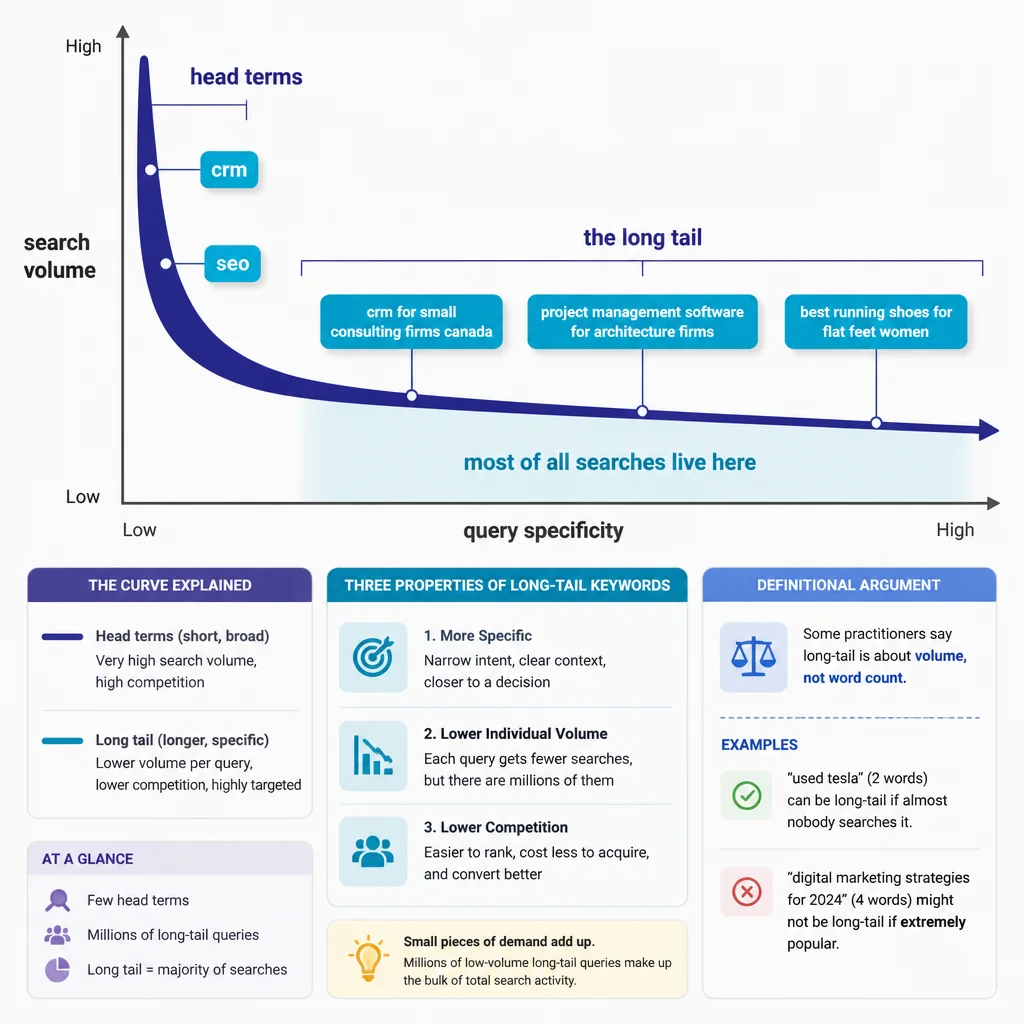
Three properties define them in practice:
- Length and specificity. Semrush's definition describes them as longer, more specific phrases searchers use when they're closer to a decision or when using voice search. Word count is a rough proxy, not the rule — the real signal is how specific the intent is.
- Low individual volume. A term might see 10 to 100 searches a month. That looks negligible in a keyword tool until you add up hundreds of them.
- Collective scale. Keyword research data updated in 2026 estimates that long-tail terms account for roughly 70% of all search traffic, and about half of all queries run four words or longer.
One definitional argument worth knowing: some practitioners insist the "long tail" is purely about volume, not word count — a two-word query can be long-tail if almost nobody searches it, and a six-word query can be a head term if millions do. That's the position taken in a well-circulated r/bigseo thread, and it's technically fair. In day-to-day SEO work, though, length, specificity, and low volume almost always travel together, so the three-to-five-word phrasing heuristic from sources like Shopify's long-tail keyword guide and Ahrefs' coverage of how long-tail keywords drive search traffic remains the working definition most teams use.
The term isn't new — it predates modern SEO and borrows from Chris Anderson's writing on retail demand curves — but its importance has grown as search behaviour fragments into conversational, question-shaped queries.
Why do long-tail keywords outperform head terms?
They outperform on three axes at once: competition, intent, and conversion. Each one is mechanical, not magical, and understanding the mechanics tells you when the advantage holds and when it doesn't.
Competition. Head terms are contested by every domain in a category. A query like "project management software" pits you against vendors with a decade of authority and eight-figure content budgets. The long-tail variant — "project management software for architecture firms" — has a fraction of the competing pages, and most of those pages answer the query incidentally rather than deliberately. Ahrefs' guidance on long-tail keywords makes the point with ranking-difficulty data: low-volume specific queries consistently show lower keyword difficulty scores than their parent head terms. For a newer or mid-authority site, this is often the difference between page one and page five.
Intent clarity. A head term tells you almost nothing about what the searcher wants. "CRM" could be a student writing a paper, a founder comparing vendors, or someone looking for a login page. "Best crm for real estate teams under $50" is one person with one need. That clarity compounds: you can match the page format to the intent (comparison page, how-to, pricing explainer) instead of hedging across all three. Botify's breakdown of head terms versus the long tail frames this as a specificity trade-off — the more specific the phrase, the more precisely you can serve it, and precision is what ranking systems reward.
Conversion. Specific queries sit later in the decision process. Yotpo's 2026 guide reports that long-tail keywords typically convert at roughly 2.5 times the rate of head terms, which matches what most B2B teams see in their own analytics: the person searching "siaseo alternatives for agency content automation" is far closer to a purchase than the person searching "content marketing." Yoast's take on why long-tail phrases deserve your focus makes the same argument from the publishing side — a site about sewing machines has a realistic path to ranking for "best sewing machine for quilting beginners" and almost none for "sewing machine."
There's also a portfolio effect. One long-tail page earns a trickle; fifty of them, each ranking for its core query plus dozens of close variants, earn a river. Because Google ranks pages for semantic clusters rather than single strings, a well-built page on a specific question tends to collect impressions across every natural rephrasing of that question.
The honest caveat: "outperform" describes efficiency, not ceiling. A mature site with real authority should still contest head terms, because the aggregate volume there is larger. The long tail is where you build the authority — and the revenue — that eventually makes head-term contention plausible.
How has AI search changed the case for long-tail keywords?
AI search has sharpened the case rather than closed it, but it changed which long-tail queries are worth pursuing. The short version: broad informational queries are increasingly answered on the results page itself, while specific, nuanced queries still send clicks and earn citations inside AI-generated answers.
The data from 2026 trend reporting points in one direction. Google's own February 2026 disclosure put AI Overviews on roughly half of US searches, and Semrush's AI SEO statistics for 2026 reports that over 68% of terms triggering AI Overviews get 100 or fewer monthly searches — in other words, the long tail is exactly where AI answers are appearing. Separate analysis from Digital Applied's AI search statistics collection found that among informational queries triggering AI Overviews, 46% are long-tail and 57.9% are question-format.
That sounds like bad news. It isn't uniformly bad, for two reasons.
First, the queries most exposed to zero-click answers are the generic definitional ones — "what is SEO" — where a two-sentence AI summary genuinely satisfies the searcher. HubSpot's analysis of how search is evolving in 2026 draws the line cleanly: the opportunity sits in specific, nuanced questions where a generic AI answer isn't quite enough, and a well-researched page still earns a citation or a click. "How does SEO work for B2B SaaS companies with long sales cycles" is the kind of query where depth wins.
Second, AI answers cite sources. Pages that answer a specific question with a direct, citable claim — a definition, a number, a mechanism — get pulled into AI Overviews and chatbot responses. This is the logic behind answer-engine optimization, and it's a structural argument for long-tail content: the more precisely your page maps to one question, the more citable it becomes. It's also why platforms like SiaSEO now track LLM visibility alongside traditional rankings — being the cited source inside an AI answer is a distinct, measurable outcome from ranking third in blue links.
There's a countercurrent worth respecting. Paid search data through August 2026 shows impressions and conversions migrating toward longer conversational queries, while some performance marketers argue that maintaining twenty thin pages for twenty keyword variants is now counterproductive — it creates internal competition and dilutes topical authority. Both observations are true, and they resolve into one rule: consolidate around questions, not phrasings. One strong page per distinct question, covering its natural variants, beats many weak pages per variant.
How do you find long-tail keywords worth targeting?
Start with the questions your buyers already ask, then validate with data — not the other way around. The practitioners who get this right treat keyword tools as confirmation, not discovery.
A working sequence:
- Mine first-party language. Sales calls, support tickets, onboarding questionnaires, and your own site-search logs contain the exact phrasing real buyers use. This language is almost always long-tail by nature, because people describe problems specifically when money is on the line.
- Expand with Google's own surfaces. Autocomplete, People Also Ask, and related searches are direct samples of query demand. PAA boxes in particular are pre-validated long-tail questions — Google has already decided people ask them.
- Validate in a keyword tool. Check volume, difficulty, and SERP composition. Semrush's long-tail keyword guide recommends filtering for low difficulty with a visible intent match in the current top results. Don't discard zero-volume terms reflexively — tools undercount specific queries, and Semrush's own data shows most AI Overview-triggering terms sit at 100 monthly searches or fewer.
- Check the SERP manually. If page one is forums, thin pages, or mismatched intent, the query is winnable. If it's wall-to-wall authoritative domains with perfectly matched content, move on.
- Cluster before you write. Group queries that share intent into one page assignment. This is the step that prevents cannibalization, and it's where automation earns its keep — SiaSEO's keyword research and calendar automation, for instance, clusters semantically related queries into single article assignments so teams don't accidentally commission three pages competing for the same question.
A practical prioritization heuristic: score each candidate on intent clarity (can you name exactly what the searcher wants?), business proximity (does the question sit one step from your offer?), and SERP weakness. Volume comes last. A 30-search query with purchase intent beats a 900-search informational query for most B2B sites.
How should you structure content for long-tail queries?
Structure the page so the answer is extractable in seconds and defensible in depth. That means the direct answer goes first — in the first sentence under the heading — and everything after it adds evidence, exceptions, and next steps.
The pattern that works for both readers and answer engines:
- One question per page, answered immediately. The Q&A format you're reading exists for this reason. A heading phrased as the reader's actual question, followed by a one-or-two-sentence answer, is the unit AI Overviews and People Also Ask boxes are built from.
- Citable specifics. Numbers with dates and sources, named mechanisms, concrete examples. Vague prose doesn't get quoted by anyone, human or machine.
- Variant coverage inside the page. Synonyms, rephrasings, and follow-up questions belong in the same article as subheadings, not as separate posts. This is how one page ranks for dozens of phrasings.
- Internal linking between question pages. Long-tail pages compound when they link to each other in clusters — a definition page linking to a strategy page linking to a tools page. The cluster signals topical authority that no single page can.
Quality control matters more at long-tail scale because the volume of pages tempts teams to lower the bar. A page targeting a specific question still needs to be the best answer to that question — original data, a real example, a named source. Thin long-tail content is the exact pattern recent spam and helpful-content systems are built to demote, and it's the failure mode behind most "we published 200 posts and nothing ranked" stories.
If your team works with structured templates, this structure can be enforced rather than remembered. SiaSEO's semantic QA scoring, for example, checks drafts against the target question's intent before publishing, which keeps a 50-page long-tail program from drifting into 50 pages of interchangeable filler.
Long-tail questions readers keep asking
Are long-tail keywords always three words or longer?
No. Length is a proxy for specificity, and specificity is what matters. A two-word query with ten monthly searches and narrow intent behaves like a long-tail term; a six-word query searched millions of times is a head term. The r/bigseo community debate on this point is settled mostly in favour of the volume-based view, but in practice the two definitions overlap almost completely.
How many long-tail keywords should one page target?
One primary question per page, plus its natural variants — typically five to twenty rephrasings that share identical intent. If two candidate keywords would require different answers or different page formats, they're two pages. If they'd produce the same page, they're one.
Do long-tail keywords still work with AI Overviews absorbing clicks?
Yes, selectively. Generic definitional queries increasingly resolve on the results page, while specific, decision-adjacent questions still earn clicks and citations. Semrush's 2026 data shows the majority of AI Overview-triggering terms are low-volume long-tail queries, which makes precise, citable long-tail content the entry ticket into those answers rather than a casualty of them.
Should a new site ignore head terms entirely?
Not ignore — deprioritize. Publish long-tail content that builds topical authority and revenue first, then contest head terms once the domain has the link equity and content depth to compete. Most sites that rank for head terms got there through the tail, not around it.