The 7 Best AI SEO Agencies Worth Hiring in 2026
A ranked roundup of the best AI SEO agencies in 2026, with selection criteria, pricing signals, and fit notes for B2B teams deciding who to hire.

Searching for an AI SEO agency in 2026 means sorting through a market that renamed itself faster than it rebuilt its delivery. Agencies spent the past year repositioning around AI search, GEO, and AEO, with new glossaries in pitch decks and rewritten service pages, according to Search Engine Land's survey of marketer language. Yet 81% of marketers still call that internal strategy SEO, and 70% would search for either "AI search optimization" or simply "SEO" when looking for help. The vocabulary is unsettled. The work is not.
This roundup covers seven agencies, ordered by reader fit rather than size or fame. Each entry states who it suits, what public evidence exists, how pricing is structured, where it falls short, and a practical verdict. Where evidence is thin, this article says so instead of filling the gap.
How these seven were selected, and what was left out
Four filters did most of the work.
AI-search capability with a stated method. The agency has to describe how it measures visibility inside AI answers, not just claim to optimize for it. "We do AI SEO" is a positioning statement. "We query every major AI system with the questions your buyers actually ask and map where you appear" is a method.
Deliverable specificity. Vague retainers promising "strategy" without named outputs were cut. The agencies here name what they produce: technical foundations, content architecture, digital PR, entity work, or measurement datasets.
Pricing transparency. Almost no agency in this category publishes rates, and that is itself a finding worth stating plainly. Where a public signal exists, it appears in the entry. Where it does not, the entry says pricing is undisclosed rather than guessing.
Retention and market signal. Agency churn in this sector runs around 38% annually, per QuickSEO's aggregation of industry statistics, so staying power matters. Agencies with a visible client base, a public point of view, or a track record predating the AI search wave rank higher.
What was left out: white-label content shops that resell AI-generated articles without measurement, generalist digital agencies with an SEO tab on their services page, and any provider whose only public evidence is a self-authored award badge. Pure software platforms are also excluded, and that distinction gets its own section below, because a platform and an agency solve different problems even when their feature lists overlap.
One caveat on evidence quality. Most agency claims in this sector are self-reported. Where this article cites a number, it comes from a named third-party source or the agency's own published description, labeled as such.
The seven agencies, reviewed
Ellipsis: for teams that need AI recommendation share measured, not estimated
Ellipsis positions itself as an AI SEO agency that turns content into AI recommendations and recommendations into leads, with strategy and implementation handled end to end. The company states it has worked on AI search since 2021, predating the AI Overviews rollout that pushed most agencies into repositioning.
The method is the differentiator. Ellipsis says it queries every major AI system with the questions a client's buyers actually ask, then maps where the client appears, where competitors appear, and why. The output is a dataset rather than a slide deck. It also identifies the claims, pages, and sources that make an AI system treat a company as a credible answer in its category, then tracks citation and recommendation share over time.
That framing addresses a real measurement gap. Rankings and traffic alone cannot tell you whether a company is being recommended inside an AI answer, how it is described, or which competitors are winning the same answer. If your board asks why organic sessions dropped while pipeline held steady, this is the reporting that answers the question.
Best for: B2B SaaS and technology companies with an existing content base that need AI-answer visibility quantified before investing further.
Cost signal: Not published. The company notes that a first call is with Alex or Anna, and that it checks where AI recommends your competitors before the meeting. Expect a diagnostic-led sales process.
Limitation: The measurement-first model assumes you already have content and authority worth measuring. Companies starting from zero will spend the first phase on foundations rather than visibility gains.
Verdict: The strongest fit when the buying question is "are we in the AI shortlist, and can you prove it?" Less useful if you need net-new content production at volume.
SCALZ.AI: for companies that want Google rankings and AI citations handled by one team
SCALZ.AI describes itself as an AI SEO, AEO, and GEO agency that gets businesses ranked in Google, cited in ChatGPT, found in Perplexity, and surfaced in AI Overviews. It pairs web design with answer engine optimization, and the stated premise is that ChatGPT, Perplexity, Gemini, and Google AI Overviews now answer questions before a user clicks a link.
The service model is deliberately dual. Traditional SEO targets crawlers and keyword positions; AI SEO also engineers content so generative engines quote it as a trusted source. SCALZ.AI says it blends both disciplines, building the technical foundation, content, and authority that Google rewards alongside the answer-engine work.
That combination is more practical than it sounds. A site with broken internal linking and thin entity coverage will not get cited by an answer engine no matter how well the content is written, because the retrieval layer depends on the same crawl and structure signals. Agencies that treat AEO as separate from technical SEO tend to produce content that never gets retrieved.
Best for: Mid-market companies that need a full-service rebuild — site architecture, content, and authority — with AI citation as an explicit outcome rather than a bonus.
Cost signal: Not published. The scope described (design plus SEO plus AEO) suggests a retainer at the higher end of mid-market.
Limitation: Full-service scope means slower time to first result than a narrow content-only engagement. If you need citations in six weeks, this is not the fastest path.
Verdict: A reasonable choice when the site itself needs work before AI visibility is realistic. Less compelling if your technical foundation is already solid.
Nine Peaks Media: for B2B SaaS teams that want a narrow specialist
Nine Peaks Media works exclusively with B2B SaaS and technology companies on SEO and AI optimization, according to its listing in Spicy Margarita's roundup of AI SEO agencies for B2B. The exclusive focus is the pitch: no ecommerce, no local service businesses, no consumer brands.
Narrow specialization has a concrete operational benefit. An agency that only serves B2B SaaS builds pattern recognition across a specific buying cycle — long consideration windows, comparison-stage queries, security review objections, integration documentation as a ranking asset. That recognition shows up in content architecture decisions a generalist would have to learn from scratch on your budget.
The tradeoff is capacity and range. A specialist firm will not help with retail feed optimization or multi-location local SEO, and it may have less experience with the enterprise procurement and legal review layers that larger B2B organizations require.
Best for: Seed-to-Series-C B2B SaaS companies whose buyers research through comparison content and technical documentation.
Cost signal: Not published.
Limitation: Public evidence about the firm's method and results is limited to third-party roundup coverage rather than detailed published case data. Ask for named references in your category and check them.
Verdict: Worth a conversation if you are a B2B SaaS company and want an agency that already knows your funnel. Verify the results claims directly.
Outerbox: for established brands that need AI visibility added to an existing SEO program
Outerbox frames AI SEO as making a brand visible, accurate, and useful inside AI search experiences including Google AI Overviews, ChatGPT, Perplexity, Gemini, and Bing Copilot. The company comes from a traditional SEO and digital marketing background and added AI search as a service line rather than rebuilding its identity around it.
That trajectory is common and, for some buyers, preferable. An agency that spent years on technical SEO, link acquisition, and conversion work brings those disciplines to the AI search problem instead of treating it as a clean-slate exercise. The risk is the opposite of the specialist problem: AI search may sit as one service among many rather than as the organizing principle.
Best for: Established brands with a working SEO program that want AI search visibility layered in without changing agencies.
Cost signal: Not published. Larger agencies in this bracket typically price on scope with a minimum retainer.
Limitation: The breadth that makes the agency stable also means AI search is one line item. Ask specifically who owns AI visibility measurement and how often it is reported.
Verdict: A defensible choice for continuity. Push for a named owner of the AI search workstream before signing.
Found: for UK and European brands that need AI search handled in-market
Found is a UK-based AI SEO agency that specializes in driving visibility and rankings in AI-powered search, using what it describes as advanced strategies and market-leading tools. The company is explicit about its geographic focus, which matters more than it might appear.
AI search behavior varies by market and language. A brand selling into the UK, France, or Benelux needs an agency that understands local query patterns, local competitors appearing in AI answers, and the language variants retrieval systems actually match against. An agency operating only in US English will miss those distinctions, and the gap shows up as citations going to local competitors.
Best for: Brands with UK or European revenue where local search behavior and language coverage affect AI answer inclusion.
Cost signal: Not published.
Limitation: If your primary market is North America, the geographic focus is a mismatch rather than an advantage.
Verdict: The right shortlist entry for European market coverage. Confirm the languages and locales covered before scoping.
XQL Group: for B2B teams that care about commercial prompts, not vanity rankings
XQL Group appears in practitioner discussion of AI SEO agencies with a specific framing: it optimizes for brand mention in the shortlists AI generates for commercial prompts, rather than for ranking positions that may not convert. That distinction came up directly in Reddit's r/b2bmarketing discussion of leading AI SEO agencies.
The underlying logic is sound and worth understanding even if you do not hire this agency. When a buyer asks an AI system to recommend vendors in a category, the answer is a shortlist. Being absent from that shortlist is a different failure than ranking fifth instead of second on a results page, and it requires different work: entity clarity, third-party corroboration, and content structured to be retrieved as evidence.
Best for: B2B companies whose buyers use AI assistants during vendor research and who want to be named in those answers.
Cost signal: Not published.
Limitation: The public evidence base is community discussion rather than published methodology or case data. Treat the positioning as a hypothesis to test in the sales conversation.
Verdict: Interesting for commercial-prompt visibility. Ask for the specific prompts tracked and the baseline measurement before committing.
Revv Growth: for enterprise teams that need architecture and digital PR combined
Revv Growth published a ranking of AI SEO agencies by what they do well in 2026, covering AIO placement, GEO, digital PR, and enterprise architecture. The company's own positioning sits in that enterprise bracket, where the work spans site architecture at scale and authority building through earned coverage.
Enterprise AI visibility has a structural problem smaller companies do not face: thousands of pages, multiple product lines, regional subdomains, and legacy content that contradicts current positioning. An AI system retrieving from that corpus can surface outdated claims. Fixing it requires architecture work and content governance, not just new articles.
Best for: Enterprise organizations with large content estates where entity consistency and page-level architecture affect what AI systems retrieve.
Cost signal: Not published. Enterprise engagements in this category typically start in the mid five figures annually.
Limitation: Enterprise scope means enterprise timelines and minimum commitments. Not a fit for companies that need to test the channel before scaling spend.
Verdict: A credible shortlist entry for large content estates. Confirm the governance workflow for retiring and updating legacy pages.
What these agencies cost, and why almost none of them say
Not one of the seven publishes rates. That is the most consistent finding in this category, and it should shape how you run the buying process.
The market context explains part of it. SEO agencies are growing at roughly 12% to 17% CAGR depending on the forecast, while annual client churn sits near 38%, according to QuickSEO's industry statistics roundup. High churn plus high growth means agencies price by negotiation and scope rather than by public rate card, because a published number would anchor every conversation.
The practical consequence: you cannot shortlist on price. You can shortlist on pricing structure, and you should ask each agency the same four questions.
- What is the minimum engagement length, and what happens at month three if results are flat?
- Is the retainer tied to deliverables (articles, technical fixes, PR placements) or to outcomes (citations, rankings, pipeline)?
- Which line items are pass-through costs — tools, data providers, PR distribution — and which are labor?
- What does the first 30 days produce, and can you see a sample of that output before signing?
Agencies that answer all four with specifics are worth a second call. Agencies that deflect to "it depends on scope" without naming a range are telling you something about how the engagement will be managed.
Where an automation platform covers the same ground
Some of what these agencies sell is content production at volume, and that portion of the work now has a software alternative. Worth naming directly, because it changes the buy decision.
SiaSEO reads a customer's website to build site-aware article drafts, running keyword research, content calendar creation, multi-model drafting, quality scoring, and direct CMS publishing from a single URL input. The workflow is URL in, seven-day content calendar in under five minutes, then either manual review or auto-publish with ongoing quality scoring and semantic drift tracking.
That does not replace an agency. It replaces the article-production line item inside a retainer. If your shortlist conversation keeps landing on "we'll produce 12 posts a month," the honest question is whether you are buying strategy or throughput. Strategy, measurement design, digital PR, and technical architecture remain agency work. Drafting at volume increasingly is not.
The split matters for budget allocation. A team that moves production in-house or to a platform and keeps the agency on architecture and measurement typically gets more strategic attention per dollar than one paying retainer rates for articles.
What actually moves AI visibility in 2026
The criteria used to rank these agencies only make sense against the evidence about what works. Three findings from 2026 research should shape your evaluation.
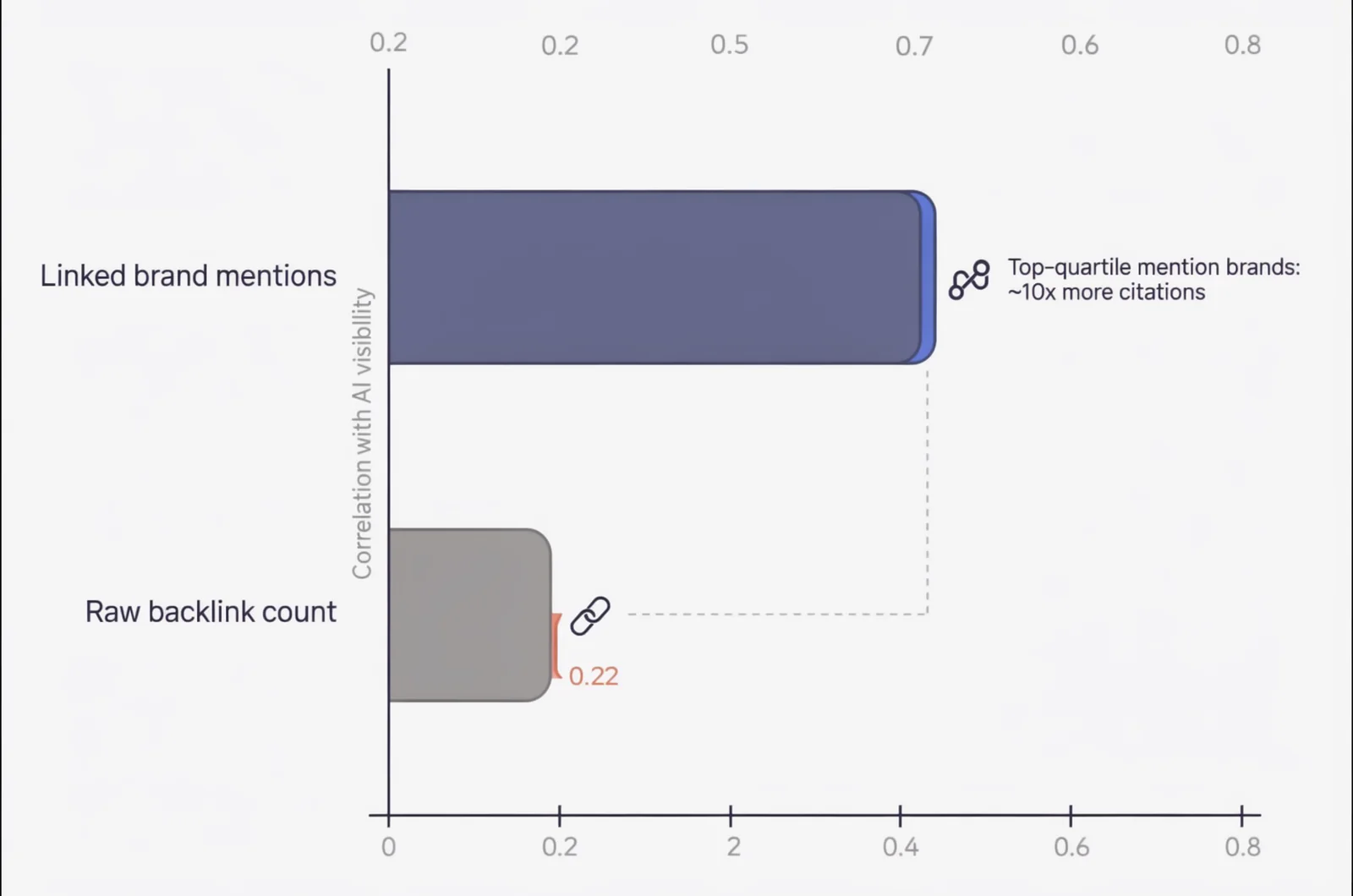
Linked brand mentions correlate with AI visibility at 0.6 to 0.7, against 0.22 for raw backlink count, per Optimization Theory's 2026 ranking signals report. Brands in the top quartile by mention volume receive on the order of 10x more citations than the rest of the field. If an agency's plan is link building without a mention-earning component, the plan is aimed at the wrong signal.
AI Overviews now appear in 25.8% of US searches as of January 2026, up from 6.49% in January 2025 — a near fourfold increase in twelve months, per the SEO Industry Intelligence Report 2026. Any agency you hire should show how it measures presence in that surface, not just rankings below it.
Client demand has already shifted. AEO and SEO for AI-driven search engines jumped to the top of the list of services clients are asking agencies to add in 2026, edging out performance-based paid ads and short-form video, according to AgencyAnalytics' 2026 benchmarks report. You are not early to this request. You are on time.
One more signal worth weighing: 54.8% of agencies integrate GEO into existing SEO retainers, while only 27.1% offer it as a standalone paid service, per Digital Agency Network data cited in the same industry report. Most of your shortlist will propose AI search as an add-on. Ask what changes in the deliverable when it is an add-on versus the core engagement.
For the underlying mechanics, Google Search Central documentation on crawling, indexing, and content quality remains the baseline that retrieval systems inherit. An agency that cannot explain how its AI search work connects to crawlable, well-structured pages is skipping a layer.
A tool to run before you take the calls
Before shortlisting, run a manual AI visibility audit on yourself. It takes about an hour and it changes the questions you ask.
Open four AI assistants. Ask each one the commercial prompt your buyers would use — "best [your category] for [your use case]" — and record whether you appear, who appears instead, and what claims the answer makes about each vendor. Repeat with two comparison prompts and one problem-aware prompt. Log the results in a spreadsheet with the date, the assistant, the prompt, and the exact answer text.
You now have a baseline. When an agency claims it can improve AI visibility, you have a number to hold it against, and you can tell within a quarter whether the work is moving anything. This is also the fastest way to spot which competitors are already being recommended and what sources the AI systems cite for them.
Questions worth asking before you sign
How do you measure AI visibility, and what does the report look like? The answer should name specific AI systems, specific prompt sets, and a cadence. "We track it" is not an answer. "We query ChatGPT, Perplexity, Gemini, and AI Overviews weekly against 40 commercial prompts and report recommendation share by competitor" is.
Who writes the content, and how much is AI-generated? This is a legitimate operational question, not a gotcha. What matters is the review layer: who checks factual claims, who owns brand voice, and what the QA process catches before publishing. Ask to see the workflow, not just the policy.
What happens to our content if we leave? You should own the drafts, the research, and the publishing pipeline. Confirm this in writing. Agencies that hold content in proprietary systems create switching costs that have nothing to do with performance.
Which of your clients are in our category, and can we speak to one? Category experience is the strongest predictor of ramp time. If the agency has never worked in your vertical, budget three to six months of learning that you are paying for.
What is your position on the September 2026 core update? The update reportedly cross-references entity completeness, internal link cohesion, and answer-depth signals, per Affiliate Times' analysis. An agency with a current view on it is paying attention. An agency that has not heard of it is not.
Matching the agency to your situation
The right pick depends less on which agency is strongest in the abstract and more on which constraint you are trying to remove.
If you have content and authority but no measurement of AI answer presence, start with Ellipsis. If your site needs architectural work before AI visibility is realistic, SCALZ.AI's combined scope fits. If you are a B2B SaaS company that wants a specialist who already knows the funnel, Nine Peaks Media is the conversation. If you have a working SEO program and want AI search added without changing agencies, Outerbox is the continuity play. If your revenue is European, Found covers the market and language layer. If your buyers shortlist through AI assistants, XQL Group's commercial-prompt focus is worth testing. If you are enterprise with a large legacy content estate, Revv Growth's architecture and digital PR combination addresses the retrieval problem directly.
And if the honest answer is that you need throughput more than strategy, price the production work separately before you sign a retainer that bundles it. The agencies above are worth their rates for architecture, measurement, and authority building. Article volume is a different purchase.
References
- Ellipsis® the world's best AI — Ellipsis® • the world's best AI SEO agency ... Ellipsis is the AI SEO agency that turns content into AI recommendations -- and recommendations into leads. Strategy and
- scalz Scalz.Ai — SCALZ.AI | AI SEO, AEO & GEO Agency ... SCALZ.AI is an AI SEO, AEO and GEO agency that gets your business ranked in Google, cited in ChatGPT, found in Perplexity, and surfaced in