
The Real Name for SEO in AI Search Is Not What Most Teams Think
Marketing teams use three competing terms for AI search optimization. Learn which one matches your actual workflow and why the distinction changes your strategy.

Your team probably can’t agree on what to call the practice of optimizing content for AI-generated search results. Some call it GEO — generative engine optimization. Others insist on AEO — answer engine optimization. The rest just say “AI SEO.” If you’ve asked anyone what this SEO for AI is called, you’ve probably gotten three different answers. That confusion isn’t just awkward in meetings. It shows up in tool budgets that don’t match, conflicting KPIs, and content that tries to serve too many surfaces at once and ends up weak on all of them.
The three labels aren’t synonyms, and they aren’t a meaningless vocabulary fight. Each term implies a different primary surface, a different measurement model, and a slightly different set of tactics. Until a team aligns on one name — and backs it with a consistent workflow — the optimization effort fragments.
This article walks you through what each term actually describes, gives you a straightforward decision framework for picking the right one for your organization, and provides a set of tactics to act on once you decide. By the last section, you’ll have a short checklist you can act on this week.
Why the Naming Fight Has a Real Cost
A content agency I consulted with last March had adopted “AI SEO” as its internal label. The team bought a tool that excelled at traditional organic keyword tracking and automated on-page suggestions geared toward blue‑link rankings. Meanwhile, their primary account wanted to improve visibility inside ChatGPT and Perplexity. The tool couldn’t measure citation rates, and the agency’s content briefs still asked for “keyword density” instead of entity associations and original data. After six months, the client moved to a competitor that specialized in GEO. The agency had done good work, but it was aiming at the wrong surface because nobody had defined the discipline clearly enough.
That kind of drift is common. When a team doesn’t name the practice, they don’t name the surface they’re optimizing for, and they don’t name what success looks like. You end up with one person reporting AI Overview impressions from Google Search Console while another reports ChatGPT mention counts from a third‑party tool, and the dashboard doesn’t add up to a coherent story for leadership.
Naming the discipline doesn’t solve the optimization problem, but it is the prerequisite for picking the right stack and aligning output. A GEO vs SEO distinction that sounds academic on first read becomes an operational decision about where your content budget flows.
The Three Terms, Decoded by Behavior
Search practitioners have settled into three big categories, though the boundaries are soft. Here’s what each one means in practice, backed by how the major platforms describe their own features.
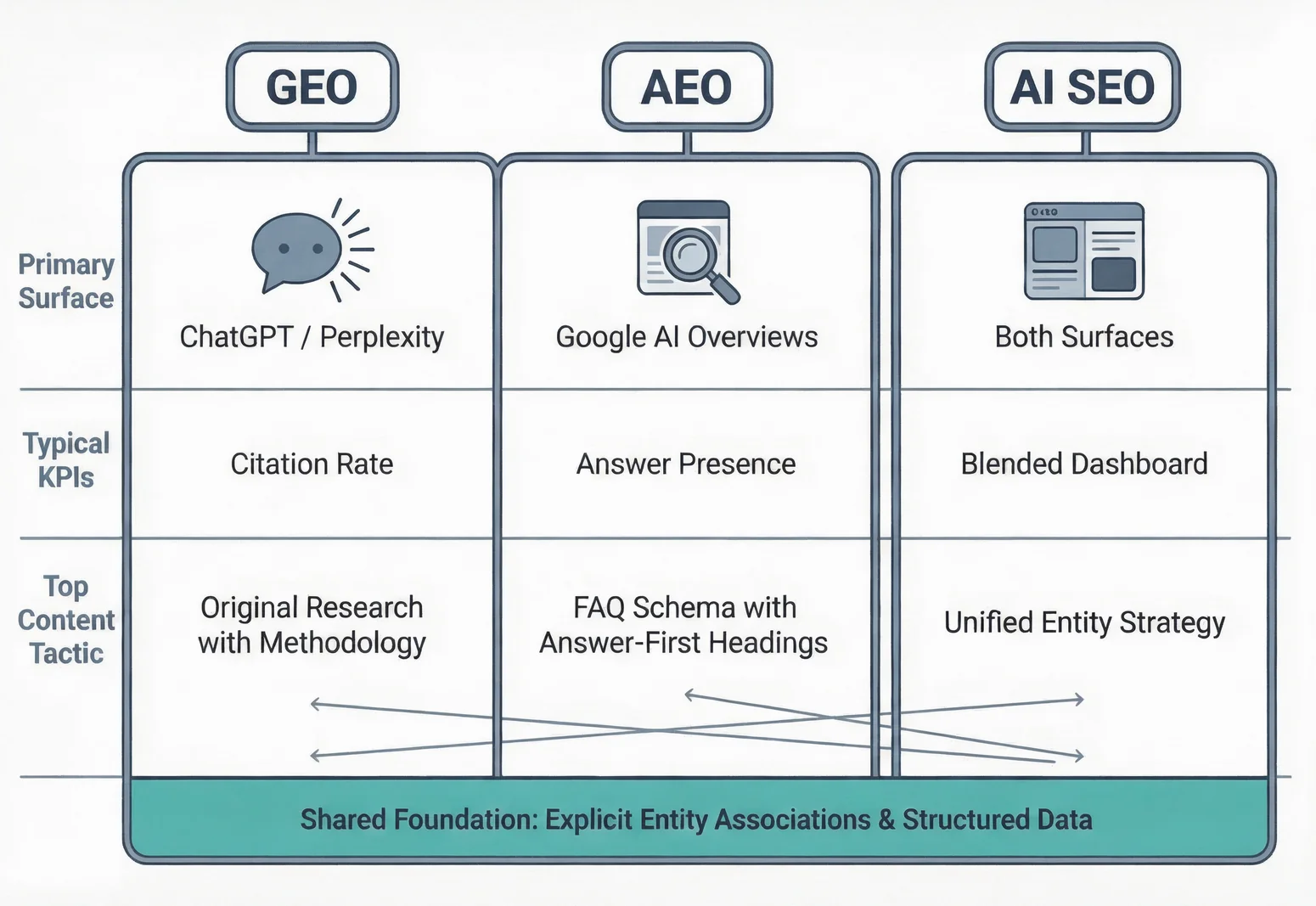
| Term | Full Name | Primary Concern | Typical Surfaces | Core Framework |
|---|---|---|---|---|
| GEO | Generative Engine Optimization | Earning citations and top‑mention positions in LLM‑generated answers | ChatGPT, Perplexity, Gemini, Claude | Entity‑first content, original data, citation authoritativeness |
| AEO | Answer Engine Optimization | Appearing inside factual, direct‑answer features on search engines | Google AI Overviews, Bing Copilot, Siri Assistant voice answers | Q&A content structure, FAQ/HowTo schema, brand authority signals |
| AI SEO | AI Search Optimization (umbrella term) | Covering both classic rankings and AI‑powered features | All of the above, plus traditional organic SERPs | Merges traditional SEO with entity and answer optimization |
GEO draws its language from the “generative” side — the LLMs that synthesize answers from multiple sources. As the Semrush guide puts it, “AI search optimization is also known as generative engine optimization (GEO) or SEO for AI search,” and the goal is “getting cited more often and positioned higher in AI‑generated responses rather than ranking well in organic search engine results” (How to optimize for AI). A team that adopts GEO as its label is typically measuring citation rate, source ranking within answers, and visibility inside standalone LLM tools.
AEO focuses on search engines that produce a single factual answer at the top of a results page or via voice. Google’s official documentation explains that features like AI Overviews “surface relevant links to help people find the information they’re looking for quickly and reliably,” and that “the best practices for SEO continue to be relevant” (AI Features and Your Website). Teams that prefer AEO often track AI Overview impressions, answer‑box placements, and visibility in voice‑assistant pull‑ins.
AI SEO works as a catch‑all but suffers from ambiguity. It gets used to mean everything from “traditional SEO for AI‑generated content sites” to “optimizing for all AI surfaces.” A 2026 benchmark from SEOScaleUp frames search as happening on five parallel surfaces: traditional Google blue links, AI Overviews, standalone chatbots, voice assistants, and search‑integrated agents. Under a broad AI SEO umbrella, a team typically commits to an entity‑wide content strategy while maintaining classic technical SEO.
Google itself has been blunt about the overlap. Its AI Optimization Guide, published May 15, 2026, states that “AEO and GEO are not separate disciplines. Strong technical SEO plus expert, original content works for both.” The distinction many practitioners still make is organizational, not technical: it tells the team which measurement surface to prioritize first and which metrics to put in the C‑suite report.
A Decision Framework for Teams
The right term for your team depends on where most of your audience discovery happens and what you’re able to measure every week. Use these three questions.
What surface generates the most un‑branded traffic that converts? Look at your referral logs for ChatGPT, Perplexity, and Google’s AI features. If the bulk of non‑branded discovery comes from LLM‑generated answers and the clicks are attributable (often tagged with
utm_source=chatgptor similar), lean toward GEO. If AI Overviews and featured snippets dominate, lean toward AEO. If both matter and your team needs to cover everything for a large site, AI SEO might be the honest label.Can your team instrument and report on that surface consistently? GEO demands third‑party citation monitoring. AEO has a direct measurement path through Google Search Console’s AI report, announced at I/O 2026. AI SEO, as a combined framework, requires both. If you can’t instrument the surface yet, pick the term that matches what you can measure and add the other later.
What language will leadership support? If your executive team still thinks in “rankings” and “organic traffic,” AI SEO is the least disruptive label to introduce while you layer in new metrics. If your leadership is already asking about ChatGPT citations, GEO gives you a precise conversation frame.
One practical way to make the call: run a 30‑day audit of your top 30 non‑branded queries across Google, ChatGPT, and Perplexity. Record where your brand appears, what format the answer takes, and whether the mention is attributed. The pattern usually makes the decision obvious. We’ve seen companies that thought they needed a full GEO strategy realize that 80% of their AI-answer appearances came through AI Overviews, making AEO the higher‑impact starting investment.
Tactics That Shift with the Label
Once your team picks a term, the content and technical work can get more specific. Below are the 3‑4 highest‑leverage moves for each label, drawn from current platform documentation and agency practice.
If you commit to GEO
- Publish original research with clear methodologies. LLMs reward unique, attributable data points. A study with a published methodology and a clean summary table gets cited more often than a curated list of others’ stats.
- Build entity associations explicitly. Use schema markup that connects your organization, people, and content topics to well‑known knowledge bases. Maintain a keywords to entities workflow that maps every piece of content to the entities it supports.
- Structure content for extractability. Front‑load the main claim in the first paragraph, follow with evidence, and avoid burying the key takeaway behind narrative. LLMs compress paragraphs into a single answer — make sure the compression still carries your core point.
- Earn citations from authoritative external sites. Digital PR that generates mentions on news, research, and .edu domains strengthens the training‑set signals LLMs use to decide what to cite. This is the GEO parallel to link building, but the metric is attribution, not PageRank.
If you commit to AEO
- Add FAQ and HowTo schema to question‑oriented content. The structured data for AI visibility approach works because Google explicitly states that AI features use the same ranking systems as core Search. Schema helps those systems identify your content as a candidate for a direct answer.
- Use H2 and H3 headings that state the answer, not just the topic. A heading like “How much does a 5‑second page load cost in conversions?” is stronger than “Page Load Impact” because the model can extract a ready‑made answer.
- Demonstrate E‑E‑A‑T signals across the open web. Author bios, third‑party interviews, and credible citations build the “trust” layer that AI Overviews reference when picking sources. A team that leans toward AEO should track brand mentions and expert‑attributed coverage as core output.
- Monitor impressions and click data through Google Search Console’s AI report. The report, added in 2026, splits AI Overview and AI Mode appearances from traditional results, so you can see whether your optimization is landing where you think it is.
If you commit to AI SEO as an umbrella
- Run a unified entity strategy across all content. Every article should have a clear primary entity, related entities, and cross‑links that match the knowledge graph your site is building over time. A semantic SEO for AI search approach applies regardless of surface.
- Track both traditional organic KPIs and AI citation appearances in the same dashboard. If you can’t see them together, your optimization decisions will treat them as competing when they often reinforce each other.
- Use a content generation system that produces site‑aware, entity‑linked drafts. For teams with high output targets, a platform that ingests your existing site structure and generates articles with the right entity links saves manual auditing. It also keeps the team aligned on the same framework even as the surface list grows.
- Refresh legacy content for AI surface compatibility. Older posts built for keyword rankings often lack the clear Q&A structure, schema, or original data that AI features pull from. A refresh old posts for AI search cadence turns those assets into usable fuel.
The Mistakes That Survive a Label Change
Choosing a label doesn’t fix everything, especially if the team’s habits don’t shift with the name. Here are four patterns that show up even after the naming decision is settled, and what to do about each.
Treating AI‑surface KPIs like traditional organic KPIs. If a piece of content appears in an AI Overview but the user gets the answer without clicking, the content has still done its job for that surface. Reporting a click‑through rate of 0% to leadership without context inflames a metric that doesn’t map. Instead, track presence — how often your content is the cited source — and pair it with downstream metrics like branded search lift or direct traffic following a mention.
Picking a tool stack from the label name alone. Several tools now market themselves as “GEO platforms” or “AEO tools,” but the functional difference is often smaller than the marketing. Audit any new tool against the specific reporting and content‑structuring needs that came out of your decision framework; don’t let the packaging make the call.
Measuring different surfaces in different systems with no synthesis. When the content team tracks GPT‑4 citation volume and the SEO manager tracks Google AI Overview impressions but nobody stitches the two together, leadership sees two incomplete stories. Assign one person — even as a rotating role — to own the weekly synthesis.
Ignoring Google’s converging guidance. The official line that AEO and GEO aren’t separate disciplines is a signal that investment in foundational SEO is not wasted even if the label skews toward one surface. A team that abandons crawl‑budget management, page speed, or internal linking because it now calls itself a GEO team is creating future breakage.
What to Execute This Week
Once the label is decided — or even while you’re still debating — a handful of actions push the work forward without waiting for full org alignment.
- Search your top 20 non‑branded queries on Google, ChatGPT, and Perplexity. Screenshot the results. Note which surface already includes your brand and which doesn’t. This small audit usually surfaces the highest‑impact next investment.
- Write down a one‑sentence definition of what your team’s chosen term means inside your organization. Circulate it with a simple table that maps the term → the surface you optimize for → the metric you report to leadership. That doc alone cuts months of misalignment.
- Update your content brief template. Add a field for “primary surface” and require, for GEO‑targeted pieces, a unique data point with source; for AEO‑targeted pieces, an explicit question the article answers. These small additions to the brief change what a writer produces.
- Set up your tracking baseline. In Google Search Console, look at AI feature impressions for the past three months. For LLM surfaces, use a third‑party tool that tracks citations across ChatGPT and Perplexity (tools that do this now include Previsible, Rankability, and a few others). Record the current baseline so the 30‑day experiment has a starting point.
- Pick one surface to optimize first. It’s better to get cited reliably in one AI surface than to spread efforts across three and appear nowhere. The audit from step one usually makes the priority clear.
These steps don’t require a new tool budget or an org‑chart change. They just require naming the work, picking a surface, and tracking whether it’s working.
References
- Google Search Central — Learn how to optimize your website for Google Search's generative AI features, including official best practices, technical SEO advice, and emerging AI ... # Optimizing your
Moving from naming to doing
- Semantic content briefs for AI writers
- Keyword research when search terms are fragmented
- Why specific examples help AI search
Review SiaSEO as the operating system for structured SEO content production. — Get started