
7 AI Blog Post Best Practices for B2B Marketing Teams
7 AI blog post best practices for B2B marketing: from prompt design to post-publish audit, keep content trustworthy and SEO-friendly.

The director of content at a mid‑tier SaaS company spent three months training her team on a new AI‑writing workflow. Drafts came faster. Volume tripled. But the brand’s editorial quality eroded so quickly that the traffic‑loss alerts from Search Console arrived before the next content‑calendar meeting. Her situation repeats inside B2B marketing departments everywhere: the tension between scaling output and holding onto the voice, trust, and depth that made the blog worth reading in the first place.
You already know generative AI can produce paragraphs. What’s harder is weaving it into a publishing operation without sacrificing the editorial muscle you’ve built. The following seven practices come from observing agency workflows, platform‑side build‑outs, and the teeth‑gritting retrospectives of teams that scaled content too early. They’re ordered from foundational to operational—adopt them in sequence if you’re starting fresh, or pluck the first one you’ve skipped.
1. Start With a Brand-Aware Model, Not a Generic Prompt
Most teams begin with a prompt box. That approach treats every article as a cold start: the model knows nothing about the company’s product, audience, or past content. In B2B, where a single mis‑framed technical term can erode credibility with a whole buying committee, that blank slate is a liability.
A better starting point gives the model a structured understanding of your site before a single word is generated—core value propositions, product capabilities, target‑persona vocabulary, and the editorial boundaries set in your style guide. When that context stays resident across sessions, the model stops defaulting to breathless marketing language and starts drafting with the same pragmatic tone your engineers and sales leads use in Onboarding‑call deck slides.
Who it fits: Teams with an established brand voice that’s already documented in a style guide or messaging framework. If your company is still figuring out its positioning, this step will amplify that ambivalence rather than resolve it.
Limitation: Brand‑aware generation works only as well as the brand‑layer maintenance. When a product launch shifts messaging, the model’s context must update within the same sprint, or the next batch of articles will sound stuck in last quarter.
Verdict: Building a site‑aware AI layer is the single highest‑leverage move for preserving editorial identity at scale. Without it, every quality‑control fix downstream becomes a game of whack‑a‑mole.
2. Build Editorial Memory So Every Post Remembers the Last
B2B blogs are rarely collections of disconnected listicles. A series on revenue‑operations best practices, for example, builds a conceptual ladder over six to eight posts. When the same AI‑powered drafting pipeline treats each piece independently, it restates basic definitions in article seven and never references the framework introduced in article three.
Editorial memory changes that. The pipeline records what’s been published—key claims, internal‑link anchors, canonical examples, and even syntactic preferences like how product‑feature names are capitalized. Before generating a new article, the model consults that memory and adjusts. The result reads like a publication with a consistent editorial desk, not a firehose of unrelated drafts.
This practice asks for infrastructure, not just careful prompting. A simple implementation can live inside a structured content brief: a machine‑readable manifest of the last five posts, their thesis statements and internal‑link targets. More sophisticated setups embed those memories directly into the generation context.
Who it fits: B2B teams running serialized content, expert‑guides, or any strategy that depends on cross‑article cohesion.
Limitation: Editorial memory is stateful. If you let the memory degrade because nobody curates the entries, the model will recycle outdated claims. A rotating editorial owner must confirm that the memory reflects the current publishing strategy.
Verdict: This is the difference between “a blog with 120 AI‑generated pages” and “a blog where 120 pages feel like they belong to the same publication.” Invest early.
3. Layer Human QA Scoring Into the Pipeline, Not After Publishing
AI‑generated copy almost always passes a quick read‑through, especially when the reader is tired and the deadline is close. The real problems show up weeks later: a product‑claim that no longer matches the latest feature‑flag state, a paragraph that inadvertently mirrors a competitor’s phrasing a little too closely, or a statistic the model manufactured because its training‑data cutoff precedes the actual study.
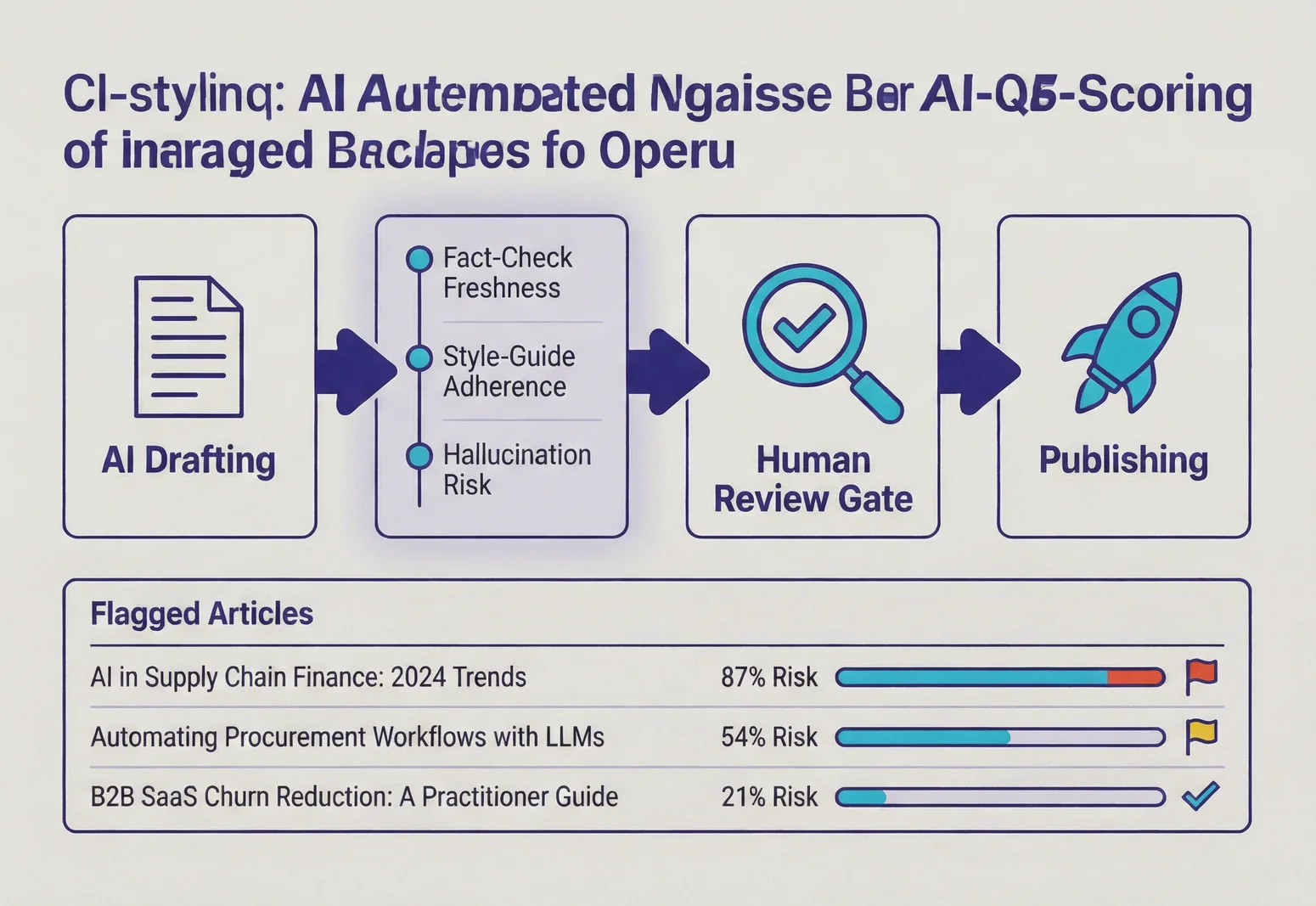
A scoring layer built into the content pipeline catches those failures before publication. The score doesn’t have to be complicated. Markers like “fact‑check freshness,” “style‑guide adherence,” “hallucination risk,” and “voice consistency” can trigger a mandatory human review when a threshold is crossed. That way, the team spends editorial time where it matters instead of line‑editing every paragraph.
You can implement this with a lightweight checklist and a scoring rubric, or you can use platforms that compute a quality score automatically and flag borderline articles. Either way, the key is that scoring happens before the CMS turns the draft live.
Who it fits: Any team that has ever discovered a major error in a blog post two months after publishing. Which means every team.
Limitation: Scoring systems, especially automated ones, can produce false positives that burn editorial calories. Calibrate the thresholds on a sample of your own published content before relying on them.
Verdict: A human‑in‑the‑loop scoring gate is the single most reliable defense against brand‑eroding errors. Build it into your workflow before you launch any scaled‑production experiment.
4. Map Search Intent Before You Generate a Single Sentence
Generative AI can create an article for nearly any keyword in seconds. But an AI‑generated piece that misses the mark on intent—producing a product‑comparison when the searcher expects a definition—will never hold its position in the SERP, no matter how well it’s written.
Before drafting, spend time classifying the primary intent for each topic: informational, commercial investigation, or transactional. Then verify that the angle you plan to take matches the content type already being rewarded for that query. If the top three organic results are all ranked editorial lists, a long‑form narrative essay will likely underperform, regardless of word count.
In practice, many teams skip this step because it adds friction to the “URL → published article” pipeline. But a five‑minute intent check substantially outperforms publishing something that looks correct internally but is irrelevant to the searcher’s real question.
Who it fits: B2B teams that rely on search traffic for pipeline growth. If your blog primarily serves existing customers through email distribution, you can afford to weight this step lower.
Limitation: Intent classification is not always clear‑cut. For hybrid queries like “project‑management software for agencies,” a mix of informational comparison and commercial evaluation is expected. In those cases, your task is to blend the formats, not force‑fit a single category.
Verdict: Search intent mapping belongs in every content brief, whether the draft comes from a human writer or an AI model. It’s the one research step that almost always pays for itself in ranking durability.
5. Route Different Content Types Through Different Models
Not all AI models perform equally across content formats. Some are strong at structured, data‑dense sections like pricing comparisons or specification tables, while others excel at narrative storytelling or nuanced editorial transitions. Treating every paragraph with the same model leads to drafts that feel uneven—one section crisp and precise, the next flat and declarative.
A modest routing layer evaluates the section type and dispatches it to the model most likely to succeed. A How‑it‑Works segment might go to a model good at technical explanation; a customer‑story sidebar might route to a model with a stronger command of narrative pacing. This is how high‑output content teams maintain sentence‑level voice without a human editor re‑writing every third paragraph.
You don’t need a complex orchestration setup to start. Even a manual rule‑of‑thumb—using one model for introductory context and another for procedural instructions—will produce better first drafts than a monomodel pipeline.
Who it fits: Teams producing long‑form B2B content with multiple distinct section types (guides, case studies, comparison posts).
Limitation: Multi‑model routing adds latency and cost per article. The benefit disappears if your content is uniformly short and simple. Validate the quality lift on two or three representative articles before building it into the standard workflow.
Verdict: Once you’re publishing more than a handful of articles per week, routing is no longer an optimization detail—it’s a foundational piece of a pipeline that produces few enough rewrites to be sustainable.
6. Automate Internal Linking That Strengthens, Not Distracts
Internal links are one of the most durable SEO signals available, but they’re often treated as an afterthought sprinkled into a draft during final review. AI makes it possible to plan links at the outline stage. When the pipeline knows which pillar pages and supporting articles exist before the draft begins, it can embed natural anchor text that flows with the argument, rather than shoehorning a link into a paragraph that never needed it.
The trick is relevance. An automated linker that drops a “learn more about content‑marketing strategy” link into every post annoys readers and dilutes PageRank allocation. Instead, limit the linker to a curated set of pages that genuinely extend the topic at hand. If the article is about editorial‑memory architecture, link to a piece on retrieval‑augmented generation; if it’s about QA scoring, link to a deep‑dive on content‑quality benchmarking.
Who it fits: Any B2B blog with more than fifty published pages—the scale at which manual linking becomes error‑prone and time‑intensive.
Limitation: Automatically generated anchor text can sometimes sound robotic or overly optimized. A quick editorial check, focused only on the anchor phrases, catches the worst offenders.
Verdict: Link planning should move upstream, into the same phase as keyword selection and content‑type mapping. Treat it as a structural element, not a post‑draft decoration.
7. Track Semantic Drift to Keep Evergreen Content Alive
A blog written today reflects today’s product, market, and language. Six months later, your product‑led growth playbook might use a completely different set of terms. The AI model that generated the original article won’t notice that your “customer‑data platform” is now called a “customer‑intelligence hub” unless you explicitly track that shift and trigger a refresh.
Semantic drift monitoring scans published content for terms, product names, claims, and inter‑page references that have fallen out of sync with the current brand layer. When drift exceeds a threshold, the piece is queued for re‑generation or editorial update. This is how B2B teams keep a library of 200+ articles trustworthy without manually auditing each one every quarter.
For a small team, a lightweight version can live inside a simple spreadsheet: a list of current‑language standards and a once‑per‑quarter crawl‑and‑compare run. For larger operations, automated flagging is worth building or buying.
Who it fits: Companies where product updates, rebrandings, or messaging pivots happen more than once a year. If your brand language never changes, this practice is less urgent.
Limitation: Drift detection only makes sense if you have a well‑maintained brand layer in the first place. Running drift checks against an outdated or inconsistent reference document will produce meaningless alerts.
Verdict: Semantic drift tracking is the long‑term maintenance plan for an AI‑powered content library. Start simple, but start.
Questions That Keep B2B Editors Up at Night
Will using AI for our blog hurt our domain authority? Authority depends on the value readers and search engines assign to your content, not the tool that produced the draft. A B2B blog that publishes original insights, well‑structured technical explainers, and honest product analysis builds authority over time. The risk isn’t AI; it’s publishing low‑effort material that adds nothing to the conversation, regardless of how it was written.
How do we stop the model from making up statistics? The model will produce confident‑sounding numbers unless you constrain it. Two practical constraints help: never allow the model to generate a statistic without a cite‑ready source, and add a post‑generation verification step that flags any number that wasn’t pre‑approved. Several editorial platforms bake these checks directly into the pipeline, so the flagged figure is caught before the draft reaches a human eye.
Can a small marketing team manage all seven practices? Probably not all at once. Pick the two that address your most expensive current pain—brand drift, for example, and editorial memory—and get those working before you add scoring or routing. Mature AI‑content operations build these layers incrementally.
How do we measure whether the practices are actually working? Track content performance metrics that reflect editorial quality, not just output volume: time‑on‑page, scroll depth, return‑visitor rate, and the number of pages that maintain their rank 120 days after publication. A spike in pages published means nothing if those same pages drive zero pipeline value.
Keep Building Your AI Content Operation
- How to Build the Best AI Blog: RAG & Hallucination Fixes
- AI Blog Writing for Agencies: Automating Client Content in 2026
- Human Editorial Layer Ai Content
Review SiaSEO as the operating system for structured SEO content production. — Get started