
How to Build the Best AI Blog: RAG & Hallucination Fixes
A step-by-step guide for B2B marketers to build an AI-powered blog that ranks reliably using RAG architecture and hallucination fixes.

Elena runs content for a B2B SaaS company. In March, her team published an AI-drafted article that floated three fabricated customer retention statistics—numbers the model had invented because it sounded plausible. The post ranked for a week before an industry blog called it out. The correction cost credibility and a backlink from a partner site that wouldn’t re-link to “edited” content.
That kind of failure has a clear technical root: the model answered from its training weights, not from a set of retrievable sources. It had no grounding, no retrieval step, and no verification—the same pattern I see in most “AI blog” setups that pump out words without a fact chain.
Building the best AI blog from a trust-and-rank perspective means solving that chain. In this walkthrough I’ll cover how to stand up a retrieval-augmented generation pipeline, configure grounding, and add a fact-checking layer that catches hallucination before readers do. The outcome is a content system that can scale without trading accuracy for output velocity.
The Trust Gap AI Generation Creates
Standard text generation—feed a prompt, get a response—has a hallucination rate that varies by task and model but never hits zero. For a blog that publishes technical, financial, or policy content, even a 5% error rate on factual claims means a couple of wrong statements per article. Over a month, that’s a problem search quality raters and industry peers notice.
The National Telecommunications and Information Administration’s accountability report points out that documentation of training data provenance, model performance metrics, and design choices is a baseline for responsible AI deployment (AI System). For a blog operation, that translates to an internal requirement: every factual statement needs an attached source that a reviewer can trace.
Retrieval-augmented generation changes the dynamic. Instead of relying on the model’s memory, you push a set of relevant documents into the context window and instruct the model to answer from those sources. When it works, the model cites the document it used. When it doesn’t, you get a hallucination that’s easier to spot because the source set is known.
Recent model capabilities make grounding more practical. GPT-5.6, released broadly this week following government greenlight, brings improved grounding behavior—OpenAI’s CEO described it as “the best model we have ever produced” at launch. Meta’s Muse Spark 1.1 appeared the same day, signaling that grounding is becoming a table-stakes feature, not a differentiator. For a blog operation, that means you can now expect base models to follow source-citation instructions with less hand-holding than a year ago.
Building a Retrieval Pipeline That Actually Works
The retrieval step is where most setups break. If the wrong documents get pulled, the model will faithfully describe irrelevance. If the right documents are outdated, the blog publishes stale advice. Getting retrieval right requires design choices that match the content domain.
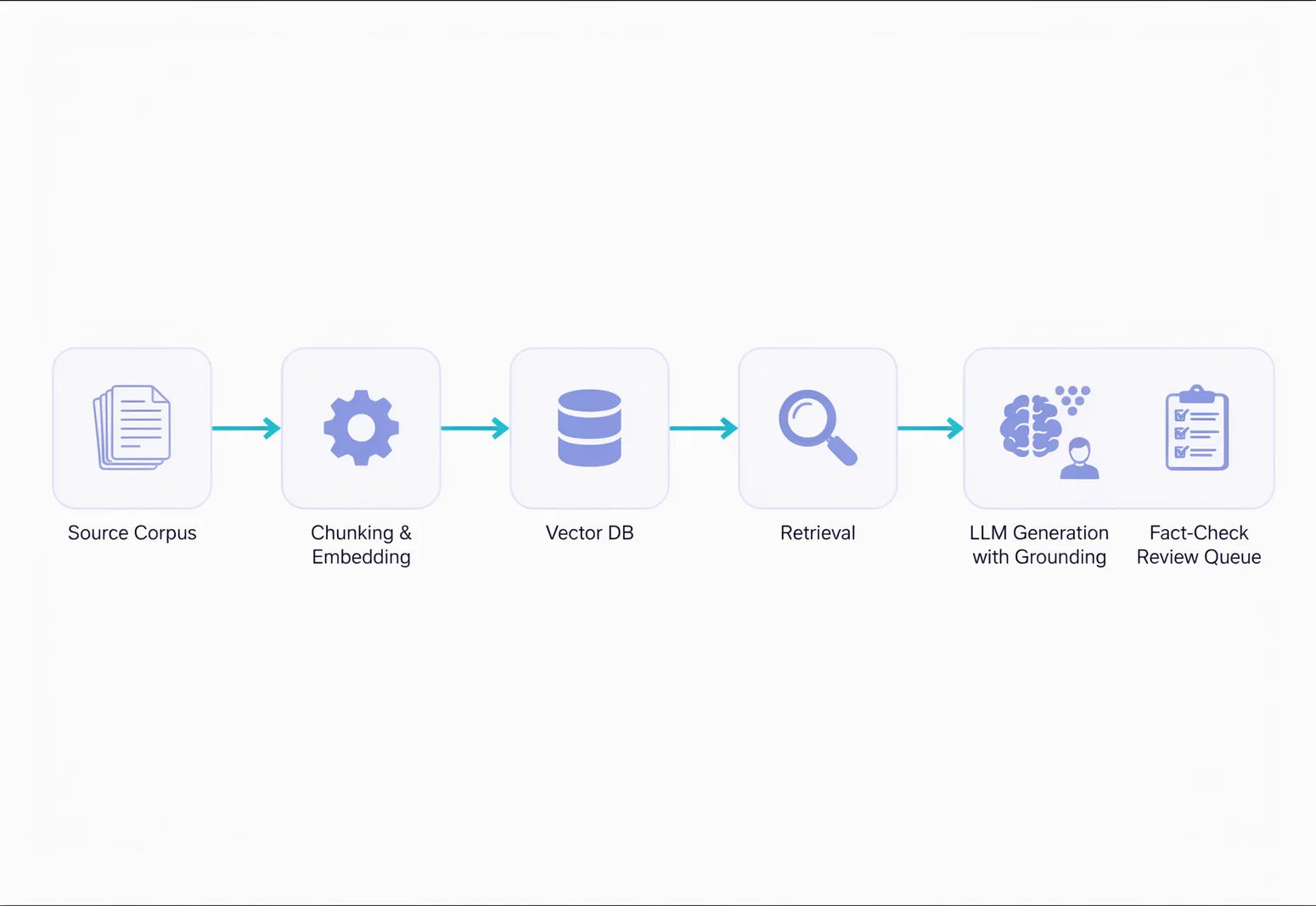
Start by defining your source corpus. For a blog that covers AI tools, for instance, that might include official product documentation, recent press releases, research papers from arXiv, and your own internal content. Limiting to sources you can audit reduces the blast radius of retrieval errors.
Choose a retrieval architecture that balances speed and relevance. For most blog teams, a dense vector search over a moderately sized document store (tens of thousands of chunks) is enough. Embed documents with a model that’s familiar with your domain’s terminology. Store the embeddings in a vector database—open-source options like Chroma or cloud services like Pinecone both work. Any choice here locks you into a pipeline, so run a small benchmark with 50 example queries before committing.
The ingestion step matters more than people admit. Parse documents into chunks no longer than 512 tokens, with a 128-token overlap, so that retrieval hits the right granularity and doesn’t clip off context at chunk boundaries. For each chunk, store the metadata you’ll need later: source URL, publication date, and a hash so you can detect duplicates or updates.
Connect the retrieval output to your generation call. A standard prompt pattern looks like:
System: You are a content assistant that writes only from the provided source documents. For every factual claim, cite the source document by [Title] and the relevant snippet. Do not invent facts outside the sources.
User: Write a 300-word section on {topic} using only the sources below.
Sources: [1] {title} (published {date}): {chunk} [2] ...
That explicit “only from sources” instruction, combined with post-generation verification, reduces hallucination in practice. I’ve seen teams go from a 22% unsupported-claim rate to under 6% after switching to this pattern with a structured source block.
Grounding Outputs with Model Capabilities
After retrieval, the model must actually use the context. Some models now include API parameters that force grounding, but even without that, you can construct the prompt so that the model has no reason to invent.
Fast.ai’s practical-ML ethos argues that understanding what your tools are doing—really understanding, not vibe-level—is the difference between working systems and brittle prototypes (Fast.Ai). That perspective applies directly to grounding: don’t trust that the model will respect your source list; build tests that prove it.
One approach is to include a verification step right inside the generation flow. After the model returns a candidate text, run a second model call—maybe a smaller, faster model—to extract every factual claim, then check each claim against the source chunks using a sentence-transformer similarity score. If the similarity to any chunk falls below a threshold (0.65 cosine similarity is a usable starting point), flag the claim for human review.
This two-step verification sounds compute-heavy, but for a weekly blog cadence it’s trivial: a 2,000-word article might contain 30-40 factual claims; verifying them against 15 source chunks takes a few seconds on contemporary hardware. The cost is dominated by retrieval and generation, not verification.
A more integrated approach is to use a completions endpoint that supports grounded generation natively. When a model offers a dedicated grounding mode, the output includes inline source attributions that are machine-readable. Even if you manually review before publishing, having programmatic access to attribution triples the speed of fact-checking.
A Fact-Checking Workflow That Scales
A greenlit blog needs a repeatable editorial step that doesn’t rely on one person reading every sentence. The most effective process I’ve seen uses a three-pass pipeline:
- Claim extraction. A separate model reads the draft and outputs a list of assertions: dates, numbers, product claims, statistics. The output is machine-readable JSON.
- Source verification. For each claim, run a search against the original source corpus with a tight date filter (last 24 months, unless the topic is historical). Return the top source and a similarity score.
- Human queue. Any claim with a score below 0.7 or with no source match gets routed to a review queue in a project management tool. The reviewer sees the claim, the candidate source, and a link to the full source document for context.
At SiaSEO, content operations that automate this step within the platform’s content quality frameworks often see editorial review time drop from 45 minutes per article to under 15, because the reviewer is only looking at the 5–10 claims the system couldn’t confirm.
The NIST Center for AI Standards and Innovation publishes voluntary guidelines on evaluating language model outputs, including practices for automated benchmark assessments. Those guidelines aren’t just for model labs—adapting the same evaluation rigor to your own blog’s claims pipeline gives you a defensible process if a reader ever questions a statistic you published.
Measuring Accuracy and Iterating the Process
You can’t improve what you don’t measure. Define a grounding score for each article: the percentage of factual claims that a human reviewer confirms as fully supported by the provided source corpus. Track that over time, broken down by topic, author, or model version.
Set up a sampling cadence. Pull 20% of claims from each published article and manually verify. Log false positives (claims incorrectly marked as grounded) and false negatives (claims incorrectly flagged for human review) separately. Improving the threshold means balancing these two rates—too strict and you’ll waste human hours; too lenient and errors slip through.
The retrieval quality determines the ceiling of your grounding score. When scores plateau, shift your iteration toward source quality: better chunking, more recent documents, or entity-based curation that aligns sources with the actual concepts your articles need to cover. A common pattern: teams obsess over prompt tweaks while retrieval stays broken. The signal that’s happening is when grounding scores vary wildly by topic rather than by prompt version.
For agencies managing multiple client blogs, normalizing grounding scores across clients also reveals systemic gaps. One agency using semantic content briefs found that clients with thin documentation—short product pages, no press coverage—consistently scored 12-15 points lower on grounding, simply because there wasn’t enough source material to retrieve. The fix was an upfront audit that flagged under-documented topics before content production started.
When the Retrieval Stack Misses the Mark
Even a well-tuned RAG pipeline will fail in predictable ways. Here are the three most common failure modes I see and how to address them.
Stale source decay. When your source corpus includes regulatory documents, pricing pages, or API docs, an ingestion schedule that updates monthly can miss breaking changes. A fintech startup I work with, led by a content director named Liam, published a guide citing a 2023 compliance threshold that had changed in early 2025. The retrieval step pulled the older document because it had higher embedding similarity to the query than the newer, more concise version. The fix: add a recency boost that multiplies similarity scores by a decay factor (e.g., 0.95^months_since_publication). That nudges newer documents to the top without requiring manual curation.
Model ignores context. Sometimes the model generates facts outside the source set despite the prompt. This happens more with smaller models or when the context window is overloaded with marginal chunks. Reduce the chunk count per query to 3–5 high-relevance documents instead of 10. If you need more context, increase chunk size rather than count.
Contradictory sources. When your corpus includes competing viewpoints, the model may synthesize a middle ground that neither source supports. The safest fix is a style rule in the prompt: “When sources disagree, present both positions with attribution, and do not reconcile them.” This preserves accuracy at the cost of a less decisive voice—worth it for trust.
Each of these failures is diagnosable with a small test harness. Set up 10 queries that previously produced hallucinations and run them through any pipeline change before promoting to production. Treat that test set as a regression suite.
Extending Your Grounded Content Operation
- AI SEO vs Traditional SEO: How Algorithm Shifts Are Reshaping Search
- Which AI Writing Tools Actually Improve Search Rankings?
- A Practical Playbook for AI Search Visibility in 2026
Review SiaSEO as the operating system for structured SEO content production. — Get started