9 Article Templates for Search Intent, Ranked by Real Fit
Nine article templates matched to informational, commercial, comparison, and transactional intent, scored on fit, effort, and ranking potential.

Most content calendars fail at the brief stage, not the writing stage. A writer gets a keyword, guesses at a structure, and produces a page that answers a question nobody asked in a format Google never rewards. This roundup of 9 article templates for search intent exists to close that gap: each template below is matched to the intent it serves, the SERP format it mirrors, and the amount of human editing it realistically needs before publication. The ranking reflects fit and effort, drawn from current SERP analysis and 2026 research on how both Google and AI answer engines cite content formats.
The reader this serves is a content operations lead, agency operator, or marketing director choosing a structure before assigning a draft. If you already know the four classic intent types, skip ahead; the value here is in the template-by-template scoring.
How these nine templates were selected and scored
The selection criteria came before the list. Each template had to clear three bars:
- A documented SERP format. The structure mirrors something Google already ranks or AI engines already cite, not a theoretical ideal.
- A distinct intent match. Each template owns a recognizable slice of informational, commercial investigation, transactional, or navigational demand. Overlapping structures were merged.
- Operational repeatability. A brief, a writer, or an AI drafting system can produce the format consistently across dozens of keywords without reinventing the outline.
Each entry is scored on three attributes: intent fit (how tightly the format maps to one intent), SERP evidence (how visible the format is in current results), and editing load (how much human judgment the draft needs after generation). Editing load matters more than most teams admit. Research on intent-formatted content briefs, including the content brief template from Scaledon, shows that structure decisions made before drafting cut revision cycles substantially, because the writer is no longer reverse-engineering the SERP mid-draft.
One 2026 data point shaped the whole ranking: Wix Studio's AI Search Lab analyzed over a million citations across ChatGPT, AI Mode, and Perplexity, and found intent to be the strongest predictor of which format gets cited. Listicles drew 21.9% of citations overall, but jumped to 40.86% for commercial intent queries. Format follows intent, and the nine templates below are ordered accordingly.
1. The direct-answer definition page
Best for: informational "what is" queries, glossary builds, top-of-funnel entity coverage.
SERP signal: featured snippets, AI Overviews, People Also Ask boxes.
Editing load: low. The structure is mechanical once the answer is right.
This template opens with a two-sentence answer in the first paragraph, follows with a definitional expansion, then covers mechanism, examples, and edge cases as H2s. It wins because both Google and AI engines extract the opening chunk. A 2026 test cited by Moonrank found 43% of queries across four industries triggered AI Overviews, with informational intent the dominant driver. That makes the direct-answer format the highest-leverage template in the set for pure informational demand.
Limitation: it earns little commercial value on its own. Use it to build topical authority and internal-link surface area, not to convert.
Verdict: the default for any keyword starting with "what is," "meaning of," or "definition."
2. The step-by-step how-to guide
Best for: informational task queries ("how to write a content brief," "how to audit internal links").
SERP signal: HowTo rich results, numbered-list snippets, video carousels.
Editing load: medium. Steps must be genuinely sequential and tested, which is where generic drafts fail.
The structure: a prerequisite block, numbered steps with one action each, a troubleshooting or variation section, and a time estimate near the top. The how-to earns its high rank because task queries carry strong engagement signals, and the format transfers directly into AI citation when steps are extractable. KeywordInsights' position-one result for content-brief queries is a how-to, which tells you what Google believes that searcher wants.
Limitation: it decays. Any how-to that references tool interfaces or platform versions needs a visible date and a review cadence.
Verdict: the workhorse of informational intent, but only when the writer has actually performed the task or is working from a source who has.
3. The curated listicle
Best for: commercial investigation and broad informational queries ("best," "top," "tools for").
SERP signal: the dominant organic format for commercial intent; 40.86% of AI citations for commercial queries in the Wix Studio dataset.
Editing load: high. Every entry needs a real reason to exist.
A listicle without selection criteria is a link dump, and readers and rankers both treat it that way. The template that works states inclusion logic up front, gives each entry a consistent review card (best for, standout trait, limitation, verdict), and closes with circumstance-based guidance rather than a single "winner." This article uses that skeleton, which is not a coincidence.
Limitation: the format invites thin stitching of other people's summaries. Editing load is high precisely because the draft must add original judgment per entry.
Verdict: the highest commercial-yield template, and the one most often published badly. Budget real editing time.
4. The X-vs-Y comparison
Best for: commercial investigation at the decision point ("Surfer vs Clearscope," "agency vs in-house").
SERP signal: comparison pages and "vs" modifiers in commercial SERPs; table-rich results.
Editing load: medium-high. Accuracy on features and pricing is non-negotiable and time-sensitive.
The structure: who each option fits, a criteria table comparing at least three attributes, scenario-based verdicts, and a visible "last checked" date for any price or capability claim. Comparisons rank because they match the exact moment a searcher is choosing, and they convert better than any other informational-adjacent format. The search intent guides published in 2026 consistently map comparison structures to commercial investigation intent for this reason.
Limitation: it demands current evidence. A comparison with stale pricing loses trust faster than no comparison at all.
Verdict: mandatory for any market with named competitors, including your own category.
5. The single-product review
Best for: commercial investigation with navigational overlap ("[product] review 2026").
SERP signal: review rich results, star ratings where schema applies.
Editing load: high. The format lives or dies on firsthand evidence.
A credible review template requires a testing or usage section, pros and cons tied to specific scenarios, pricing context, and an explicit statement of who should skip the product. Without usage evidence, the page reads as affiliate filler, and post-2024 ranking systems have been visibly harsh on that pattern.
Limitation: you can only write as many real reviews as products your team has genuinely used. Scale comes slowly.
Verdict: high trust value per page, low throughput. Reserve it for products central to your audience's decisions.
6. The question-and-answer page
Best for: conversational informational queries and AI answer engines.
SERP signal: People Also Ask expansion, FAQ rich results (where still shown), AI Overview extraction.
Editing load: low-medium. The research is in the question sourcing, not the prose.
The working 2026 version of this template uses question-shaped H2s, each opening with a direct answer of 40 to 90 words, followed by supporting detail. AEO-focused template research from ranki.io describes a six-part skeleton: question H1, two-line summary, short-version block, definitional intro, six to eight question H2s with direct answers, and a closing FAQ block with matching schema. The format is built for extraction, which is exactly why it punches above its weight in AI citations.
Limitation: shallow versions of this template answer everything at the surface and satisfy nothing. Each answer still needs depth below the extractable chunk.
Verdict: the fastest template to produce well, and the best fit for AI-search visibility goals.
7. The curated roundup
Best for: resource-selection decisions ("templates for," "examples of," "checklists for").
SERP signal: mixed organic results where the reader wants a vetted set, not a single answer.
Editing load: medium. Curation judgment is the whole product.
The roundup differs from the listicle in one way that matters: the unit of value is the resource or pattern, not a product. The template requires transparent inclusion criteria, a consistent annotation per entry, and an honest note about what was considered and omitted. The content brief workflow guides from CodexSEO treat this format as the standard vehicle for "best resource" intent because the reader's task is picking one item from a trusted set.
Limitation: it needs real curation. Nine entries copied from page one of Google is detectable and worthless.
Verdict: the right call whenever the reader's job is selection among resources, methods, or examples.
8. The deep-dive explainer
Best for: complex informational topics where the searcher wants mechanism, not a quick answer.
SERP signal: long-form organic results, "guide" modifiers, strong dwell-time queries.
Editing load: high. This is the most skill-dependent template in the set.
The structure: intuition first, mechanism second, limitations third, practical application last. It mirrors the research-blog register that earns citations in technical niches, and it builds the topical depth that supports every other template on this list through internal links. Deep-dives also age better than any other format, because mechanism changes slower than interfaces.
Limitation: low velocity. A good deep-dive takes days of expert time, and a bad one is obvious within two paragraphs.
Verdict: the authority anchor of a content cluster. Publish fewer of these and invest more per page.
9. The transactional landing hybrid
Best for: transactional and high-commercial queries where the searcher is ready to act.
SERP signal: product and pricing pages dominating the SERP, local packs, ads.
Editing load: medium. The risk is tonal, not structural.
This template blends a decision-support block (comparison rows, proof points, an honest objection section) with a single clear action. It ranks ninth here only because it serves the narrowest slice of queries, not because it matters least. When the SERP shows product pages at every position, no article template will displace them, and forcing one wastes a brief.
Limitation: it belongs to the product and marketing team more than the content team, which creates ownership friction in most organizations.
Verdict: use it when the SERP itself tells you articles have lost. Read the results before assigning the template.
Matching template to intent without guesswork
The operational rule across all nine entries: read the SERP before choosing the structure. The formats already ranking for a query are Google's stated belief about what the searcher wants, and the brief-building guidance from LaunchScaler puts intent and answer-shape fields ahead of everything else in the brief for the same reason. A word count target, by contrast, should never drive template choice.
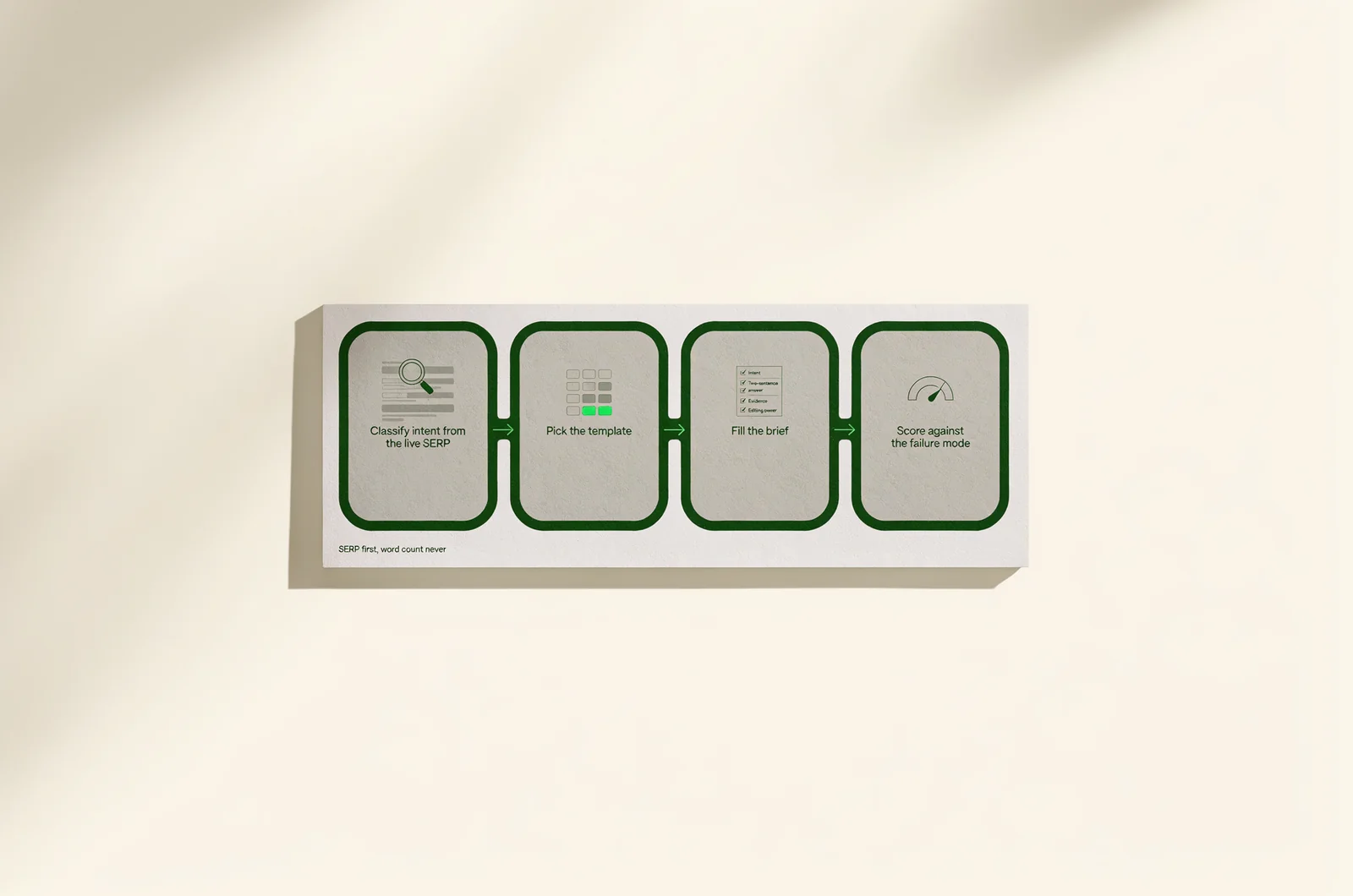
A practical workflow for teams producing at volume:
- Classify the query by intent using the live SERP, not a keyword tool's label.
- Pick the template from the table below.
- Fill a brief that names the intent, the two-sentence answer, the required evidence, and the editing owner before any drafting starts.
- Score the draft against the template's known failure mode (thin listicle entries, stale comparison pricing, unsourced review claims).
| Intent | Primary template | Backup | Main failure mode |
|---|---|---|---|
| Informational (learn) | Direct-answer definition | Q&A page | Burying the answer |
| Informational (do) | How-to guide | Deep-dive | Untested steps |
| Commercial investigation | Listicle or comparison | Review | No selection criteria |
| Transactional | Landing hybrid | Comparison | Article forced into a product SERP |
Teams running AI-assisted production can encode this mapping directly. SiaSEO, for instance, applies site-aware drafting with quality scoring so the template decision happens at the calendar stage rather than in a writer's head, which is where most intent mismatches originate. Whether you automate the step or run it manually, the decision has to happen before the draft, and the long-tail queries your competitors ignore often map cleanly to one template, as covered in our piece on long-tail keyword strategy.
If your team handles this selection weekly, a simple interactive selector — intent in, recommended template and brief fields out — is a worthwhile internal tool build. It removes the one judgment call that causes the most rework.
Questions teams ask about intent-matched templates
Can one page serve two intents? Yes, when the SERP itself is mixed. A comparison page with a transactional block serves commercial investigation and transactional intent together. If the SERP shows a clean split, publish two pages instead of diluting one.
How often should templates be reviewed? Quarterly for any format with time-sensitive claims (comparisons, reviews, how-tos referencing tools). Deep-dives and definitions can run on a six-to-twelve-month cadence.
Does AI-generated drafting change which template to pick? No. It changes the editing load column. Direct-answer and Q&A formats survive generation with light edits; reviews, comparisons, and deep-dives need heavy human passes regardless of the drafting system.
What about AI answer engines — do they prefer different templates? The 2026 citation data says the same intent-format mapping holds, with an extra premium on extractable answers. Q&A and listicle formats gain the most; nothing loses.