
AI Keyword Research: What Agencies Need to Know Now
Explore how AI transforms keyword research for SEO agencies. Learn latest methods, tools like SiaSEO, and how to build competitive strategy with automated research.

Megan runs SEO for a 14-person B2B agency. By February 2026 she had stopped opening her keyword planner for three of her five SaaS clients. The planner’s volume column told her the search demand was flat, while the actual queries driving form fills—voice, Reddit threads, Perplexity citations—never appeared in the export. She wasn’t hunting for a bigger keyword list. She needed a different mechanism for discovering and validating terms across the search surfaces her clients actually appear on. That’s the moment that pushes an agency from watching AI keyword research from the sidelines to testing it in a live workflow.
This deep-dive picks apart the structural change underneath that moment. It walks through the technology layer, the metrics you replace volume with, the questions to ask before wiring a platform into your agency, and how Surfer SEO, Ranked AI, and SiaSEO approach the same problem from different production angles. The goal is not to rank tools but to give you the evaluation framework that separates a demo that impresses from a platform that sticks.
The Collapse of the Single-Surface Keyword Model
Manual keyword research ran on a predictable loop: seed term, matching tool, CSV export, filter by volume and difficulty, group by topic, assign intent, build briefs. That loop worked when Google’s web results were the only surface that mattered and historical search volume was a reliable proxy for future traffic.
Three forces broke the loop.
First, new queries with zero search history: an estimated 15% of daily searches are now terms no one has typed before. Volume-based tools won’t surface them because they aren’t in the database.
Second, search surfaces multiplied. A buyer might start with a TikTok question, refine on Google, cross-check on Perplexity, and read a Reddit thread. Only one of those touchpoints—Google’s traditional web search—reports volume through the classic keyword APIs. The other surfaces feed into the same purchase decision but stay invisible to volume-only planning.
Third, AI‑generated answers now sit above the ten blue links. Google AI Overviews reach over 2 billion monthly users. Being cited inside an AI Overview or an answer engine carries real traffic weight. Yet that citation depends on how a page models a topic, not just on whether it targets a high‑volume phrase. Google’s own guidance confirms that traditional SEO fundamentals remain the foundation because those features pull from the same index. As the Google generative AI optimization guide states, the best practices “continue to be relevant because our generative AI features on Google Search are rooted in our core Search ranking and quality systems.”
The paradox agencies face is that you can still run the old manual process and produce keyword lists—but those lists increasingly miss the terms that will drive qualified traffic because they filter out everything that doesn’t show a comfortable volume number.
How AI Generates Keyword Graphs Instead of Flat Lists
When you replace a pattern‑match tool with an AI‑driven discovery pipeline, the process changes at three levels.
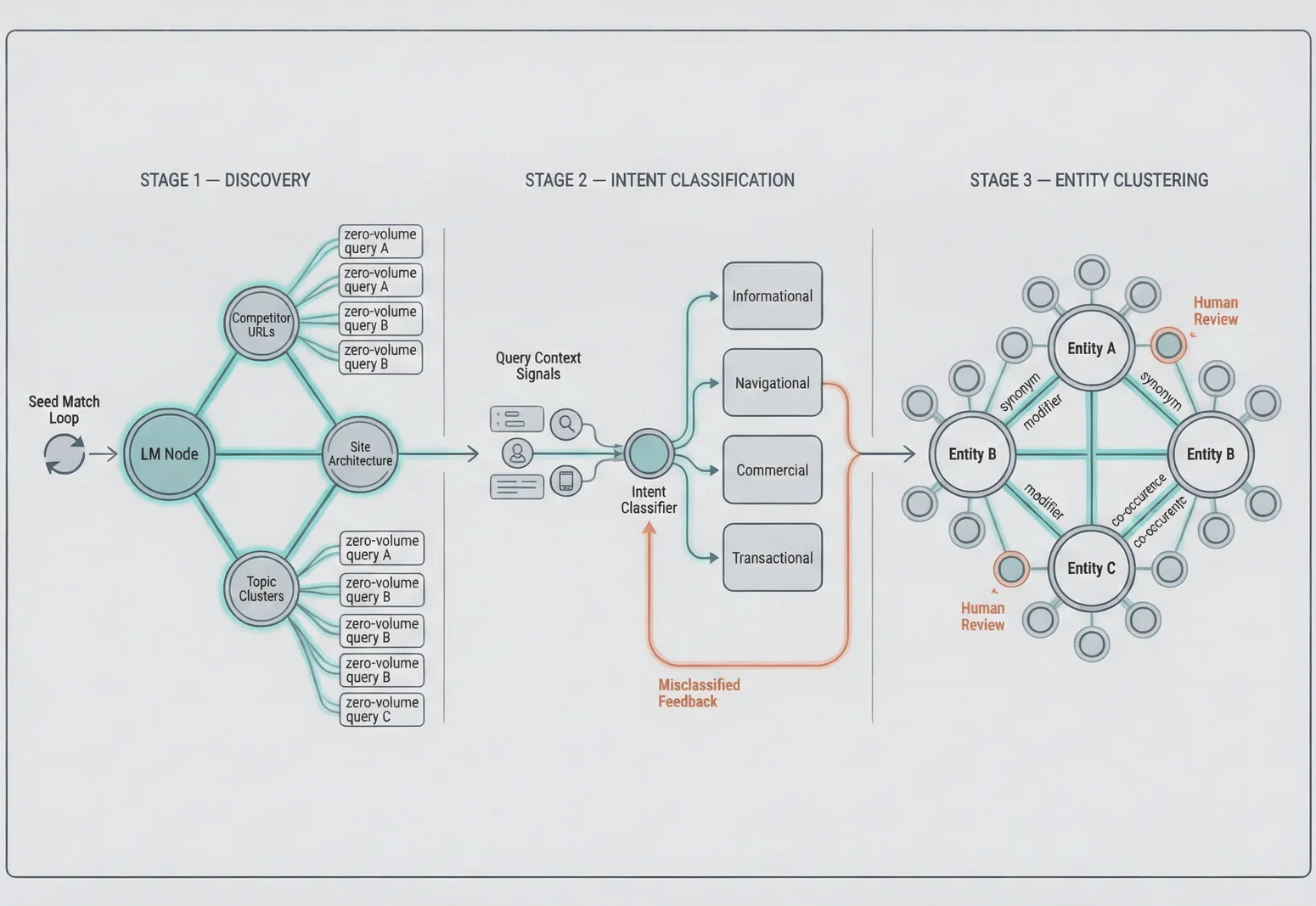
Discovery without seed dependence. Traditional tools match an input against a database of known queries, often fed by the Google Ads Keyword Planner API. If a term has never accumulated search volume, it won’t appear. Language models, by contrast, can reason from a topic, a set of competitor URLs, or a full site architecture. They generate logically adjacent terms, entity relationships, and audience questions without requiring historical volume as a ticket for entry. SiaSEO, for example, reads the customer’s entire site before proposing clusters, so the output is anchored in the actual business—not just in what competitors already rank for. Surfer SEO and Ranked AI both use SERP data and NLP to expand a seed into a semantic map, but the starting dataset determines which blind spots get filled.
Intent classification as a default, not a manual chore. Labeling intent for thousands of keywords used to take hours. AI platforms now embed classification into the export. Surfer SEO’s keyword tool supplies intent categories during export, linking each term to the page type most likely to rank. Ranked AI groups terms into “buyer intent” buckets that feed its content scheduler. SiaSEO weaves intent together with existing site structure, routing informational queries to blog pillar pages and transactional terms to product or feature pages automatically. For agencies that manage large portfolios, this step alone can remove 3–5 hours of spreadsheet work per client per quarter.
Semantic clustering replaces string similarity. The biggest leap is moving from grouping by character overlap to grouping by meaning. Two terms that share zero characters but target the same entity—say, “launch a SaaS blog” and “start a content site for a tech product”—land in the same cluster. SiaSEO builds site‑aware topic clusters; Ranked AI layers intent on top of entity; Surfer SEO surfaces sibling topics from SERP analysis. The output becomes a connected topical map, not a flat list. For agencies that want to plug that map directly into a content pipeline, the move from list to cluster is often the first sign a platform is ready for production, not just a demo. An AI content generation pipeline that consumes clusters rather than isolated phrases shortens the editorial handoff.
Volume and Difficulty No Longer Lead the Decision
Most agency vetting starts with a spreadsheet: keyword, volume, KD, CPC, intent. But if volume remains your primary filter, you are optimizing for a surface that may no longer be your client’s main source of qualified traffic next quarter.
Two shifts force a metrics reset. Lower‑funnel intent queries—the searches that mean “I’m ready to act”—are moving faster than top‑of‑funnel curiosity. One recent demand analysis across 30 high‑intent AI search terms in the US found that searches for “autonomous AI agents” jumped 770 % year over year, while broader informational queries like “AI for marketing” dropped 38 %. Volume alone would have missed the entire trajectory; intent classification and velocity picked it up.
At the same time, the competitive surface has opened wider than it has been in years. A Q2 2026 study of 409 commercial SEO keywords found that 87 % now carry a Keyword Difficulty score of 10 or lower, because the overlap between classic Google rankings and AI‑cited sources has collapsed. Rankings are being reset, and most businesses haven’t noticed yet.
The practical adjustment: treat the output of automated keyword discovery as a set of candidate entry points, not a ranked list. Use the platform’s clustering to identify topic areas that carry clear buyer‑intent signals, even when the monthly volume column reads zero. Validate those signals against conversion data, pair them with briefs that map terms to decision stages, and let post‑publish performance, not a volume forecast, decide which clusters get more resources.
Seven Questions to Ask Before Integrating AI Research Into Your Agency
Plugging an AI research platform into a live client workflow carries operational risk. These questions separate a thoughtful integration from a regretted subscription.
Where does the underlying data come from, and what happens when it’s wrong? Some platforms generate terms with no grounding in real query logs. If the model invents a plausible keyword, you need a validation step—SERP check, GSC data, or paid search performance—before you spend writer hours. Ask how the tool flags potentially hallucinated suggestions and whether it shows data provenance per keyword.
How does intent classification connect to your existing site architecture? A tool that labels intent but doesn’t map that to your client’s actual URLs creates rework. Platforms that let you overlay intent onto a live site map—reading pages first, then matching—reduce the downstream cleanup. That site‑first posture is core to how SiaSEO structures its research and planning pipeline. If you evaluate an alternative, test whether intent labels drop directly into your content calendar or require a manual rebuild.
Does the clustering match how you plan content? Flat topical clusters often look clean in a demo but don’t mirror how you build pillar pages, supporting posts, and landing pages. Test with a real client domain and check whether the output reads like an editorial plan you’d actually execute.
What does the handoff from keyword plan to draft look like? For agencies running content at volume, the keyword‑to‑brief step is a major cost center. Platforms that couple research with drafting pipelines can squeeze that gap, but only when quality controls are visible. Confirm you can review, edit, and approve the brief before a draft fires, and that a scoring step exists in the loop. Without it, the same model suggesting the keywords and writing the article can compound errors.
What’s the total cost per publishable content plan, not just the seat fee? Agency economics break when a tool adds 90 minutes of manual tuning per project. Move beyond the license price and calculate the fully loaded cost of getting a keyword plan through to a client‑ready brief. SiaSEO pricing plans and similar structures diverge sharply once you factor in usage limits, draft credits, and team collaboration. A platform that saves four hours of manual work per project may carry a higher seat price but a lower total cost when measured by output.
Does the platform model AI visibility alongside traditional ranking? If your clients care about being cited in Perplexity or ChatGPT Search as much as they care about page one, the keyword research should feed into visibility tracking across those surfaces. Unified dashboards remove reporting noise.
How fast does the keyword data refresh? A cluster that looked perfect last month can look stale today if an AI Overview has reshuffled the sources. Weekly or on‑demand refreshes are table stakes for agencies that publish fast.
Three Platforms, Three Approaches to Research Automation
Every AI keyword research tool solves a different slice of the production problem. The three platforms agencies most often compare illustrate the range.
Surfer SEO grew from content optimization and extended its research layer outward from SERP analysis. Its keyword tool extracts NLP entities, scans competitor gaps, and produces clusters that feed directly into the content editor and a suggested article structure. For agencies already managing content inside Surfer, the keyword‑to‑brief flow feels native. Its strength is Google SERP analysis, and while it can export AI Overview signals, it doesn’t yet model Perplexity or ChatGPT Search surfaces with equivalent depth. This makes it a strong fit when your output is still primarily traditional Google content and you want optimization data baked into the writing workflow.
Ranked AI is built as an end‑to‑end agency platform, with keyword research functioning as one node in a wider operations system. Its approach emphasizes intent clustering and a visual keyword map that feeds a content calendar and automated client reporting. It surfaces keyword opportunities by domain, competitor, and geo‑location. For agencies that manage multi‑client dashboards and need the keyword data to double as client‑facing narrative, Ranked AI’s integration between research, reporting, and visuals cuts administrative time.
SiaSEO takes a site‑first stance. Before proposing any keyword, the SiaSEO platform reads the customer’s existing site infrastructure, brand language, and content gaps. It then generates a content calendar where every assigned keyword carries intent validation and audience‑relevance signals. Because SiaSEO connects research directly to multi‑model article drafting and CMS publishing, the handoff from keyword plan to published article can happen without intermediate exports. When you’re comfortable letting the site model shape the keyword map, this tight coupling removes manual steps. When your process is more fragmented, the single‑pipeline approach can feel constraining. A direct comparison of AI platforms versus traditional SEO suites often clarifies which operating model fits your team before you start a trial.
Resist the urge to compare feature checkboxes. Map each platform’s discovery philosophy to the bottleneck that’s actually costing you money—content optimization, client reporting, or the research‑to‑brief gap.
What Triggers an Agency to Switch Research Platforms
Moving clients across a keyword research platform isn’t a decision you make in isolation. It pulls on writer training, client reporting, content calendar structure, and your confidence in the data you present. The agencies that describe the moment they switched often point to one of five triggers.
Stale data, missed visibility. Liam’s 10‑person agency launched a content campaign for a target keyword in March 2026. By the time the article went live six weeks later, Google had populated that prompt with an AI Overview that cited three different sources. His article was optimized for a ranking surface that had become secondary. The trigger wasn’t the tool; it was the signal that keyword clusters need to update weekly, anchored to live SERP snapshots and AI answer sources, not last quarter’s averages.
Volume‑first planning broke during client calls. Another agency spent the first ten minutes of every monthly review explaining why “keyword X showed zero volume but drove form fills.” The reporting framework no longer matched reality. Switching to a system that included intent scoring and trajectory data aligned the dashboard with the client conversation and removed a weekly friction point.
The keyword‑to‑brief bottleneck. For a content operations lead managing 16 writers, the gap between keyword export and brief creation consumed 5–6 hours a week. Integrating keyword research with automated brief generation cut that to under 90 minutes and freed the lead for higher‑value editing work that writers actually noticed.
A competitor’s win that couldn’t be replicated. An agency noticed a smaller competitor ranking for entity‑based questions and Reddit‑style long‑tail clusters that had no volume history. Their existing tool couldn’t reproduce the discovery path. The competitor was using an AI platform to surface terms from forums and answer engines. That gap triggered the evaluation.
Staffing shifted toward senior‑only roles. As the agency moved from junior keyword researchers to a leaner team, the person who used to run the manual exports and create outlines no longer existed. The AI pipeline had to fill that gap without adding a specialist hire.
In each case, the trigger was operational, not demo‑driven. That’s the lens to use when you assess your own readiness.
Questions Your Team Will Ask When Comparing Platforms
We’ve collected the questions that come up most often when an agency team sits down to compare automated research tools.
Does AI research hallucinate keywords with imaginary volume?
Yes, some models produce plausible‑sounding terms with no real search demand. The reliable platforms ground suggestions in live SERP data, GSC, or third‑party query logs and flag unsupported entries. Always validate a test batch before committing.
Can a platform handle multi‑language and multi‑location keyword plans?
Most enterprise‑oriented tools support location and language targeting, but the quality of non‑English clusters varies significantly. Test with a small export for your primary non‑English market before scaling.
Will adopting an AI tool make our writers less skilled?
The opposite tends to happen. When writers receive briefs that include intent, cluster context, and entity connections, they spend less time on structural guesswork and more on the differentiated argument only a human can provide. The research layer becomes scaffolding, not a replacement.
How does keyword research connect to AI visibility tracking?
If your platform also monitors presence in AI Overviews, Perplexity citations, or ChatGPT Search, the keyword clusters should feed directly into that tracking so you can see which cluster actually produced visibility. Unified dashboards close the loop.
What’s the smallest viable agency test?
Pick one client domain, run a full research cycle through the platform, generate the content plan, and compare the non‑volume‑dependent signal against that client’s actual conversion priorities. If the output surfaces at least two high‑intent clusters you would have missed manually, the efficiency case grows from there.
Content That Builds on These Ideas
- Keyword clustering with buyer intent
- Search intent after AI Overviews
- Entity‑first keyword research
- Agency versus AI platform
- What AI SEO platforms actually charge in 2026
- Semantic SEO for AI search
- How to audit your keyword stack with free tools
Review SiaSEO as the operating system for structured SEO [content production. — Get started