
Best SEO Blogs 2026: Search Engine Land, Moz, Ahrefs, Semrush, Backlinko
12 SEO blogs ranked by signal quality, update speed, and practical value for B2B marketing teams building search programs in 2026.
An SEO blog list without a 2026 timestamp is already stale. Google, Bing, and AI answer engines have moved faster in the last eighteen months than in the previous five years. A publication that published a solid on-page guide in 2024 but went silent on AI Overviews, retrieval-augmented generation, or the new Search Console AI-visibility reports is not useful to a marketing director building next week’s content calendar.
We filtered every frequently cited SEO blog through three mid-2026 conditions: coverage of current algorithm shifts with recency signals, a track record of original research or data releases, and content organized around frameworks a practitioner can act on. The six publications below are ranked by how well they serve a B2B founder, agency operator, or content operations lead whose daily work is being reshaped by generative AI search.
How We Scored the Shortlist
We scored each candidate across five signals that matter to a practitioner in July 2026:
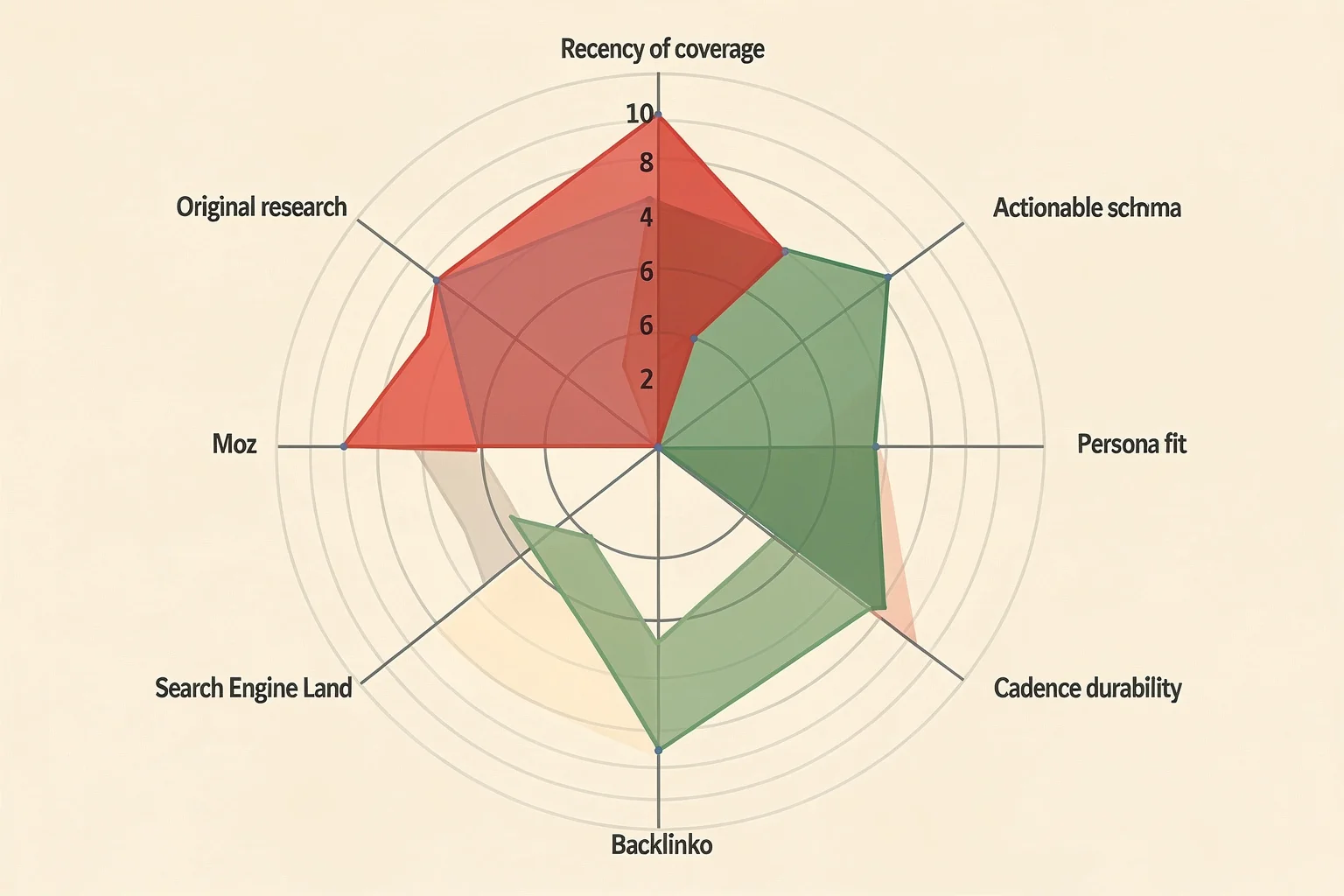
- Recency of algorithm coverage. Does the blog publish first-hand analysis within days of a confirmed Google core update or an AI search announcement?
- Original research payload. Does the publication run its own ranking-factor studies, crawler data, or large-scale tests — not just repackage third-party work?
- Actionable schema. Can a reader finish a post and immediately adjust a content brief, crawl budget, or llms.txt file?
- Persona fit. Does the editorial voice match an intermediate-to-expert B2B user, not a hobbyist?
- Cadence and signal durability. How reliably does the blog deliver the signal its audience expects?
Every entry earned its position by cumulative signal strength on these vectors, not by brand recognition. The scores reflect July 2026 and will shift the next time Google ships a core update.
1. Search Engine Land: The Newsroom That Matches the Pace of AI Search
If you keep one tab open all day, make it Search Engine Land. The editorial team covers breaking Google Search announcements, AI Mode rollouts, and PPC-SEO convergence stories faster than any other English-language SEO publication right now.
In a single July 2026 week, the site published stories on Google AI Mode ads reaching nearly 30% of queries, the rollout of Top Stories in AI Overviews, and a breakdown of the biggest technical SEO time-wasters. That cadence lets an agency operator read the morning briefing and adjust a client’s crawl settings or content template before lunch.
What makes it distinct. Search Engine Land operates as a newsroom first. Articles carry direct quotes from Google representatives, links to official documentation, and timestamped updates aligned to algorithm tracking. When you need to know whether a ranking fluctuation is a confirmed update or noise, this is the publication most likely to have a sourced answer within hours.
Best-fit reader. Marketing leads and agency operators who need a real-time signal on search engine behavior. Other SEO blogs cite it regularly — a reasonable proxy for influence.
Limitation. The daily-news format means some pieces are pure announcements without tactical depth. A founder wanting a 3,000-word framework on entity-based content modeling will get more from the research blogs lower on this list. Feed the daily scans here and use the other publications for deep tissue work.
2. Ahrefs Blog: Original Research That Turns AI Complexity into Action
Ahrefs runs its own crawler that processes billions of pages daily. That hardware investment shows up in the blog. When Ahrefs publishes a study — on traffic drop causes after an AI overview rollout, on the correlation between llms.txt presence and citation rates, or on click-through distribution across SERP features — the data comes from their own index, not a small survey panel.
In early 2026, a large-scale Ahrefs analysis showed how AI-generated summary boxes changed click patterns for informational queries, with results broken down by industry vertical and intent type. A B2B SaaS founder could read that study and decide immediately whether to prioritize FAQ schema or an expert-cited answer block.
What makes it distinct. Original research plus applied frameworks. The blog often ships a Google Sheets template, a Looker Studio connector, or a batch-report configuration alongside the study. The editorial voice assumes you understand crawl budget and PageRank sculpting and rarely wastes a paragraph on meta-introductions.
Best-fit reader. Agency operators who build content strategies from quantitative evidence, and B2B content operations leads who need primary data to defend their roadmap.
Limitation. The blog’s natural orientation is toward the Ahrefs toolset; some actionable guides require an active subscription. The publication also updates less frequently than a daily newsroom — a reader relying only on Ahrefs for algorithm update detection will be roughly 24–48 hours behind.
3. Semrush Blog: Tool-Integrated Research for Mid-Funnel Execution
Semrush occupies a position similar to Ahrefs — its blog is powered by the company’s own data — but it opens the aperture wider with vertical-specific research, paid media studies, and social media trend reports. That breadth helps an agency operator who manages cross-channel clients see how search changes bleed into display, shopping, and local.
Semrush’s 2026 output includes a recurring “State of Search” report tracking zero-click rates across devices, a study on AI Mode ad saturation by industry, and workflow templates — editorial calendar structures, keyword clustering frameworks, reporting dashboards — that are not paywalled.
What makes it distinct. The blog invests in topics that pure-SEO research blogs skip: local SEO for multi-location brands, Amazon advertising intersections, and enterprise competitive intelligence. That cross-channel perspective makes it a strong second screen for a content director justifying SEO investment alongside paid budget allocations.
Best-fit reader. Marketing directors at mid-market SaaS companies and agency account leads who need to correlate organic performance with the broader marketing mix.
Limitation. Semrush publishes multiple articles per day; not all carry original data. A reader needs to filter for the “Research” and “Studies” categories or rely on the weekly digest to avoid mid-tier listicles.
4. Moz Blog: Foundational Depth That Hasn’t Broken Under Pressure
Moz was writing about domain authority and link graphs long before today’s practitioners entered the field. In 2026, the blog still produces detailed, editor-reviewed articles that don’t chase AI hot takes. The Whiteboard Friday series delivers some of the most tightly argued 20-minute lessons in the industry — covering topics like pivot-based internal linking taxonomies or how to instrument entity-salience experiments using Search Console data.
A mid-2026 post on duplicate content and canonical signals traced the behavior through six Google patent filings, then walked through a decision tree for heavy CMS deployments. A startup CTO could read that post and configure their Next.js app router the same afternoon.
What makes it distinct. Peer-reviewed depth with legal-grade sourcing. The editorial process requires citation of official Google statements, research papers, or empirical tests. The blog rarely publishes a claim without a linked reference — a discipline that is rare in an industry where “studies show” often references a 43-respondent Twitter poll.
Best-fit reader. Technical SEO leads, in-house search engineers, and agency consultants who want primary-source backing for their recommendations.
Limitation. Moz’s publication velocity is slower than the news cycle and it is less aggressive about original data releases than Ahrefs or Semrush. For detecting an unconfirmed algorithm tremor in real time, Moz is the wrong tool.
5. Backlinko: Fewer Posts, More Signal — When the Timing Aligns
Brian Dean’s Backlinko brand now operates as a small team under Semrush, but it retains a distinct editorial metabolism. The site publishes only a few articles per quarter. Each one is long, visually dense, and structured for shareability. The best — like the 2025 skyscraper-technique update that adapted the method for AI-cited content — become reference documents that other blogs link to for years.
The constraint in 2026 is topical coverage. Backlinko’s editorial choices skew toward link-building frameworks and content upgrade techniques. Those subjects remain important, but they overlap with only about 20% of what a B2B founder needs to worry about in an AI-overview world. When Backlinko does publish a piece on generative engine optimization, the signal-to-noise ratio is high — you just can’t plan your week around it.
What makes it distinct. Structural rigor. A Backlinko article reads like a manual: problem statement, numbered method, visual example, deviation test, warnings. The team also maintains older cornerstone posts, updating them when the underlying platform changes — a maintenance habit most SEO blogs abandoned years ago.
Best-fit reader. Content marketing managers at B2B startups who want one clean template to try each quarter. Also useful for a founder who needs to understand link acquisition at a mechanical level before delegating.
Limitation. Quarterly cadence and narrow editorial scope. If your primary worry is that Google just changed how it scores page experience, Backlinko won’t be the publication that tells you first — or at all.
6. Google Search Central Blog: The Primary Source for What Matters
The Google Search Central Blog is not an SEO how-to publication. It is a changelog and policy window. Posts here announce core algorithm updates, new Search Console reports, and changes to the Search Essentials guidelines. When Google shipped the first AI-search visibility reporting in Search Console in July 2026, this blog was the only place that documented the feature’s dimensions and limitations directly from the engineering team.
Every other publication on this list reads this blog and then writes about it. Reading it directly cuts out the interpretation layer. The Google Search Central Blog is where you find official core algorithm updates and the company’s own framing of how AI overviews source and rank content. The archive also contains the SEO Starter Guide, a document quietly updated to reflect AI-search realities while staying grounded in crawlability, indexability, and page experience — the fundamentals that Google repeats are the strongest signals for appearing in AI-generated answers.
Best-fit reader. Every SEO practitioner. This is not optional. Agency leads should configure an RSS-to-Slack alert for this blog. B2B founders should at least scan the monthly summary.
Limitation. The blog does not offer tactical frameworks, tool recommendations, or industry commentary. It is a specification document, not a consultant. For the “what do I do about this?” piece, you need the analysis layer that Search Engine Land, Ahrefs, and Moz provide.
Using These Blogs as a Workflow Input
A blog list becomes a time expense if every entry gets equal attention. From observing how agency operators and in-house leads consume SEO publications in 2026, a practical rhythm has emerged:
- Daily: 15 minutes on Search Engine Land for breaking search engine behavior changes.
- Weekly: 60 minutes on the Ahrefs or Semrush blog (alternating weeks) for data-backed strategic shifts.
- Biweekly: 30 minutes on Moz or a deep Backlinko post for structural pattern updates.
- Continuous passive: RSS from Google Search Central — never miss a cycle.
This avoids the common trap of reading five summaries of the same Google tweet while missing the one original study that would actually change how you build a page.
Platforms designed to convert reading into output can shorten the distance further. When Ahrefs publishes a new framework for structuring content for AI retrieval, a site-aware content system can absorb that framework into a quality-scoring pipeline that checks every drafted article against the new standard before it reaches the CMS. That loop — read high-signal source, encode the insight into a production rule, publish scored content — turns a blog subscription into a competitive asset rather than a background hum.
Which Blogs Fit Your Search Stack in 2026
Are there other SEO blogs worth reading beyond this shortlist?
Publications like Search Engine Journal, the Onely technical blog, and Kevin Indig’s Growth memo publish strong individual articles, but they did not meet all five ranking criteria across the full 2026 evaluation period. Each can supplement a specific sub-discipline. Search Engine Journal, for instance, tends to duplicate the news beat already covered faster by Search Engine Land while offering less original data than Ahrefs or Semrush.
Why is Backlinko ranked below Moz if its posts are more actionable?
Actionability is one vector. We weighted recency of algorithm coverage and cadence higher because years with accelerated search changes punish slow publications. Backlinko’s quarterly frequency means a B2B founder relying on it alone would miss critical signals during a core update week. Moz’s broader, more frequent output and stricter sourcing gave it a higher composite score.
Do these blogs help with AI search optimization?
Yes, unevenly. Search Engine Land reports on AI search features hours after they ship. Ahrefs and Semrush publish studies measuring how AI overviews affect traffic. Google Search Central documents the official requirements. For a dedicated AI search playbook, look for resources that translate these sources into production content workflows.
More Guides for AI-Age SEO Practitioners
- Semantic SEO in 2026
- A practical playbook for AI search visibility in 2026
- AI SEO vs traditional SEO: how algorithm shifts are reshaping search
Review SiaSEO as the operating system for structured SEO content production. — Get started