
Clutch's Jun 2026 Rankings: Top 100 SEO Agencies in the US
Discover Clutch's Jun 2026 rankings of the top 100 SEO agencies in the US. Compare firms like Funnel Boost Media, Intero Digital, Ignite Visibility & more.

If you search for an SEO partner in mid‑2026, you face a marketplace where every firm’s website says the same thing about first‑page rankings — yet the skills that won traffic two years ago often look inadequate against Google’s AI Overviews and the personalization introduced in March and May’s core updates. Sifting through hundreds of providers without a common evaluation yardstick wastes discovery calls on agencies that aren’t equipped for the current search environment.
Clutch’s June 2026 rankings consolidate verified client feedback and market presence data across more than 78,000 companies, giving B2B teams a structured starting point for building a shortlist. The clutch top seo rankings 2026 snapshot, refreshed on June 22, rewards recency and accountability over legacy reputation. This article explains how Clutch calculates those scores, which capabilities separate agencies that are AI‑ready from those still running 2023 playbooks, and how to cross‑reference the directory with independent sources so your final list reflects consistency, not a single platform’s optimization. For a closer look at why well‑structured comparison page intent matters in research like this, we’ve examined the mechanics elsewhere.
How Clutch Builds Its Agency Rankings
Clutch doesn’t publish one universal score. Every directory page applies a formula tailored to its purpose, so the same agency can rank differently on the “SEO Companies” list than on a location‑specific view or a leadership matrix. The backbone is a metric called Company Ability to Deliver, which tops out at 40 points and breaks into three components: reviews, clients and experience, and market presence.
The reviews component — the most influential — weighs overall rating, recency, and verification status. Clutch’s own guidance states that “reviews are the most important factor in your Clutch rank”; verified feedback carries substantially more weight than unverified. That means an agency can protect its position only by collecting fresh, authenticated reviews on a consistent cadence.
Clients and experience draws on information found on the provider’s Clutch profile, website, and social channels: case studies, listed clients, past recognitions, and evidence of completed projects. Market presence captures a wider brand footprint — domain authority, industry awards, press mentions, and profile completeness. Together, the three components produce a score that is as much about ongoing transparency as it is about historical performance.
That weighting has a practical consequence for buyers: a newer firm with a short but recent stack of verified reviews can outrank a larger competitor that hasn’t maintained its profile. For anyone evaluating an agency in 2026, that’s a signal worth paying attention to — freshness and public feedback matter more than a decade‑old logo wall.
What Separates a Useful Agency in 2026
A star rating tells you whether past clients were happy; it doesn’t tell you whether the agency can keep you visible as search behavior migrates toward AI‑generated answers. When you allocate budget to an SEO partner, you need vetting criteria that go beyond the directory view.
AI‑readiness is now a table‑stakes filter. Agencies worth talking to treat generative‑engine optimization — ensuring your content gets cited accurately by Google’s AI Mode, ChatGPT, and Perplexity — as a core capability, not an add‑on. They can show you examples where client pages appeared in AI Overviews, explain how they structure entity‑rich content to cover multi‑step queries, and describe their citation‑monitoring workflow. It’s worth noting that many marketing teams still don’t track this dimension at all, even as it becomes a central strategic priority.
Technical depth still matters, but the checkpoints have moved. Google’s March and May 2026 core updates caused weeks of ranking turbulence; sites that held their ground typically had clean information architecture, strong Core Web Vitals, and a clearly mapped topical authority. An agency that can walk you through how it navigated those updates for another client — with actual before‑and‑after Search Console data — earns more trust than one that recites a generic framework.
Communication honesty separates partners from vendors. Promises of guaranteed first‑page rankings ignore how personalization and AI‑driven results make “rank #3” a fluid concept. A credible firm will frame the engagement around visibility share, AI‑citation rate, and qualified traffic growth, and will be transparent about ramp‑up time. For a deeper set of criteria to apply during your evaluation, we’ve written about evaluating SEO companies beyond what a directory alone can show.
Alternative Rankings Worth Cross‑Referencing
No single directory should anchor a six‑figure agency decision. Multiple independent sources publish SEO agency lists that can confirm or complement what Clutch surfaces. The three below take different methodological approaches, which helps you triangulate which firms demonstrate consistency across evaluation frameworks, not just optimization for one platform’s algorithm.
ITProfiles Top 100+ SEO Companies
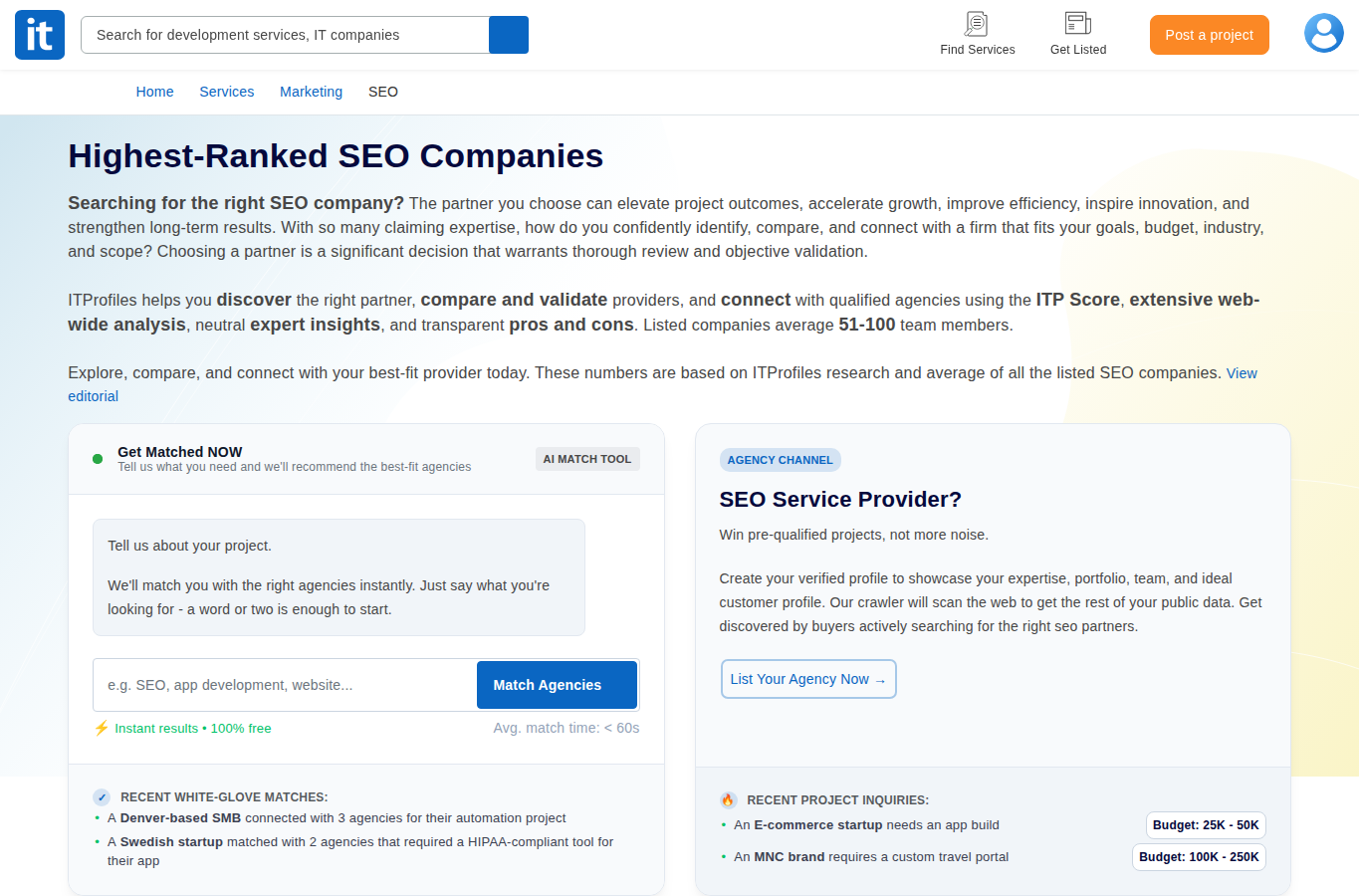
ITProfiles applies a neutral expert analysis to more than 3,700 companies, generating an ITP Score that weighs project size, client demographics, and service breadth. Because it aggregates data from multiple review sites rather than a single collection method, it can surface agencies that look strong in aggregate, not just on a single directory. The average project size among listed firms falls in the $5,000 to $10,000 range, so the list is naturally weighted toward mid‑market engagements — useful if you’re shopping in that bracket.
Outsource Accelerator’s US SEO Company List
Outsource Accelerator maintains a frequently updated ranking of US SEO firms that stretches to 50 entries, from household names like WebFX and SmartSites to boutique shops such as Victorious and OuterBox. The list draws on publicly available reviews, case studies, and industry recognition, and it includes a longer tail of smaller agencies that don’t always appear in Clutch’s most‑viewed pages. It’s a practical cross‑check if you’re open to working with a specialist team rather than a full‑service digital marketing firm.
Blackthorn Vision’s Top 10 USA SEO Companies (2026)
Blackthorn Vision takes an intentionally critical approach, evaluating more than 40 agencies and then narrowing to a final ten with honest assessments of who should not hire each firm and what clients typically complain about. That candor is rare in “top agency” roundups — and it holds particular value for B2B buyers who have been burned by a previous engagement and need a way to avoid repeating the mistake. The article also includes realistic pricing ranges for US SEO retainers, which helps anchor expectations before you reach a sales conversation.
Triangulating these three sources against the Clutch directory produces a sharper picture of which agencies perform reliably under different scoring lenses — and which ones might be scoring well only because they’ve learned to optimize for a single platform.
Using the Rankings as a Filter, Not a Leaderboard
A Clutch ranking is a starting point, not a selection. The most reliable way to use the June 2026 snapshot is to treat it as a filtering tool, not a finish line.
Begin with the platform’s own controls: set a budget range that matches the scope of work you actually need, limit the list to agencies that have completed projects in your industry, and filter by team size so you aren’t talking to a solo consultant when you need an embedded team. Then read the review text, not just the rating. Look for patterns in what clients say about communication, deadline adherence, and whether results appeared in the timeframe that was promised. Because Clutch’s methodology rewards recency, a tight cluster of recent five‑star reviews matters more than a hundred reviews from three years ago.
Once you have a shortlist of four to six names, request a call or a proposal that addresses your current visibility picture. Pay attention to whether the agency asks about your existing content and technical setup before it pitches a plan. The best partners will want to see your Google Search Console data, your CRM tagging, and your content inventory before making any commitments — and they’ll scope the work around measurable outcomes like organic‑assisted revenue or AI‑citation share, not just ranking movements.
For teams that are also evaluating whether an AI‑powered content platform can complement or partially replace an agency relationship — for instance, a system that handles site‑aware content generation and publishing at scale while tracking listicle SEO strategy for structured comparison pages — the same evaluation criteria apply: output quality, transparency, and fit with existing workflows.
Questions Worth Asking Before You Commit
The agencies on Clutch’s list are vetted, but that doesn’t mean every one fits your business. Here are a few questions that cut past boilerplate sales decks.
“Can you walk me through how you handled the March and May 2026 core updates for a client similar to us?”
A strong answer includes specific dates, what was affected, what was changed, and the measured recovery timeline. If the response is a generic statement about “best practices,” ask for a concrete example.
“How do you track AI‑citation visibility for your clients?”
The tooling for this is still maturing, but any agency serious about modern search should be able to show a dashboard or report that captures how often client pages appear in AI‑generated answers, not just traditional organic SERPs.
“What’s the smallest metric you report on that still drives real business decisions?”
This reveals whether the agency thinks in traffic volume or in revenue‑connected actions — demo requests, qualified leads, assisted conversions. The latter is more expensive to measure but far more useful.
“How long before we should expect a meaningful business result, and how do you define that?”
Listen for an honest timeframe — six to nine months is typical for a competitive market — and a measurable outcome that isn’t just “higher rankings.” Revenue‑lift attribution is hard, but a partner that won’t discuss it at all is a red flag.
“What tooling or platforms do you use for content production and quality control?”
This helps you understand whether the agency relies mostly on manual processes or has invested in systematic ways to maintain consistency as output scales. The answer also signals compatibility with any in‑house systems you already run.
These conversations reveal more about fit than any directory rank can. The best agencies welcome them; the ones that deflect or over‑promise you should remove from your list quickly.
Keep Sharpening Your Agency Evaluation
- agency vs AI platform
- AI summarizing comparisons
- refreshing comparison content
- AI platforms vs traditional
- AI visibility playbook
Review SiaSEO as the operating system for structured SEO content production. — Get started