How Generative Engine Optimization Gets Brands Into AI Search Results
Learn how generative engine optimization decides which brands appear in AI search results, and which signals actually move citations.

Something changed in how buyers find vendors, and most content teams are still optimizing for the old system. A prospect asks ChatGPT or Perplexity which tools solve their problem, reads a synthesized answer with two or three cited sources, and never touches a results page. If your brand is not one of those citations, you are invisible at the exact moment the consideration set forms. Showing up in AI search results is now a distinct discipline with its own mechanics, and the teams treating it as "SEO with a new name" are losing ground. This article maps how generative engine optimization (GEO) actually works: what the engines retrieve, why they cite some pages and ignore others, and which signals you can operationalize without rebuilding your whole content operation.
The stakes are concrete. Google AI Overviews appeared on more than 80% of tracked branded queries by late September 2026, up from about 26% at the start of that month, according to DemandSphere data reported by Search Engine Land. Branded queries were the last safe territory in search. They are not anymore.
What generative engines actually do with your content
Classic search ranks documents. Generative search reads them, extracts passages, and composes an answer from multiple sources. That difference changes everything about what "optimization" means.
The term GEO comes from a 2024 research paper by Aggarwal and colleagues, later published in the proceedings of ACM SIGKDD, which framed the problem precisely: in generative engines, visibility is not a position on a list but inclusion inside a generated response. The original GEO paper on arXiv tested content interventions across thousands of queries and found that specific changes to how a page presents information — adding citations, quotations from credible sources, and statistics — measurably improved the chance of being cited. The headline result: some interventions lifted visibility in generative responses by up to 40% on their benchmark.
The pipeline behind those responses is worth understanding, because every optimization lever hangs off one of its stages:
- Query interpretation. The engine decomposes a question into sub-questions and intents.
- Retrieval. A retrieval system (often retrieval-augmented generation over a web index) pulls candidate passages, not whole pages.
- Selection and reranking. The model scores which passages are trustworthy, relevant, and self-contained enough to quote.
- Synthesis. The answer is composed, and sources are attached as citations — or not, depending on the engine.
Your content competes at stage two and stage three. Traditional ranking factors still matter for getting retrieved at all, but they no longer decide the outcome. A page can rank fourth on Google and be the primary citation in an AI Overview, or rank first and be ignored entirely.
The citation market is small, and it is growing fast
One reason GEO feels abstract is that citation rates are still low in absolute terms. Similarweb's AI search statistics for 2026 show citations appearing in US ChatGPT prompts rose from roughly 1.6% in June 2025 to about 6.8% by May 2026. That sounds minor until you read the trend line: the rate more than quadrupled in eleven months, and the steepest jumps came after the engines expanded their browsing and retrieval features.
Meanwhile the interface itself keeps absorbing more of the SERP. Aggregated AI search and GEO statistics put AI Overview penetration at roughly 25% of all Google searches by early 2026, with informational categories far higher — around 88% for healthcare queries and 70–82% for some B2B technology queries. If you sell B2B software, your buyers' research questions sit squarely in the highest-penetration band.
There is also a behavioral shift underneath the interface numbers. HubSpot's reporting on the evolution of search notes that close to two-thirds of buyers now start research with a generative AI tool — AI Overviews, AI Mode, ChatGPT, Claude — rather than a traditional query box. The consideration set is being decided inside a synthesized answer before anyone visits a vendor site.
The practical read: citations are a scarce, compounding asset. Engines learn which sources they trust for a topic, and early citation history tends to reinforce itself. Waiting for the market to "mature" means entering it after the incumbents are entrenched.
The four signals that decide who gets cited
Cut across the research and the practitioner guides — Moz's GEO workflows overview, Semrush's practical GEO guide, and the Wikipedia entry on generative engine optimization — and the same four mechanisms keep appearing. They are not ranking factors in the classic sense. They are properties that make a passage extractable, trustworthy, and attributable.
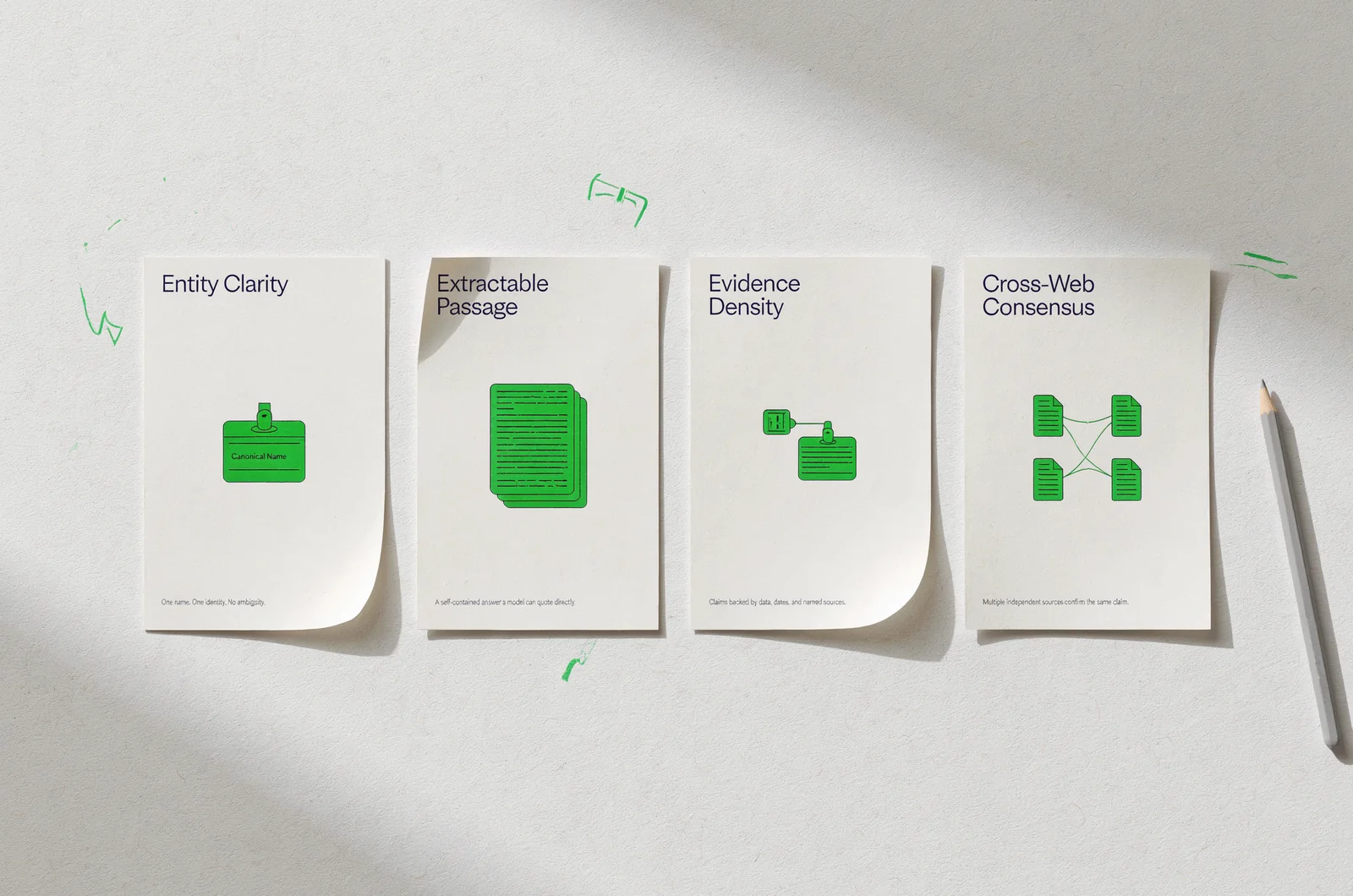
Entity clarity
A generative engine builds answers around entities: named brands, products, people, and concepts with unambiguous identities. If your site refers to your product three different ways, never states plainly what it is and who it serves, and has no consistent presence off-site, the model cannot confidently attach claims to you. Entity clarity means one canonical product name, consistent descriptions across your site and third-party profiles, and pages that state the entity relationship in plain declarative sentences near the top: what it is, who it is for, what it does.
Passage-level extractability
Retrieval systems lift passages of a few sentences, not articles. A passage gets cited when it answers a question completely on its own, without depending on surrounding context. That means writing in self-contained chunks: a clear claim, its supporting evidence, and its qualifier, all inside two to four sentences. Long throat-clearing intros, pronouns that refer back three paragraphs, and buried conclusions all fail extraction. Front-load every section.
Evidence density
The GEO paper's central empirical finding was that content containing verifiable evidence — statistics with sources, direct quotations, named references — was cited far more often than equivalent content without it. Generative engines are trained to prefer attributable claims because attribution is how they manage hallucination risk. Every quantitative claim on your pages should carry a source and, where the claim is time-sensitive, a date.
Cross-web consensus
Engines triangulate. A claim that appears only on your own domain carries less weight than one corroborated by reviews, directories, community threads, and third-party coverage. This is why brands with strong digital PR footprints dominate AI answers disproportionately: the model sees the same fact from multiple independent sources and treats it as settled. Consensus building is the slowest lever, but it is the one competitors cannot copy overnight.
Why citation sets rotate, and what stability looks like
A common frustration: a brand appears in AI answers for weeks, then vanishes without any change on their side. Daily tracking of the query "how to optimize for Google AI Overviews and AI Mode" over 30 days, published by Verticality, shows why. Google returned 29 AI Overviews across the month and cited 59 different URLs. Four guides that had been cited in 11 to 18 answers each stopped appearing at various points in late September, while three newly published pages appeared for the first time in early October. One constant: Google's own AI optimization guide held first position in 26 of 29 answers.
Two lessons sit in that data. First, freshness is a genuine reranking signal in generative systems — engines rotate sources to test new candidates, and stale pages quietly drop. Second, authoritative, comprehensive, well-structured pages can hold position through the rotation. The pages that survived were the ones that owned their topic completely rather than answering one narrow question.
This is also where operational discipline pays. Teams publishing on a fixed calendar with quality scoring catch drift early: a page losing citations usually shows declining extractability or outdated claims weeks before the drop becomes obvious. Platforms like SiaSEO exist precisely because this monitoring loop — draft, score, publish, track AI visibility, refresh — is tedious to run by hand across a hundred pages, and the cost of missing it compounds.
A working model you can apply to your own site
Theory is only useful if it changes what you publish. Here is the mechanism map compressed into an audit you can run against any existing page, in order of leverage.
The entity pass. Read only your H1, first paragraph, and product mentions. Could a model that has never seen your site state, from that text alone, what the page is about and which brand it belongs to? Rewrite until yes. Put the primary entity, audience, and outcome in the opening chunk.
The extraction pass. Take each H2 section in isolation. Does the first two sentences under it answer a real query completely? If a section only makes sense after reading the previous one, it will not be quoted. Split overloaded paragraphs; keep claims, numbers, and qualifiers together in the same breath.
The evidence pass. Count verifiable artifacts per page: named sources, dated statistics, direct quotations. The GEO research suggests this is the single highest-yield content change. Aim for evidence in every section that makes a factual claim, not one statistic per article.
The consensus pass. Search for your core claims outside your domain. If the only place on the web that says your category matters is your blog, the engine has nothing to triangulate. Prioritize the two or three claims you most want to be cited for and seed corroboration: guest analysis, community answers, review platforms, partner content.
The freshness pass. Add visible dates to time-sensitive claims and set a review cadence. As the Verticality tracking showed, citation sets turn over monthly; a page untouched for a year is a page in the rotation queue.
One tool idea that makes this repeatable: a citation-likelihood checklist scored per draft, where each of the five passes contributes points and no page ships below a threshold. SiaSEO's semantic QA scoring works on this principle, but a spreadsheet version costs nothing and will already change your output quality.
Where GEO and SEO overlap, and where they diverge
Google's own guidance on optimizing for generative AI features is instructive because it is conservative: the same fundamentals — crawlability, helpful content, clear structure — underpin both classic ranking and AI Overviews. There is no separate schema or meta tag that unlocks citations.
The divergence is in the unit of competition. SEO optimizes pages for positions; GEO optimizes passages for inclusion. Three practical consequences:
- Long, thin coverage beats short, broad coverage. A 2,500-word page that fully owns one question generates more citable passages than five shallow posts on adjacent questions.
- Boilerplate hurts twice. Generic filler text dilutes the proportion of extractable, evidence-dense passages on a page, and engines weight the page by its best passages.
- Brand search is contested ground. With AI Overviews now answering branded queries at scale, your own brand SERP is partially written by whoever the engine cites about you. Third-party reviews and comparison content about your brand are now assets you manage, not just monitor.
The teams handling this well did not abandon SEO. They kept the technical foundation and added a passage-level editorial standard on top of it.
Questions readers keep asking about AI search visibility
Does ranking first on Google still matter for AI citations? It helps with retrieval, but the citation decision happens after retrieval. Google's AI Overviews frequently cite pages outside the top three organic positions, and the Verticality 30-day tracking showed a rotating cast of 59 URLs for a single query. Ranking gets you into the candidate pool; passage quality decides the rest.
Is GEO a separate budget from SEO? Mechanically, no — the inputs overlap heavily. What changes is the editorial standard: evidence density, extractable structure, and entity consistency are content-production requirements, not new channels. Most teams fund it by redirecting part of their existing content volume toward fewer, deeper, better-sourced pages.
How do I measure whether it is working? Track a fixed panel of 20 to 50 queries your buyers actually ask, across Google AI Overviews, ChatGPT, and Perplexity, on a weekly cadence, and record whether your domain is cited and in what position. Citation share on that panel is the GEO equivalent of rank tracking. LLM visibility tracking is one of the features baked into SiaSEO for exactly this reason — manual spot checks do not scale past a handful of queries.
How long does it take to start appearing? Faster than classic SEO for new pages in low-competition topics, because engines actively test fresh sources in their citation rotation. The Verticality data showed new pages entering citation sets within weeks. Durable presence on competitive queries takes months of evidence and consensus building, same as it always did.