Finding Long Tail Keywords With AI: A Video Walkthrough
A video walkthrough of finding long tail keywords with AI research, plus the checks that keep the resulting list useful for SEO content.

If you are trying to work out how to find long tail keywords without drowning in a spreadsheet, the bottleneck is rarely generation. Tools produce thousands of phrases in seconds. The hard part is deciding which ones deserve a page, which ones duplicate a page you already have, and which ones will never convert because the searcher wants an answer, not a vendor. This walkthrough follows one explanatory video that covers the fundamentals, then extends it into the parts a five-minute clip cannot cover: intent classification, duplicate rejection, and routing surviving terms into a publishing calendar.
Video: What Are Long Tail Keywords? - YouTube
The video below is a short primer on what long tail keywords are and why they matter for smaller sites trying to rank against larger domains. It is a useful starting frame, and it is honest about the basics. What it does not do is tell you what to do when your list has 4,000 rows, when two keywords describe the same page, or when an AI Overview already answers the query before anyone clicks. Those are the decisions that determine whether the research produces traffic or just a tidy file.
What the video gets right about the long tail
The clip frames the long tail as the set of specific, multi-word queries that carry lower individual volume but higher collective intent. That framing holds up. Recent keyword research data puts long tail terms at roughly 70% of all search traffic, with about half of all queries running four words or longer. The video's core claim, that specificity beats breadth for a site without domain authority, is supported by the numbers rather than just asserted.
The second thing it gets right is the direction of the payoff. Someone searching a broad term is browsing. Someone searching a five-word phrase has usually already decided what problem they have and is looking for the specific fix. That gap in intent is why a page ranking for a 40-search-per-month phrase can outperform a page ranking for a 4,000-search-per-month phrase on conversion rate.
Where the video stops short is the assumption that finding the phrases is the task. It is not. Finding them is the first ten minutes. The remaining work is judgment, and that is where most teams lose the value they just generated.
How AI research changes the collection step
Manual collection has a familiar shape: seed term into a keyword tool, filter by volume, export, repeat. The output is a list sorted by a metric that no longer maps cleanly to opportunity. AI-assisted research changes two things about that loop.
First, it widens the input surface. Instead of one seed, you can feed a site URL, a product page, a support inbox, or a competitor's category structure and ask for the queries those assets imply. Language models aggregate patterns across forums, review platforms, and support threads that a volume database does not index well. That is why prompting an engine with "what do people in this category typically search around this problem" surfaces phrasing that Ahrefs or Semrush will show as zero volume.
Second, it changes the unit of analysis. Volume-based sorting assumes each keyword is an independent asset. AI-assisted clustering groups phrases by the underlying question, which is closer to how a search engine now evaluates a page. Twenty pages targeting twenty near-identical phrasings compete with each other and dilute topical authority. One page covering the cluster does not.
The practical setup: run your seed terms through both a volume tool and an AI engine, then merge the outputs and deduplicate by intent rather than by string match. The AI list will contain phrases with no measurable volume. Do not discard those automatically.
"Maybe for one keyword, Ahrefs and SEMrush only show 20 traffic. If there's only 20 traffic worldwide, shouldn't I just discard this word? It's the same old story."
That question, raised in a 2026 video on building content plans from low-volume terms, is the right one to sit with. Zero-volume phrases often reflect real demand that the tool has not indexed, particularly in B2B and manufacturing categories where the searcher uses internal terminology.
Reading intent before you commit a page
Every surviving keyword needs an intent label before it earns a slot in the calendar. Three buckets cover most of it.
Informational. The searcher wants an explanation. "What is a semantic keyword" belongs here. These queries are cheap to satisfy and expensive to monetize directly, but they build the topical footprint that supports commercial pages.
Commercial investigation. The searcher is comparing. "Best keyword research tool for agencies" belongs here. These convert at a higher rate and are worth a dedicated page with real comparison substance.
Transactional or task. The searcher wants to do something. "How to export keyword lists to a content calendar" belongs here. Task queries reward step-by-step structure and screenshots over prose.
The trap is mislabeling. A phrase like "long tail keyword strategy" reads informational but is often searched by someone who already knows the definition and wants a framework they can hand to a team. Check the current results page before you decide. If the top results are all definitional, write definitional. If they are all playbooks, write a playbook. The results page is the most reliable intent signal available, and it costs nothing to check.
One more consideration that did not exist a few years ago: whether the query triggers an AI-generated answer. Queries of eight or more words are seven times more likely to generate a Google AI Overview than shorter queries, per BrightEdge tracking data cited in a 2026 analysis of long tail search. AI Overviews appear in 99.2% of informational queries, according to Ahrefs research referenced in the same piece. If your target phrase sits in that territory, a page that only restates the definition will not earn the click. It needs a reason to be visited: a template, a dataset, a worked example, a tool.
Rejecting duplicates and near-duplicates
This is the step that separates a usable list from a liability. Two keywords belong on the same page when a single searcher would be satisfied by the same content. They belong on separate pages when the answers genuinely differ.
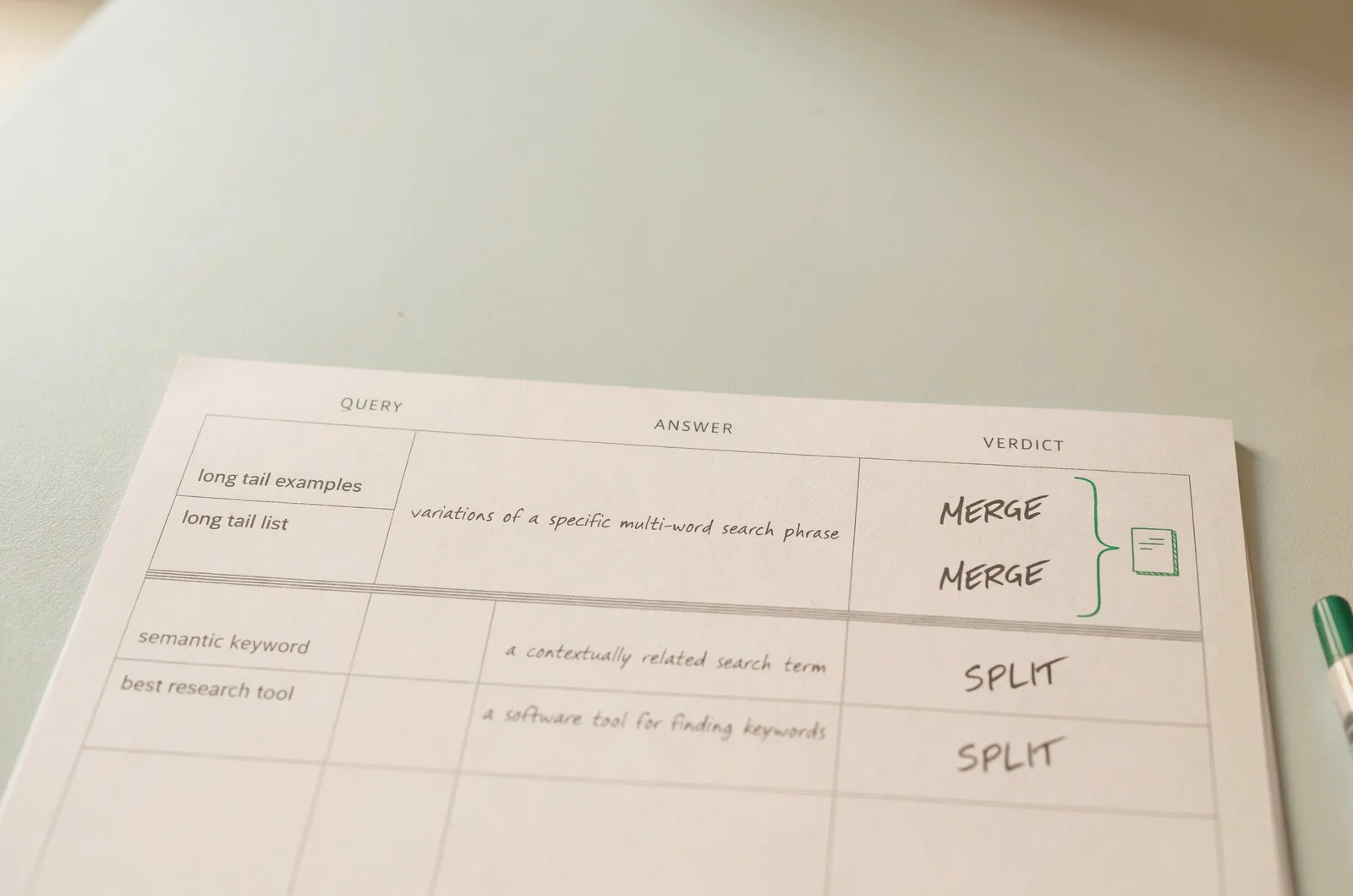
A workable test: write the one-sentence answer you would give each query. If the sentences are the same, merge. If they differ in substance, split. "Long tail keyword examples" and "long tail keyword list" produce the same answer. "Long tail keyword examples for SaaS" and "long tail keyword examples for local services" do not, because the examples themselves change.
Run the test in batches of twenty. It takes about fifteen minutes per batch and it prevents the more expensive problem of publishing two pages that split their own ranking signals. A 2026 performance marketing analysis put the cost plainly: twenty pages targeting twenty variations of one phrase creates internal competition and dilutes the perceived authority of the domain.
Keep a rejection log alongside the approved list. When someone asks in three months why a keyword was skipped, the log answers it without re-running the analysis.
From filtered list to publishing calendar
A filtered list is not a calendar. The gap between them is sequencing, and sequencing depends on three variables: how close the query sits to revenue, how much internal linking support the page will get, and how long the page needs to mature.
A practical ordering rule that holds up across B2B and agency work:
- Publish commercial investigation clusters first when the site already has topical coverage in that area. They convert sooner and they fund the rest.
- Publish task and how-to clusters second. They attract links and internal link equity more readily than comparison pages.
- Publish definitional and informational clusters last, or fold them into existing pages rather than creating new ones.
The reason to fold rather than create is the same duplicate logic from the previous section, applied at the site level. If a definitional query is already answered inside a larger guide, a new page competes with your own content.
This is the point where a research file usually stalls. The list exists, the intent labels are applied, the duplicates are gone, and then someone has to write forty briefs. Site-aware drafting tools help here because they read the existing site before writing, which reduces the chance that a new article contradicts or duplicates a page you published last quarter. SiaSEO's approach is to take the URL, build the calendar from the site's actual structure, and score each draft against semantic drift before it publishes. That does not replace the intent judgment above. It removes the mechanical work that follows it.
If you want a lightweight version of this without a platform, build a single spreadsheet with five columns: keyword, intent label, target page, cluster, and status. Sort by cluster, not by volume. The cluster sort is what keeps the calendar coherent.
Where long tail research is heading
Two shifts are worth tracking, because both change how you should weight the list you just built.
The first is the migration of search behavior toward longer queries. Between January 2025 and August 2026, impression share for one- and two-word queries dropped from 42% to 24%, while three- and four-word queries rose from 33% to 48%, according to Search Engine Land metrics reported in September 2026. Conversions moved in the same direction. Long tail is not a niche tactic anymore; it is most of the query surface.
The second is the shift in what counts as a win. Citation eligibility in AI-generated answers is becoming a more useful unit of analysis than raw ranking position, because a page surfaced by Perplexity, ChatGPT, or a Google AI Overview contributes brand pull that a high-volume ranking page may no longer deliver. That changes the brief. Pages written to be cited need extractable claims, clear entity relationships, and dates attached to time-sensitive facts.
The video is a good starting point for the vocabulary. The work that follows it is judgment applied at scale, and that part still belongs to whoever is accountable for the content calendar.
Questions that come up during the process
How many long tail keywords should one article target? One cluster, not one phrase. A cluster is the set of queries a single searcher would consider answered by the same page. In practice that is often five to fifteen related phrases, with one as the primary.
Should I ignore keywords with zero reported volume? No. Zero volume usually means the tool has not indexed the phrase, not that nobody searches it. Check whether the phrase appears in support tickets, sales calls, or forum threads. If it does, it is real demand.
Do long tail keywords still work if AI Overviews answer the query? They work differently. The click goes to pages that add something the summary cannot: original data, a template, a calculator, a worked example. Definitional pages lose; operational pages hold.
How long before a long tail page ranks? Programmatic content plays typically need nine to fourteen months to mature, according to a 2026 SaaS playbook on long tail strategy. Plan the calendar around that window rather than expecting quarter-one results.
What is the fastest way to check intent? Read the current top five results for the query. If they are all one content type, match it. If they are mixed, the query is ambiguous and you should pick the interpretation closest to your commercial goal.
Sources and further context
- What Are Long Tail Keywords?
- Long-Tail Keywords: Profitable SEO Strategy on a Budget
- Short Tail vs Long Tail Keywords: What's Better for SEO?