Long Tail Keywords vs Short Tail: What AI Search Rewards
Long tail keywords vs short tail: how query length changes search volume, competition, and which pages AI search engines actually cite.

If you are deciding where to point your next quarter of content budget, the long tail keywords versus short tail question is really a question about where search demand still converts into traffic. The head of the curve still holds the raw volume — a term like "keyword research" pulls roughly 5,400 searches a month in current demand data, while a specific phrase may pull 40 or fewer. But volume is no longer the whole story. AI Overviews and chat-based assistants now intercept a large share of broad informational queries, and the queries they answer most consistently are the long, specific ones. This comparison walks through both query types on the dimensions that decide a content plan: measured volume, competition, conversion behavior, and how AI answer engines select sources. The goal is to help you choose a research investment, not to crown a winner.
What actually separates the two query types
The distinction is older than AI search, and it is worth stating precisely because a lot of advice still gets it wrong. Short tail keywords are broad queries of one to three words: "seo agency", "blog generator", "keyword research". Long tail keywords are longer, more specific phrasings: "how to find long tail keywords for a SaaS blog", "ai seo workflow for agency client reporting". As Long-Tail vs Short-Tail Keywords put it, short-tail terms represent the fat head of the demand curve while the long tail consists of longer, more specific phrases.
Three properties follow from that structure:
- Volume concentrates at the head. A September 2026 index of AI-services search demand across the US, UK, and Australia found that 61.2% of generic keywords report zero measured monthly volume, with demand concentrated in a small number of head terms and a long tail of specific questions.
- The tail is most of search. Keyword research data updated in mid-2026 suggests long-tail terms make up roughly 70% of all search traffic, and about half of all queries run four words or longer. Individually small, collectively dominant.
- Specificity signals intent. "Seo agency" (390 searches a month, low competition in current signals) could be a job seeker, a student, or a buyer. "Ai seo agency for B2B SaaS pricing" is almost always a buyer.
That last point is why conversion behavior differs so sharply between the two types, and why the comparison cannot stop at volume.
Search volume and traffic potential
Short tail wins on impressions, full stop. A single page ranking in the top three for a head term can outdraw an entire cluster of long-tail pages. The demand signals behind this article illustrate the spread: "keyword research" at 5,400 monthly searches, "seo agency" at 390, "long tail keywords" at 40, and specific phrasings like "how to find long tail keywords" at 10 or fewer.
But raw volume overstates what a head-term ranking delivers in 2026. Google's own disclosure in February 2026 indicates AI Overviews now appear on roughly half of all US searches. When a broad query triggers an AI summary, a share of that traffic never reaches any website — the answer is consumed on the results page. Ahrefs research cited in industry coverage places AI Overviews on 99.2% of informational queries, which is the territory where broad educational head terms live.
Long-tail pages face the same interception dynamic, and some analyses are blunt about it: TripleDart's 2026 SaaS playbook reports AI Overviews intercepting 30 to 60 percent of click-through on long-tail informational pages. The difference is what you get in return, which the citation section below covers.
The practical reading: head terms still deliver the largest absolute traffic if you can rank, but the gap between "searches" and "clicks" has widened for both query types. Plan on click-adjusted volume, not search volume.
Competition and the cost of ranking
Here the long tail holds its traditional advantage. Broad terms attract entrenched domains with years of link equity. Specific phrases attract whoever bothered to write the page — often nobody good.
Current competition signals in this topic family show the pattern. "Seo agency" carries low competition at 390 monthly searches, which is unusual for a head term and reflects how fragmented agency search behavior is. "Long tail keywords" itself sits at medium competition with only 40 searches. The deeper tail — comparison and how-to phrasings — often registers as unknown or unmeasured competition, meaning the SERP is thin.
Hashmeta's long tail versus short tail guide notes that specific queries deliver more targeted traffic with higher conversion potential, particularly for newer websites. That matches what most practitioners observe: a domain without authority can win a long-tail SERP in weeks with a single well-structured page, while the equivalent head term may be unreachable for years.
One nuance worth keeping: low measured competition on a long-tail phrase sometimes means low value, not low difficulty. Check that the phrase maps to a real decision or task before building a page around it. A query nobody with budget ever types is not an opportunity; it is a rounding error.
Conversion behavior and commercial intent
This is the dimension where the two query types diverge most, and where the classic advice still holds. As Understanding Long Tail and Short Tail Keywords frames it, long-tail keywords are highly specific and cater to a more targeted audience, whereas short-tail keywords are broad and reach a wider one. FourFront makes the strategic version of the same point: Understanding Long-Tail and Short-Tail Keywords for, while long-tail terms let you target specific needs.
Say you run content for a mid-market SaaS. A visitor arriving from "content marketing" is browsing. A visitor arriving from "ai content calendar tool for B2B tech startup" is comparing vendors, and the page that matches that phrasing can speak directly to the comparison in progress. Cost-per-click data supports the intent reading: commercial head terms in this demand set carry CPCs between $5 and $14 ("keyword research" at $6.91, "perfect post" at $13.78), which tells you advertisers pay for broad commercial queries too. But the long-tail versions of those queries convert at higher rates per visitor because the page can match the exact moment.
The catch is scale. One long-tail page converts well and brings forty visits a month. You need dozens of them to move pipeline, which is a production-capacity problem, not a strategy problem.
What AI answer engines actually cite
This is where the comparison has genuinely changed since 2024, and where the old "long tail for conversions, head for awareness" split needs an update.
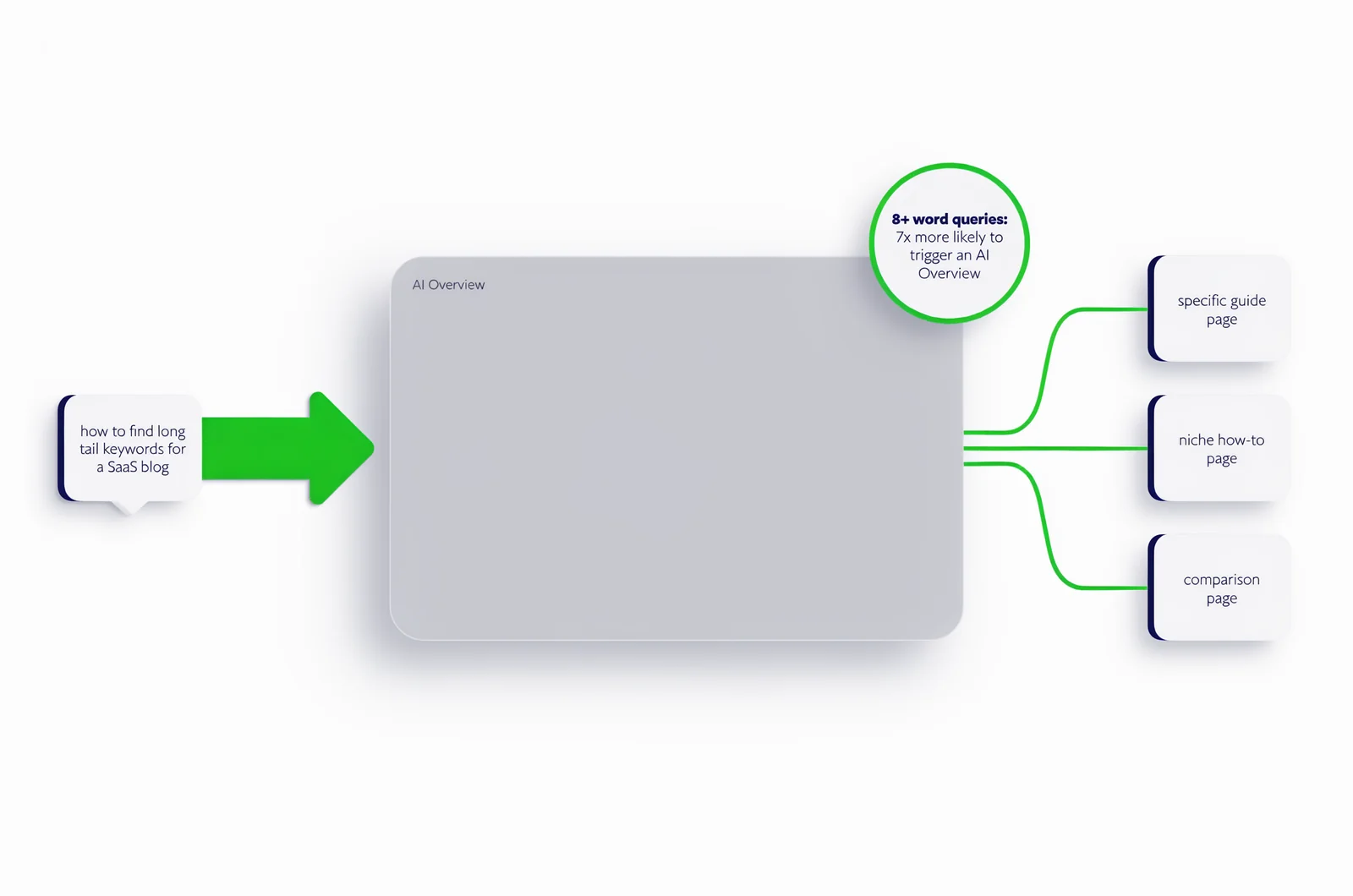
Queries of eight or more words are seven times more likely to generate a Google AI Overview than shorter queries, per BrightEdge tracking data cited in recent industry analysis. Long, question-shaped queries are exactly the territory long-tail phrasing occupies. And the emerging argument — stated plainly in TripleDart's 2026 playbook — is that citation eligibility, not search volume, is the right unit of analysis. A page lifted by Perplexity, ChatGPT, or Google AI Overviews contributes brand pull that a high-volume ranking page can no longer guarantee.
Semrush's guide to choosing long-tail keywords makes the operational version of the point: AI Overviews, AI Mode, and chat assistants increasingly answer specific, question-shaped queries directly, and long-tail phrasing is what you target if you want to show up in those systems. Ahrefs' long-tail keyword research guide adds that individually small queries often make up the majority of a site's search traffic when grouped — the collective-tail argument applied to AI citations as well as clicks.
There is also fresh evidence about when people reach for AI at all. Reporting on Google's latest AI data, summarized by ForeFront Web's VP of Operations Nicholas Aiello in October 2026, suggests people turn to AI search when a decision is hard, has real consequences, and requires weighing options. The content that appears in those moments is rarely your highest-volume page; it is the specific comparison or how-to that matches the decision.
Short tail is not absent from AI answers. Head terms still trigger AI Overviews, but those answers tend to cite large reference domains — Wikipedia, major publications, category leaders. The realistic citation path for a mid-authority site runs through the tail.
Where each type fits in a working content plan
Given the four dimensions above, the allocation question resolves into a few concrete rules:
Use short tail targets when:
- The term maps to a category you sell into ("seo agency", "blog generator") and you can support the page with links, comparison assets, and a strong template.
- The SERP is not yet saturated with AI summaries that fully satisfy the query — check manually before committing.
- You already hold topical authority in the cluster and the head term is the natural hub.
Use long-tail targets when:
- You need citations in AI answers, which now means targeting specific, question-shaped phrasing.
- Your domain lacks the authority to contest head terms — the realistic path is tail-first, cluster by cluster.
- The phrase maps to a decision moment: comparisons, pricing questions, integration questions, "vs" queries like the one that brought you here.
Do both when: the cluster supports a hub-and-spoke structure — one head-term page surrounded by long-tail spokes that link up. This is still the most durable architecture, and it is how tools like SiaSEO structure automated content calendars: a 7-day plan generated from your site's own context, mixing head-term hubs with the long-tail phrasings AI engines cite, with quality scoring applied before anything publishes.
If evaluating outside help for this kind of structured production, our review of AI SEO agencies worth hiring covers what to look for.
How the top-ranking guides handle the comparison
Three guides currently lead the SERP for this exact comparison query. Each takes a different angle, and reading them together shows what the consensus position is — and where this article departs from it.
Childsey
Childsey's guide, published in July 2024, draws the core definitional line: long-tail keywords are highly specific and target a narrower audience, while short-tail keywords are broad and reach a wider one. It is the cleanest statement of the classic framing and a good starting point if you are new to the distinction. What it predates is the AI-citation dimension — the piece treats the choice as a traffic-and-conversion trade-off, which was accurate in 2024 and is incomplete now.
FourFront
FourFront's analysis, also from July 2024, frames the two types as complementary rather than competing: short tail for reach and brand awareness, long tail for targeting specific needs. That "use both" position is the current industry consensus, and it is correct as far as it goes. Its limitation is that it offers no allocation logic — no guidance on how much of each, or how the balance shifts when AI answers absorb broad-query clicks.
Softtrix
Softtrix's comparison, updated in October 2025, anchors the curve metaphor precisely: short-tail keywords of one to three words form the fat head, while longer phrases form the tail. It is the most structurally careful of the three on definitions and differences. Like the others, its AI-search treatment is thinner than the 2026 evidence warrants — none of the three leaders engages with the BrightEdge seven-times figure or the citation-eligibility argument, which is the gap this article is written to fill.
Questions readers ask about query length and AI search
Do long-tail keywords still matter now that AI answers so many queries? More than before, by the citation logic. Long queries are the ones most likely to trigger AI Overviews, and pages written to those phrasings are the ones eligible to be cited. The click-through on those pages has dropped, but the brand visibility path has opened.
Should a new site ever target short tail terms? Only when the term is commercial, low-competition, and directly maps to your offer — "seo agency" at low competition is a legitimate early target for an actual agency. Purely informational head terms are usually a poor first investment.
How many words make a keyword "long tail"? There is no fixed cutoff. The working definitions run from three or four words upward, but the functional test is specificity, not word count. A two-word query with a niche modifier can behave like a long-tail term.
Is search volume still the right metric for choosing targets? Not alone. Click-adjusted volume, conversion intent, and citation eligibility together give a truer picture. A 40-search phrase that AI engines quote is worth more than a 5,000-search term whose clicks an AI summary absorbs.
What is the fastest way to build long-tail coverage at scale? Cluster first: group the specific phrasings under a head-term hub, then produce the spoke pages in batches. Automation platforms that generate calendars from your site's existing context (SiaSEO is one) remove the research bottleneck; a simple alternative is a spreadsheet scoring each phrase on intent, competition, and AI-citation potential — a lightweight selector you can build in an afternoon.