Nine Article Templates Map to Search Intent: Matrix Evidence
How nine article templates map to search intent, with a matrix of informational, commercial, navigational, and transactional fit.

Teams that publish at volume keep facing one decision: which template does this query get? The query "9 article templates search intent" reads like a request for a lookup table, so this paper builds one. It classifies a working set of nine templates against the four search intents (informational, navigational, commercial investigation, and transactional), reports where each template fits and where it dilutes the match, and keeps measured evidence apart from analyst judgment. The intended reader assigns templates across dozens or hundreds of briefs and needs a rule that survives editorial review.
Research question, scope, and evidence standard
The research question is narrow. Given a query with a known intent, which article structure gives the page the best chance of being read, and cited, as the answer? Ranking position, writing quality, and domain authority are out of scope because they vary independently of template.
Template counts are a convention. RepublishAI catalogs 10 WordPress article templates for 2026, while Daniel Agrici's guide on claude-blog.md counts 12 blog templates. This paper uses nine: explainer, how-to guide, listicle, comparison, single-product review, question-led article, deep-dive, news and trend analysis, and whitepaper. Roundups fold into listicles. A video-derived article takes whichever template its target intent calls for.
Evidence comes in three tiers, and each claim below says which one it uses. Tier one is search engine documentation. Tier two is a published measurement with a stated sample. Tier three is analysis: the classification judgments made here, which are testable but have not been tested at page level. Every tier-two figure reaches this paper through a secondary report, and the text names the original publisher.
Four intents and three tests: the classification model
An intent is the goal behind a query. A template is a commitment about structure: where the answer sits, how much context surrounds it, and what the reader is invited to do next. Matching one to the other is a classification problem, and the label set is settled. The Stacc's 2026 search intent guide lists informational, navigational, commercial investigation, and transactional, and advises reading intent off the SERP, since the formats already ranking show what the search engine believes the searcher wants.
Mapping guides frame the task in the same order. Inspace's search intent and content mapping guide and seo-keyword.com's framework for mapping intent to page type both start from the intent and choose the content format afterward. Topical-map libraries such as Indibloghub's search intent types and mapping plan organize that choice across a whole topic cluster.
Three tests turn the labels into a procedure. They are analysis, which means they are testable but unmeasured here.
- The answer-position test asks whether the full answer fits in two sentences. If it does, the template should state it in the opening lines (explainer, question-led article). LaunchScaler's brief template uses the same device, asking for a two-sentence answer as one of its eight fields.
- The choice-set test asks whether the reader is picking among named options. If so, the template is a listicle, comparison, or review, depending on how many options appear and how much evidence each one gets.
- The action test asks whether there is a task to finish or an item to obtain. A task points to a how-to guide. An acquisition points away from articles, toward a tool or product page.
The nine-template matrix against four intents
Table 1 records the classification. "Primary" means the template's native structure answers that intent without modification. The last column names the condition under which the structure works against the intent.
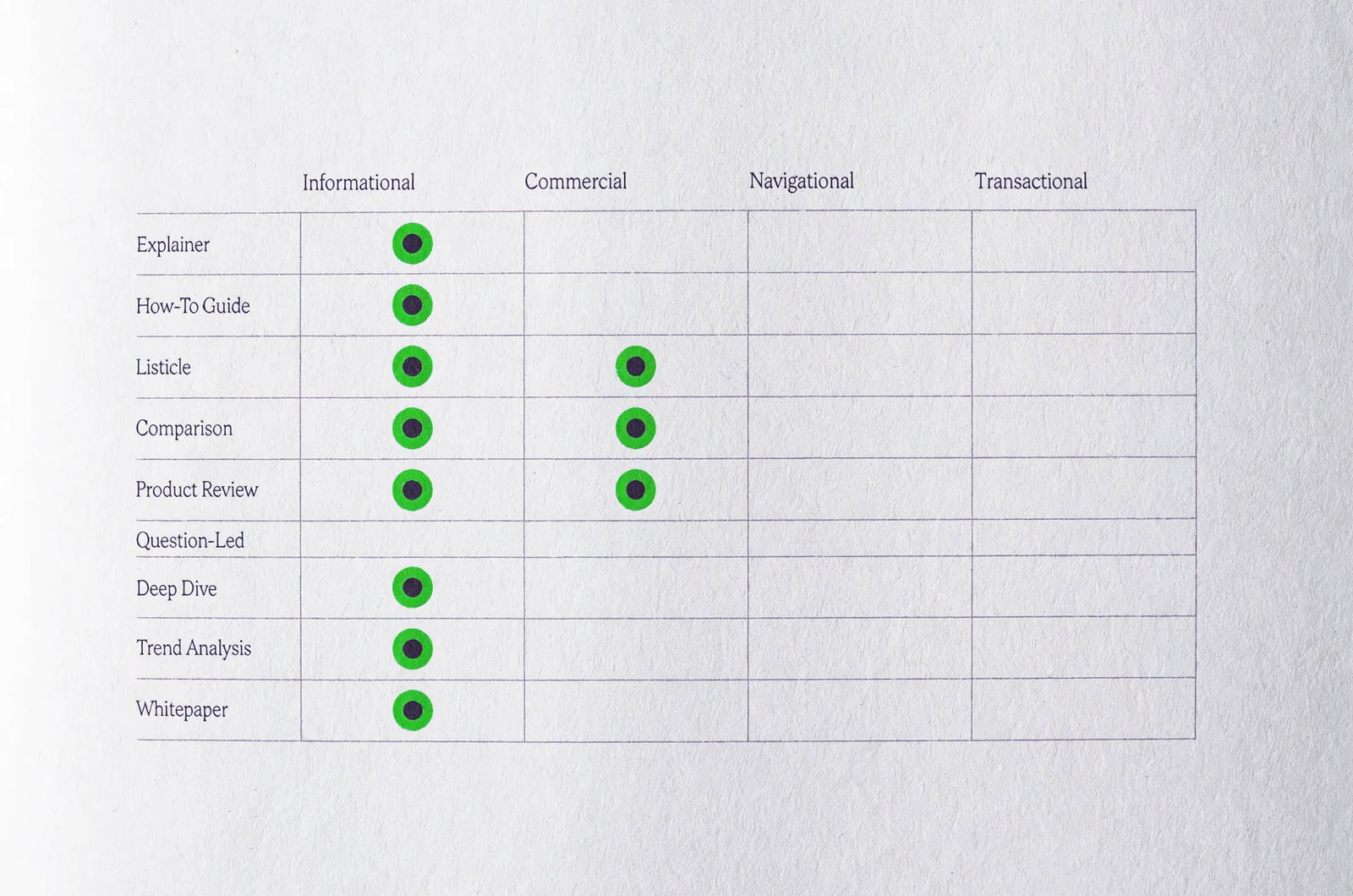
| Template | Primary intent | Secondary fit | Dilutes when |
|---|---|---|---|
| Explainer | Informational | Navigational, for brand-concept terms | The definition sits below a product pitch |
| How-to guide | Informational (task) | Transactional, when a tool completes the task | Background theory precedes the first step |
| Listicle | Commercial investigation | Informational | The query has one right answer |
| Comparison | Commercial investigation | Transactional, late stage | Criteria go unstated or options are not like-for-like |
| Single-product review | Commercial investigation | Navigational, for brand-plus-review queries | Features are listed with no verdict |
| Question-led article | Informational | Commercial investigation, early stage | Questions chain into an essay |
| Deep-dive | Informational (depth) | None | The SERP rewards a quick answer |
| News and trend analysis | Informational (time-bound) | Commercial investigation | The news window closes |
| Whitepaper | Informational research | Commercial investigation, B2B evaluation | The query wants a quick answer or a purchase |
Three patterns follow. Six of the nine templates are primarily informational, so the choice inside that intent matters more than the choice between intents. Three serve commercial investigation, and all three depend on a visible choice set. No article template is primary for transactional or navigational intent. The Stacc's format list assigns transactional intent to a tool or calculator rather than a prose template, and it assigns no format to navigational queries. Articles can support those intents, but the destination, tool, or product page carries them.
Two row pairs are contested. Comparison and review differ in choice-set size: a comparison holds two or more options to the same criteria, while a review holds one option against the reader's needs. A searcher typing a product name plus "review" has usually narrowed the set already, which is why the review row carries a navigational secondary fit. Deep-dive and whitepaper differ in evidence standard rather than topic. A deep-dive explains one subject thoroughly. A whitepaper states a research question, an evidence standard, findings, and limitations, so it suits readers who must defend a decision to someone else.
Published measurements: what intent predicts about cited format
The strongest published evidence comes from citation studies of AI answers rather than from classic rankings. Dawid Walczyk of Vistrix Labs summarizes the largest one:
Analyzing 75,000 answers and 1,056,727 citations across ChatGPT, AI Mode, and Perplexity, Wix Studio’s AI Search Lab found intent to be the best predictor of cited format, ahead of industry or model (Wix Studio AI Search Lab, March 2026). — Dawid Walczyk, Vistrix Labs, September 2026
In that dataset, listicles drew 21.9 percent of all citations, articles 16.7 percent, and product pages 13.7 percent. For commercial intent, listicles rose to 40.86 percent. That is the commercial-investigation column of Table 1 showing up in cited behavior: the listicle is the primary template there, and it over-indexes by nearly 19 points.
Two cautions apply. Citation share in AI answers is not ranking. And the "articles" bucket pools several of the nine templates, so the study cannot say whether a how-to guide outperforms a deep-dive within informational intent.
A second source widens the label set. GeoScout, citing AthenaHQ's State of AI Search 2026 (8 million responses, Q1 2026), reports that AI models recognize nine content intent categories against four in classic SEO. Informational intent takes 27 to 49 percent of responses, comparative or selection intent 19 to 26 percent, and acquisition 11 to 17 percent, with the remaining six categories sharing 15 to 25 percent. Those nine categories are not the nine templates in this paper, and the matching count should not be read as a mapping. The relevant point is granularity. Answer engines separate comparing from acquiring, and so does the matrix, which is why comparison and listicle templates sit apart from any transactional page.
Google's documentation now addresses the same surface. Its generative AI guidance in Search Central covers optimizing for those features, which puts extraction by AI answers beside ranking as a design concern for every template.
Exception cases where the matrix bends
Mixed-intent queries, starting with this paper's own SERP
The SERP snapshot behind this paper shows how one query can pull in several directions. The intent classifier's confidence splits informational 41.7, commercial investigation 33.3, transactional 25, and navigational 0. Of the top five results, one is classified as a general article, one as a how-to guide, and three as tool or resource pages: a keyword-mapping guide bundled with a free template, a set of six GEO templates, and a Pinterest template board.
The likely reading is that searchers who type "templates" and "matrix" expect something they can copy. These figures are classifier confidence for one query at one moment, not shares of searchers. The consequence for a whitepaper is still structural. A research narrative alone would dilute the match, so the matrix has to exist as a copyable artifact, which is why Table 1 is a table. The general rule for mixed intent: choose the primary template by the highest confidence score, then add one secondary element (a table, a tool, a checklist) for the next score down. Do not stack two structures on one page.
Navigational queries have no article template
A navigational query seeks a known destination, such as a login page or a brand's pricing. An article that targets one competes with the destination the searcher already has in mind. When the label comes back navigational, the correct output is not a new article. Fix the destination page's title, headings, and internal links instead.
Intent drifts with time and buyer stage
Labels expire. In a US set of 30 high-intent AI search terms covering 3.4 million monthly searches, Lilach Bullock's 2026 report found demand for AI grew 33.5 percent year on year while its mix changed: autonomous AI agents rose 770 percent and AI for marketing fell 38 percent. That is one topic family with two opposite intent movements inside twelve months. The news and trend template is the extreme case, because its fit lasts only as long as the news window.
Buyer stage shifts fit as well. A whitepaper is informational for a researcher and commercial investigation for a B2B evaluator shortlisting vendors, which is why its evidence table and limitations section matter more than its length.
From matrix to brief: operating the classification at volume
A matrix helps only if the brief enforces it. Brief frameworks converge on this. LaunchScaler's template has eight fields: four define the target (queries, intent, searcher, answer) and four define the build (facts and sources, question headings, internal links, call to action). Clickwebstudio's 2026 template opens with a primary keyword and an intent classification, and gives the reason: different intents demand different article shapes. UpliftAI's guidance asks for one primary audience, question, and search intent per page.
Five working rules follow from the matrix:
- Assign one intent label per brief before any outline exists.
- Record the formats of the top three SERP results next to the label, and treat a mismatch with the matrix as a flag to investigate.
- Pick the template with the three tests, then add at most one secondary element for mixed intent.
- Route navigational labels to fixes on the destination page.
- Re-read labels on a fixed schedule, quarterly at minimum, for news-adjacent and fast-moving topics.
In a workflow like SiaSEO's, where a website URL produces a 7-day content calendar, the intent label and template belong on each calendar entry before drafting begins. Reviewers then approve structure instead of prose, and quality scoring and semantic drift tracking have a stated intent to measure the draft against. A how-to that slides into a product pitch is exactly the dilution pattern in Table 1, and a recorded label makes it detectable. Narrow long-tail queries are the simplest place to start, since their intent is usually unambiguous, and SiaSEO's earlier post with long tail keyword examples shows the query shapes involved.
Matrix planning is old spreadsheet practice. The Gray Company published a free Airtable keyword matrix in 2023, and SE Ranking's open-source seo-skills repository includes an intent template map inside its content brief skill. Compare its pairings with Table 1 before adopting either.
A template selector would make the tests executable. The inputs are a query, the formats of the top three results, and yes-or-no answers to the three tests. The outputs are a recommended template, one secondary element, and a flag when the SERP's intent confidence is split the way it was above.
Limitations of this study
This paper has no page-level performance data. The Wix-derived figures measure citation share by broad format in AI answers. They say nothing about clicks or rankings by template. Most sources are vendor and agency publications, and the study numbers arrive through secondary reports whose raw data this paper did not inspect. The matrix rows are judgment calls: two analysts could reasonably split on review versus comparison. The SERP snapshot covers one query at one moment.
The matrix is therefore a hypothesis with a test most teams can run on data they already hold. Tag every published URL with its template and intent label, then compare impressions and click-through by template within each intent for 60 to 90 days. Do not compare across intents, where the baselines differ.
References
- Indibloghub — Search Intent Types and Mapping Topical Map Library SEO Content Plan
- Inspace — Search Intent and Content Mapping Guide for SEO
- Republishai — 10 Best Article Templates for WordPress in 2026 - RepublishAI
- Seo Keyword — Search Intent Mapping for the Right Page Type
- Github — skills/seo-content-brief/references/intent-template-map.md
- Thegray — Next-Gen SEO Content & Keyword Matrix [Free Airtable Template]
- Google — Google's Guide to Optimizing for Generative AI Features on Google Search Google Search Central Documentation Google for Developers