Reality Augmented Generation Tools Built for SEO Content
A roundup of reality augmented generation tools that keep AI-written SEO content grounded in verified sources, ranked by method and workflow fit.

Reality augmented generation describes the practical problem most content teams now face: language models write fluently about things that never happened, and SEO workflows publish those sentences at volume. The term borrows its shape from retrieval-augmented generation, but the constraint is wider. Grounding has to survive contact with a live website, a CMS, a brand voice, and a review process that a marketing director has to sign off on.
This roundup covers the tools that attempt that, scored on four things: how they retrieve, how much control you keep over sources, how citations map to claims, and whether output reaches a publishing queue without manual reformatting.
How this shortlist was built and what it excludes
Three filters, applied in order.
The tool has to ground generation in something external to model weights: retrieval from a knowledge base, a crawled site, a document store, or a live search layer. Tools that only prompt a model with a longer instruction do not qualify, whatever the demo looks like.
The grounding has to be inspectable. A content lead approving forty articles a week needs to see which source produced which claim. If the platform cannot show that, it fails the test that matters most in review.
The tool has to connect to a publishing destination. A grounding engine that ends at a copy-paste box is a research assistant, not a content operation.
Excluded: pure research assistants with no publishing path, generic chat interfaces, and SEO suites that bolt a writing box onto a keyword database without a retrieval layer. Also excluded are vendors whose public documentation does not describe their grounding method at all. If a vendor will not say how retrieval works, there is nothing to evaluate.
One caveat on evidence. Pricing and capability pages in this category change quickly, and several vendors publish feature claims without version dates. Where a claim could not be checked against a dated source, it is marked unknown rather than stated as fact.
The four attributes that separate grounded platforms from prompt wrappers
Vendors describe these with overlapping language, so state them plainly.
Retrieval method. Does the tool pull from a vector index, a keyword index, a live crawl, or a hybrid? Vector search handles paraphrase well and exact matches poorly. Keyword search does the reverse. Most production systems now run both and merge results, which is the approach that survives real queries.
Source control. Can you restrict generation to an approved domain list? Can you exclude competitor pages, deprecated help docs, or user-generated content? Regulated teams need this. So does anyone whose site has legacy pages they would rather not have quoted back at them.
Citation handling. Three behaviours exist. Some tools attach inline links to retrieved passages. Some produce a source list at the end with no mapping to individual claims. Some produce nothing and leave verification to the writer. Only the first is useful for editorial review at volume.
Workflow fit. Where does the draft land — a CMS field, a document, a review queue, a webhook? Grounding quality matters less than you would expect if the output needs reformatting before it can be scheduled.
A fifth consideration cuts across all four: whether the system tracks drift. A page well-grounded in January can go stale by June as its sources change. Few platforms monitor that.
Grounding engines you assemble yourself
These are infrastructure-layer options. They are not content tools in the marketing sense, but several platforms below are built on them, and some teams assemble a stack from them.
LlamaIndex
LlamaIndex is a data framework for connecting language models to external sources. It handles ingestion, chunking, indexing, and retrieval, and it exposes the retrieval step so you can swap strategies without rewriting the application.
Best for engineering teams building a custom pipeline who want retrieval logic they control.
Standout capability is the range of index types and query engines: a simple vector store, a keyword table, a tree index that summarises hierarchical documents, or a router that sends different queries to different indexes. The router pattern is the interesting one for content, because product questions can go to product docs and pricing questions to a pricing table.
The limitation is that it is a library, not a product. No editorial interface, no approval queue, no CMS connector. Someone on your team builds and maintains the pipeline, and that person needs to still be there in twelve months.
Evidence: the project is open source and its documentation describes the retrieval and indexing components in detail. The library itself carries no licence cost; you pay the model and embedding providers you connect.
Verdict: right choice with engineering capacity and unusual retrieval requirements. Wrong choice if you need to ship content this quarter.
LangChain
LangChain overlaps with LlamaIndex but positions itself as a broader orchestration layer. Retrieval is one component among chains, agents, memory, and tool calling.
Best for teams that want retrieval inside a larger automated workflow, including steps that call external APIs or trigger publishing actions.
Standout capability is integration breadth. If a service exists, there is likely a connector, which matters when a pipeline has to touch a CMS, a search console, an analytics tool, and a review system in one run.
The limitation is abstraction depth. The framework changes quickly, and code written against one version often needs rework against the next. Teams adopting it for a simple retrieval task frequently take on more surface area than the job required.
Evidence: open source with public documentation covering retrieval, document loaders, and output parsers. As with LlamaIndex, the library is free and you pay for connected models and services.
Verdict: strong fit when retrieval is one step in a multi-step automation. Overkill when it is the whole job.
Haystack
Haystack is a retrieval-focused framework from deepset, built around pipelines of nodes that each perform one operation.
Best for teams that want explicit, readable pipeline definitions rather than implicit chain behaviour.
Standout capability is pipeline transparency. Each node declares its inputs and outputs, which makes it straightforward to log exactly what was retrieved for a given generation and to debug when grounding fails.
The limitation is a smaller integration ecosystem than the two above, so you may write more connectors yourself.
Evidence: open source, with documentation describing pipeline construction and the available retrievers and readers.
Verdict: a reasonable middle path for teams that want structure without the full breadth of a general orchestration framework.
Platforms that package grounding for content teams
This is where most SEO content operations land. These tools combine retrieval with an editorial interface, and the differences show up in review workflow more than in retrieval quality.
SiaSEO
SiaSEO reads a customer's website before writing anything, which is the grounding step most content tools skip. You supply a URL, the platform analyses the site for brand context and existing coverage, and it returns a seven-day content calendar. Drafts then route through multiple models, get scored for quality, and publish to a connected CMS.
Best for content operations leads and agency owners who need volume without losing the review step.
Standout capability is the combination of site-aware drafting and semantic drift tracking. Drift tracking is the piece most platforms omit, and it addresses staleness directly: a page grounded in January gets flagged when its grounding stops matching the current site.
The limitation is that an end-to-end system is less useful if you only want a retrieval component for an existing pipeline. Teams with a mature in-house stack may find the integrated approach constrains them.
Evidence: the platform's public documentation describes the URL-to-calendar flow, multi-model routing, quality scoring, and CMS sync. Pricing is published on the site.
Verdict: a strong fit when the bottleneck is production throughput rather than retrieval architecture.
Surfer SEO
Surfer built its reputation on content optimisation against SERP data and added AI writing on top. The grounding here is largely SERP-derived: the tool retrieves what currently ranks and shapes the draft toward that pattern.
Best for writers who want structural guidance on a single page and a clear picture of competitor coverage.
Standout capability is the content editor's term and structure recommendations, still among the more concrete optimisation signals available.
The limitation is that SERP data is not verified fact. Optimising toward what ranks tells you about coverage and format, not whether a claim is true. Treating Surfer output as grounded content conflates two different things.
Evidence: public materials describe the SERP analysis and content scoring. Pricing tiers are published.
Verdict: useful as an optimisation layer, not a substitute for a retrieval layer.
Clearscope
Clearscope focuses on content optimisation and, more recently, on visibility inside AI-generated answers. Its grounding is again corpus-derived rather than source-verified.
Best for teams optimising existing content and tracking how they appear in AI search results.
Standout capability is reporting on AI answer visibility, a question most SEO tools have been slow to answer.
The limitation mirrors Surfer's. The signal is about coverage and relevance, not factual verification. The tool tells you what to include, not whether what you included is accurate.
Evidence: the company publishes research on AI search and content optimisation on its own blog. Pricing is available on request rather than published.
Verdict: reasonable when AI-search visibility reporting matters alongside traditional optimisation.
MarketMuse
MarketMuse approaches the problem from content inventory and planning. It analyses your existing site, identifies gaps and overlaps, and recommends what to build or update.
Best for teams managing a large library that grew without a plan.
Standout capability is site-level analysis. Rather than optimising one page at a time, it looks at how pages relate and where coverage is thin or duplicated.
The limitation is that grounding is internal to your own corpus. It is strong at telling you what you have not covered and weak at verifying external facts.
Evidence: the company publishes guides on content optimisation and quality. Pricing is available on request.
Verdict: best used as a planning layer above whichever drafting tool you choose.
Copy.ai
Copy.ai started in short-form marketing copy and moved toward workflow automation, including retrieval steps that pull from connected data sources.
Best for teams automating repetitive content tasks with a retrieval step attached.
Standout capability is the workflow builder, which chains a retrieval action to a generation action and routes the result somewhere useful.
The limitation is content depth. The product is oriented toward shorter formats, and long-form SEO articles with citation requirements are not where it is strongest.
Evidence: the company publishes templates and workflow documentation. Pricing tiers are published.
Verdict: a fit for operational content at scale, less so for citation-heavy long-form work.
Jasper
Jasper targets marketing teams with brand-voice controls and a range of templates, plus features aimed at keeping output consistent with a defined brand.
Best for marketing teams that need consistent voice across many writers and formats.
Standout capability is the brand voice and style controls, among the more developed in the category.
The limitation is that grounding in external verified sources is not the product's centre. It is a strong writing environment with retrieval features attached, rather than a retrieval system with a writing interface.
Evidence: the company publishes marketing research and product documentation. Pricing tiers are published.
Verdict: a good fit when voice consistency is the main constraint. Pair it with a separate grounding layer if factual verification matters.
Comparing the options on the attributes that decide the purchase
| Tool | Retrieval method | Source control | Citation handling | Workflow fit |
|---|---|---|---|---|
| LlamaIndex | Configurable indexes, hybrid capable | Full, code-level | Depends on implementation | Custom build required |
| LangChain | Configurable via integrations | Full, code-level | Depends on implementation | Custom build required |
| Haystack | Explicit pipeline nodes | Full, code-level | Depends on implementation | Custom build required |
| SiaSEO | Site crawl plus multi-model routing | Site-scoped | Inline, with drift tracking | Direct CMS sync |
| Surfer SEO | SERP corpus | Limited to SERP scope | None by default | Editor plus export |
| Clearscope | SERP and corpus | Limited | None by default | Editor plus export |
| MarketMuse | Internal corpus | Site-scoped | None by default | Planning layer |
| Copy.ai | Connected data sources | Workflow-scoped | Limited | Workflow automation |
| Jasper | Brand and template context | Brand-scoped | Limited | Templates plus integrations |
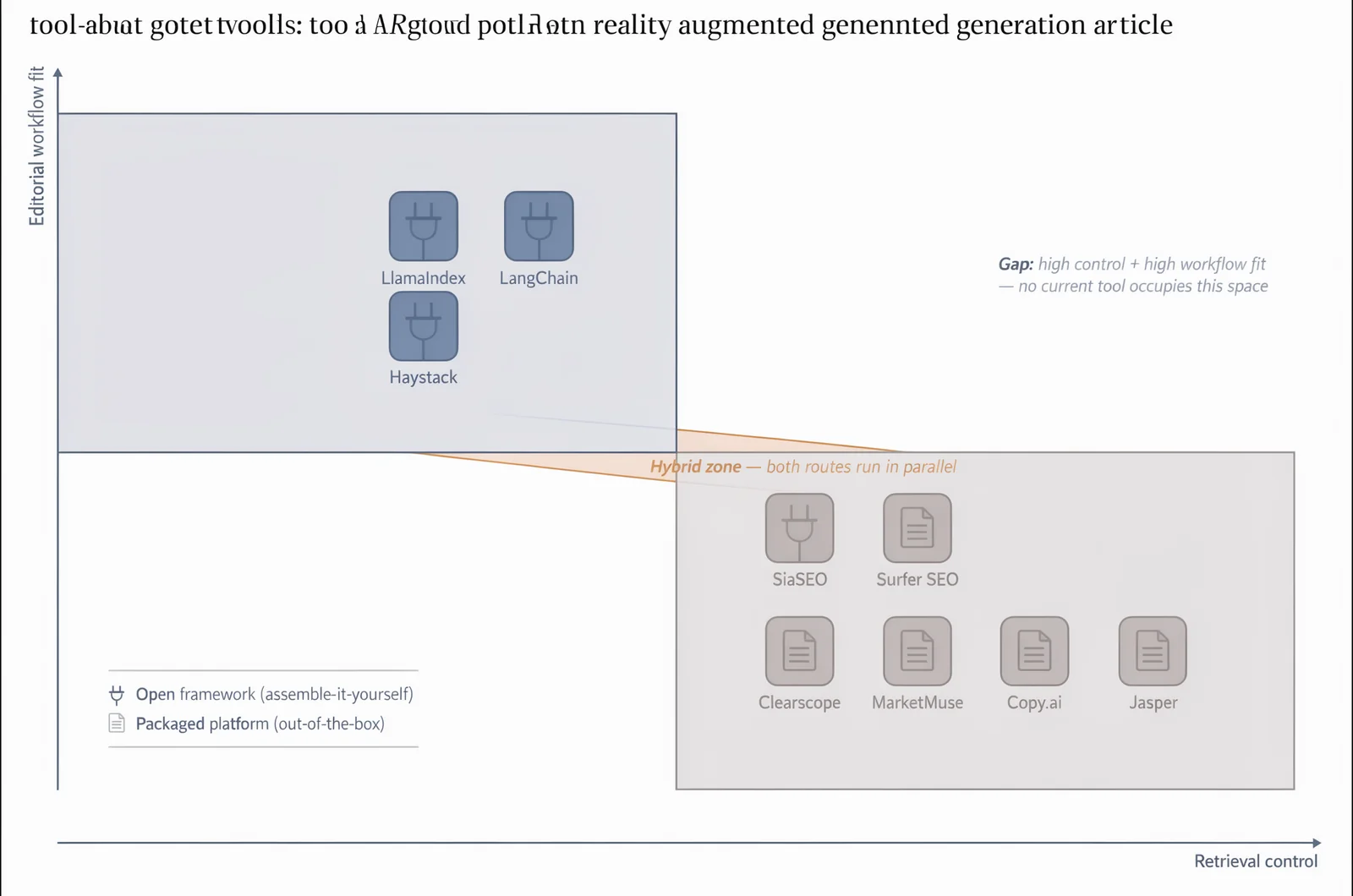
The pattern is clear. Frameworks give you control and cost you time. Packaged platforms give you speed and cost you control over retrieval specifics. Few options give you both, and none without a build.
What the underlying research actually says
The retrieval approach these tools depend on is well documented. Retrieval-augmented generation as a technique is covered in depth by the standard RAG overview, which describes how models retrieve and incorporate external information rather than relying on training data alone.
The adjacent work on generative augmentation is worth reading for the conceptual frame. Generative augmented reality research reframes augmentation as world re-synthesis rather than composition by a conventional engine, replacing multi-stage modules with a unified generative backbone. The parallel to content generation is direct: instead of assembling a draft from retrieved fragments, a unified model conditions on retrieved context throughout.
There is also a knowledge-transfer angle. the ArK knowledge interaction paper describes an agent that transfers knowledge-memory from foundation models to novel domains for scene understanding and generation, using a mechanism the authors call Augmented Reality with Knowledge Inference Interaction. The relevant part for content operations is the transfer step: grounding is not only fetching the right passage, but carrying context from one domain into another without losing fidelity.
None of this research is about SEO content specifically. It is about the mechanics underneath, and those mechanics determine whether a tool can be trusted at volume.
Where grounding breaks once it reaches production
Four failure modes show up repeatedly.
Stale retrieval. The index was built in March and the product shipped a new pricing page in June. The model keeps citing old numbers with full confidence. Drift tracking exists because this failure is invisible without it.
Source contamination. The index includes pages you would not want quoted: an old support thread, a competitor comparison page, a deprecated help article. Source control is the fix, and it has to be enforced at query time, not at ingestion.
Citation theatre. The tool appends a list of sources that were retrieved but not necessarily used. A reviewer cannot tell which claim came from which source, so the citation adds no verification value. Inline mapping is the only version that helps.
Format drift. The draft is well-grounded and well-written, then arrives in a format that needs manual restructuring before scheduling. At forty articles a week, that step consumes the time grounding was supposed to save.
Test all four against your own site before committing. A trial on ten real pages surfaces more than any feature comparison.
A short evaluation checklist
Run this against any candidate before signing.
- Ask the vendor to show which source produced a specific sentence in a sample draft.
- Confirm whether retrieval can be restricted to an approved domain list.
- Check whether citations map to individual claims or appear as a list.
- Test what happens when a source page changes after the draft is written.
- Verify the publishing path end to end, including formatting.
- Ask how the system handles a query where no good source exists.
That last one matters more than it sounds. A grounded system should be able to say it does not have enough to answer. A system that always produces confident output is not grounded, whatever the architecture diagram says.
If you want a concrete tool idea for your own team, build a small grounding scorecard: six rows, one per check above, scored pass or fail per candidate, with the sample draft attached as evidence. It takes an afternoon and replaces most of the debate.
Questions teams ask before committing
Is reality augmented generation a real term or a marketing invention? The phrase is not standard in the research literature, where retrieval-augmented generation and generative augmented reality are the established terms. It describes the practical combination of retrieval grounding and generation applied to real-world content. Treat it as useful shorthand rather than a formal technique.
Can I get grounding without replacing my whole content stack? Yes, but it takes assembly. A retrieval framework plus your existing editor and CMS covers most of it. The trade-off is maintenance, and packaged platforms exist because most teams do not want to own that maintenance long term.
How many sources should a grounded article cite? There is no standard number. What matters is that each material claim traces to a source a reviewer can check. An article with three well-mapped citations is more verifiable than one with fifteen unattributed ones.
Does grounding eliminate hallucination? No. Retrieval reduces fabrication when the retrieved context is relevant and the model is instructed to stay within it. It does not remove errors when retrieval returns the wrong passage or when the model over-generalises from a correct one. Review remains necessary.
What is the smallest useful implementation? A single index of your own site content, a retrieval step, and a generation step that cites what it retrieved. That covers brand-consistent drafting with traceable sourcing. Everything else is refinement.
Matching the pipeline to your actual constraint
No single tool covers the full path from retrieval to published article without a gap somewhere. Frameworks give you retrieval you control and leave the editorial layer to you. Packaged platforms give you the editorial layer and abstract the retrieval. The right choice depends on which gap you can live with.
When throughput is the constraint, the packaged route reaches production faster. When accuracy in a regulated or technical domain is the constraint, the framework route gives you the control that review requirements demand. Some operations run both: a framework for high-stakes content, a platform for volume.
Whichever path you take, test the four failure modes on your own pages first. Grounding quality is measurable, and the measurement is more useful than any vendor comparison.