GEO vs SEO Cost Structure: What AI Search Visibility Actually Requires
GEO vs SEO cost comparison: what generative engine optimization actually requires in tools, talent, and content investment versus traditional search.

Marketing leaders reallocating budget in 2026 face a blunt question: does generative engine optimization demand a parallel spending track, or is it a reconfiguration of existing SEO investment? The search intent behind "generative engine optimization cost GEO vs SEO cost structure" is not theoretical. People typing this want line items, talent models, tool stacks, and content velocity math they can take to a CFO.
This article compares the actual cost architecture of both disciplines. It draws on agency pricing surveys, platform subscription data, and operational benchmarks from teams running both SEO and GEO programs. The goal is not to declare one superior. It is to show what each costs to execute well, where the overlap lives, and how to budget without paying twice for the same work.
What GEO and SEO Actually Require
GEO is the practice of structuring content, brand entities, and technical signals so that LLMs and AI answer engines cite you as a source. SEO is the practice of ranking in traditional search results. The GEO vs SEO difference comes down to destination: blue links versus synthesized answers.
Google's own documentation treats GEO as an extension of SEO, not a separate discipline. As Google Search Central notes, "optimizing for generative AI search is optimizing for the search experience, and thus still SEO," while warning that many suggested "AEO" or "GEO" hacks "aren't effective or supported by how Google Search actually works." This matters for cost planning because it means the foundation—technical SEO, content quality, site structure—is largely shared.
The divergence sits in four areas:
- Citation formatting: Content structured so LLMs can extract and attribute specific passages cleanly
- Entity clarity: Schema and on-page signals that tell AI engines exactly who you are and what you do
- AI-specific tracking: Monitoring verbatim answers across ChatGPT, Perplexity, Gemini, and Copilot rather than just rank position
- Technical groundwork: Files like
llms.txtand crawler access configurations tuned for AI consumption
These additive layers cost money. The question is how much, and whether they require new budget or reallocated spend.
Tool Stack Costs: Overlap and Divergence
The software layer reveals where GEO and SEO share infrastructure and where they split.
Shared Foundation
Most teams already run keyword research platforms, rank trackers, and content optimization tools. Semrush, Ahrefs, Surfer SEO, and Clearscope serve both disciplines. A mid-market SEO tool stack typically runs $500–$2,000 per month depending on seat count and data limits. Our Semrush pricing plans breakdown shows how these tiers scale.
Content management systems, analytics (GA4, Looker Studio), and technical audit tools (Screaming Frog, Sitebulb) are universal overhead. They do not duplicate.
GEO-Specific Additions
GEO introduces three tool categories with distinct pricing:

AI visibility monitoring: Platforms like LLM Pulse, GEO Perf, and custom citation trackers monitor which sources AI engines cite for target queries. These range from $300–$1,500 per month for mid-market coverage. The premium reflects API costs for querying multiple LLMs and parsing unstructured answer text.
Entity and schema management: Advanced schema deployment, knowledge graph monitoring, and entity consistency tools add $200–$800 monthly. This is partially overlapping with existing structured data investments but requires deeper implementation.
Answer simulation and testing: Tools that preview how content renders in AI Overviews or simulate LLM extraction are emerging. Pricing is volatile—$100–$600 monthly—as the category matures.
One research finding from early 2026: GEO Pricing How Much Does generative engine optimization cost 1.5x to 2x comparable-scope SEO services when purchased separately. This premium reflects "queries against AI engines, waiting for responses, and manually or semi-automatically parsing the results."
Realistic Combined Stack
For a team running both disciplines seriously:
| Component | Monthly Cost Range |
|---|---|
| Core SEO platform (Semrush/Ahrefs) | $500–$2,000 |
| Content optimization (Surfer/Clearscope) | $200–$600 |
| AI visibility monitoring | $300–$1,500 |
| Entity/schema tooling | $200–$800 |
| Answer simulation | $100–$600 |
| Total | $1,300–$5,500 |
The upper end assumes aggressive multi-engine tracking and large site schemas. Many teams can operate toward the lower end by leveraging existing SEO tools for dual purposes and adding only citation monitoring.
Talent and Agency Models
Tools are the smaller line item. Labor—whether in-house, freelance, or agency—is where budgets diverge meaningfully.
SEO Talent Benchmarks
SEO headcount or retainer costs are well-established:
- Junior SEO specialist: $55,000–$75,000 annually (US)
- Senior SEO manager: $95,000–$140,000
- Agency retainer (mid-market): $3,000–$10,000 monthly
- Enterprise agency engagement: $10,000–$50,000+ monthly
Our analysis of SEO company costs for small business shows how AI automation is compressing the lower end of this range, with some teams replacing junior hours with platform workflows.
GEO Talent Premium
GEO expertise commands a premium because the talent pool is thinner and the work requires hybrid skills: traditional SEO fluency plus LLM behavior understanding, prompt engineering for testing, and structured data depth.
- GEO specialist (dedicated): $80,000–$120,000 annually
- SEO/GEO hybrid senior role: $110,000–$160,000
- GEO agency add-on to existing SEO: 15–20% implementation time increase
- Dedicated GEO agency retainer: $3,000–$15,000 monthly
The Searchless Journal's 2026 pricing research found one-time GEO audits at $2,000–$10,000 and ongoing retainers at $3,000–$15,000 monthly, with comprehensive multi-brand programs reaching $10,000–$50,000+.
A critical caveat from practitioner research: agencies that charge 2x for "SEO + GEO" are often "doing the same work and billing twice." The actual additive work—schema rigor, entity development, citation auditing, content reformatting—represents roughly 15–20% more implementation time, not a doubling.
In-House vs. Agency Math
For a mid-market company spending $6,800 monthly on SEO tools and services, adding GEO in-house might mean:
- One additional 0.5–0.75 FTE at $90,000 blended cost: ~$3,750–$5,625 monthly loaded
- Or agency GEO add-on at 15–20% premium: ~$1,020–$1,360 monthly
The agency route looks cheaper but may deliver less institutional knowledge. The in-house route builds capability but requires training investment. Our AI SEO training costs research shows structured programs run $500–$3,000 per person, with certification premiums higher.
Content Velocity and Production Economics
Content is the third major cost vector, and here GEO changes the production equation more than the tooling or talent layers.
Traditional SEO Content Costs
SEO content economics are mature:
- Freelance blog post (1,500–2,000 words): $300–$800
- Agency content piece: $800–$2,500
- In-house writer output: 4–8 pieces monthly at $65,000–$85,000 salary
The cost driver is volume at quality. A site publishing 20 optimized posts monthly might spend $6,000–$20,000 on production alone.
GEO Content Requirements
GEO does not necessarily demand more content. It demands differently structured content:
- Definitional sentences that LLMs can extract cleanly
- TL;DR boxes with attributed facts
- Comparison tables with clear sourcing
- Passage-level semantic completeness
These formatting requirements add 10–20% production time per piece for writers trained in the patterns. For untrained writers, the overhead is higher—30–50%—until fluency develops.
The larger GEO content cost is coverage breadth. AI engines synthesize across sources. A brand cited in one narrow area may not appear in adjacent queries. This creates pressure to build topical authority faster, which means either more content or more concentrated cluster depth.
Teams using AI content research costs automation report 40–60% reductions in research time, which partially offsets the formatting overhead. The net effect: GEO content costs roughly 1.1–1.3x equivalent SEO content when systems are mature, higher during ramp-up.
Velocity Benchmarks
A practical framing: if your SEO program produces 20 posts monthly, GEO might require 22–25 equivalent pieces (counting reformatted existing content) to achieve comparable citation coverage. The incremental cost is not double. It is 10–25% more production capacity, focused on restructuring and cluster completion rather than starting from zero.
Measurement and Reporting Overhead
The final cost layer is often underestimated: proving value.
SEO Measurement
SEO reporting is standardized. Rank tracking, organic traffic, conversion attribution, and ROI calculations are table stakes. Tooling is embedded in platforms. A senior SEO manager might spend 3–5 hours weekly on reporting.
GEO Measurement
GEO reporting is manual and fragmented. Current practice involves:
- Weekly verbatim answer tracking across 4–6 AI engines
- Citation rate calculation (what percentage of target queries cite your brand)
- Sentiment and positioning analysis within answers
- Share of voice versus competitors in synthesized responses
This work resists full automation. Teams report 5–12 hours weekly for meaningful GEO reporting, depending on query set size. At $75/hour blended cost, that is $1,500–$3,600 monthly in labor alone.
Emerging platforms are reducing this, but as of late 2026, most teams still supplement software with human verification. The measurement gap is a real budget line that does not exist in mature SEO programs.
Budget Allocation Frameworks
Given these cost components, how should teams actually split budget?
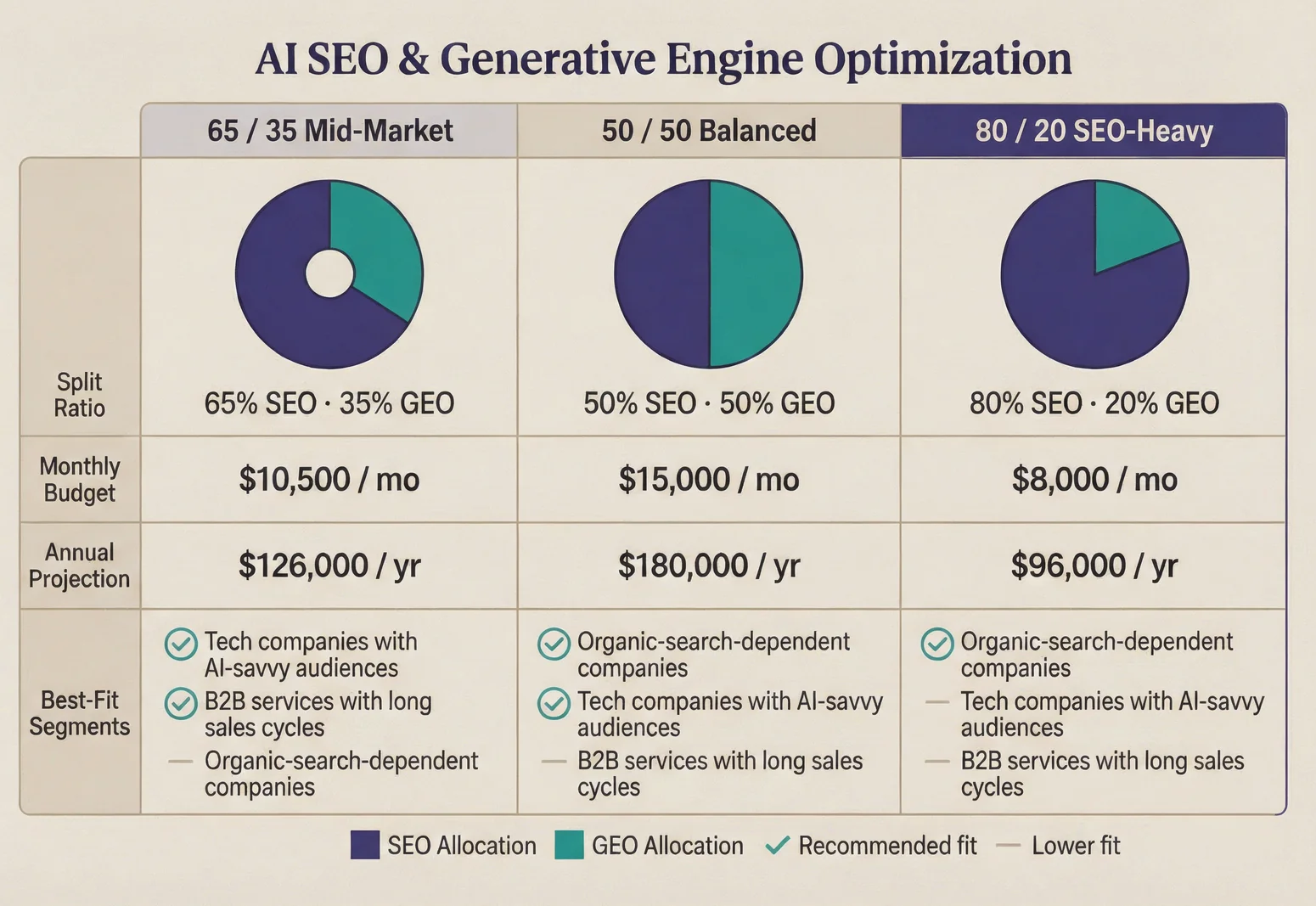
The 65/35 Starting Point
Research from Presenc.ai (March 2026) suggests a 65% SEO / 35% GEO split for mid-market companies, approximately $10,500 monthly total. This reflects current ROI curves: SEO still drives more attributable revenue, but GEO delivers incremental visibility that compounds.
Their data shows combined GEO+SEO strategies deliver 41% higher overall search visibility ROI than SEO-only approaches. This does not mean GEO is cheaper. It means the incremental investment pays back when integrated rather than siloed.
Segment Variations
- Tech companies with AI-savvy audiences: 50/50 or even 35% SEO / 65% GEO, as buyers increasingly research via ChatGPT and Perplexity
- Companies heavily dependent on organic search: 80% SEO / 20% GEO initially, preserving core revenue while testing AI visibility
- B2B services with long sales cycles: 60/40, as GEO citations influence early-stage research that SEO may miss
Avoiding the Double-Pay Trap
The most expensive mistake is treating GEO as a separate vendor relationship. Agencies selling "GEO packages" distinct from SEO often repackage identical work. The additive GEO layer—schema, entity clarity, citation formatting, AI tracking—should cost 15–25% more than SEO alone, not 100% more.
Teams should audit any GEO proposal against their current SEO scope. Overlap should be explicit, not buried in ambiguous deliverables.
What Forward Budgets Look Like
GEO budgets are growing at 89% year-over-year versus 12% for SEO, but from a smaller base. The trajectory suggests convergence: within 24–36 months, many mid-market teams will run 45–55% GEO allocations.
For planning purposes, a team spending $120,000 annually on SEO in 2026 might budget:
- Conservative: $120,000 SEO + $24,000 GEO (20%) = $144,000 total
- Balanced: $120,000 SEO + $48,000 GEO (40% incremental) = $168,000 total, restructured as ~$110,000 SEO + $58,000 GEO blended
- Aggressive: $120,000 SEO + $90,000 GEO, then restructure to $90,000 SEO + $120,000 GEO as performance data validates
The restructure is key. GEO investment should eventually replace some SEO spend as AI search captures query volume, not simply stack on top.
When GEO Costs More Than It Should
Three patterns inflate GEO budgets unnecessarily:
Vendor duplication: Buying separate SEO and GEO retainers from different agencies without scope coordination. The SEO vs GEO myths research shows this is the most common budget leak.
Tool sprawl: Subscribing to overlapping AI visibility platforms before exhausting existing SEO tool capabilities. Many rank trackers now include AI Overview monitoring.
Content restart: Abandoning existing content libraries rather than retrofitting for citation formatting. Restructuring a 200-post archive costs 20–30% of replacing it.
Teams that map GEO requirements onto current operations before adding vendors typically spend 30–40% less in year one.
Reader Questions: Budget Realities
Does GEO require separate headcount? Not necessarily. A senior SEO professional can absorb GEO responsibilities with 40–60 hours of structured training and tool onboarding. Dedicated GEO hires make sense at enterprise scale or when AI visibility is a board-level priority.
Can small teams afford GEO? Yes, with discipline. A solo operator can add basic GEO—schema refinement, citation formatting, monthly AI answer checks—for $300–$600 monthly in tools and 5–8 hours of labor. The free keyword audit tools and free SEO courses resources reduce training costs.
How do I justify GEO spend without attribution? This is the hardest question. Current GEO measurement is correlation-heavy. Leading indicators—citation rate, answer sentiment, share of voice—require 3–6 months to show trend validity. Frame initial GEO investment as brand visibility research with revenue attribution to follow, not immediate ROI.
Is the 1.5–2x GEO premium permanent? Likely not. As tools automate citation tracking and answer simulation, the labor premium compresses. The 2026–2027 window is transitional pricing. Teams locking in long GEO retainers at peak rates may overpay as the market matures.