How to Get Cited in AI Search Results: Structured Data & Formatting
Learn how to get cited in AI search results. Step-by-step guide to structured data, formatting patterns, and content optimization for generative search citations.

Getting cited by generative search engines is not the same as ranking on page one. Traditional SEO chases position; AI citation optimization chases attribution—the moment an LLM names your page as a source. The mechanics differ, and most teams are still applying old playbooks to a new game.
This guide walks through the specific content-structure changes that increase citation probability in generative search engines. We cover semantic markup, entity density, source attribution patterns, and QA formatting. Each section includes a verification cue so you can confirm whether your changes are working.
What Generative Search Engines Actually Cite
Generative engines—Google's AI Overviews, AI Mode, Perplexity, ChatGPT with browsing—do not reproduce the ten-blue-links model. They synthesize answers from multiple sources, then surface links as citations. The 2026 AI Visibility Index from Lucie Content found that more than one in four brands have become "completely invisible" to AI systems despite maintaining traditional search presence. A separate Fractl analysis noted that some brands with the strongest SEO footprints barely appear in AI answers, while smaller sites with clearer entity signals show up repeatedly.
The distinction matters. Being cited requires that an engine can:
- Identify your content as a distinct source (entity resolution)
- Extract a verifiable claim (structured, attributable information)
- Validate that claim against other sources (consistency and corroboration)
Google's own guidance confirms this: AI features surface "relevant links to help people find the information they're looking for quickly and reliably," with systems designed to appear on queries where generative responses are "additive to classic Search." The Google Search Central documentation emphasizes that these features "offer unique opportunities for more types of sites to appear"—but only if their content meets specific structural criteria.
The Foundation: Entity-First Content Architecture
Before formatting specifics, your content needs entity clarity. Generative engines resolve sources by named entities—people, organizations, products, concepts—not just keyword density.
Map Your Core Entities
List the 5–10 entities your page must be associated with. For a B2B SaaS pricing guide, these might include: your company name, your product category, specific pricing model names, competitor alternatives, and key integration partners.
Each entity should appear:
- In the H1 or first H2
- In the opening paragraph with a definitional context
- In schema markup (Organization, Product, or Article type)
- In at least one internal link anchor elsewhere on your site
Use Consistent Disambiguation
If your brand name is ambiguous ("Atlas" for project management, not the map), add clarifying phrases in the first mention: "Atlas, the B2B project management platform." Repeat this disambiguation in meta descriptions, Open Graph tags, and schema alternateName fields.
Verification cue: Search your brand name in Perplexity or ChatGPT. Does the response correctly identify your category and link to your domain? If not, your entity signals are insufficient.
Structured Data That Engines Actually Parse
Schema.org markup is not optional for AI citation. Google's guide to optimizing for generative AI features explicitly notes that these systems rely on "core Search ranking and quality systems" augmented with AI techniques. Structured data feeds those core systems.
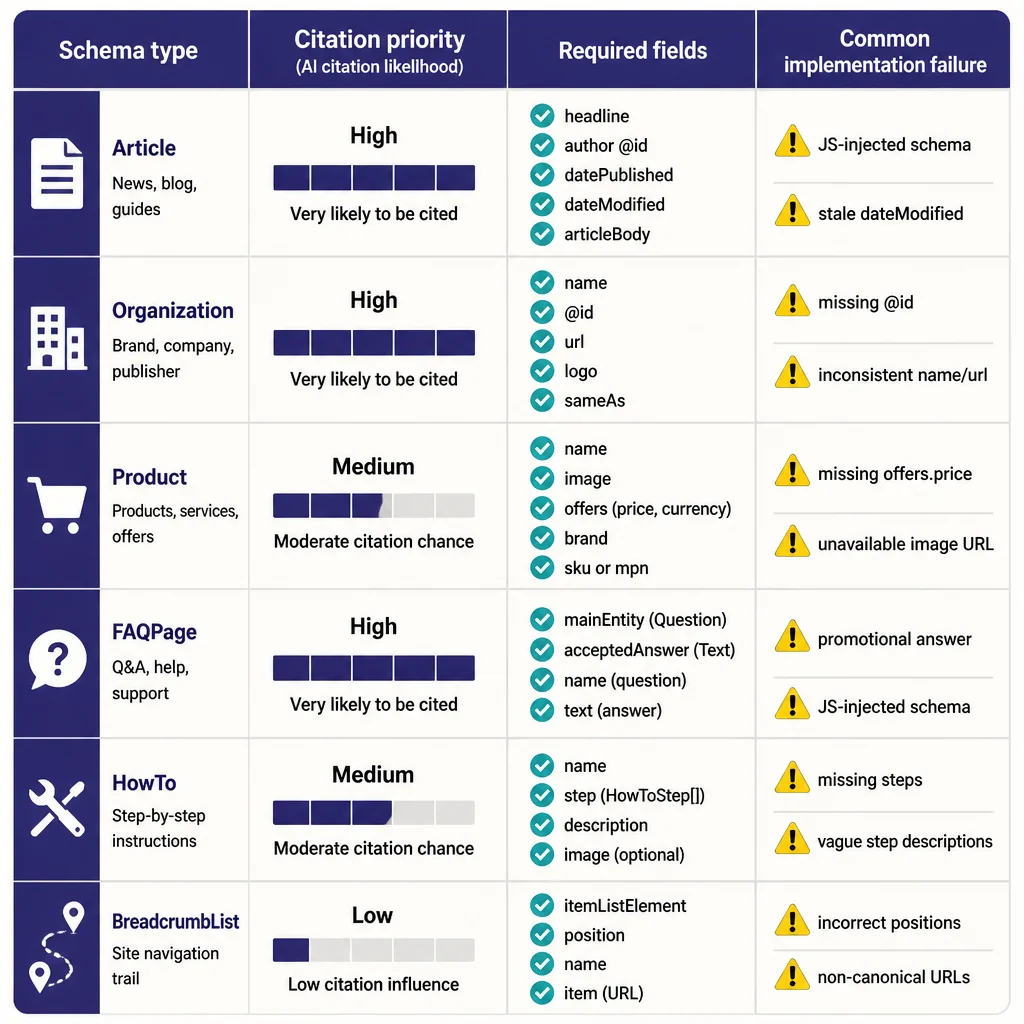
Required Schema Types
| Schema Type | Purpose | Priority |
|---|---|---|
Article or BlogPosting |
Identifies content type and authorship | Required |
Organization |
Establishes publisher entity | Required |
BreadcrumbList |
Clarifies site hierarchy and URL context | Required |
FAQPage |
Enables direct answer extraction | High |
HowTo |
Signals procedural content structure | High |
Speakable |
Marks content suitable for voice/AI summarization | Medium |
Implementation Details
Place Article schema in the <head> or as JSON-LD in the body. Include:
headline: Matches H1 exactlyauthor: Person or Organization with@idreferencedatePublishedanddateModified: ISO 8601 format, withdateModifiedupdated on substantive revisionsarticleBody: Full text or truncated version—some engines use this for direct extraction
For FAQPage, each mainEntity needs a name (the question) and acceptedAnswer.text (the answer). The answer should be a complete sentence, not a fragment. Fragment answers trigger "found on web" citations rather than direct attribution.
Verification cue: Run your URL through Google's Rich Results Test. All required fields should populate without warnings. Then check the rendered HTML—some CMS plugins inject schema that never reaches the DOM.
Formatting Patterns for Extraction and Attribution
How you format content determines whether engines can extract discrete claims. Dense paragraphs with multiple ideas buried inside fail. Clear, bounded information units succeed.
The Claim-Source-Context Pattern
Every attributable statement should follow this structure:
Claim: A specific, verifiable assertion.
Source signal: Attribution phrase ("according to," "data from," "research by").
Context: Why the claim matters to the reader.
Example (weak):
Many companies are investing in AI search optimization.
Example (strong):
Semrush's July 2026 study of 600,000 keywords found that AI Overviews expanded across commercial-intent SERPs by 71% over six months, with the trend accelerating in Q2.
The strong version names the source, specifies the methodology, and provides a time-bound metric. Generative engines can extract this as a citable unit.
Use Hierarchical Headings as Extraction Boundaries
Engines use heading structure to segment content. Each H2 should introduce one claim category; each H3 should contain one specific claim with supporting evidence.
Structure pattern:
H2: Pricing Model Comparison
  H3: Cost-Plus Pricing in Manufacturing
    - Definition
    - Typical margin range
    - When it fails
  H3: Value-Based Pricing in SaaS
    - Definition
    - Implementation requirements
    - Risk factors
This segmentation lets engines cite your H3 as a specific source for a specific claim, rather than attributing a broad statement to your entire article.
List and Table Discipline
Use ordered lists for sequential processes, unordered lists for attribute sets, and tables for comparisons of three or more options across two or more attributes.
Table requirements for citation:
- Header row with explicit attribute names
- Consistent units (don't mix percentages and ratios)
- Source column or footnote for contested data
- No merged cells—break complex comparisons into simpler tables
Verification cue: Copy a paragraph into ChatGPT and ask it to extract all citable claims with sources. If it cannot identify discrete claims with attribution, restructure.
Source Attribution and Corroboration Signals
Generative engines validate claims by cross-referencing multiple sources. Your content should signal where corroboration exists and where it does not.
Cite Primary Sources Inline
Link to primary research, official documentation, or original datasets—not secondary summaries. The anchor text should describe the source content, not the action of visiting:
- Strong: "BrightLocal's 2026 consumer survey found 45% of consumers now turn to AI for business recommendations"
- Weak: "a study found" or "click here for data"
When primary sources are unavailable, state the limitation: "No published study directly compares these methods; the following analysis draws on reported implementation outcomes from three SaaS companies."
Include Contradictory Evidence
Content that acknowledges uncertainty or conflicting data signals higher trustworthiness to validation systems. If two studies disagree, present both with their methodologies and sample contexts. This mirrors how RAG hallucination fixes improve output reliability—by grounding claims in retrievable, verifiable context rather than forcing consensus where none exists.
Date Everything
Time-bound claims need visible dates. Place publication or data-collection dates immediately after the claim, not buried in footnotes:
GPO's August 2026 State of Search analysis distinguished between "being cited" and "being recommended"—a distinction their earlier reports did not emphasize.
Verification cue: Search for one of your claims in Perplexity. Does the response cite your page, or a secondary source that mentioned the same data? If the latter, your attribution chain is too weak.
QA and Procedural Content Optimization
How-to content and FAQ sections receive disproportionate AI citation because they match query formats directly. But structure determines whether they get attributed or merely scraped.
FAQ Schema with Complete Answers
Each FAQ entry needs:
- A question in natural language (not keyword-stuffed)
- An answer of 40–80 words
- No promotional content in the answer
- A single discrete claim per answer
Avoid combining multiple questions or embedding CTAs. Google's systems extract FAQ content for direct answer panels; promotional language disqualifies the source.
HowTo Markup for Procedures
For step-by-step content, use HowTo schema with:
totalTime: ISO 8601 durationsupplyandtoollistssteparray withname,text, and optionalimage
Each step should be actionable in isolation. "Optimize your content" fails; "Add Article schema with dateModified to your template header" succeeds.
The GEO SEO whitepaper covers how these structural patterns influence generative engine behavior at scale, including the black-box optimization framework that researchers formalized to measure citation probability across different content architectures.
Verification cue: Search your how-to query in Google AI Mode. Does your page appear in the "Sources" panel? If not, check whether your steps are extractable as discrete instructions or buried in narrative text.
Content Freshness and Drift Monitoring
AI citation favors recent content for time-sensitive queries. But freshness without accuracy signals is worse than older, stable content.
Update Patterns
- Data-driven claims: Update annually or when new primary research publishes
- Procedural content: Update when tools, interfaces, or requirements change
- Evergreen definitions: Refresh with new examples or applications, not vacuous "updated" timestamps
Use dateModified schema and visible "Last updated" text. Some CMS systems update timestamps on trivial changes—disable this. Engines may weight pages with suspicious update patterns lower.
Semantic Drift Detection
As language models evolve, the terms and concepts they associate with your entities shift. Monitor whether your content still resolves to the same queries. Tools that track LLM visibility—how often your brand appears in AI responses for target queries—help identify when your entity associations have drifted from your intended positioning.
Verification cue: Compare your AI visibility for target queries month-over-month. A decline without ranking changes in traditional search indicates semantic drift, not content quality issues.
Common Implementation Failures
Teams often implement the right patterns incorrectly. These failures block citation without obvious symptoms:
Schema in the DOM but not the rendered page: JavaScript-injected schema fails for engines that parse static HTML. Verify with view-source: or curl, not just browser DevTools.
Over-optimized anchor text: Exact-match internal links signal manipulation. Use descriptive phrases that include the entity naturally: GEO vs SEO differences rather than repeated "GEO SEO" links.
Cited but not recommended: GPO's research distinguishes these states. A citation appears in the sources panel; a recommendation means the engine presents your brand as the answer. Recommendation requires stronger entity authority and consistent corroboration across sources.
Fragment answers in FAQ schema: Answers under 20 words or over 200 words fail extraction. Target the 40–80 word range with complete sentences.
What to Measure and When
AI citation optimization lacks the immediate feedback of ranking tools. Establish these measurement rhythms:
| Interval | Action | Tool/Method |
|---|---|---|
| Weekly | Manual query test in 3+ generative engines | Perplexity, ChatGPT, Google AI Mode |
| Monthly | Citation rate analysis for target queries | Track presence in source panels |
| Quarterly | Schema validation and entity resolution check | Rich Results Test, direct LLM queries |
| Semi-annually | Full content audit against current AI search patterns | Compare to AI algorithm shifts coverage |
The July 2026 AI Search Visibility Report from Meltwater noted that LinkedIn citations grew 67.8% month-over-month, driven mainly by Perplexity and Google AI Mode, while Wikipedia and NIH declined. Platform-specific citation patterns shift rapidly; your measurement must keep pace.
From Citation to Recommendation
Citation is the baseline. Recommendation—where AI systems present your brand as the definitive answer—requires building entity authority over time. This means consistent publication in your target topic areas, corroboration from independent sources, and structural clarity that lets engines verify your claims against others.
The SEO vs GEO myths that persist in marketing teams often block this progression—treating generative optimization as a layer on top of traditional SEO rather than a distinct discipline with its own success metrics.
Start with structure. Verify with extraction tests. Measure citation presence. Build toward recommendation through entity consistency and source corroboration.
When AI Search Engines Change the Rules
Generative search is not stable. Google's August 2026 spam update, the expansion of AI Overviews into commercial queries, and the introduction of AI impression data in Search Console all changed the measurement landscape within a single quarter. The AI search SEO terminology continues evolving as platforms consolidate their naming and publishers adapt their strategies.
Your content architecture should be robust to these changes: clear entities, verifiable claims, proper attribution, and schema that engines can parse regardless of which model generation processes it. The specific features will shift; the structural requirements for citation will not.
References
- GEO: Generative Engine Optimization — The advent of large language models (LLMs) has ushered in a new paradigm of search engines that use generative models to gather and summarize information to answer user queries.