
What Is GEO SEO? A Whitepaper for AI Search Teams
Download this technical whitepaper exploring the definition, mechanics, and measurable impact of generative engine optimization for AI-driven search.

B2B founders, agency operators, and marketing directors who built organic traffic on traditional search engine optimization now confront a structural shift. As of mid-2026, users increasingly pose questions to ChatGPT, Perplexity, Claude, or Google’s AI Overviews instead of scanning ten blue links. The core challenge is no longer ranking on page one — it is becoming the source a language model cites when it assembles an answer. This whitepaper defines generative engine optimization, traces the evidence for its emergence, and lays out the mechanisms marketing teams need to understand before committing budget and rewriting editorial standards.
The Search and Citation Decoupling
Google itself now reports that AI-powered search features such as AI Overviews and AI Mode are drawing users into longer engagement sessions and, in several categories, higher conversion rates. The Google Search Central guidance frames this not as a replacement of search but as an upgrade — one that “offers new opportunities to reach people who may be more inclined to engage with your site, spend more time with your content, or even convert by becoming a subscriber or making a purchase.”
Independent measurement tells a more dramatic story. By early 2026, Ahrefs found that only about 38% of pages cited in AI Overviews also ranked in Google’s top 10 organic results, down from roughly 76% the year before. BrightEdge placed the overlap as low as 17%. In plain terms, a page that dominates the classic SERP can be completely invisible to the large language model assembling the generative answer — and a highly cited AI source may not rank anywhere near the first page.
This decoupling is not a marginal anomaly. A 2026 survey cited by Lureon.ai indicated that 67% of Fortune 500 CMOs now name GEO a top-three digital priority, up from 18% in 2024. The shift in executive attention reflects the economic pressure to regain visibility on surfaces where customers increasingly start their research.
For teams that cut their teeth on traditional keyword strategies, the disorientation is real. The work you poured into technical SEO, link building, and keyword-optimized content still matters — but it signals to a different audience now. Where the algorithm once rewarded click probability, it now rewards retrieval fit and citation likelihood. Recognizing this as a parallel surface of visibility, rather than a replacement, is the first mental pivot.
Defining the Field: A Formal Account of Generative Engine Optimization
The term “GEO SEO” — though slightly redundant to practitioners inside the field — describes the discipline of optimizing digital content to appear as an authoritative source or direct citation within the responses delivered by generative AI engines. In daily use it is shortened to GEO. Marketers also encounter “answer engine optimization” (AEO) as a near-synonym, though strict taxonomists reserve AEO for zero‑click featured‑snippet strategies and GEO for the broader ecosystem of large language model‑powered search.
A clean working definition appears in the Semrush guide to GEO: “Generative engine optimization (GEO) is the practice of optimizing your presence and content to appear in responses generated by AI-powered search systems such as ChatGPT, Google, Perplexity, Claude, and others.” The objective is not to earn the click but to earn the citation.
This is not a trivial rebranding. When an AI model synthesizes an answer from multiple sources, it does not crawl the web in the same way a traditional crawler does. Instead, it relies on retrieval-augmented generation (RAG) — pulling semantically matched chunks from an index and passing them to a language model that weights authority, recency, semantic density, and entity coherence. The WordStream guide on GEO vs. SEO underlines the distinction: “traditional SEO focuses on ranking in search engine results pages (SERPs) to earn clicks, GEO aims to position your content as the primary source that AI engines reference when they generate answers.”
The real name for the practice is generative engine optimization, and the confusion in the market about the real name for AI search SEO highlights how new the field is. The official terminology settled by Google and major research labs is simply GEO, and that is the label used throughout this paper.
Four Mechanisms That Determine AI Search Citations
Understanding GEO requires moving past the definition and into the retrieval pipeline. Four mechanisms consistently appear in the behavior of generative systems and in the guidance published by Google’s search team.
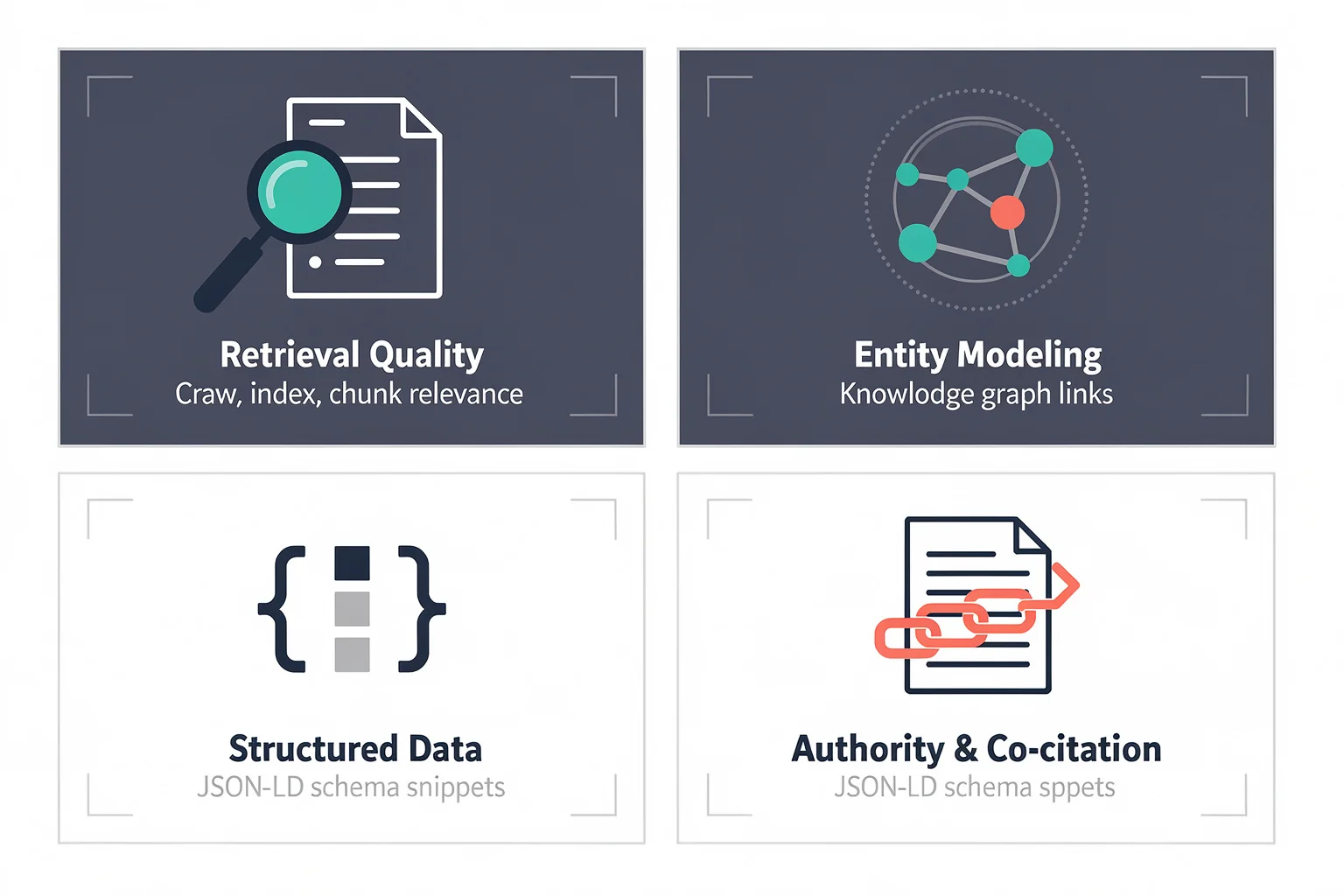
Retrieval quality and index representation
Generative engines depend on the same index signals that power traditional search — crawlability, page speed, mobile-friendliness — but they apply an additional layer of chunk‑level relevance. When a query arrives, the retriever fetches semantically matched passages, not whole pages. A page built with clear heading hierarchy, short self-contained paragraphs, and explicit entity annotations is far more likely to yield retrievable chunks. Google Search Central’s guide affirms that “foundational SEO best practices continue to be relevant because our generative AI features on Google Search are rooted in our core Search ranking and quality systems.”
Entity modeling and semantic coherence
Large language models compare the concepts that appear in a page against vast knowledge graphs. When an article about a software product includes its developer, release date, and technical classification in consistent, machine-readable language, the retriever can align that chunk with the query’s intent with higher precision. This is why semantic SEO for AI search has moved from a niche phrase to a central skill: writing for meaning — not keyword density — aligns content with the way language models encode topics.
Structured data as a retrieval cue
Schema markup that describes products, reviews, organizations, and events still acts as a strong signal. It is not a ranking hack, but it gives retrieval systems a canonical reference to resolve ambiguous entities. A short JSON-LD snippet can encapsulate the core entities of a service page in a format that is unambiguous to both crawlers and the retrieval index.
`json { "@context": "https://schema.org", "@type": "SoftwareApplication", "name": "SiaSEO", "applicationCategory": "BusinessApplication", "operatingSystem": "Web", "offers": { "@type": "Offer", "category": "AI Content Platform" } }
Our own measurement on [structured data in AI search](https://siaseo.com/blog/structured-data-ai-search-visibility) confirms that pages with rich, validated schema are cited more reliably in Google AI Overviews, especially for commercial and technical queries.

### Authority and co‑citation patterns

While link-based PageRank remains part of Google’s underlying index, generative systems also measure how frequently a source is referenced by other trusted documents in the same topical cluster — a modern co-citation analysis. This rewards brands that build dense, interconnected topic clusters rather than isolated articles, because the retriever encounters consistent entity references across multiple trusted pages.

## From Definition to Operations: A GEO Implementation Framework

For a marketing director at a mid‑market SaaS company or an agency operator managing multiple clients, the following sequence provides a pragmatic on‑ramp without requiring a full organizational restructure.

| GEO workstream | Core objective | Typical lead time |
|----------------|----------------|-------------------|
| Retrievability audit | Ensure key claims survive passage extraction | 2–3 weeks |
| Site‑aware content production | Generate citation-ready, entity‑linked material | 4–8 weeks per cluster |
| Structured data refresh | Deploy validated schema across core pages | 2–4 weeks |
| Topic cluster build‑out | Cover subjects from multiple interconnected angles | 8–12 weeks |

**Audit existing content for retrievability.** Use a tool that simulates RAG extraction: break each key landing page into semantic chunks and check whether the essential claim survives isolation. Many pages built for skimming fail this test because the core statement is buried in a long introductory anecdote.

**Invest in site‑aware content production.** Generic AI copy tools produce text that reads well but rarely cites sources correctly or respects entity relationships. Platforms that ingest a site’s existing structure and write against a quality‑scored brief — like SiaSEO — help ensure that new content aligns with the domain’s established entity graph and reduces the hallucination rate typical of uncontrolled large language model outputs. The goal is not volume but structured, citation‑ready material.

**Implement or refresh structured data.** Start with Organization, WebSite, Article, and FAQPage schemas. Validate via Google’s Rich Results Tool, then monitor Google Search Console for AI Overview impressions in the performance report (now available for AI features). This step often surfaces pages that are already being retrieved but lack the schema polish to rise to the top.

**Build topic clusters instead of one‑off pieces.** Analysis of AI Overview citations shows that the cited sources frequently belong to domains covering a subject from multiple angles with interlinked assets. A platform like SiaSEO can generate a seven‑day content calendar mapped to semantic gaps, speeding up the cluster build‑out without sacrificing editorial coherence.

**Track citation, not just clicks.** Because some AI answers are synthesized summaries that satisfy the query without requiring a visit, click‑through rate loses its diagnostic power. Teams should adopt proxy metrics: brand mention frequency in AI outputs, “citation share” within a topic, and the delta between conventional organic traffic and attributed AI referral traffic (when available).

The [GEO vs SEO difference](https://siaseo.com/blog/geo-vs-seo-generative-engine-optimization-difference) ultimately boils down to this: SEO earns the rank; GEO earns the citation. Many of the underlying technical practices overlap, but the objective function changes, and with it, the required measurement stack.

## Key Limitations and Unanswered Questions

No honest whitepaper ends without stating the boundaries of current knowledge. Several open questions remain.

First, attribution remains broken. AI‑generated answers often cite multiple sources without a clear weight for each, and the conversion path from “cited in an answer” to “customer action” has no standard tracking mechanism. Early adopters profiled by Search Engine Land are building regression models that correlate AI visibility with revenue, but these are custom, expensive, and not yet measurable in widely available analytics platforms.

Second, platform differences are large and unstable. A page that performs well in Google AI Overviews may be ignored by Perplexity or Claude. The retrieval and ranking algorithms differ, and there is no unified GEO dashboard. The best teams run multi‑platform tests and accept that a single optimization pass cannot satisfy all engines.

Third, freshness poses a structural challenge for RAG‑based systems. Indexing a new article through the crawl‑render‑retrieve pipeline still takes time, meaning time‑sensitive content may appear in traditional search before it surfaces in generative answers. Google’s guidance suggests that a well‑optimized page using standard best practices will eventually be incorporated, but the latency window is not documented.

Fourth, the long‑term impact of AI‑generated content on the corpus used to train the next generation of retrieval models remains unknown. A feedback loop could narrow the surface of citable material to a small set of highly optimized domains, reducing diversity over time. Researchers have begun to flag this, but no accepted mitigation strategy exists yet.

These gaps do not make GEO a low‑priority effort. They mean that marketing leaders should treat early GEO investments as experiments tied to learning budgets rather than as replacement pipelines for proven SEO programs.

## Questions from the C‑Suite

The following questions emerged from conversations with agency operators and SaaS marketing leaders who are evaluating GEO for the first time. The answers reflect the state of published evidence and practical field signals, not speculative predictions.

**Is GEO replacing traditional SEO?**

No. Google’s own documentation and every major analyst report indicate that GEO operates alongside SEO. The same technical foundations — crawlability, mobile experience, page speed, schema — help both channels. The difference is in content architecture: GEO demands a citation‑worthy, entity‑rich presentation, whereas classic SEO can sometimes thrive on longer‑form, listicle‑style pages that satisfy user intent but do not compress cleanly into a retrieval chunk. A smart team maintains both capabilities.

**How quickly do GEO optimizations show results?**

No reliable benchmark exists yet. Some early experimenters, such as those observing [AI SEO algorithm shifts](https://siaseo.com/blog/ai-seo-vs-traditional-seo-how-algorithm-shifts-are-reshaping), saw citation improvements within weeks when they reworked existing pages with clear schema and semantic structure. Others saw no movement for months, likely due to crawl budget and index refresh cycles. Plan for a 3–6 month feedback loop.

**Do we need different content for different AI platforms?**

For now, pragmatic teams are segmenting by platform intent. Google’s AI features, which draw from the existing index, reward the strongest alignment with traditional SEO best practices. Standalone answer engines like Perplexity and ChatGPT appear to weight recency, directness, and source diversity more heavily. A common approach is to maintain a single canonical asset that is well‑structured and then publish derivative summaries in formats known to perform well on other platforms (e.g., a concise Q&A version for Perplexity ingestion).

**What role does schema play when AI doesn’t “crawl” the hard way?**

AI engines retrieve from indexes that are themselves built by crawlers. Structured data helps the crawler understand and classify entities at index time. When the retriever later queries the index for “project management tool for remote teams,” the schema‑marked page has higher precision. It is a background signal, but a durable one.

## Building Your AI Search Capability

The material above defines the baseline understanding a marketing leader needs to assess GEO investments. The next level of detail lives in tactical guides that translate these principles into weekly workflows.

- [AI search visibility playbook](https://siaseo.com/blog/practical-playbook-ai-search-visibility-2026)
- [Multilingual AI search strategies](https://siaseo.com/blog/multilingual-ai-search-visibility)
- [GEO Vs SEO Difference](https://siaseo.com/blog/geo-vs-seo-generative-engine-optimization-difference)

<!-- BLG_STRATEGY_CTA -->

> **Review SiaSEO as the operating system for structured SEO content production.** — [Get started](https://siaseo.com)

<!-- /BLG_STRATEGY_CTA -->