
10 SEO vs GEO Myths That Are Costing You Search Traffic
Debunking the top 10 SEO vs GEO myths that drain your search traffic. From 'GEO kills SEO' to 'keywords are dead', see the evidence and update your strategy.

The search landscape in 2026 has split into two distinct visibility problems. Traditional search engine optimization still pulls in traffic from Google’s ranked lists. Generative engine optimization (GEO) determines whether your brand gets cited inside AI-generated answers from tools such as ChatGPT, Perplexity, and Google AI Overviews. Yet in boardrooms and Slack channels, the conversation often flattens these two disciplines into a single playbook. That conflation is not just inaccurate — it wastes budget, misdirects content teams, and leaves citation share on the table.
What follows are the ten most damaging myths about the relationship between SEO and GEO, ranked by how frequently they mislead marketing organizations and the measurable traffic consequences they create. Every claim is grounded in published research, platform documentation, and operational field reports from 2025–2026.
1. Myth: SEO and GEO are the same discipline
This myth persists because both activities share a founding goal: get your content in front of someone who wants it. The difference is the mechanism. SEO optimizes for ranking; GEO optimizes for selection and citation. When a user types a query into Google, SEO determines which blue link appears at position one. When they ask ChatGPT a product question, GEO determines whether your product gets named in the paragraph that follows.
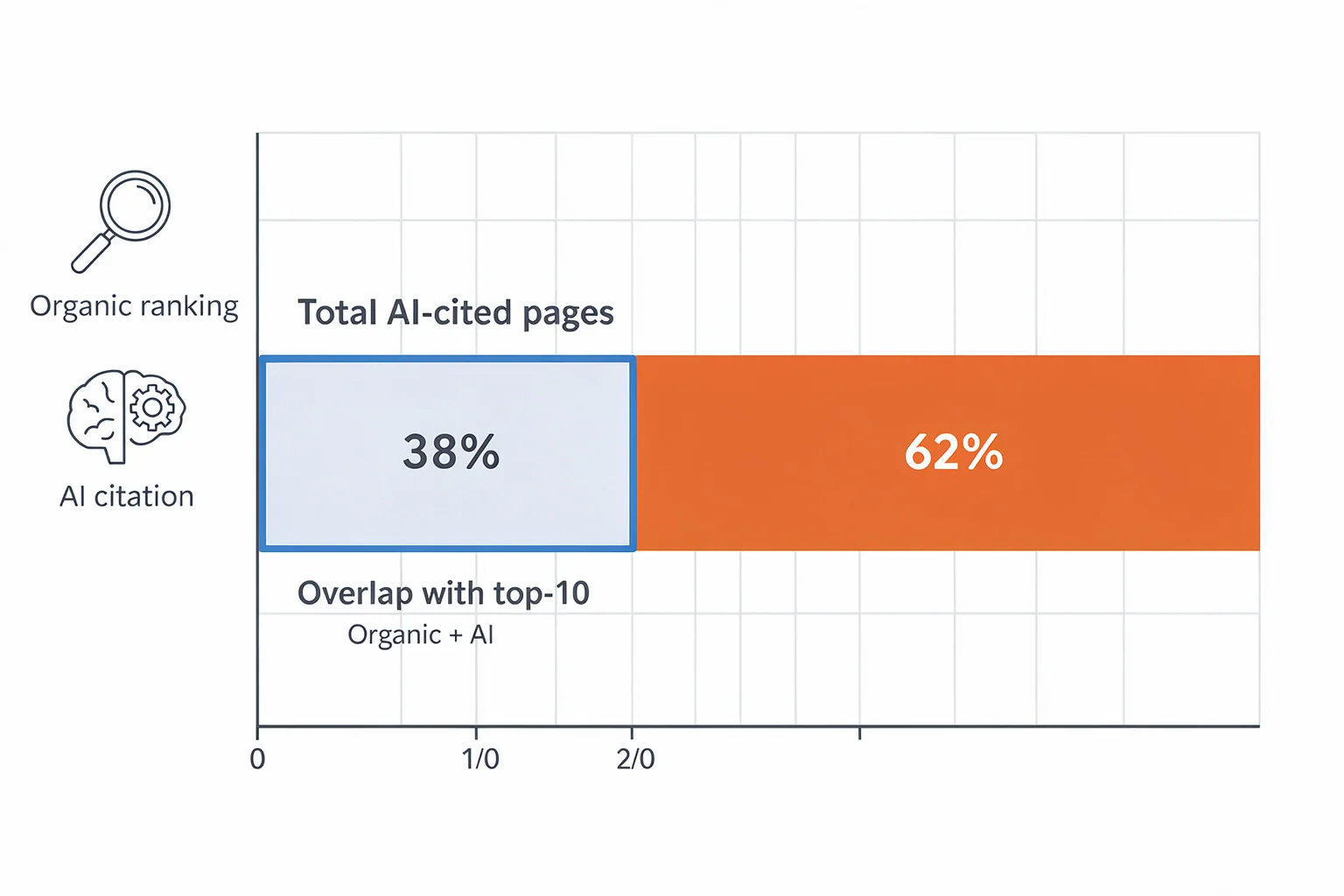
The overlap between the two is shrinking fast. In early 2026, an analysis by Omid Saffari found that only 38% of AI-cited pages still ranked in Google’s top 10 organic results, down from roughly 76% a year earlier; BrightEdge put the figure as low as 17%. Treating them interchangeably means a brand can dominate the SERP yet remain invisible where AI answers are surfaced.
Who it hits hardest: Agencies and in-house teams that repackage the same content for both surfaces without adjusting structure, format, or citation signals.
Limitation: The two share technical foundations — crawlability, site structure, and authority remain essential for both — so completely separating the practices is counterproductive.
Verdict: Understand them as two outcomes of the same site foundation, demanding different tactical layers. For a clear breakdown, read the difference between GEO and SEO and the naming confusion around SEO in AI search that often distorts strategy.
2. Myth: A number-one Google ranking guarantees an AI citation
Ranking well has never been a promise of anything other than a clickable blue link. The 2026 citation data makes that starkly concrete. Only 38% of pages cited in AI Overviews also hold a top-10 organic position, which means 62% of citations come from pages the user might never scroll to organically. Even a top-three ranking does not secure a mention — many highly ranked pages lack the factual directness and structured information that AI engines need to extract and quote.
The reason is mechanical. AI models parse content for answer extraction, not for page authority signals alone. A page that ranks first because of its backlink profile can still be ignored if its core claims are buried in narrative prose rather than presented in a machine-readable paragraph block.
Who it hits hardest: SEO teams that report rankings as a proxy for overall visibility without monitoring AI citations.
Limitation: Rankings still correlate with authority, and authority still matters for GEO; the correlation is just far weaker than it was.
Verdict: Treat ranking as one input, not the outcome. Monitor what AI surfaces cite — and, critically, what they do not cite — for your target topics.
3. Myth: GEO will replace SEO
“Is SEO dead?” has been a tired refrain for a decade. The 2026 version asks whether generative AI answers will make traditional search irrelevant. Traffic data does not support it. Google remains the starting point for billions of purchase decisions and research journeys. What has shifted is the composition of that traffic: AI Overviews sit above the fold for many commercial queries, compressing organic click-through rates, but the underlying search volume has not evaporated.
Rachel McLeay, writing on Searchverse Insights, frames the practical split clearly: “SEO finds the many, GEO speaks to the individual.” SEO strategies are built for breadth — ranking across a cluster to capture aggregate demand. GEO strategies aim for precision — being the exact answer for one specific query, even if that answer is delivered inside a conversational interface.
Who it hits hardest: Founders who consider reallocating the entire content budget away from traditional SEO based on a single quarter’s trendline.
Limitation: The balance varies by niche. In some B2B categories, the user still clicks a link to read a detailed specification; in consumer decision support, AI summaries are already the front door.
Verdict: Keep the SEO that still drives attributable revenue, and build GEO capability for the citations that increasingly sit between the consumer and the organic result. The shifts in AI SEO vs traditional SEO show how platforms are blending, not replacing, the two.
4. Myth: Keywords no longer matter for GEO
It is true that exact-match keyword density is irrelevant for AI-driven citation. What matters is entity coverage — does your content unambiguously address the entities, attributes, and relationships the user’s query implies? That still demands systematic topic research, which begins with understanding the language people use, i.e., keywords.
SEMRush’s GEO vs. SEO guide notes that GEO requires “factual, concise language” and “structured content so LLMs can easily parse and summarize it.” That doesn’t mean throwing out keyword research; it means pivoting from a single-keyword-focus to topic clusters that mirror how AI models actually decompose a query.
An effective approach combines keyword intelligence with entity mapping, ensuring each page covers the full conceptual space around a topic instead of over-optimizing for one phrase. Platforms that automate this mapping, linking briefs to site context and scoring semantic coverage, turn a labor-intensive task into a repeatable production step.
Who it hits hardest: Content teams that abandoned keyword tools when AI summarization entered the search results, only to see their content become invisible.
Limitation: Topic modeling alone cannot replace the foundational work of understanding search intent and intent shifts; it is one layer in a broader GEO toolkit.
Verdict: Evolve your keyword workflow to entity-aware briefs. Stop counting density, start measuring conceptual completeness.
5. Myth: Backlinks are dead for generative AI search
Google addressed this directly in its official guidance on optimizing for generative AI features: “The best practices for SEO continue to be relevant because our generative AI features on Google Search are rooted in our core Search ranking and quality systems.” Those core systems still factor in PageRank and equivalent authority signals. A page with strong inbound links from trusted sources is fundamentally more likely to be indexed and considered by the systems that feed AI Overviews.
That said, the backlink’s role has shifted. A single authoritative mention no longer guarantees a citation, because the AI needs extractable claims, not a vague endorsement. The backlink opens the door; on-page structure and factual clarity walk through it.
Who it hits hardest: Link builders who heard “links don’t matter for AI” and stopped everything — and, conversely, teams that thought links alone would carry them into GEO.
Limitation: In some platforms (ChatGPT’s browsing mode, Perplexity), the influence of backlinks is indirect at best. Yet for Google’s AI surfaces, the documented connection is clear.
Verdict: Continue earning authoritative backlinks; pair them with content that AI can actually cite. As Google’s generative AI search documentation underscores, foundational SEO is not optional — it is the layer that GEO builds on.
6. Myth: GEO just means adding FAQ schema
Schema markup helps machines understand page structure, and FAQPage schema can occasionally trigger rich results. But GEO is not a schema specification. AI models extract meaning from unstructured text, headings, lists, and the relationships among entities — not just from JSON-LD blocks.
The SEMRush guide further clarifies that GEO optimization calls for authoritative content that other trusted sources mention, clear and factual prose, and structured on-page information that language models can parse without ambiguity. Schema is one signal among many.
Who it hits hardest: Technical SEOs who implemented FAQ schema, saw no citation lift, and declared GEO “doesn’t work.”
Limitation: Schema remains valuable, especially for structured data types that directly support entity disambiguation and product knowledge. It just cannot carry the full weight.
Verdict: Use structured data thoughtfully, but invest the bulk of effort in how the page reads to a model — clear headings, declarative statements, and entity-linked references that need no inference.
7. Myth: Only long-form, comprehensive guides get cited
Length, by itself, is a proxy for neither authority nor extractability. AI models are trained to pull concise answers from content, and a 4,000-word article that buries the one sentence an engine wants is less likely to be cited than a 600-word explainer that states the fact directly.
Field experiments reported by Automaton Agency in mid-2026 found that pages with clear headings, short declarative sections, and entity-rich factual blocks outperformed longer, more diffuse pieces in citation rates, even when domain authority was slightly lower. The AI rewards signal density, not word count.
Who it hits hardest: Teams that pad every article to hit an arbitrary length target believing that comprehensive equals authoritative.
Limitation: For some topics — especially those where the AI summarizes and still expects the user to click for depth — longer, well-structured pieces that answer multiple sub-questions perform well in both organic and AI channels.
Verdict: Optimize for the minimum viable answer first, then expand. Structure the article so the core fact sits in the opening block, followed by supporting layers.
8. Myth: GEO only applies to Google AI Overviews
Google’s AI Overviews capture attention because they sit inside the world’s most-used search engine, but the generative answer ecosystem is broader. ChatGPT’s browsing mode cites web content, Perplexity builds entire answer pages from aggregated sources, and Bing’s AI chat incorporates live search results. Even vertical tools like Consensus for academic search and various enterprise AI assistants pull from web pages via retrieval-augmented generation (RAG).
The Presenc AI 2026 State of GEO report noted that brands with mature GEO programs see 3.7× higher AI search visibility across platforms, not just on Google. Companies that optimize only for one engine leave citation share on the table in spaces where competitors are already being named.
Who it hits hardest: Marketing directors who equate GEO exclusively with Google’s AI features and ignore the growing non-Google AI search volume.
Limitation: Google still commands the majority of search queries, so prioritizing its AI surfaces is rational. The risk is in ignoring other platforms entirely.
Verdict: Run a cross-platform citation audit at least quarterly. Identify which AI engine your audience uses for high-intent queries and ensure your content is parseable by their retrieval mechanisms.
9. Myth: You can optimize for GEO without traditional SEO
This myth takes the form of “GEO is a new playbook, so we can skip the old one.” But the crawlability, indexability, page speed, and authority signals that drive traditional SEO are exactly the infrastructure that allows a page to enter the generative AI pipeline in the first place. Google’s generative AI features retrieve content from the same index that powers organic search; a page that cannot be crawled or is flagged as low-quality by core ranking systems will rarely surface in an AI Overview.
Search Engine Land’s analysis of the two fields emphasizes that while the tactical surface layers differ, the foundational layers — technical health, site architecture, entity authority — are shared. A broken sitemap hurts GEO. A spammy backlink profile hurts GEO. Neglecting these fundamentals while chasing AI-specific tweaks is like upgrading the paint on a car with a stalled engine.
Who it hits hardest: Teams that split into separate “SEO” and “GEO” squads with no shared technical standards.
Limitation: Some GEO-specific factors (citation signals, response formatting) function independently of traditional ranking factors, so SEO alone is not sufficient for GEO success either.
Verdict: Build GEO on a technically sound SEO foundation. One team, one infrastructure, two distinct content optimization layers.
10. Myth: There’s no way to measure GEO performance
Measurement for GEO is more nascent than for SEO, but it is not absent. Teams can track branded mentions in AI answers on the platforms their audience uses, monitor referral traffic from AI-driven search surfaces (when attribution strings are passed), and correlate content changes with shifts in AI-cited URL sets. Tools from Presenc AI and other vendors now offer dashboards that show AI visibility share across engines, while manual “prompt-and-check” audits remain practical for small portfolios.
The Presenc report found that 78% of marketing leaders now consider GEO essential, yet only 34% have mature programs, partly because measurement has been perceived as opaque. As RAG-based architectures expose more of their retrieval sources, the data will become more accessible — but waiting for perfect attribution before acting is the fastest way to lose first-mover advantage.
Who it hits hardest: CFOs who refuse to fund GEO initiatives without a guaranteed ROAS model.
Limitation: Attribution remains imperfect; some AI engines strip referrer data, and causal links between content changes and citation outcomes take days or weeks to surface. Accepting a measurement approach that mixes quantitative tracking with strategic correlation is currently necessary.
Verdict: Start with the metrics you can track now — branded mentions, AI referral clicks, and topic-level citation frequency — and treat GEO measurement as an evolving practice, not a prerequisite.
Where you take SEO today still determines the bedrock GEO stands on tomorrow. If the myths above have cut through one assumption you were carrying into your next content planning cycle, the highest-leverage action is to pick a single high-intent topic and test both optimization layers in parallel — traditional authority building for rankings, structured answer-ready formatting for citations. The two are not rivals. They run on the same infrastructure and, managed deliberately, they compound.
- GEO SEO whitepaper for AI search teams
- Best AI newsletter for marketers that drives rankings
- GEO vs SEO difference explained
Review SiaSEO as the operating system for structured SEO content production. — Get started