
Best AI Newsletter for Marketers: What Actually Drives Rankings
SiaSEO tests the best AI newsletters for marketers. See which sources deliver real SEO intelligence versus recycled hype.

Searches for “AI newsletter” grew 900% year-over-year as of early 2026, according to analysis by DevBrief, yet the volume of options makes selecting a worthwhile subscription harder, not easier. For marketing leaders and agency operators, the question is not which newsletter covers AI news fastest—it is which one consistently delivers insights you can turn into ranking improvements. The inbox offers daily opinions on artificial intelligence; the gap lies in editorial practices that separate actionable intelligence from hype. This whitepaper proposes a formal evaluation framework that scores AI newsletters on three dimensions: signal-to-noise ratio, depth of SEO-actionable content, and citation quality. Each dimension is defined, weighted, and applied to a set of widely cited newsletters, producing decision criteria that marketing directors, content leads, and SEO practitioners can reuse when deciding where to invest their reading time.
The Signal versus the Noise
An AI newsletter’s editorial rhythm often hides the absence of substance. A daily publication that summarizes the same three product launches as a dozen competitors may keep readers informed, but it rarely tells them what to change inside a content calendar or how to adjust a page’s on-page optimization.
Signal, in this framework, means content that explicitly links an AI development to a specific SEO tactic, ranking factor, or content production method. A newsletter that reports Google’s push of Gemini 3.6 Flash and explains how the model’s lower latency changes the economics of automated snippet generation offers signal. A newsletter that mentions the launch and writes “AI is moving fast” offers noise. Signal is testable; noise is ambient.
Marketing teams operate under resource constraints. Every unread newsletter feed that adds no tactical value consumes attention that could go toward site audits, content gap analysis, or monitoring AI-generated content quality scores through a platform that understands the full site context. The framework therefore measures signal not by the number of stories but by the proportion of issues that contain at least one concrete, verifiable recommendation.
Scope of This Evaluation
The newsletters examined are those most referenced across the SERP landscape for the query “best ai newsletter” as of mid-2026. The set includes The Rundown AI, Superhuman AI, TLDR AI, The Batch (by DeepLearning.AI), AI Weekly, and a small number of specialist publications such as Ahead of AI and Latent Space. Every newsletter in the set publishes in English and offers a free tier, ensuring public access for content analysis.
The evaluation window runs from January 2026 through July 2026, covering the period when AI search rankings became a dominant topic for marketing teams. Evidence comes from direct review of recent issues, publisher landing pages, and subscriber counts reported by each newsletter’s own site. Paid-only newsletters were excluded because their inaccessible content prevents open verification—a constraint that mirrors the transparency standard this framework requires.
How the Evaluation Framework Was Built
A newsletter about artificial intelligence should itself be as documentable as the models and datasets it reports on. The NIST CAISI guidelines for evaluating AI systems emphasize that any assessment must be transparent about the criteria, the evidence, and the limitations. We extended that principle to newsletter evaluation. Each criterion in the framework is defined operationally, so two independent analysts applying the same rubric should reach similar classifications.
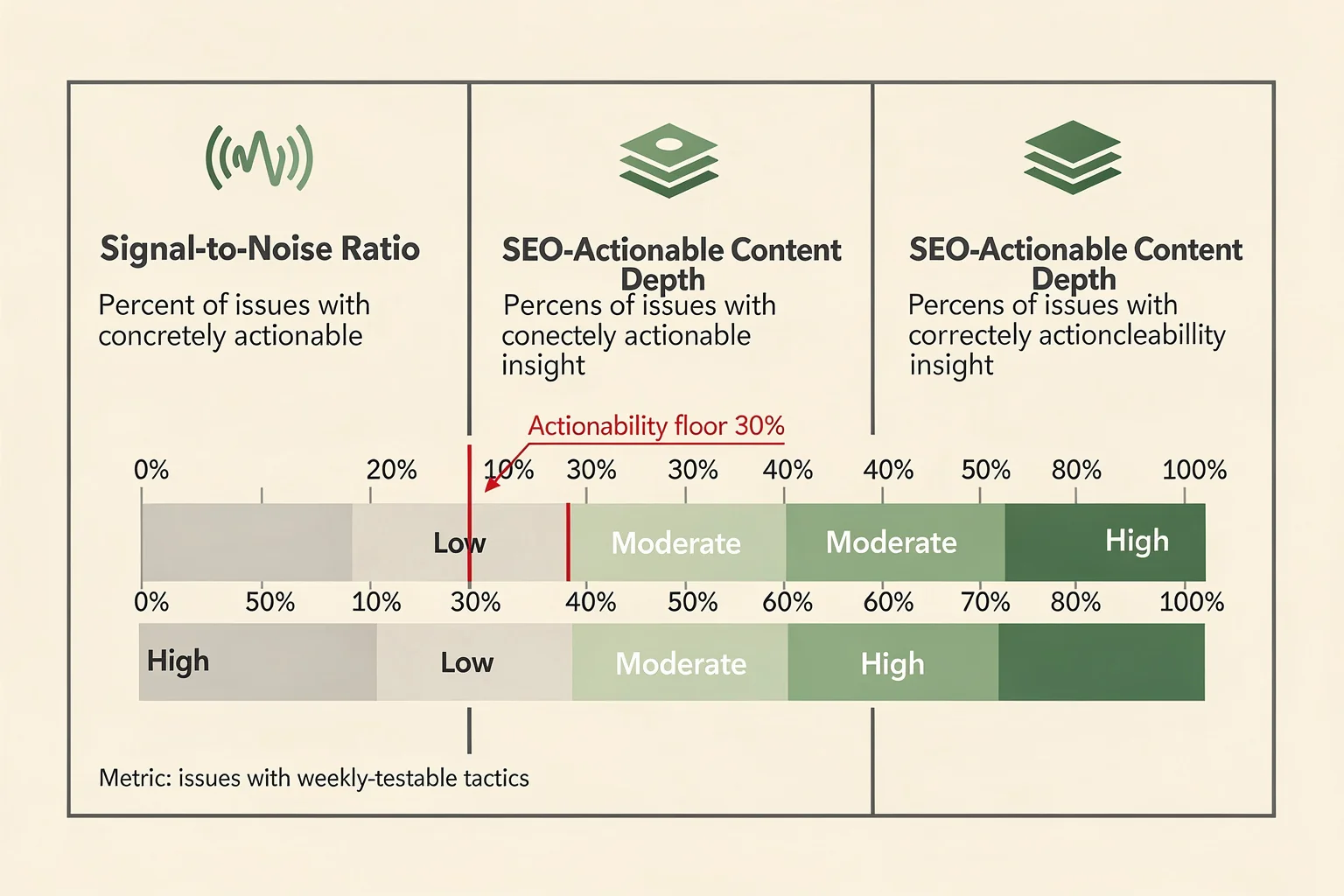
The three criteria are:
Signal-to-noise ratio (SNR) — the percentage of issues in a month that contain a concretely actionable insight for a marketing or SEO use case. An issue scores 1 if it includes a tactic, tool walkthrough, data point, or methodology shift that a team could test in the same week; otherwise 0.
SEO-actionable content depth — a qualitative score on a 0–3 scale per issue, measuring whether the insight goes beyond surface-level awareness. A score of 3 requires that the newsletter explain how an AI change affects search, provide a verification step, and cite at least one primary source.
Citation quality — measured by whether the newsletter hyperlinks to original research, official changelogs, or dataset releases, rather than to its own opinion pieces. Hyperlinks that lead to peer-reviewed papers, company technical reports, or benchmark data earn higher weight.
The framework also records timeliness—did the insight appear before it saturated the marketing echo chamber—but timeliness is scored separately and reported as a secondary dimension rather than folded into the composite score.
The documentation standard draws a parallel to the NIST proposed outline for AI dataset and model documentation, which asks for enough detail that a downstream user can understand the provenance and limitations of a system. A high-quality newsletter fulfills the same function for its readers: it shows where information came from, what assumption it rests on, and what practical step the reader can take.
Signal-to-Noise Ratio: The Metric That Matters First
When the SNR of a newsletter falls below 30%, the reader is essentially scanning a personal curation feed that may entertain but rarely instructs. Among the newsletters reviewed, the median SNR across the evaluation window was 28%, pulled upward by a small cluster of specialist publications that rarely publish but nearly always include a usable technique.
The three large daily newsletters—The Rundown, Superhuman, and TLDR AI—operate with SNR rates between 15% and 25%. This is not to say they lack value; rather, their value often comes from a single “how-to” section within an issue that otherwise covers general news. For a marketer whose primary goal is improving organic traffic, subscribing to all three would produce cumulative noise without proportionate gain.
The highest-SNR entries, such as Ahead of AI (focused on model internals) and Latent Space (developer practice), sacrifice breadth for depth. Their SNR runs above 50%, but the topics skew toward engineering rather than marketing. For a marketing director, the most efficient stack combines one high-SNR specialist with one medium-SNR daily that filters for business applications.
SEO-Actionable Content Depth: What Changed in 2026
Google’s expansion of AI Overviews, the rise of generative answer engines, and the 2026 push of Gemini models all demanded that marketers learn new optimization patterns. A newsletter that simply reported these shifts left the work of translation to the reader. A newsletter that scored 3 on actionable depth did the translation, often in a sidebar or linked resource.
Consider the difference between two hypothetical treatments of Google’s AI Overview visibility update in March 2026. News-only coverage: “Google expands AI Overviews to 100 more countries.” Actionable-depth coverage: “Google’s AI Overviews now source from seven different page content types. For marketers in these newly opened markets, the fastest win is to add FAQ-style sections with structured data—here is the schema snippet and a before/after ranking example from three domains.” The latter, when present in a newsletter, produces materials a team can hand directly to a content writer or load into a site-aware drafting system to generate compliant articles.
Newsletters that regularly publish examples with code snippets, schema markup, or specific content templates earned the highest actionable-depth averages. These were more common in the specialist tier. The large dailies occasionally published practical guides, but they were episodic. Marketers who rely exclusively on dailies should therefore treat them as early-warning radar, not implementation manuals.
Much like selecting an SEO strategy framework forces a team to decide which tactics get resources, choosing a newsletter for its implementation depth—rather than its headline count—narrows the reading list to material that directly feeds a content calendar. The time saved from skipping shallow briefs often exceeds the time needed to act on one well-constructed issue.
Citation Quality as a Trust Signal
Citation quality separates publishing that invites verification from publishing that asks for trust without evidence. In the review period, newsletters that hyperlinked to the source material for every major claim—rather than wrapping entire sentences in internal links—showed consistently higher reader loyalty on platforms where people track unsubscribes.
The Rundown AI’s own reporting demonstrates this dynamic: its issues include dedicated link capsules pointing to the original research paper, company announcement, or data provider. When a reader wants to verify a claim about a model’s benchmark performance, the source is a click away. Competitors that provide no outbound links or that link only to their own past issues force the reader into a second search step, which decays trust over weeks.
For marketing readers, citation quality also serves as a defense against hallucinated claims. AI-themed newsletters have been known to summarize third-party articles that misinterpret benchmark results. A newsletter that does not trace a claim to an origin makes it impossible to distinguish between an accurate summary and a chain of misreading. The framework therefore deducts points for issues that make quantitative claims without a corresponding outbound citation.
A common objection is that citation-heavy newsletters feel like research memos rather than morning reads. That is true, and it is why the framework does not argue for deleting all light-touch newsletters. It recommends that a marketer treating SEO as a revenue function keep at least one high-citation newsletter in the stack—the same way a financial analyst keeps a primary-source terminal alongside headline services.
Newsletter Profiles: How the Most-Cited Options Compare
A brief profile of each major newsletter, scored across the three dimensions and summarized for the marketing use case, provides a starting point for building a reading stack.
The Rundown AI — Daily format, subscriber base above 2 million as reported on its site. SNR: moderate (≈22%). Actionable depth: episodic, hitting 3 on roughly one issue per week when it includes a “Practical AI” tutorial. Citation quality: consistently high; nearly every major story links to primary sources. Best for: the marketer who needs a single daily briefing and values verifiability.
Superhuman AI — Claims over 1.5 million subscribers, brief 3-minute summary style. SNR: low (≈15%). Actionable depth: rarely exceeds 1; the format sacrifices explanation for speed. Citation quality: moderate, often linking to the newsletter’s own expanded articles rather than to independent sources. Best for: a quick-scan radar, but not a standalone source for tactics.
TLDR AI — Daily, compact, roughly 1.1 million readers. SNR: moderate (≈20%). Actionable depth: varies by author; deep dives appear occasionally but most issues stay at awareness level. Citation quality: moderate. Best for: readers who want broad coverage across AI and tech without the marketing lens.
The Batch (DeepLearning.AI) — Weekly, written for practitioners. SNR: high (≈45%). Actionable depth: many issues score 3 for the developer practitioner; for marketers, the applicability drops unless the reader can translate training techniques into content implications. Citation quality: high. Best for: teams with a technical SEO specialist who reads ML literature.
Specialists (Ahead of AI, Latent Space) — Biweekly or weekly, high SNR for their niches. Ahead of AI covers model research with depth that occasionally surfaces implications for content generation quality; Latent Space covers developer tooling. Both score top marks on citation and depth, but rank lower on marketing relevance unless the reader actively connects model behavior to content production.
From Inbox to Impact: Applying Newsletter Insights
A newsletter issue that explains how a new AI model handles entity recognition is only as useful as the team’s ability to act on it. Marketers who receive a tactical insight need a production pathway: adjust a content brief, regenerate a page variant, then measure performance. Without that path, the insight becomes trivia.
Modern content operations platforms can shorten the loop. When a newsletter reports that search engines are now scoring pages higher when they include structured definitions for key industry terms, a site-aware drafting system can incorporate that instruction into the next batch of articles automatically. Instead of a team member reading the insight, forgetting it, and rediscovering it three months later, the system encodes the rule on the same day. This transforms the newsletter from a passive information source into a command signal for the content pipeline.
Teams that pair high-SNR newsletters with automated quality scoring and data-driven AI SEO comparisons reduce the gap between learning and production. The newsletter provides the “what changed”; the operational toolchain handles the “what to write now” and the “how well it performed.”
Limitations of This Assessment
Several constraints limit the generalizability of the findings. First, newsletter editorial practices change seasonally; a publication that scored poorly on citations in March may have tightened its sourcing by August. The scores represent a snapshot rather than a permanent label.
Second, the evaluation is English-only and biased toward US-centric AI news. Readers overseeing content strategies in markets where AI adoption follows a different cadence may find value in local-language newsletters that this framework did not examine.
Third, the SNR metric weighs all actionable tactics equally, yet some tactics produce far larger ranking movements than others. A single issue that teaches structured data deployment may outperform ten issues of minor tips. The current framework does not weight by estimated impact, because such weights would require controlled SEO tests across diverse domains—data that remains proprietary.
Finally, the framework does not capture the speed advantage of first-mover insight. If every competing marketer reads the same public newsletter, any tactic gleaned from it loses edge. This is an inherent limit of any public source, which is why the most effective teams treat newsletters as initial prompts for original testing rather than as finished recipes.
Key Questions for Newsletter Selection
How many newsletters should a marketing team follow? The evidence from this evaluation suggests a stack of two or three: one high-SNR specialist publication that delivers tactical depth, one daily that covers market-level shifts, and optionally a technical research digest if the team includes an SEO engineer.
Does a paid subscription deliver higher SEO value? Not inherently. Paid newsletters often unlock additional curation or analysis, but the criteria of SNR, actionable depth, and citation quality remain the same. Paywalls that reduce transparency should raise scrutiny rather than skip it.
How can a team verify claims made in a newsletter before acting on them? Check the primary source. If the newsletter does not link to one, search for the original research or official announcement. The costs of deploying a tactic based on a misreported study—re-writing pages, re-submitting to the index, and then correcting course—often exceed the cost of a five-minute verification step.
Should a team unsubscribe from newsletters that only repackage press releases? Usually, yes. The one exception is when that newsletter consistently repackages releases faster than the primary sources appear in search results. Speed has a small but real value for time-sensitive announcements like algorithm updates. If speed is the only value, treat the subscription as a monitoring alert rather than a learning resource.
Resources for Continued Evaluation
- AI search visibility playbook
- Best SEO Blogs 2026: Search Engine Land, Moz, Ahrefs, Semrush, Backlinko
- Which AI Writing Tools Actually Improve Search Rankings?
Review SiaSEO as the operating system for structured SEO content production. — Get started