
Not All SEO Types Are Equal: A Framework for Picking What Works
A decision framework to help marketing leaders allocate resources across different SEO types based on business goals and search intent.

You sit down to plan the quarter’s SEO work, and the list of types sprawls: on-page, off-page, technical, local, international, news, video, image, and now AI-generated content optimization, answer engine optimization, generative engine optimization. No team can fix all of them at once. The real question behind a seo types comparison is not which type is best—it’s which one will move revenue first, given the constraints on your calendar, your talent, and your budget.
That question is harder to answer in 2026 than it was two years ago. The SERP has split. Organic blue links share the page with AI Overviews, Perspectives carousels, and generative answers that don’t always cite a website at all. In a survey by GoodFirms earlier this year, 76% of marketers said the search results page has already shifted from a link list to an AI-generated answer layer. Yet only 14% of those same teams track whether their content appears inside AI-generated citations. That gap—between where search lives and what most SEO plans still measure—defines the next era of prioritization.
This article lays out a practical framework for evaluating the ROI of each major SEO type. It draws on published documentation, industry data, and the operational realities of B2B teams so you can stop doing a little of everything and start allocating effort where it compounds.
The Core Levers of Search Visibility
Google’s own SEO Starter Guide describes the work as helping search engines understand your content and helping users decide to visit your site. To do that, most practitioners group the work into three foundational types, later expanded with local, vertical, and AI-specific layers.
Semrush’s Types of SEO guide organizes them as on-page (content and HTML), off-page (links and external signals), and technical (crawl, index, speed). Add local SEO—the separate signals of reviews, proximity, and Google Business Profile—and you have the classic quartet. In 2026, however, a fifth category has hardened from experiment into necessity: AI content optimization and generative visibility, which spans answer engine optimization (AEO) and generative engine optimization (GEO).
These five groups aren’t equally urgent for every site. A SaaS company with no physical location might never invest in local SEO beyond a nominal profile. An e‑commerce site with ten thousand product pages probably needs technical SEO before another blog post. The value of a seo types comparison is that it forces you to name which lever you’re pulling and why.
What You Actually Compare When You Compare SEO Types
A type label like “off-page SEO” is too vague to fund. To compare types usefully, ask four questions about each one:
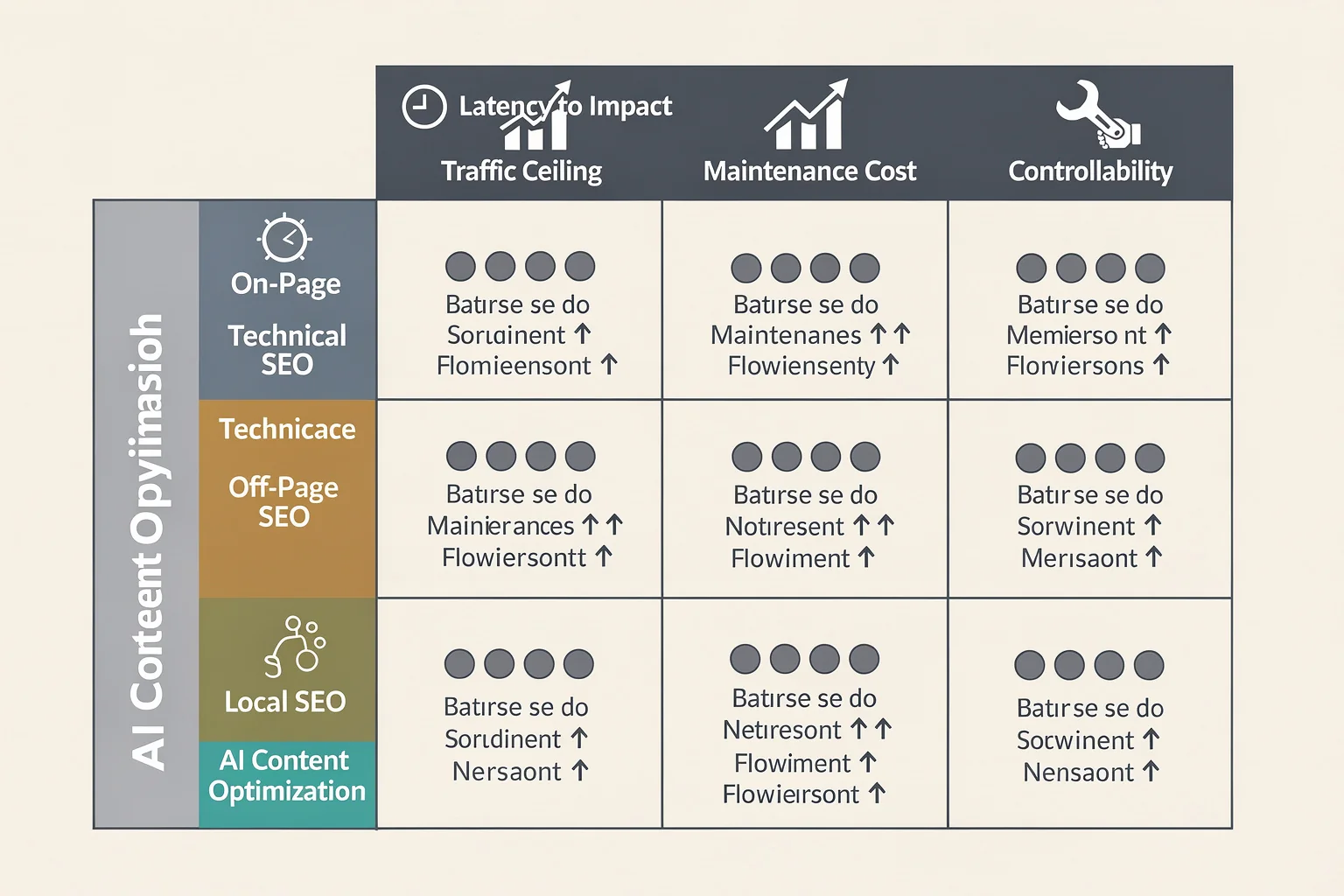
- What is the latency? (How soon after effort does a measurable signal move?)
- What is the ceiling? (How much traffic or revenue can this type realistically unlock for your market?)
- What is the maintenance cost? (Does the work decay over time, or is it largely permanent?)
- How controllable is the outcome? (Can you influence it directly with your own resources, or are you dependent on third-party platforms and editors?)
Answer those for your site, and a priority sequence emerges that no generic blog post can hand you. Still, some patterns recur. Technical SEO is highly controllable and can lift an entire site at once, but it often takes weeks or months before a crawl fully reflects the fixes. Local SEO is fast to deploy for businesses with a physical footprint but offers little ceiling for a pure digital product. On-page SEO is the most controllable of all—you own the pages—but the ceiling depends entirely on the search volume of your chosen topics.
Picture a 12-person marketing team at a mid-market B2B SaaS company. The site isn’t broken, but organic traffic has flatlined. The temptation is to chase AI optimization because that’s where the headlines are. The higher-ROI sequence might be: (1) on-page content gap fill (immediate, high control, modest ceiling), (2) technical indexation and Core Web Vitals repair (latent but high ceiling across all pages), (3) selective off-page digital PR (high ceiling, low control, long latency), and only then (4) structured AI visibility work, which builds on the first three steps anyway. AI search engines crawl the same web; they just rank it differently. Getting the foundation right before layering AEO/GEO tends to produce citation growth rather than dead‑end page views.
The Effort-to-Value Graph Most Teams Miss
The hardest part of any seo types comparison is acknowledging that high-effort work does not always deliver high value. Technical SEO audits routinely surface dozens of issues, but only a handful affect rankings meaningfully. Off-page link building burns time on outreach with a success rate often below 10%. On-page content can be a bottomless pit if no editorial triage exists.
A simple way to cut through the noise: map each candidate task to the size of the traffic lift it might produce multiplied by the conversion rate of those visitors, then divide by the calendar weeks until impact. Tasks that score high—small technical fixes on high-traffic pages, updating existing content that already ranks on page two—usually beat starting from zero. This isn’t a novel framework, but it is one that most teams abandon under pressure to “do SEO” across every type at once.
On-Page SEO: High Control, High Ownership
On-page SEO includes keyword targeting, content quality, title tags, meta descriptions, header hierarchy, internal linking, and image alt text. Because you control every piece of it, on-page is the first type to optimize when you have zero budget and a small team. The Google Search Central documentation emphasizes making content findable and genuinely useful; no third-party permission is required.
The limitation is volume. The number of pages you can make excellent is bounded by editorial capacity. That’s where automation and AI content governance start to matter. Platforms that can ingest a site’s existing context and generate drafts with correct internal linking, keyword placement, and QA scoring—rather than generic blog filler—shift the effort dimension sharply. They also surface semantic drift over time, which pure human editing often misses. Still, no tool changes the topology of search demand; on-page SEO can only capture intent that already exists. For B2B teams with a tight content budget, the programmatic SEO vs AI content decision is worth examining, because the two methods attack on-page scale from opposite directions.
Technical SEO: The Substructure That Delays Gratification
Technical SEO covers crawlability, indexation, page speed, structured data, mobile usability, and site architecture. Fixes here are binary—a page is indexable or it isn’t, a Core Web Vital passes or it doesn’t—but the return is multiplicative. An architecture improvement lifts every page that shares the new pattern.
The challenge is that technical SEO rarely changes traffic the week you deploy. It can take 28 days for Google to re‑crawl a medium-sized site, and even longer for ranking effects to stabilize. Many teams over-invest in technical SEO early because audit tools produce long, actionable checklists, and it feels productive to tick them off. But if your pages return blank SERP snippets or your on-page relevance is weak, making the site faster won’t turn visits into conversions. Technical SEO works best as the second act, after the content foundation is sound and the revenue that follows is worth the wait.
When weighing whether to staff technical SEO in-house or outsource, the SEO agency vs AI platform comparison becomes relevant: agencies bring deep platform-specific expertise, while AI-driven platforms can monitor technical health continuously at a lower recurring cost, though they lack the judgment calls a skilled developer makes.
Off-Page SEO: The Slow-Building Authority Layer
Off-page SEO revolves around backlinks, brand mentions, and co-citation patterns. It is the least controllable type because you don’t own the linking page and editorial links are earned, not placed. The latency is long—a digital PR campaign might run six months before delivering ten links—and measuring the exact ranking contribution of a single link remains imprecise.
Yet off-page SEO raises the ceiling for every other type. Two pages with identical on-page quality can see radically different rank positions when one site commands far more domain authority. For B2B teams, the most practical approach is to treat off-page work as a parallel track that runs behind content and technical efforts, not as an opening move. Focus link acquisition on a handful of hub pages that support your highest-opportunity commercial terms, and invest in relationships with industry publications rather than bulk guest‑post outreach. Link velocity is less important than link relevance and the domain’s topical authority.
Local SEO: Hyper-Relevance for Physical Reach
Local SEO is the most immediately measurable type for businesses that serve a geographical area. Google Business Profile optimization, review acquisition, and local citation consistency can generate phone calls and foot traffic within days of implementation. The ceiling is strictly bounded by the number of people searching for the service in that radius, but the conversion rates tend to be high because intent is strong.
For SaaS and purely digital businesses, local SEO is often zero-priority. The mistake comes when a company with a hybrid model—say, a regional services firm that also sells an online tool—over-allocates to local at the expense of information queries that pull prospects from a national audience. Separate the local SEO budget by revenue line, not by size of the geographic community.
AI Content Optimization and Generative Visibility: The New Layer
The fifth type didn’t exist in most planning documents three years ago. Today, ignoring it means leaving visibility on the table for a growing number of queries. AI search engines and Google’s own AI Overviews select citations from pages that are highly relevant, well-structured, and semantically dense. The optimization tactics—concise, declarative answers placed early in the text, clear HTML structure, frequent entity co‑occurrence—overlap with on-page SEO but are applied with a different intent: to get cited in a generated answer rather than simply ranked in a blue link.
This shift changes the ROI math. A ranking at position #10 can now generate zero clicks if an AI Overview occupies the top of the page, yet if your page is cited in that overview, you might capture brand exposure even without the click. The tension is that the same 76% of marketers who see the SERP shifting are also struggling to measure the outcome. Tools for SEO in AI search tracking are emerging, but most B2B teams are still relying on manual sampling and branded query spot-checks.
Separating AI content optimization from on-page SEO makes sense when you treat citations as a distinct KPI. The core task—producing accurate, well-sourced, entity-rich content—is the same, but the distribution surface demands monitoring that doesn’t show up in Google Search Console. If your 2026 plan includes scaling content with automated tools, ensure those tools also alert you to whether the content is surfacing in LLM‑driven answers. That forward-looking AI SEO vs traditional SEO comparison underscores why the types are no longer separate disciplines; they feed one system.
A Practical Prioritization Sequence for B2B Teams
You don’t need a complex model to start. Ask your team the four questions from earlier—latency, ceiling, maintenance cost, controllability—for each type, using data from your own analytics and Search Console. Then order the types in the sequence that compounds. For most B2B sites with an existing content library, the pattern looks like this:
- On-page triage: address pages that already rank on pages two and three. Small keyword adjustments and improved internal links often push them into the top ten within weeks. This is your fastest ROI.
- Technical cleanup of critical blockers: fix 4xx errors on high-traffic URLs, resolve mobile usability issues, ensure structured data passes Google’s Rich Results Test.
- AI-ready content structure: before you scale new content, retrofit your template so that each article’s opening paragraph answers a specific question in under 50 words and the page uses clear header nesting. This supports both classic ranking and AI citation.
- Off-page authority building: identify the five pages where a handful of quality backlinks would close the gap with competitors, then run a narrow, high-quality outreach campaign. Leave bulk link-building alone unless your domain is brand new.
- Local SEO (if applicable) and generative visibility measurement: set up a manual citation tracker for your top 10 branded queries and monitor which pages AI search engines cite over time.
Revisit the sequence quarterly. A type that sits at priority four today may jump to priority one after a core algorithm update rewards authority signals differently. Flexibility is part of the framework.
Where Teams Misread the SEO Types Comparison
Three mistakes show up repeatedly when B2B teams compare SEO types and allocate resources.
Mistaking activity for impact. A technical audit that flags 200 issues rarely warrants fixing all 200. The small subset that intersects with pages driving revenue deserves attention. The rest can wait.
Ignoring the decay rate. On-page content for a fast-changing industry (cybersecurity, AI policy, ad tech) can lose relevance in six months. Off‑page links tend to persist but degrade slowly as domains change hands or remove pages. Technical infrastructure can break overnight with a CMS update. Factor maintenance into the type’s true cost before comparing it to a one‑time, permanent fix.
Treating AI optimization as a separate, later-stage add-on. In practice, AI search engines crawl the web the same way Googlebot does—they just rank differently. A well-optimized on-page foundation with clear topic authority often performs well in both environments. The GEO vs SEO differences matter most in how you structure claims and citations, not in whether you start from scratch.
What Many Teams Ask Before They Commit to a Sequence
Can I skip off-page SEO entirely if my domain already has strong authority? Yes, for a period. Authority decays slower than content, but it does decay. Monitor referring domain counts monthly; if the trend is flat or declining for six months, plan a modest off-page refresh.
How much should I spend on AI content optimization vs. traditional on‑page work right now? If your site’s on-page basics are solid, allocate roughly 20% of your content effort to AI-answer structuring—rewriting opening paragraphs, adding concise Q&A blocks, and tracking LLM citations for your target queries. The other 80% should continue serving the organic blue link channel because it still drives the majority of attributable conversions for most B2B sites.
Is local SEO worth the effort for a national SaaS company? Only if you staff sales teams in specific cities and want to appear for “[city] [job title]” queries. Otherwise, invest that time in on-page or technical work.
What’s the fastest way to find which on-page pages to fix first? Pull a Search Console report filtered to queries where your average position is between 8 and 20. Sort by impressions. For each, ensure the corresponding page uses the exact phrase in the title tag, H1, and first 100 words. That quick on-page adjustment produces the fastest rank movement of any type.
Build Your SEO Practice on These Resources
Review SiaSEO as the operating system for structured SEO content production. — Get started