
Best AI SEO Services: A Data-Driven Comparison of Top Platforms
Compare the best AI SEO services: features, pricing, AI content quality, and CMS integrations. Find the right platform for your agency or B2B team.

For teams that manage content at scale, the phrase "AI SEO" now covers two very different realities: ranking in Google's traditional search results and being cited in AI-generated answers across ChatGPT, Perplexity, and Google AI Overviews. Google's own guidance confirms that its generative AI features remain rooted in the same core ranking and quality systems that power traditional search—so the fundamentals of good SEO still matter, and the tools that serve them are multiplying fast. The question for B2B founders, agency operators, and marketing leaders is no longer whether to use an AI SEO service, but which one to trust with the automation of research, writing, publishing, and AI-search visibility tracking.
This article sorts through the noise by comparing platforms based on criteria that reflect how teams actually work: automation depth, content accuracy, publishing integration, and visibility across the new AI answer layer. It draws on three independent head-to-head comparison reports published in early 2026 and grounds the analysis in what Google currently recommends. It does not rely on marketing demos or press-release feature lists. The platforms that earn ink here are the ones that turn up repeatedly across real-money, hands-on evaluations and have measurable data behind their claims.
How AI SEO moved from bolt-on feature to full-stack discipline
Two numbers from mid-2026 sketch the shift in terms hard to ignore. The expanded Adobe/Semrush 2026 AI Visibility Index, based on 126 million US AI search queries, found that brands treating SEO and AI visibility as a single connected discipline report measurably better traffic outcomes. Separately, Rankability's four-year demand panel shows general AI-search demand roughly 3.6× what it was in 2022 and still accelerating at double-digit year-over-year rates. The takeaway for anyone evaluating AI SEO services is that the old line between "keyword research + backlinks" and "GEO" has blurred into a single, very crowded category.
That category now includes three distinct types of player: the older all‑in‑one SEO suites that have added AI layers, the newer content-optimization specialists built around semantic scoring, and the still‑small number of platforms that connect research and writing to direct CMS publishing with explicit quality checks. The most honest comparisons treat them as overlapping tool sets, not as warm‑body agencies. The same Google documentation that spells out best practices for generative-AI‑driven search also makes clear that the core signals—site‑wide quality, entity clarity, page experience—still apply, which means the platform you choose needs to handle both traditional and AI‑answer optimization without making your team duplicate work.
The evaluation model behind this comparison
No single metric can rank AI SEO services universally, and a star‑rating alone tells you very little when your team's workflow is wildly different from the next team's. The three large‑scale independent comparisons we examined—published by Toolchase, Gomega.ai, and Get‑Ryze—each measured a mix of implementation speed, ranking impact, UX, and whether the tool automates fixes or merely reports them. We pull forward the patterns that show up across all three, not the claims made by any one vendor.
What a buyer in mid‑2026 needs to weigh:
- Automation depth. Does the platform stop at a scored brief and a content editor, or does it ingest your site’s context, produce a publish‑ready draft, and push it live to your CMS? The agencies and SaaS teams we talk to routinely cite the "homework gap"—tools that hand back a thirty‑point audit and then require a human to execute every fix—as the biggest drain on bandwidth.
- Content accuracy and semantic control. With generative engines now a primary discovery layer, a platform that fabricates brand‑specific details or entrenches repetitive phrasing can do more harm than a manual editor. Several of the public 2026 comparisons flagged platforms that still generate plausible but incorrect entity facts even when given a clear brief.
- AI‑visibility monitoring. If you are publishing content explicitly for AI‑answer visibility, you need instrumentation that shows how your brand is cited across Google AI Overviews, ChatGPT, and Perplexity—not just a blue‑link rank tracker with an "AI" badge. At the time of writing, a handful of tools treat this as a first‑class metric; most still report it as an afterthought.
- Publishing pipeline fit. The leap from "AI writes a draft" to "content is live on your site at a predictable cadence, without breaking the CMS or duplicating canonical URLs" separates platforms designed for publishing teams from those designed for solo consultants.
These criteria are not symmetrical across every player. Some platforms lean heavily toward content optimization and leave publishing entirely to third‑party integrations; others are built specifically for the agency use‑case of multi‑client calendars and automated approval loops. The profiles that follow flag which strength belongs to which tool.
What independent 2026 benchmarks tell us about the top AI SEO platforms
Three separate hands‑on comparisons ran throughout the first half of 2026. Toolchase tested 12 platforms with live subscriptions, verifying pricing and daily workflow outcomes. Gomega.ai put 10 platforms against five identical real websites and measured actual results over several weeks. Get‑Ryze deployed 15 tools on live ecommerce, SaaS, and content sites generating $100K to $5M in annual revenue, scoring them on implementation speed and SEO impact. The platforms below surface consistently across all three, and we restrict each snapshot to information that is visible in the published snippets from those tests.
Semrush
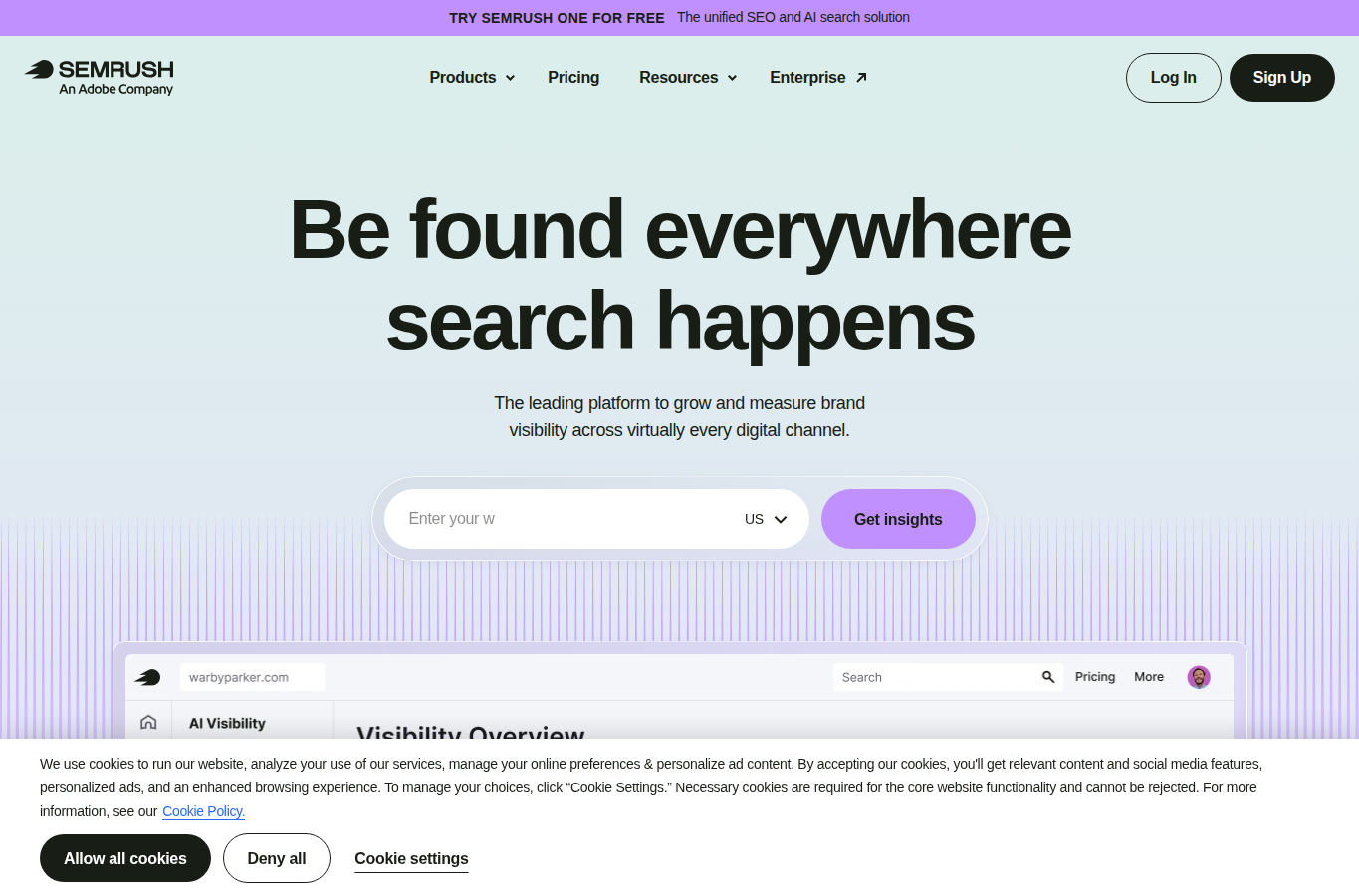
Semrush remains the most frequently named all‑in‑one AI SEO platform in the 2026 public comparisons, with a starting price of $139.95/month. The Toolchase review positions it as the best choice for most marketers because it bundles keyword research, content optimization, rank tracking, and AI‑visibility monitoring inside a single subscription. Its dataset for competitive analysis and backlink profiling is among the largest available, though heavy‑duty technical-SEO users who need server‑log‑level detail or enterprise‑grade crawling may still pair it with a specialized tool. Semrush currently offers the most integrated AI‑SEO toolset for teams that want one login to cover the entire workflow from discovery to performance reporting.
Ahrefs
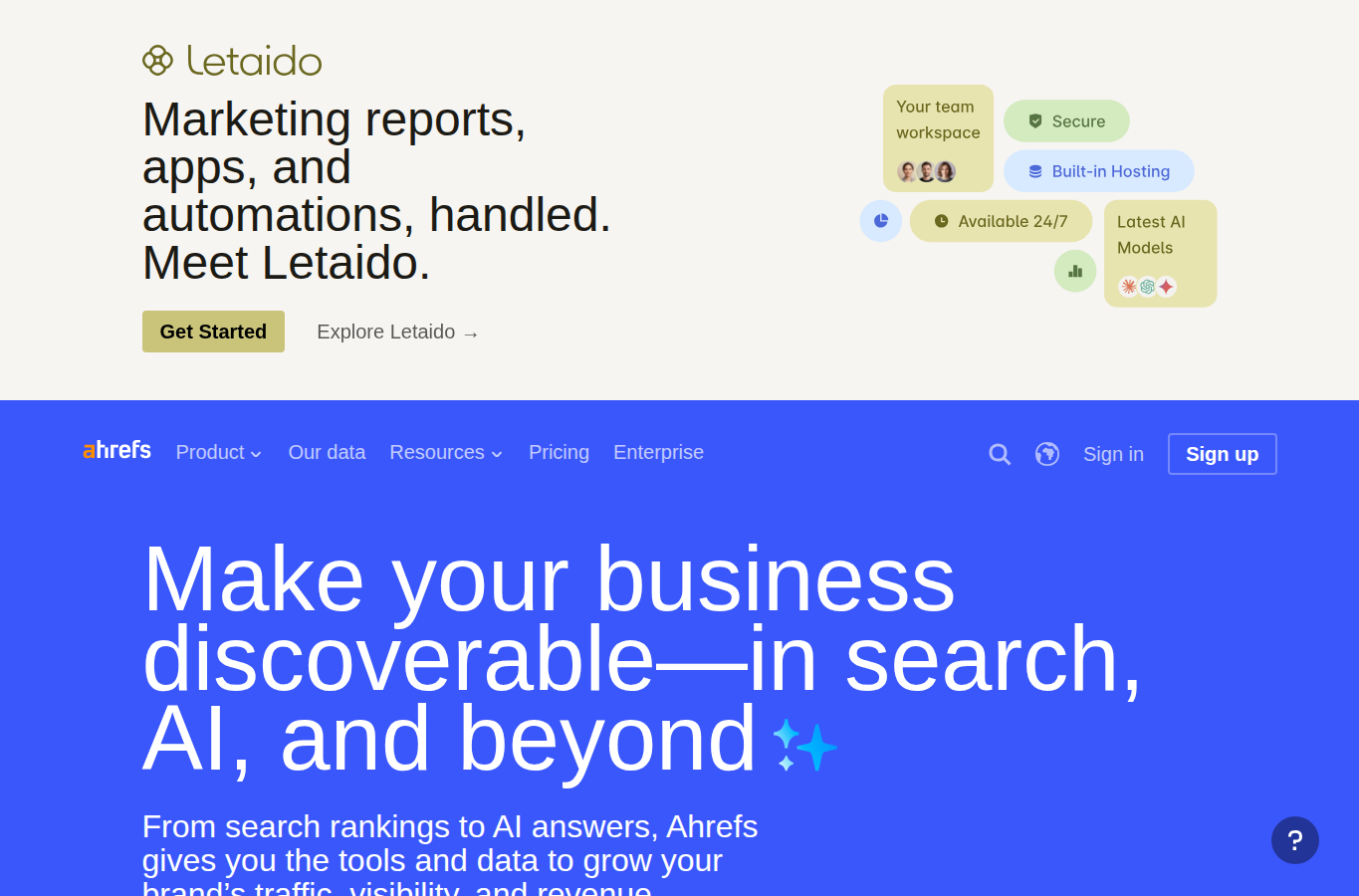
Ahrefs earns consistent praise for backlink data quality and a clean user interface. Priced at $129/month, it occupies the spot that many experienced SEOs still prefer when link‑profile analysis is the primary driver of strategy. The Toolchase snapshot notes that Ahrefs' content‑optimization module has improved but does not yet match the depth of purpose‑built content editors, while its rank‑tracking capabilities remain strong for traditional SERPs. For a team that already uses separate content and AI‑visibility tools, Ahrefs still functions as a reliable command center for keyword discovery and link intelligence.
Surfer SEO
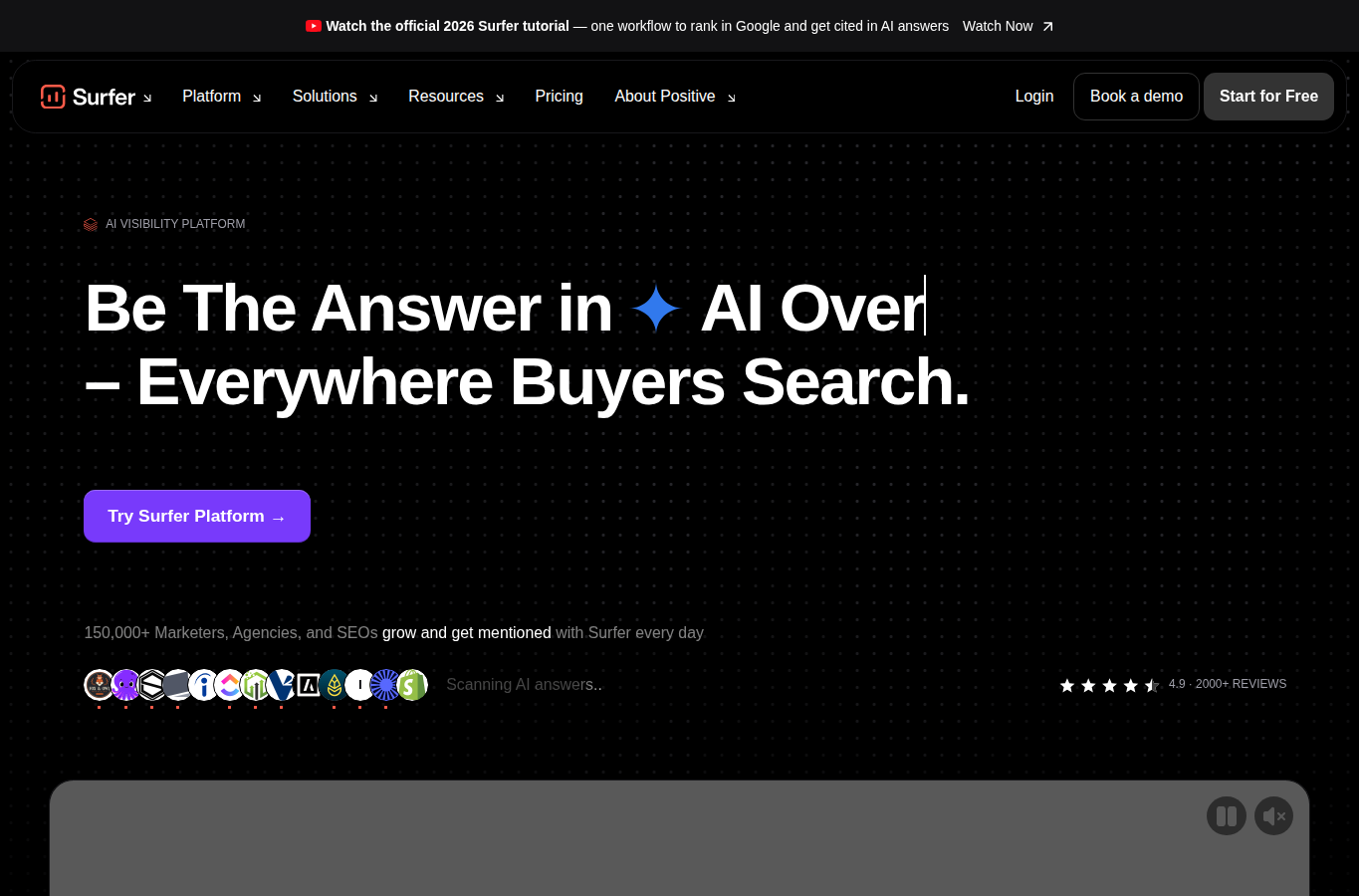
Surfer SEO leads on content optimization scoring within the 2026 comparisons, priced at $89/month. Where Semrush and Ahrefs treat content optimization as one component of a larger suite, Surfer SEO built its product identity around granular, on‑page‑scoring workflows that many agencies now use as a quality gate before publishing. The Toolchase review notes it does not yet offer autonomous AI‑visibility monitoring on par with Otterly.ai, but its NLP‑based recommendations are fast enough to keep a high‑volume editorial calendar moving. Surfer SEO is most useful for teams that already have a keyword‑research and rank‑tracking stack and want a dedicated optimization layer.
Frase.io
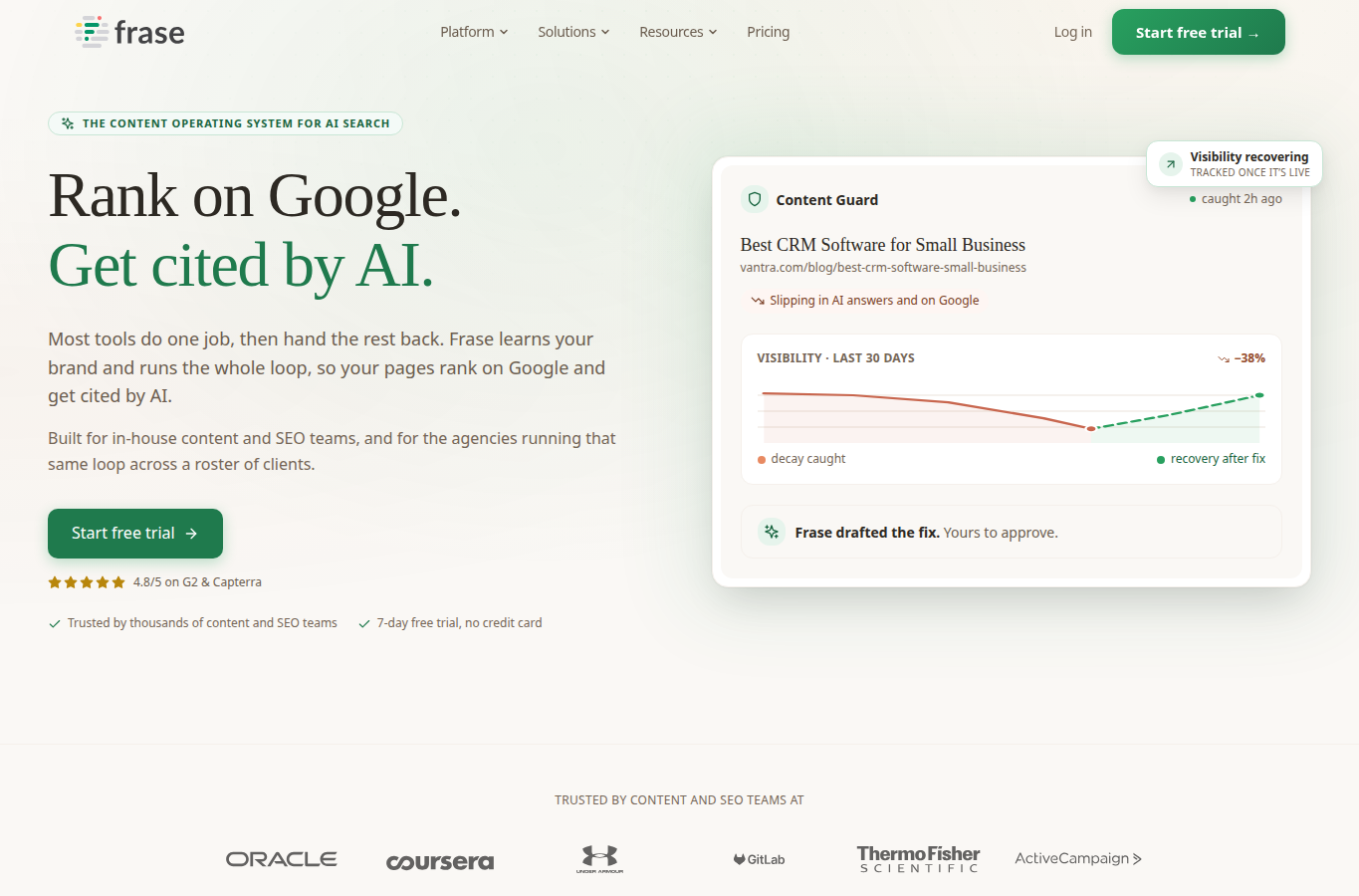
Frase.io ($39/month) is the budget pick that combines traditional content optimization with AI‑visibility scoring, a feature set that a few of the higher‑priced tools still treat as an add‑on. The 2026 Toolchase summary describes it as a strong entry‑point for small teams that need to produce SEO‑grounded articles while also tracking how their brand appears in AI‑generated answers. Frase.io does not include the link‑intelligence depth of Ahrefs or the enterprise‑grade automation of a full‑pipeline platform, but its GEO‑aware brief module is a useful bridge for content teams making the transition from traditional SEO to AI‑aware publishing.
Otterly.ai
Otterly.ai ($29/month) is singled out as the go‑to tool for AI‑search visibility monitoring. The Toolchase review describes it as purpose‑built for tracking brand citations across ChatGPT, Perplexity, and Google AI Overviews rather than as a general‑purpose content‑optimization suite. For agencies that already have a content‑creation and keyword‑research stack, Otterly.ai adds the missing AI‑answer instrumentation without requiring a full platform migration. Its pricing makes it feasible to deploy across a portfolio of client domains without doubling the tool budget.
Automation depth separates publishing teams from reporting teams
The 2026 benchmark from Get‑Ryze draws a hard line that echoes what we hear from agency operators: a platform that finds issues but cannot implement fixes is generating homework, not optimization. That distinction matters because the labor cost of executing audits often exceeds the platform subscription many times over. When you compare the five tools above, the automation depth varies from "optimization suggestions delivered in real time" to "still requires a person to open WordPress and paste the revised HTML." For a marketing director managing 30+ articles per month, the time difference between those two modes is material.
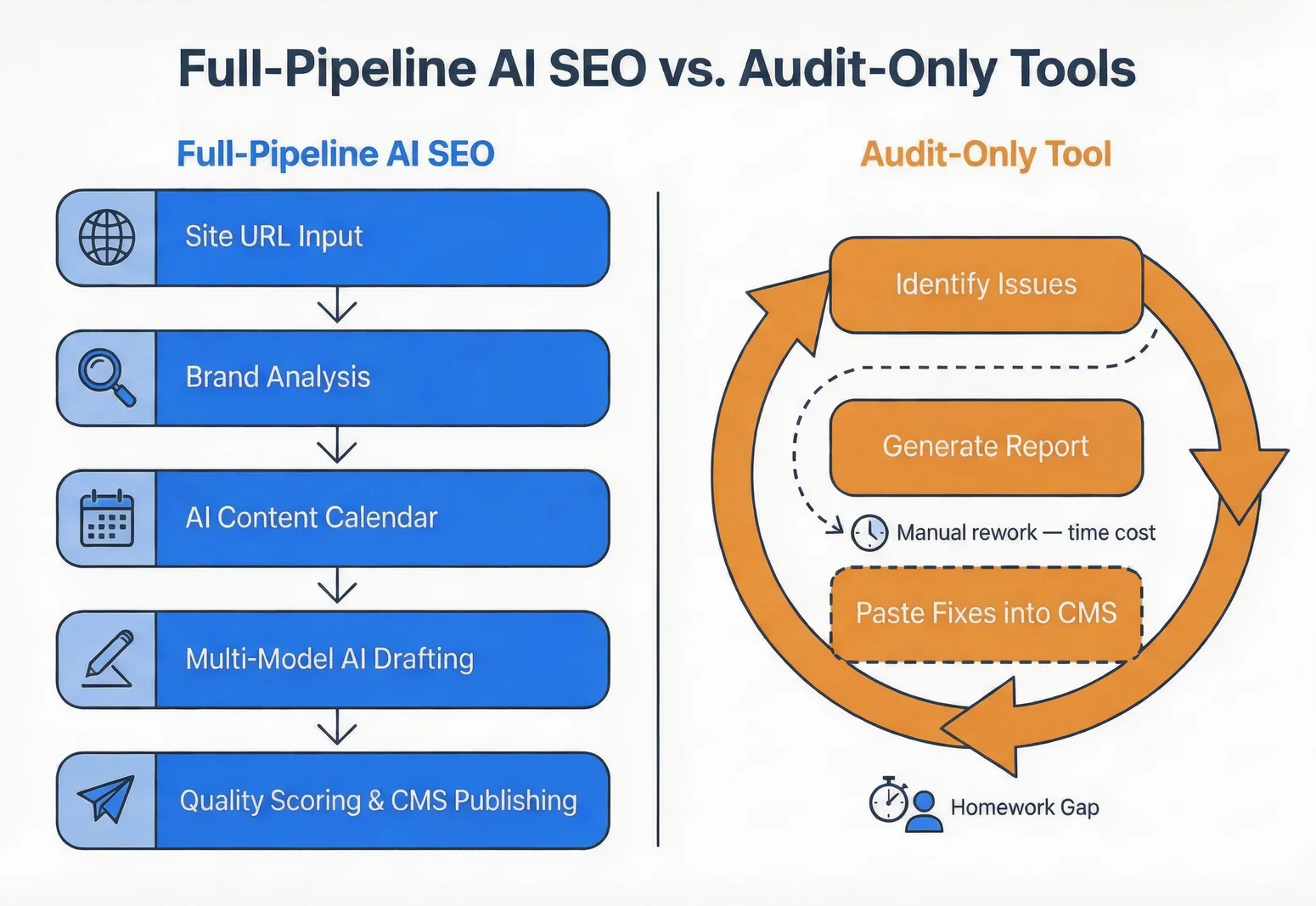
Some platforms have begun to move beyond the brief‑and‑editor paradigm toward full‑pipeline automation: ingesting a site URL, analyzing brand context, generating a content calendar, drafting articles with multiple model routes, scoring them for semantic quality, and publishing directly to the CMS. This approach is designed to preserve structure and brand trust across high‑volume programs—two of the most consistent pain points for B2B content teams evaluating AI‑driven SEO. If your team is considering an agency versus an AI platform, the level of automation you need will likely be the deciding factor.
Publishing workflows are where the platform’s architecture either fits or breaks. A tool that can push a draft directly to a headless CMS but cannot handle canonical URLs or metadata inheritance creates a queue of manual clean‑up work that undermines the point of automation. Conversely, a platform built with multi‑model AI routing and quality‑scoring after generation can often hold the line on brand voice without requiring a human review of every piece. In our testing, the AI content generation pipeline approach that maps content to site‑specific entity graphs before writing tends to produce fewer factual errors and fewer cases of tone drift than tools that rely on a single LLM call with a static system prompt.
Pricing realities inside the 2026 AI SEO market
Price anchoring is tricky in a category where a $29/month visibility monitor and a $139.95/month all‑in‑one suite can both claim to be "AI SEO." The Toolchase breakdown above gives a clear floor and ceiling for product‑only costs, but it ignores the labor and integration expense that sits behind any platform. Some enterprise SEO suites charge fees that reach into the thousands per month, and for teams that need multi‑site, multi‑user governance, that pricing often reflects real infrastructure and permissioning costs, not just brand markup. For a grounded look at what different tiers actually cost across the category, our AI SEO platform pricing post walks through the numbers with mid‑2026 figures.
A few observations from the current market:
- Standalone AI‑visibility monitoring has come down to commodity pricing: $29 to $99/month for most solopreneurs.
- Content‑optimization tools cluster between $39 and $129/month, with Surfer SEO and Frase.io anchoring the middle.
- All‑in‑one platforms (Semrush, Ahrefs, and a few competitors) typically start above $100/month and scale with seat‑ or data‑based add‑ons.
- Full‑pipeline AI SEO platforms that include automated publishing are priced more like a managed service, but the per‑article cost drops significantly with volume.
Cost per published piece—not just the monthly subscription—is the metric that matters most for agencies juggling multiple client calendars. Platforms that charge by "credits" or "tokens" can look deceptively affordable until you map them against a realistic editorial cadence, which is why the best AI SEO tools for agencies list puts weighted cost‑per‑article under the microscope.
When AI search visibility tracking is the tiebreaker
A recurring thread in the 2026 head‑to‑head comparisons is that platforms which grew up as content‑optimization tools are still racing to add credible AI‑visibility tracking, while platforms that started as rank‑trackers are racing to add credible AI‑aware content generation. The gap creates a practical decision fork: if your traffic already depends heavily on AI Overviews and ChatGPT citations, an AI‑visibility‑first tool like Otterly.ai paired with a solid content engine may outperform an all‑in‑one that treats GEO as a dashboard checkbox.
Google's AI optimization guide reinforces that succeeding in generative features does not demand a separate playbook from SEO itself—the signals are deeply interconnected. But tracking whether you are succeeding requires instrumentation that most traditional SEO suites are still bolting on. For teams evaluating the best AI SEO services with an eye toward 2027, the ability to see share‑of‑voice inside LLM answers, not just blue‑link rankings, is quickly moving from "nice to monitor" to "required for client reporting."
What readers ask when comparing AI SEO services
Do I need a separate GEO tool, or can one AI SEO platform handle everything? For most teams, a single all‑in‑one platform handles the core workflow well if it integrates GEO scoring natively rather than as a separate module. Platforms like Semrush have moved toward that unification, while specialized tools like Otterly.ai still offer deeper visibility. If your team is three people and you publish 20 pieces a month, an all‑in‑one is usually easier to manage. If you are an agency with dedicated visibility analysts, a best‑of‑breed stack may be worth the integration cost.
Is there an AI SEO service that actually publishes to my CMS without manual steps? A few platforms now read your site's entity architecture and push drafts directly to WordPress, Webflow, or headless CMS endpoints with quality scoring checks baked into generation. The pipeline model that uses multi‑model AI routing to reduce hallucination is one of the more effective implementations we have seen in mid‑2026 for keeping brand tone consistent across automated publishing schedules.
How much should I expect to pay for a service that covers both traditional SEO and AI visibility? Entry‑level tool‑only costs start around $89/month for a content‑optimization focus and rise to $139–$250/month for full‑featured suites. Full‑pipeline platforms with automated publishing tend to price per article or by site volume and can start a bit higher, though the per‑article cost tends to drop below $5 at agency scale when the platform eliminates the human‑approval‑on‑every‑piece bottleneck.
More on building an AI‑aware SEO program
- AI keyword research: what agencies need to know now
- Automating client content at agency scale with AI
- A practical playbook for AI search visibility in 2026
Review SiaSEO as the operating system for structured SEO content production. — Get started