
AI SEO Course Cost: What Agencies Actually Pay for Training
Compare AI SEO course costs, certification value, and agency team outcomes. Data on what training budgets deliver in 2026.

When a mid-market digital agency sets aside $5,000 for team training, the allocation usually starts with a blunt question: what does an AI SEO certification actually cost, and will the team come back with skills that cover the fee within the first quarter? The answer shifts depending on whether the agency buys self‑paced video courses, enrolls staff in live cohort programs, or sponsors access to platform‑specific credentials bundled with tool subscriptions. This report uncouples the pricing signals from the marketing noise to give agency operators a clear view of where the money goes, what drives cost variation, and how to calculate whether a particular credential pays for itself.
The Market for AI SEO Credentials: Scope and Methodology
This analysis focuses on structured programs that issue a certificate or digital badge after assessing proficiency in AI‑augmented search strategy. That includes content generation with large language models, prompt engineering for SEO workflows, optimization for AI Overviews and answer engines, and evaluation of machine‑generated content quality. Programs that remain strictly in the traditional SEO lane — even if they mention AI incidentally — fall outside the core set, though they serve as useful benchmarks.
The pricing figures collected in this report come from publicly listed program pages, aggregate learning platforms such as Coursera and Udemy, and information shared by agency operators in professional communities as of July 2026. No proprietary survey data is included, and vendor‑specific promotional discounts are excluded. Where a price range appears, it reflects the standard listed rate for an individual learner; team and corporate rates are noted separately when disclosed.
Pricing Architecture: How AI SEO Training Programs Monetize
Providers adopt one of four broad commercial models, and each carries a different cost structure.
Free academy courses. Platforms such as HubSpot Academy offer an AEO Fundamentals certification with no direct tuition. The cost to the learner is zero, though the curriculum typically stays at the awareness and framework level. Semrush Academy includes SEO courses that touch on AI search without a standalone AI SEO certification; those modules remain free but are designed to complement the platform’s paid product suite.
One‑time enrollment fees. Many self‑paced video courses on marketplaces like Udemy list for $50–$200 and include a certificate of completion. The depth of AI coverage varies widely, and most do not include live instructor access or proctored assessment. These courses suit individuals who need a quick primer, but they rarely satisfy an agency’s demand for accountable outcomes.
Subscription‑bundled access. Reforge, a membership‑based learning community, charges $1,995 per year for access to its full library, including the Mastering Search & AI Optimization program. There is no separate certificate fee, but the upfront membership cost is high and the program does not issue a verifiable credential beyond a completion record. The Coursera Professional Certificate in AI SEO & GEO operates on a subscription model, typically requiring 2–3 months of study at roughly $49–$79 per month, which translates to a total cost between $100 and $240 depending on pace, though prices can shift based on promotional pricing.
Live cohort and enterprise licenses. Instructor‑led courses from providers like CXL range from $1,500 to $3,000 per seat for short‑form intensive workshops. Fully mentored, multi‑week programs that include hands‑on labs and team‑specific curriculum can exceed $5,000 per learner. Enterprise volume licenses often negotiate per‑seat rates 20–40 % below the listed price.
Hidden costs sit on top of every tuition line. Nearly all courses require access to commercial SEO and content tools — Semrush, Ahrefs, Jasper, or similar — to apply the lessons. A team of five already carrying a Semrush plan pricing at $449.95 per month faces a mixed signal: the AI SEO certification may teach methods that the current subscription tier cannot execute. When an agency upgrades its tool stack to support the training, the effective cost of certification rises well beyond the course fee. Another often overlooked expense is the billable‑hour opportunity cost: a senior strategist who spends 40 hours on a certification program withdraws that time from client work, which at an effective rate of $150–$250 per hour adds $6,000–$10,000 in soft cost.
Observed Price Ranges Across Provider Types
The table below consolidates the range of publicly visible prices as they stood in mid‑2026. Figures should be verified directly with each provider before committing a training budget.
| Provider type | Typical cost per learner | Includes proctored assessment | Live instructor access |
|---|---|---|---|
| Free academy course (e.g., HubSpot AEO Fundamentals) | $0 | No | No |
| Marketplace self‑paced (e.g., Udemy) | $50–$200 | No | No |
| Platform subscription certificate (e.g., Coursera) | $100–$240 (2–3 months at ~$79/month) | Peer‑reviewed assignments, not proctored exams | Discussion forums only |
| Membership library (e.g., Reforge) | $1,995/year | No | No |
| Instructor‑led short course (e.g., CXL) | $1,500–$3,000 | Sometimes | Yes |
| Mentored live cohort program | $3,000–$5,000 | Yes | Yes |
| Enterprise team license (vendor‑specific) | Custom, often $4,000–$12,000 for 5–10 seats | Varies | Yes |
An agency evaluating these figures against current AI SEO platform costs may notice that a single team member’s certification sometimes exceeds the annual subscription spend for the very tools the course teaches to use. That comparison is not a reason to dismiss training; it signals that the credential investment must be judged on how it changes the team’s ability to deploy those tools effectively, not on the sticker price alone.
Cost Multipliers: What Drives the Price of a Certification
Even within the same delivery format, prices diverge by several thousand dollars. Five factors consistently explain most of the variation.
Instructor access. Live feedback from an experienced practitioner raises instructional cost and account retention, yet agencies routinely report that the direct coaching shaves weeks off the learning curve compared to recorded video. Programs that offer scheduled office hours, group project reviews, or one‑on‑one critique sessions command a premium.
Assessment rigor. Courses that issue a verifiable, industry‑recognized credential almost always include a proctored exam, a portfolio review, or a capstone project scored by faculty. The Certificate from eMarketing Institute, while free, ends with a multiple‑choice test based on a 156‑page eBook; a certification from a university‑affiliated continuing education program may require a published case study. The extra credentialing weight matters if agencies plan to use the certification in client proposals or agency qualification documents.
Curriculum depth. Foundational courses cover prompt engineering, AI overview landscape, and content quality scoring. Premium programs add modules on retrieval‑augmented generation, model‑aware content architecture, and AI internal linking tactics that directly serve client deliverables. Agencies should map the syllabus against internal skill gaps before assuming a higher price equals better fit.
Tool and lab integration. A handful of programs provide sandbox environments where learners operate AI SEO tools for agencies on sample data. The cost of provisioning these labs — cloud compute credits, platform API calls, tool trial seats — gets built into the tuition. When labs are absent, the agency must budget for it separately, either through a practice‑period subscription or a dedicated test environment.
Brand and renewal fees. Credentials associated with recognized brands or industry associations sometimes command a reputation premium. Some also require annual recertification exams or continuing education credits, which can cost $100–$300 per year per certified individual.
Team ROI: Calculating the Agency‑Side Payback
A certification’s worth to an agency depends on whether the acquired skills convert into measurable performance lift: faster content production, higher client retention, or new revenue from AI‑SEO service lines. The most practical ROI estimate starts with a speed‑and‑quality equation.
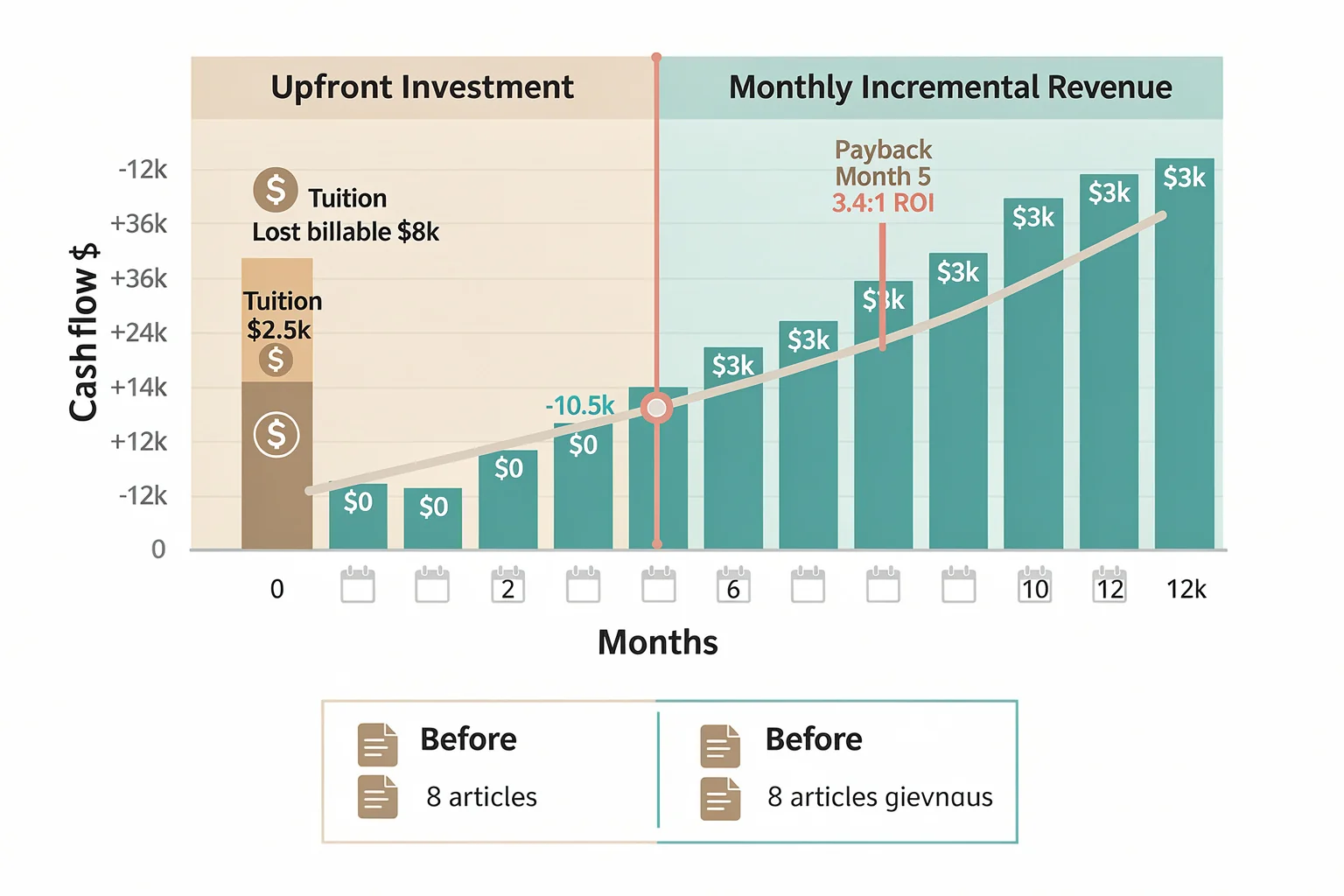
Assume a content strategist currently produces and optimises 8 articles per month, with an average client retainer of $3,000 per month per client. After completing an AI SEO certification that includes prompt engineering and automated quality evaluation, the strategist can reliably deliver 12 articles per month without sacrificing editorial standards. If the increased throughput allows the agency to support one additional client at the same retainer, the annual incremental revenue is $36,000. Against a certification cost of $2,500 plus 40 hours of billable time (~$8,000), the first‑year payback is roughly 3.4∶1.
Not every outcome folds into a neat line‑item formula, though. Certification often reduces the need to outsource technical SEO work or buy premium consultancy hours. It also improves the team’s ability to evaluate the output of AI‑generated content, a skill that directly lowers reputational risk. For an agency that already uses SiaSEO’s automated content calendar and semantic QA scoring, a certified operator can configure the platform’s guardrails more precisely, catching off‑brand suggestions before they reach a client review queue. This internal capability building tends to compound across multiple client engagements, making the spend easier to justify qualitatively even when exact margin attribution is elusive.
Agencies that complement training with a structured practice environment — for instance, using AI keyword research skills as the first applied module — report a shorter time‑to‑competence. The practice reinforces the curriculum and produces client‑ready deliverables during the learning period, partially offsetting the opportunity cost.
What Formal Courses Leave Out: Implementation Gaps
No certification program covers the full operational reality of running AI‑augmented SEO inside a scaling agency. Several recurring gaps should be accounted for before an agency signs off on a training investment.
Platform‑specific execution. Courses teach canonical workflows, but most agencies operate a specific stack. A certification that explains content quality scoring in the abstract is less useful than hands‑on experience with an AI content system that reads the agency’s own site, as SiaSEO does when it analyses a domain and generates site‑aware articles. Bridging that gap usually demands internal documentation, paired practice sessions, and a dedicated test environment — none of which is included in course tuition.
Model evolution and course staleness. The half‑life of an AI SEO curriculum is short. A course recorded in January 2026 that references specific LLM capabilities may be outdated by July 2026 if the underlying models have been updated or if search engine AI Overviews have changed their retrieval patterns. Agencies should factor in ongoing learning time and expect to refresh credentials or supplement with continuous education from sources like semantic SEO for AI search research.
Geo‑specific and multi‑language considerations. Many programs assume a single‑language, US‑centric search environment. For agencies with clients targeting multiple regions or languages, the standard curriculum under‑serves the complexity of entity optimization, hreflang management, and local AI search ranking factors. Additional investment in specialized modules or internal knowledge transfer is typically required.
Team dynamics and knowledge distribution. Certifications usually train individuals, but agencies need teams who can collectively apply the training. A single certified specialist who cannot transfer knowledge to the content producers, account managers, or client success leads creates a bottleneck. The highest‑ROI training programs are often those followed by an internal workshop where the certified staff member rebuilds the curriculum in the agency’s own context.
Choosing the Right Training Investment: A Decision Framework
Given the range of prices and formats, a straightforward set of criteria helps agencies rank options against their operating realities.
First, align the certification curriculum with the agency’s tech stack. If the team relies on AI SEO platform differences that require deep understanding of structured content and entity‑driven optimisation, a foundational course that stops at keyword research will under‑deliver. Second, weigh the value of live coaching against the premium it adds. For a senior strategist who learns rapidly from documentation, an instructor‑led program may be unnecessary; for a team of content writers who need prompted practice, the live component can be the difference between completion and abandonment.
Third, evaluate the credential’s market recognition. If the agency regularly submits RFPs that ask for staff qualifications, a certificate from a university‑branded program or a recognised industry body carries more weight than a marketplace completion badge. Fourth, calculate the per‑hour cost of the program relative to the learner’s billable rate. A $3,000 course that demands 60 hours of active engagement costs $50 per hour plus the lost billable opportunity, making the total economic cost closer to $15,000 for a senior consultant. That trade‑off may be acceptable if the training unlocks a new service offering, but it requires explicit cost justification.
For agencies with under $1 million in revenue, starting with a free academy course and supplementing it with platform‑specific documentation often yields the highest short‑term payback. The team can later escalate to a paid certification once the core skills are needed for competitive differentiation. Agencies scaling past $2 million in revenue typically find that a $2,000–$5,000 per‑person investment in a live cohort program pays for itself within six months if it lifts content velocity or client satisfaction by a measurable margin.
Questions Agency Leaders Ask About Training Spend
Is an AI SEO certification worth the investment if we already use AI tools?
A formal program provides structured knowledge about algorithm‑level optimisation that tool usage alone rarely covers. While tools can suggest content structures and audit pages, they seldom teach why certain patterns work for AI‑generated search results or how to adjust when model behaviour shifts. Many agencies find that certification reduces the time their senior staff spend troubleshooting tool outputs by 30–50 %.
How quickly can a team member apply what they learn?
Self‑paced courses typically require 4–8 weeks of part‑time effort, with immediate application possible on live client projects if the agency allocates supervised practice time. Live cohorts usually run 6–8 weeks with 3–6 hours of weekly commitment; the instructional structure allows learners to deliver client‑ready work during the course itself.
Should the agency fund certifications or expect team members to self‑fund?
Agency‑funded training aligns incentives: the business captures the productivity gains and the team member acquires a credential without personal expense. Many agencies recover certification costs through higher retainer rates or expanded service lines. Individual self‑funding may make sense for career‑change learners, but it rarely serves an agency’s immediate client needs as well as an employer‑sponsored program.
What ongoing cost should we budget beyond the initial certification fee?
Plan for annual recertification fees if the credential requires them, tool subscription upgrades that may be needed to practise advanced techniques, and the time cost of continuous learning as AI search evolves. A reasonable annual line item for a team of five is $1,000–$2,500 beyond the upfront certification expense, covering renewals, platform practice accounts, and supplementary micro‑courses.
Perspectives on AI SEO Investment
- The Best Free SEO Courses for B2B Marketers in 2026
- Which AI Writing Tools Actually Improve Search Rankings?
- AI Blog Writing for Agencies: Automating Client Content in 2026
Review SiaSEO as the operating system for structured SEO content production. — Get started