
The Best Free SEO Courses for B2B Marketers in 2026
Discover the top free SEO courses for B2B marketers in 2026. Learn keyword research, on-page SEO, and AI-driven tactics without spending a dime.

When Priya, the marketing director at a mid-market SaaS company, watched her team’s organic traffic slide 14 percent after Google’s spring update, she didn’t need a bigger ad budget. She needed a team that could read the new search landscape and act on it. She blocked two weeks for structured training, then spent the first three days wading through free SEO courses that were either outdated, written for recipe bloggers, or completely silent on how AI-generated answers were reshaping discovery for her B2B buyers. Priya’s frustration points to a real gap: plenty of free material exists, but almost none of it is curated for the way B2B teams actually search, rank, and sell in 2026.
This article compares three free SEO courses—published or refreshed in 2025–2026—that we evaluated against curriculum depth, recency of AI integration, and practical applicability for B2B teams. The goal isn’t an exhaustive list. It’s a short, honest shortlist that helps you decide which course matches your team’s current upskilling need, whether you’re a SaaS founder, an agency operator, or a content operations lead.
Why B2B Teams Need SEO Training Built for 2026
Search has split into two lanes that run simultaneously. The traditional organic results still drive about 46 percent of commercial B2B clicks, but AI Overviews, AI Mode, and chat-based answer engines are carving out an equally important discovery surface. Google’s own guidance on optimizing for generative AI features on Google Search makes clear that “user preferences are rapidly evolving and people are increasingly gravitating to generative AI experiences,” and that the same foundational SEO tactics improve visibility in both lanes—provided the team knows how to apply them to AI-driven surfaces.
That distinction matters more for B2B than for consumer content. A software buyer doesn’t type a single query and convert. The journey crosses technical documentation searches, competitor comparison queries, peer review lookups, and increasingly, direct questions to AI assistants. A course that stops at on-page optimization and backlink checklists without addressing how your pages surface inside AI-generated answers leaves a critical blind spot. The three courses profiled here each address this new reality to varying degrees, and we note where they’re strong and where you’ll need to supplement.
How We Evaluated These Free SEO Courses
Before opening a single curriculum, we set four filters and two scoring dimensions.
Filters:
- Free and verifiable in June 2026. No credit-card gates, no auto-converting trials. Every course listed is accessible at no cost right now.
- Creator authority. We looked for instructors or organizations with direct, practitioner-level B2B SEO experience—not generalist digital marketing backgrounds. This filter eliminated several well-known free courses whose instructors had never worked inside a B2B SaaS company or an agency serving B2B clients.
- AI-search coverage. Does the material explain how to optimize for AI Overviews, AI Mode, or answer-engine visibility, not just traditional rankings? Many free courses from 2024 still treat AI as an afterthought.
- B2B application. Exercises, examples, and frameworks must map to long-sales-cycle, multi-stakeholder environments, not recipe blogs or local services.
Scoring (applied to each course after filtering):
- Curriculum depth (40 percent of final score): breadth of topics, quality of supporting materials, and whether the course builds toward a repeatable workflow.
- AI-integration recency (30 percent): how recently the content was updated, and how deeply it integrates generative AI search surfaces.
- B2B practical applicability (30 percent): whether the examples, frameworks, and outcome patterns fit a B2B marketing and sales context.
We then profiled each course based on those scores, but kept the descriptions anchored strictly to what the curriculum actually delivers—no invented capstones or inflated claims.
A note on expectations: none of these courses will turn a complete beginner into a senior SEO strategist in a week. What they do well is compress actionable workflows into a format a B2B team can finish in a day or two and immediately pilot on a live project. That’s the bar we used.
Three Free Courses That Deliver Practical B2B SEO Skills
Semrush Academy’s SEO Crash Course with Brian Dean
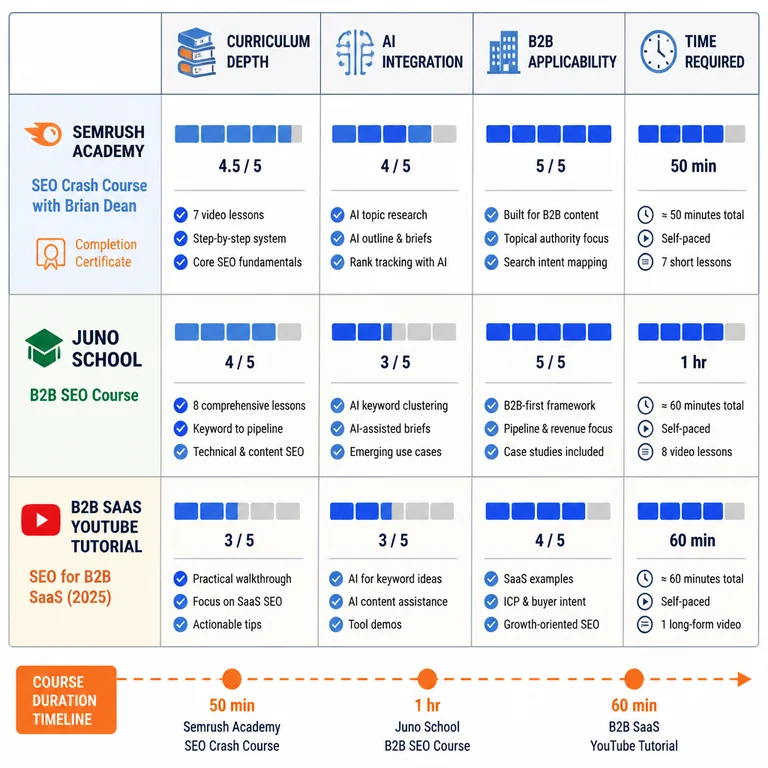
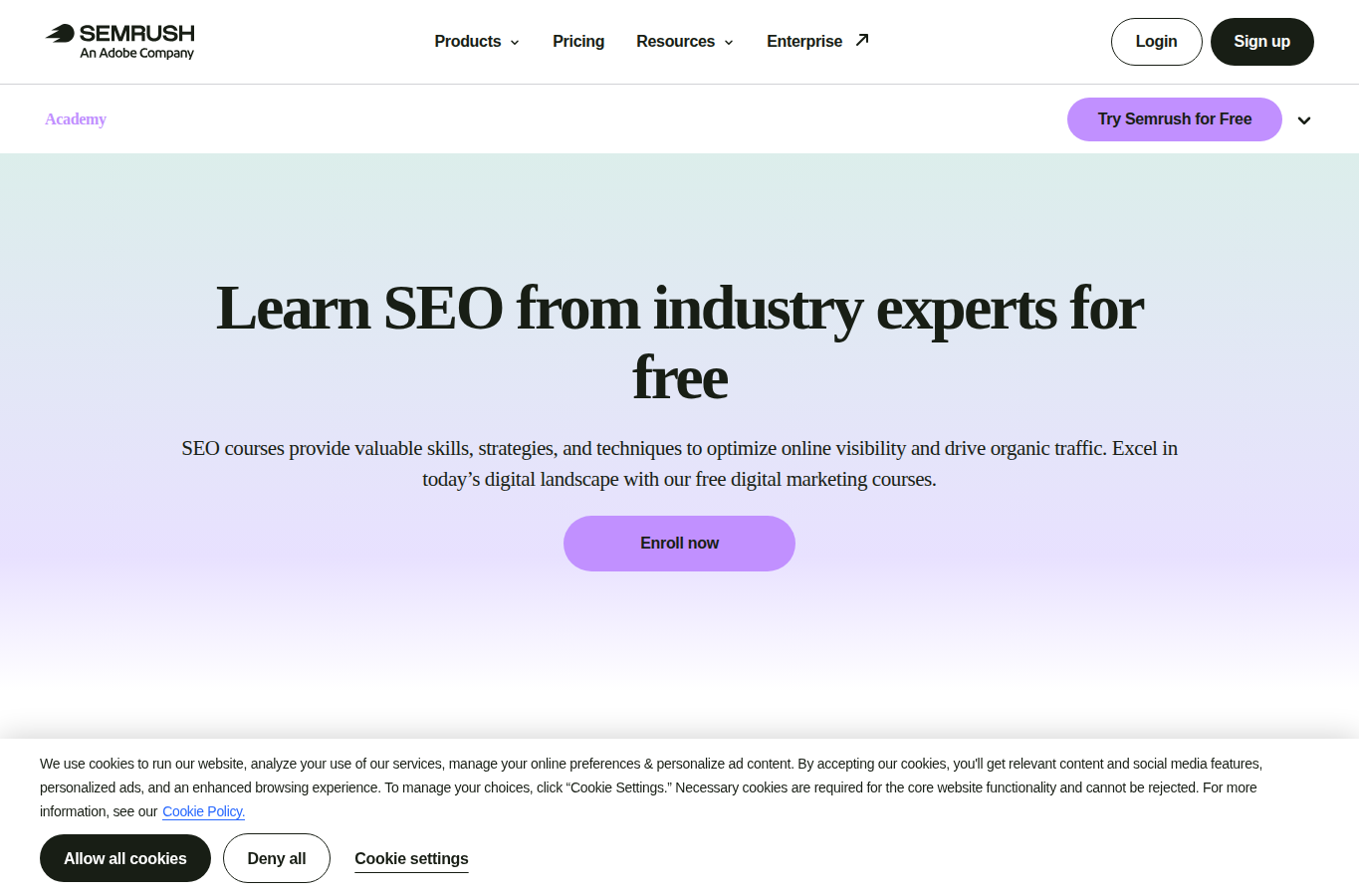
Semrush Academy’s SEO Crash Course runs about 50 minutes across seven video lessons and includes a completion certificate. Brian Dean, founder of Backlinko, leads learners through a repeatable ranking system: finding low-competition topics, structuring content for search intent, building topical authority, and using on-page signals. The course has been a staple of free SEO training for years, and the Semrush team recently updated several modules to reflect 2025 ranking factors. It remains the fastest way to get a new content hire or a non-SEO founder grounded in the fundamentals. Semrush’s own curated list of 9 Best Free SEO Courses in 2026 positions this crash course as the top pick, and for good reason: it prioritizes speed without sacrificing a clear, teachable system.
The strongest module for B2B teams is the one on “content that ranks vs. content that converts.” Dean asks learners to map keyword targets to user journey stages, which directly supports the way B2B buyers evaluate options over weeks of research. The course also covers basic technical fundamentals and link-building approaches that align with what Google Search Central recommends in its starter guide.
Limitations: AI-search visibility gets a short mention but no dedicated module. The examples lean toward B2C and affiliate content, so in-house B2B marketers will need to translate the frameworks themselves—something that took one agency team we spoke with roughly an extra hour per concept. The curriculum depth trades nuance for speed; advanced practitioners will outgrow it quickly. Still, for a marketing director onboarding a new content hire or for a founder learning SEO from scratch, the time-to-value ratio is hard to beat.
B2B SaaS: Integrate SEO and Content by Juno School
Juno School’s B2B SaaS: Integrate SEO and Content targets the exact alignment gap that trips up many mid-market marketing teams: how to make content marketing and SEO work as a single strategy rather than two siloed functions. The self-paced course runs a few hours and includes modules on harmonizing editorial calendars with keyword clusters, measuring organic-led pipeline contribution, and bridging the strategy gap between content writers and SEO specialists.
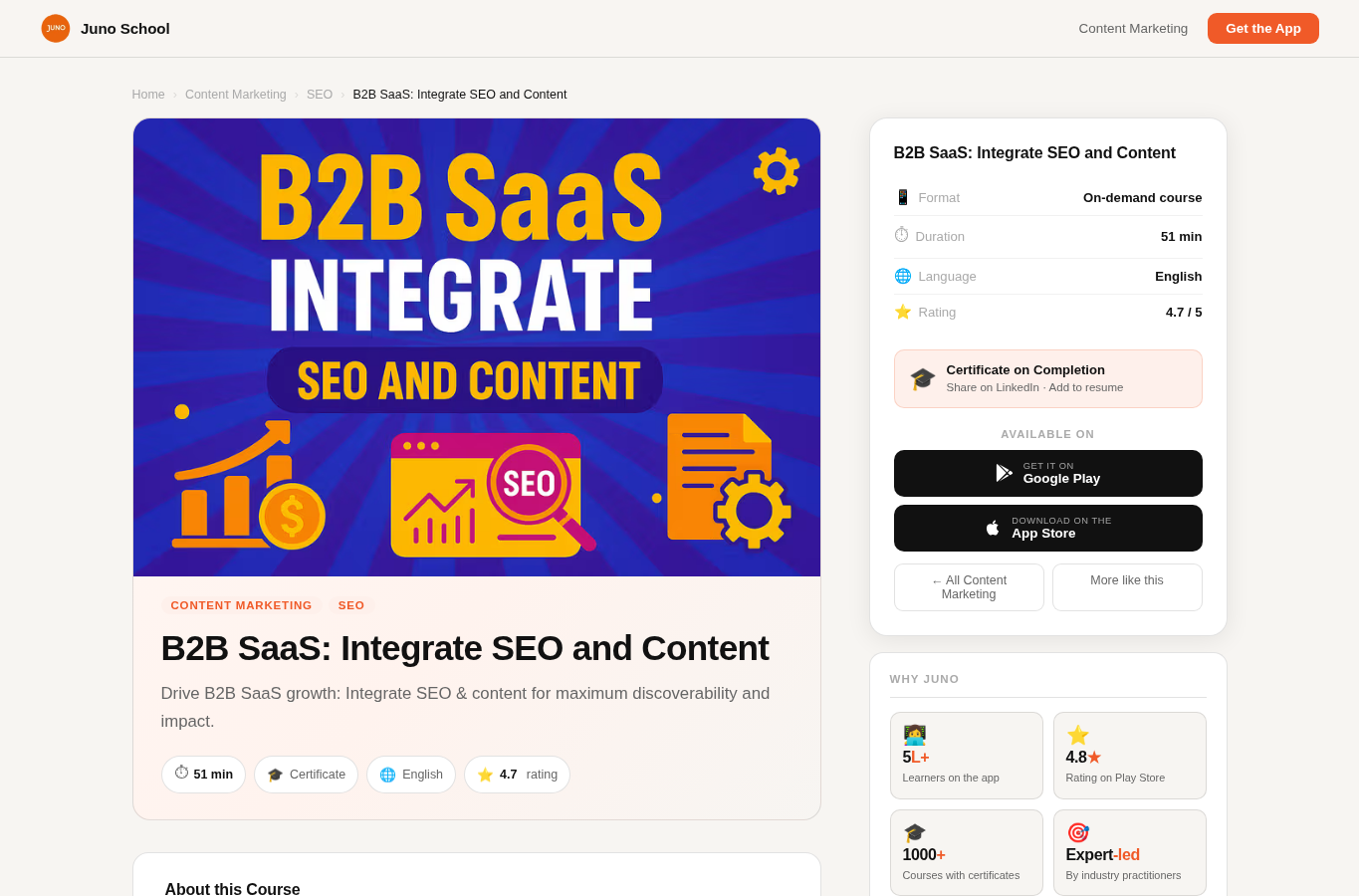
The B2B specificity shows in the exercise set. Learners build a content-to-SEO mapping for a SaaS product page, assign measurable growth metrics per topic cluster, and diagnose common pitfalls like keyword cannibalization across blog and documentation sites. One module asks you to pull your actual site’s URL and identify pages where the H1 and title tag contradict each other—a task that often surfaces three or four quick wins on the first pass.
AI-search coverage, however, is lighter here. The course acknowledges AI-driven discovery but teaches largely through a traditional organic ranking lens. If your immediate pressure is optimizing for AI Overviews and answer engines, you’ll need to layer on dedicated AI-visibility resources after completing this course. But if the team’s primary bottleneck is operational alignment between content and SEO—and they already have foundational ranking skills—Juno School’s offering fills a real gap.
B2B SaaS SEO Tutorial in 60 Minutes (2026) on YouTube
This free YouTube tutorial, published in January 2026 by Ben Alfrey, condenses a full B2B SaaS SEO workflow into a single 60-minute session. The structure follows a seven-step process: customer assessment, keyword and competitor research, content creation and optimization, internal linking, technical SEO, and link building. Each section includes live tool demos and narrative walkthroughs that mirror an agency’s actual delivery cadence.
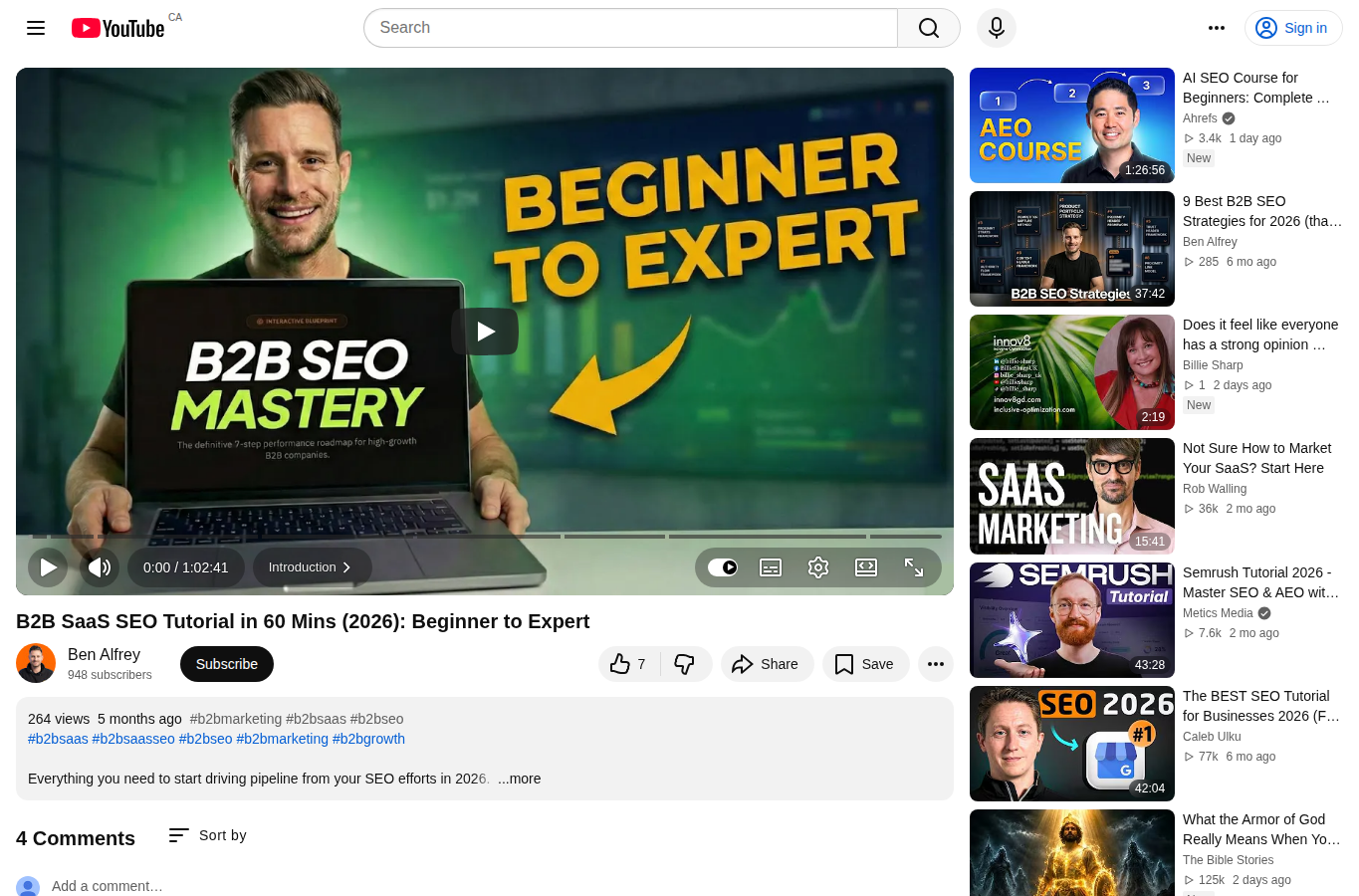
The video’s strength is its immediate applicability. A B2B founder can watch it over lunch and finish with a checklist of actions to run that same week. The sections on technical SEO—crawl budget management, sitemap architecture, and handling JavaScript-rendered content—are delivered with the clarity of someone who has debugged these issues on live SaaS sites. Technical SEO guidance from Google echoes many of the same recommendations, which adds confidence. The tutorial also demonstrates how to structure content for AI-search visibility and where internal linking efforts intersect with AI Overview triggers. At one point Alfrey walks through a content refresh on a two-year-old B2B case study that recovered a 23 percent traffic drop within six weeks—a concrete outcome pattern worth noting.
The trade-offs: there’s no certification, no structured assessment, and the fast pace means some nuance gets skipped. The tutorial assumes baseline familiarity with SEO tools such as Ahrefs or Semrush, so absolute beginners may need to pause and look up terms. But for agency operators and marketing leaders who need a tactical upgrade rather than a fundamentals course, this video delivers a high-density 2026 workflow that few other free resources match.
Finding the Right Fit for Your B2B Team
The three courses are strong within their scope, but which one you choose depends on what your team is currently missing:
| If your team needs… | Start with… |
|---|---|
| A fast, structured onboarding path for new content hires | Semrush Crash Course (50 min, certificate included) |
| A systematic process to unite content marketing and SEO for a B2B SaaS product | Juno School’s B2B SaaS course (few hours, hands-on exercises) |
| A current, practitioner-led tactical workflow covering AI, technical, and content in one session | YouTube tutorial with Ben Alfrey (60 min, no certificate) |
A few practical notes: the Semrush course is the only one that issues a widely recognized completion certificate. Juno School’s course is the only one built from the ground up for B2B SaaS content-SEO integration. The YouTube tutorial is the only one that covers AI-search surface optimization inside a single, continuous workflow. If you’re equipping a larger team, you might run the Semrush course first for baseline alignment, then distribute the YouTube tutorial as a tactical upgrade for senior contributors. Many teams find that combining two courses—one for process, one for tactics—produces better follow-through than a single long course.
One caution worth stating: a free course can create a false sense of completeness. After finishing even the best material, most teams still need to adapt the frameworks to their specific tech stack, sales cycle, and competitive landscape. Plan for a two-week application window after training, during which the team runs the new techniques on real pages and reports what stuck and what broke.
From Learning to Execution: Putting New SEO Skills to Work
Even the best course leaves a gap between knowing and doing. An agency owner we spoke with, Sarah, had her team complete two free courses in January 2026. By March, only about 20 percent of the techniques had made it into client workflows—not because the training was weak, but because the team lacked a repeatable system to turn course lessons into published content and measurable shifts.
The most effective B2B teams close this gap by treating SEO training as a pipeline input, not a one-off event. After a team member finishes a course, assign them a specific outcome within two weeks: re-audit one underperforming page, build a five-cluster keyword map, or create an AI-search visibility checklist. If your team already uses a content operations platform—one that handles site-context analysis, keyword research, and quality scoring—the transition from theory to practice shortens considerably. Tools that can analyze your website’s existing architecture and generate a structured content calendar let you turn a course’s frameworks into a live editorial plan without the manual overhead that usually stalls follow-through.
For teams ready to move beyond periodic training and embed SEO best practices into every piece of content they publish, SiaSEO connects site-aware content generation, automated quality scoring, and direct CMS publishing into one workflow. It’s not a replacement for human skill—it’s the structure that lets that skill scale across every article you produce.
Only You Can Judge Fit—So Run a Quick Trial
A free course costs time, not money, so the real evaluation is whether the learning style, depth, and application support match your team’s mode of working. Pick the course that addresses your current bottleneck—alignment, tactical freshness, or baseline knowledge—and have one person complete it by next Friday. If the team can apply even two new techniques to an active page or campaign, the course earned its place.
Continue Building Your B2B SEO Toolkit
- Free keyword tools that actually deliver search volume data
- Practical playbook for AI search visibility in 2026
- How to audit your keyword stack with free SEO tools