Best SEO Companies for Small Business 2026: AI Automation vs Agency Retainer
Compare the best SEO companies for small business in 2026. See how AI automation stacks up against agency retainers for rankings, cost, and content output.

Finding the right SEO companies for small business near me has become a more complex calculation in 2026 than it was even two years ago. Search itself is fragmenting. Google AI Overviews now appear on more than one in four queries, and when they do, the top organic result loses 34.5% to 58% of its clicks, according to SparkToro data cited by Beancount.io. Meanwhile, 45% of consumers have used ChatGPT, Gemini, or Perplexity to find a local business. The old playbook—hire an agency, wait six months, measure rankings—no longer maps cleanly to how customers actually discover businesses.
This article compares two distinct paths: the traditional agency retainer and the emerging model of AI-automated SEO platforms. Both can work. The question is which fits your internal capabilities, content velocity needs, and risk tolerance given how search behavior is shifting.
How Search Behavior Changed the Retainer Math
The standard small-business SEO retainer in 2026 runs between $1,500 and $5,000 monthly, with enterprise agencies charging more. For that, you typically receive technical audits, keyword research, content briefs, link outreach, and monthly reporting. The model assumes that ranking higher in traditional blue-link results drives qualified traffic.
That assumption is under pressure. Pew Research observed 68,000 real searches and found click-through rates falling from 15% to 8% when an AI summary appears. Only about 1% of users click a source link inside the AI Overview itself. LocaliQ's 2026 survey of 300+ SMBs confirms that business owners now face "a dozen different platforms" where customers might find them, not just Google Search.
What this means for retainer economics: you may be paying for rankings that generate fewer direct clicks than they did in 2023. The value of traditional SEO work hasn't disappeared, but its isolation is a problem. Agencies that do not explicitly address AI-search visibility—generative engine optimization (GEO)—are delivering an incomplete service in 2026.
"Being cited in an AI answer and being the brand AI recommends are two very different things," notes Jill Poston at GPO's August 2026 State of Search report. "Conflating them leads to a false sense of visibility."
This is where the AI SEO vs traditional SEO distinction becomes material. Traditional agencies optimize for crawlers and ranking algorithms. AI-native platforms optimize for how large language models ingest, summarize, and recommend content.
What AI Automation Platforms Actually Deliver
AI SEO automation platforms—SiaSEO, Surfer, Clearscope, MarketMuse, and newer entrants—offer a different value proposition: speed, repeatability, and explicit quality scoring at lower per-article cost. The trade-off is strategic depth and human judgment in complex or reputation-sensitive situations.
A typical platform workflow looks like this: you input your domain, the system analyzes your existing content and brand positioning, generates a keyword-driven content calendar, drafts articles using multiple AI models routed by task type, scores each draft for semantic coverage and drift from your established voice, and publishes directly to your CMS. Some platforms, including SiaSEO, add LLM-visibility tracking to monitor whether your content gets cited in AI-search responses.
The AI SEO services comparison landscape in 2026 includes several distinct approaches:
- Content velocity platforms (SiaSEO, Copy.ai, Jasper) optimize for volume with quality guardrails
- Optimization tools (Surfer, Clearscope) focus on improving existing drafts against SERP competitors
- Research and brief generators (MarketMuse) emphasize topical authority and content gap analysis
The common thread is automation of production tasks that agencies historically billed hourly for: keyword research, brief creation, first-draft writing, internal linking, and publishing logistics.
For small businesses with lean marketing teams, this matters because headcount is usually the binding constraint. A marketing director at a 50-person SaaS company cannot justify a full-time SEO specialist, yet needs 8–12 published articles monthly to maintain topical coverage. AI automation collapses that gap.
Three SEO Service Models Worth Evaluating
The SERP for "best SEO companies for small business 2026" surfaces three distinct provider types. Each serves a different organizational need.
Traditional Full-Service Agencies
Firms listed on Top SEO Companies Services directories like Clutch typically offer comprehensive strategy, execution, and reporting. The August 2026 Clutch index tracks 79,531 SEO companies globally. These agencies excel at technical migrations, PR-driven authority building, and executive-level guidance where stakeholder management matters as much as execution.
The limitation is speed and cost. A single agency-produced article may cost $400–$800 in labor, with turnaround times of 1–2 weeks. For a small business needing 10+ articles monthly, that math becomes prohibitive. Agencies also rarely optimize explicitly for AI-search citation; their frameworks were built for traditional ranking signals.
Hybrid AI-Agency Models
Some providers now combine automation with periodic human strategy review. EarlySEO's 2026 decision guide argues that "many growing companies get the strongest result by using automation for production and an agency or consultant for periodic strategy review." This model preserves strategic oversight while collapsing production costs.
The hybrid approach works best when you have internal marketing leadership that can direct an agency's quarterly planning, then delegate execution to automated systems. It fails when communication overhead between agency and platform exceeds the savings.
Pure AI Automation Platforms
Platforms like BlogSEO.io and SiaSEO target businesses that want direct control over publishing velocity. BlogSEO.io's 2026 guide notes that "the best SEO company is not always the biggest agency. It is the one that can connect SEO work to leads, bookings, sales, or qualified traffic without burying you in complexity."
Pure automation fits when:
- You have clear positioning and do not need external strategic discovery
- Content volume is the primary growth lever
- Your team can review and approve drafts but not write them
- You need AI blog writing automation that syncs with your existing CMS
It fits poorly when your market requires original research, controversial positioning, or regulatory precision that demands human legal review.
Cost, Speed, and Quality: A Practical Framework
The retainer versus automation decision usually reduces to three variables: total cost, time-to-rank, and content quality at scale.
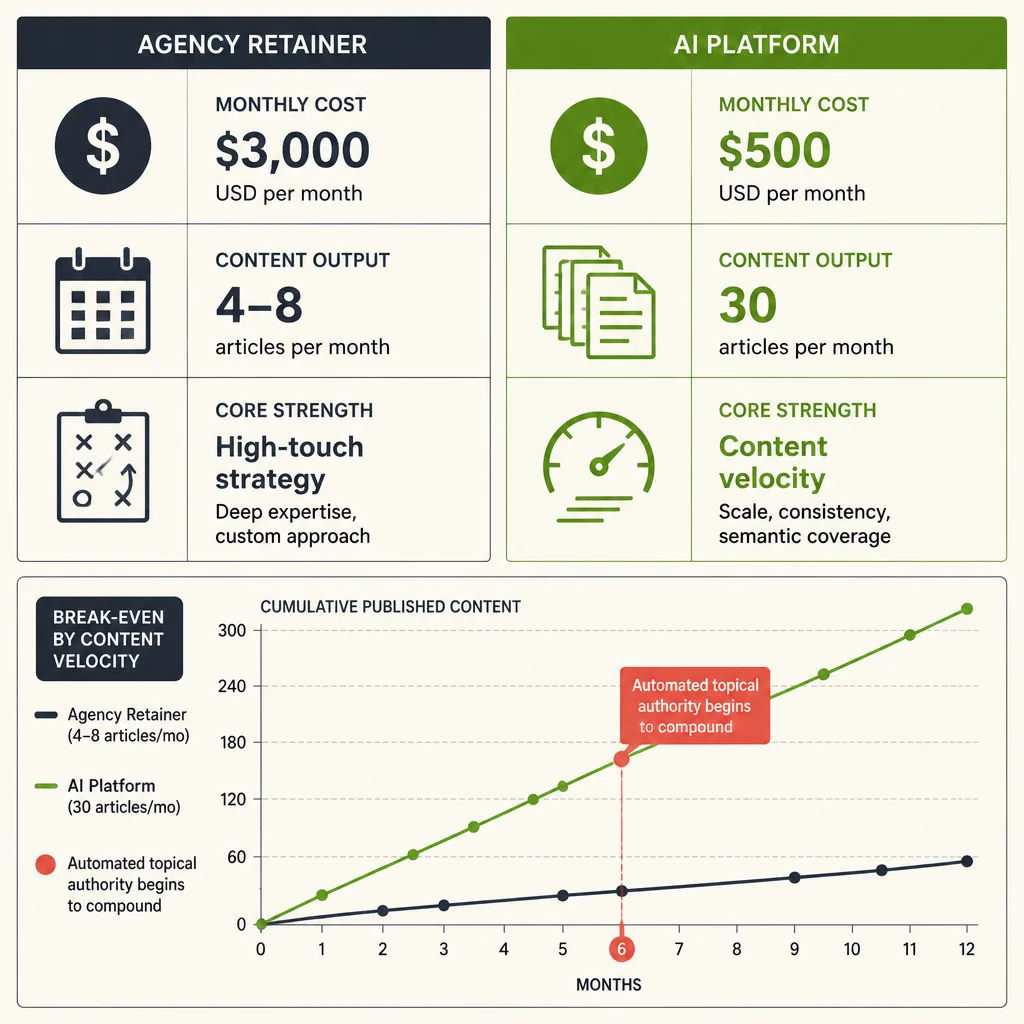
| Factor | Agency Retainer ($3K/month) | AI Platform ($300–800/month) |
|---|---|---|
| Monthly article output | 4–8 articles | 15–40 articles |
| Per-article production cost | $400–$800 | $15–$50 |
| Time to first draft | 5–10 business days | Under 5 minutes |
| Strategic oversight | Included | Requires internal owner |
| AI-search optimization | Rarely explicit | Built into some platforms |
| Quality consistency | High variance by writer | Scored and drift-tracked |
| CMS integration | Manual or delayed | Direct publishing |
This table simplifies complex trade-offs. A $3,000 retainer from a specialized B2B SaaS agency may deliver higher-converting content than a $500 platform subscription if the agency deeply understands your buyer psychology. Conversely, a platform generating 30 articles monthly with semantic QA scoring may build topical authority faster than an agency constrained by writer bandwidth.
The AI SEO platform pricing landscape in 2026 shows significant spread. Entry-level tools start near $50 monthly; enterprise automation suites with CMS integration and multi-model routing run $500–$1,200. Most small businesses land in the $200–$600 range for functional automation.
Where Agencies Still Win
Despite automation advances, three scenarios still favor traditional agencies or specialized consultants:
Complex technical environments. If your site runs on a custom stack with legacy URL structures, JavaScript rendering issues, or international hreflang implementations, you need hands-on engineering that platforms do not provide.
Reputation-sensitive industries. Healthcare, financial services, and legal verticals often require compliance review that automated systems cannot reliably perform. The cost of a single inaccurate claim exceeds any production savings.
PR and authority building. When your SEO strategy depends on original research, journalist outreach, or executive bylines, human relationship management remains irreplaceable. AI can draft; it cannot source exclusive quotes or negotiate placement.
For these cases, the AI SEO consultant checklist still applies—whether you hire a traditional agency or an AI-native advisor who understands both worlds.
Where Automation Pulls Ahead
Conversely, four signals suggest automation is the better fit:
Content velocity as competitive advantage. In markets where topical coverage breadth directly correlates with search visibility, production speed matters more than polish. AI platforms that generate site-aware content—content that reads your existing pages before drafting new ones—maintain voice consistency without manual brief writing.
Limited internal SEO expertise. If your team cannot evaluate keyword difficulty, structure header hierarchies, or implement schema markup, a platform with built-in guardrails reduces error rates compared to outsourcing to low-cost writers.
Multi-location or multi-language needs. Scaling content across service areas or languages multiplies agency costs linearly. Automation platforms with localization workflows flatten that curve.
Explicit AI-search visibility goals. As GEO becomes distinct from traditional SEO, platforms that track LLM citations and optimize for being recommended—not just ranked—offer capability that most agencies have not yet built.
The AI SEO agency tools category is itself splitting. Some tools serve agencies trying to scale their own output; others serve end businesses eliminating agency dependency. Understanding which layer you are buying matters for expectation-setting.
Red Flags in Either Model
Whether you choose an agency or platform, several warning signs predict poor outcomes:
Guaranteed rankings. No provider can promise specific positions; Google's index is dynamic and competitive. Be skeptical of any firm making position-one commitments.
Opaque reporting. You should see exactly what was published, where it ranks, how traffic flows, and whether AI systems cite your content. Dashboards with vanity metrics but no conversion or citation tracking are insufficient in 2026.
No AI-search strategy. If a provider's framework stops at traditional blue-link optimization, they are not preparing you for how 45% of consumers now find local businesses. Ask specifically how they address Google AI Overviews, ChatGPT recommendations, and Perplexity citations.
Generic content at volume. Automation without site-awareness produces interchangeable articles that do not advance your positioning. The SEO type selection framework helps clarify whether you need authority content, conversion content, or topical coverage—and whether your provider can deliver the right type.
Making the Decision: A Diagnostic
Choose your path based on where you sit on three axes:
Internal marketing maturity. Do you have someone who can own strategy, briefs, and quality review? If yes, automation multiplies their output. If no, an agency provides management you cannot supply internally.
Content as growth lever priority. Is publishing velocity among your top three growth initiatives? If content is secondary to product development or sales expansion, a lower-touch platform prevents SEO from becoming a distraction.
Search environment complexity. Do you compete in a market with heavy AI Overview presence, local pack dominance, or emerging GEO requirements? The more your visibility depends on AI-search recommendation rather than traditional ranking, the more you need platform-native optimization.
For most small businesses in 2026, the answer is not either-or but sequencing: start with automation to establish baseline coverage and learn what content resonates, then add strategic agency support once you have data on which topics drive qualified traffic.
What to Verify Before Signing
Regardless of provider type, conduct this verification before committing budget:
- Request a sample content calendar based on your domain, not a generic template. This reveals whether the provider understands your market.
- Check AI-search citation tracking. Can they show whether your content appears in Gemini, ChatGPT, or Perplexity responses for your target queries?
- Review quality scoring methodology. How do they measure semantic coverage, brand voice consistency, and factual accuracy? Opaque scoring means uncontrolled drift.
- Confirm CMS integration scope. Will articles publish directly, or require manual copy-paste? Friction at this step often kills execution consistency.
- Validate cancellation terms. SEO is cumulative; you want to own your content and data if you switch providers.
Reader Questions
How much should a small business budget for SEO in 2026?
Most functional programs require $500–$3,000 monthly depending on whether you use automation, agency support, or both. Pure automation can start lower; comprehensive agency retainers rarely fall below $1,500 for meaningful work. Budget for at least 6–12 months before evaluating ROI, as both traditional and AI-search visibility compound over time.
Can AI-generated content rank well in Google?
Yes, when it meets Google's quality standards. The Google Search Central guidelines emphasize helpfulness, originality, and satisfying search intent—not production method. AI content that merely rephrases existing sources without adding value will underperform. Platform quality scoring and semantic drift tracking help maintain the standards Google rewards.
Do I still need an agency if I use AI automation?
Not necessarily for production, but possibly for strategy, technical complexity, or authority building. Many businesses run automation for 12–18 months, then add agency support for specific campaigns or migrations. The hybrid model is increasingly common.
What is GEO and how is it different from SEO?
Generative engine optimization (GEO) is the practice of structuring content and business data so AI systems surface, cite, or recommend it. Traditional SEO optimizes for search engine crawlers and ranking algorithms. GEO optimizes for large language models that synthesize answers without requiring clicks. The GEO vs SEO difference is becoming material for businesses dependent on organic discovery.
How do I know if AI search is affecting my traffic?
Monitor your Search Console data for declining clicks on queries that trigger AI Overviews. Supplement with direct testing: search your target keywords in ChatGPT, Perplexity, and Gemini. Does your brand appear in recommendations? Are your pages cited? If not, your traditional SEO investment may be invisible to a growing segment of searchers.