
Hire AI SEO Consultant: What to Verify Before Signing
Hire an AI SEO consultant with confidence. Learn the 6 verification steps agency operators use to evaluate expertise, tools, and deliverables before signing.

A marketing director at a mid-market SaaS company reviews a proposal from an AI SEO consultant who promises to double organic traffic in 90 days using proprietary models. The proposal lists “AI content generation” and “RAG-based optimization” but says nothing about hallucination testing, source attribution, or how the consultant plans to integrate with the company’s CMS. This is a common decision point — and the difference between hiring a partner who builds durable visibility and paying for a black box that produces citations no one can verify.
You’re right to be cautious: the AI SEO space is moving fast, and not everyone claiming expertise can back it up with operational discipline. This article walks you through the specific verification points you should apply before signing any engagement — from RAG pipeline hygiene to content QA discipline, CMS integration, and proof-of-effectiveness metrics. By the end, you’ll have a concrete screening checklist to separate consultants who operate with technical depth from those who ride the trend.
Know the Consultant’s AI Infrastructure and RAG Setup
When you hire an AI SEO consultant, you’re effectively hiring an access point to language model pipelines that turn keyword research into published content. Without a clear understanding of how that pipeline works, you risk handing over your brand’s voice to a black box that can generate plausible-sounding hallucinations — fabricated facts that undermine trust with readers and search engines alike.
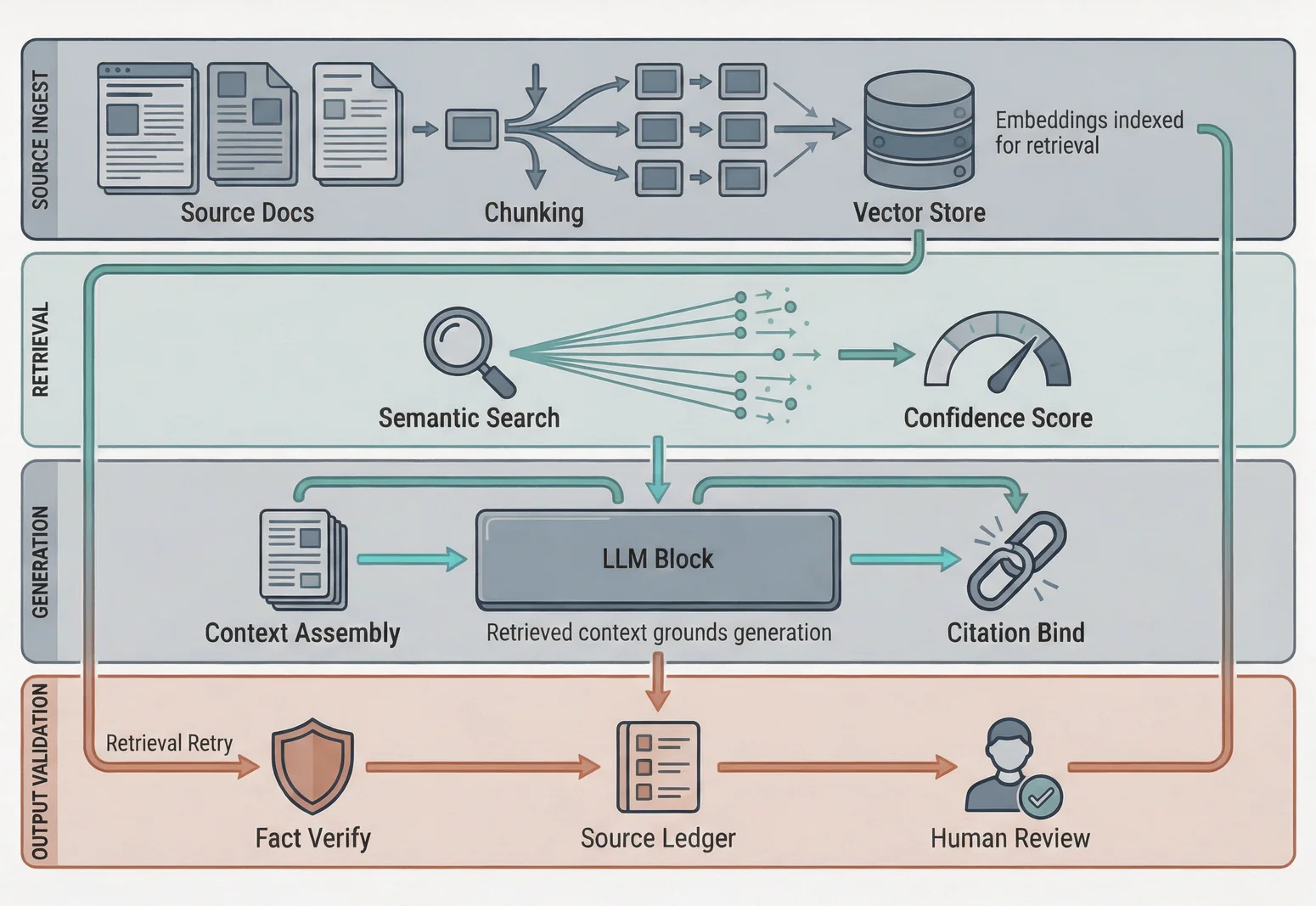
Ask the consultant to walk you through their retrieval-augmented generation (RAG) architecture — the system that retrieves relevant source material before the model generates text. A capable setup uses a vector database to store indexed content, semantic chunking to preserve context, and a citation layer that ties each factual claim back to a source. The difference between a RAG-based system and a raw model prompt is comparable to the difference between assembling a referenced report and asking someone to guess from memory. A consultant who can’t articulate how they split content for chunking, handle embedding updates, or test for hallucination rates is operating at surface level.
One concrete test: request a walk-through of how the system manages conflicting source statements. For example, if one source says “best AI content tools rely on GPT-4” and another says “Gemini Pro offers superior factual accuracy,” how does the output resolve that? A mature pipeline uses a confidence scoring step or surfaces both claims with clear attribution, not a synthetic blend that mixes them into a single unsupported “average” answer. If the consultant describes the model as “the authority,” that’s a signal they lack RAG discipline.
You can deepen your understanding of these technical requirements with our RAG and hallucination control guide. And beyond the pipeline itself, a well-rounded consultant should distinguish between using an SEO agency versus AI platform — knowing whether the collaboration relies on resold platform access or a custom-built stack is a key part of your infrastructure evaluation.
Also pay attention to the consultant’s approach to source freshness. In 2026, a growing share of search queries are being answered by generative engines that prioritize recent, well-attributed content. If the consultant’s content pipeline uses a static knowledge base that hasn’t been updated since the model’s training cutoff, the output will reflect outdated stats and stale recommendations. Google’s official guide to generative AI search optimization explicitly frames reliable, expert-driven content as foundational, and that starts with a pipeline that can pull current data.
Verify Content QA Discipline, Not Just Output Volume
Proposals that promise “x number of blog posts per month” are easy to find. Harder to find is a consultant who can articulate the difference between a first-draft AI output and a published article that meets editorial standards. The July 2026 algorithmic shift made this distinction even more important: Google’s systems now evaluate the editorial processes behind content, assessing whether the material was reviewed, fact-checked, and shaped by a human who understands the subject — not whether the text “reads like AI.” (Calvin Ng, in his breakdown of Google’s July 2026 core update, noted that the algorithm now looks for evidence of “strategic intent” behind content creation.)
So your next line of questioning should focus on the consultant’s quality assurance workflow. Specific questions to ask:
- Do you use a structured scoring rubric for each piece? A reliable consultant will describe dimensions like factual accuracy, source attribution coverage, brand voice alignment, and structural consistency — with actual numeric thresholds, not just hand-waving.
- How do you catch hallucinations before they reach the CMS? Look for an answer that includes automated fact-verification against a source ledger, plus a human review step for claims that fall below a confidence threshold. Our comparison of AI content QA and human editing outlines what a hybrid process should look like.
- What happens when a post underperforms? A strong QA process includes a feedback loop that feeds performance data back into the content pipeline, adjusting for things like low dwell time or high bounce rates. If the consultant treats every piece as “published and done,” they’re not operating a learning system.
Even the most automated system needs a human gate for regulated topics, where inaccuracy carries genuine risk. If your industry sits in a regulated space, insist on seeing a documented protocol for handling sensitive claims, not a generic assurance.
Confirm CMS and Publishing Integration
A surprising number of AI SEO engagements fall apart at the last mile: the consultant delivers content in .docx or Google Docs, and the client’s team spends hours each week manually uploading, formatting, and metadata-tagging posts. That workflow eats up the promised efficiency and introduces human errors — wrong URLs, broken images, missing canonical tags.
During your vetting, ask the consultant to specify their integration method. Does their pipeline push posts directly to your content management system via its API (REST or GraphQL), or does it rely on a tool like Zapier to bridge gaps? If you use WordPress, the consultant should be comfortable working with the WordPress REST API and custom post type mapping. For headless CMS setups like Contentful or Strapi, ask how they handle structured content fields and granular frontmatter requirements.
A concrete probe: “Walk me through exactly what happens from the moment an article is approved to the moment it appears live on our domain.” A consultant who struggles to answer — or who says they’ve “never needed to worry about that” — is more of a content writer than a systems-oriented SEO partner. Conversely, a consultant who can explain their staging environment, scheduled deployment, and rollback protocols is thinking like an operator.
Platforms like SIA SEO’s AI-powered content generation pipeline demonstrate how deep this integration can go: from URL analysis all the way to direct CMS publication with metadata populated and quality scores attached. Even if you’re hiring a human consultant rather than a platform, the same technical discipline should be present. If the consultant’s own process requires you to manually enter meta descriptions and alt text, you’re absorbing the overhead that AI SEO was supposed to eliminate.
Demand Evidence of Performance, Not Promises
Consultants who claim to improve “AI visibility” should be able to show you exactly how they measure it. At a minimum, ask for a sample performance report that covers:
- Citations across major AI answer engines (Google AI Overviews, ChatGPT, Perplexity) for your priority topics, tracked over time and compared to your main competitors.
- Traffic changes segmented by source, so you can distinguish direct organic search from AI-referral traffic — especially important now that generative AI can answer many queries without a clickthrough.
- Engagement metrics for AI-generated content versus human-written content, to rule out the possibility that you’re getting volume at the expense of user experience.
The consultant should also be transparent about the baseline. If you hire someone promising to increase your brand’s appearance in ChatGPT answers, they must first audit where you currently appear. That audit can be as simple as querying your company name and a competitor’s name across major LLM interfaces and documenting the results. Ankit Chauhan, an experienced practitioner, emphasizes this initial “AI-readiness score” as a prerequisite for any targeted campaign — because you can’t improve what you can’t measure.
When reviewing past client results, press for specifics: “Show me a domain where you improved AI citation count from X to Y over six months, and walk me through how you did it.” Vague case studies that say “we increased organic traffic by 300%” without connecting the outcome to specific AI optimization actions are not evidence — they’re generic marketing. One seasoned consultant, Harpreet Munjal, frames his entire approach around building “the complete search architecture, technical foundation, topical authority, entity coverage, and GEO that makes your brand the default answer” — a claim worth verifying with concrete timelines and measurable milestones.
Finally, use your new knowledge of AI SEO platform pricing benchmarks to compare consultant fees against the cost of a dedicated platform subscription. If a consultant charges a premium over what the tooling would cost directly, that premium must be justified by strategic oversight, custom integration work, or quality assurance that a platform alone can’t deliver. Don’t pay expert rates for a resold platform disguised as bespoke consulting.
Evaluate Technical Depth in Entity-Based and Generative Search
Modern AI SEO goes far beyond keywords and backlinks. Google’s search algorithms are built on entity recognition and knowledge graph relationships, and generative engines like ChatGPT use those same signals to decide which brands to cite. A capable AI SEO consultant should be able to explain how they optimize your content architecture for entity coverage — not just for current queries, but for the semantic neighborhood around them.
Draft a question like this for your interview: “Given our core service, which entities should our content cluster around in order to be the most likely citation when someone asks a generic question in our category?” A technically deep consultant will reference entity extraction tools, schema.org markup strategies, and content mapping that bridges gaps in topical authority. If the answer revolves around keyword volume metrics or backlink profiles, you’re hearing the older SEO playbook.
Shifts in search behavior also demand familiarity with generative engine optimization (GEO) and answer engine optimization (AEO). Ask how the consultant structures pages to appear in AI-generated summaries or featured snippets. A clear litmus test: “How would you modify a product comparison page so that ChatGPT is more likely to summarize our product alongside competitors?” The answer should touch on structured data (especially FAQ and HowTo schema), clear entity definitions, and a front-loaded answer format that mirrors how language models extract information.
To deepen your own understanding of why these concepts matter, our AI SEO versus traditional SEO shifts piece breaks down the algorithm changes that have made entity coverage a core requirement. And if you hear terms like “GEO” and “SEO” used interchangeably during a consultant pitch, treat it as a warning sign — these disciplines share roots but require distinct execution.
Run a Vetting Call That Reveals Real Competence
With the groundwork above, you can now structure the actual interview or RFP process to surface what matters. Here is a sequence of questions, grouped by verification area, that will help you separate operational maturity from generic sales talk. Use these as a living script during your screening calls.
RAG Pipeline and AI Infrastructure
- “Walk me through your content generation pipeline from source retrieval to final output, including how you prevent hallucination and enforce factual sourcing.”
- “What’s your chunking strategy for long-form articles? How do you handle source contradictions when they arise?”
- “How do you keep your training or retrieval data current? What’s the refresh cadence?”
Content QA and Editorial Process 4. “Describe your quality scoring rubric — what dimensions do you measure, and what threshold does an article need to pass before publication?” 5. “Where does human review sit in your workflow, and how do you handle false positives/negatives in your automated checks?” 6. “How do you adjust your process for regulated niches, such as finance or health?”
Integration and Publishing 7. “Exactly how does your process push finished content to our CMS? Please describe the technical handoff, including handling of custom fields, metadata, and scheduling.” 8. “What happens if a post is published and we later discover an error? What’s your rollback or correction procedure?”
Performance and Measurement 9. “Show me a sample performance dashboard. How do you track AI citations, organic traffic, and engagement for the content you produce?” 10. “What metrics do you use to link your work to revenue, and how long does it typically take to see measurable movement after your optimizations are applied?”
These questions are designed to produce substantive responses; if a consultant deflects or cannot answer without pulling up materials, that itself is informative. A good AI SEO consultant will welcome the rigor — it signals a client who values outcomes over volume.
Strengthen Your AI SEO Foundations
Review SiaSEO as the operating system for structured SEO content production. — Get started