
The Keyword Research Framework That Scales With Your AI Content
Discover the step-by-step framework for scaling keyword research using AI, from seed generation to intent mapping and content briefs.

At ten articles a month, keyword research is a person and a spreadsheet. At fifty, the spreadsheet breaks. At a hundred, the guesses multiply and the quality collapses. The familiar workflow—grab terms from a planner, sort by volume, pick the ones that sound right—was never designed for velocity. It was designed for a single editor managing one blog. When content production scales past twenty or thirty pieces a month, the old process stops being slow and starts being dangerous, producing keyword lists that are bloated, intent-blind, and full of head terms that rank for nobody.
The fix is not faster tools or more aggressive AI. It is a repeatable system. This article walks through a three-layer keyword research framework built for teams that publish high volumes of AI-assisted content: automated seed generation from competitor and SERP data, AI-driven intent clustering, and competitive filtering to produce clean, prioritized lists that feed a content calendar. The framework does not depend on any single platform, although the way SiaSEO automates site analysis and calendar creation mirrors these layers in practice.
The Volume Trap: When Spreadsheets Stop Working
Traditional keyword research treats each article like a one-off event. You brainstorm ten variations of a topic, check search volume, maybe glance at keyword difficulty, and call it done. That workflow survives because it feels careful. What it rarely accounts for is the compound cost at volume: the time spent repeating discovery tasks for every new post, the uncaught intent mismatches that send traffic to dead pages, the list drift where priority lists fall out of sync with actual publishing by week three.
When a team produces fifty or more articles a month, decisions that were personal and artful become batch decisions, and batch decisions demand structure. An editor can no longer hold the entire keyword map in memory. Without a framework, the output defaults to a pattern: safe commercial terms get overused, long-tail informational queries get ignored, and content clusters fragment across the calendar instead of reinforcing each other.
The scale problem is sharpened by how search behavior has shifted. Google's own data shows the average AI Mode query now runs three times longer than a traditional search query. Truncated keyword lists built on short head terms miss the conversational, multi-intent queries that now dominate the tail. A keyword research framework that scales needs to start by capturing that full query surface, not the fraction visible through a handful of brainstormed seeds.
Layer 1: Automated Seed Generation from Live Search Data
The first layer replaces manual ideation with programmatic harvesting. Instead of asking a human to list every possible variation of "enterprise SEO platform," the framework pulls seeds from four sources simultaneously: competitor sitemaps and title tags, SERP features like "People Also Ask" and related searches, search query data from site search logs or Search Console, and tool-generated expansions from seed terms. The output is not the final keyword list; it is a wide topography of candidate phrases that will get filtered and clustered downstream.
This step benefits from a taxonomic mindset. The Department of Homeland Security's keywording standards for federal websites recommend building keyword taxonomies from actual search query data rather than institutional jargon, and they caution against attaching keywords to content where the term is only tangentially referenced. The principle scales: a seed list drawn from genuine user queries inherits the language of the audience, not the product team.
Tools are the workhorses here. Google's Keyword Planner remains a reliable starting point for volume-validated expansions, especially when you upload an existing page or a competitor URL to reverse-engineer its term surface. But relying on Planner alone limits your list to the terms Google chooses to expose. Many teams layer on API calls to search-result scrapers, competitor keyword databases, and SERP feature parsers to collect the full range of questions, modifiers, and location variants that a human wouldn't think to type. When SiaSEO analyzes a website for brand-aware content planning, it scans the competitive landscape in this same way, extracting seed terms that are already winning for players in the space.
Layer 2: AI-Driven Intent Clustering
A raw seed list of two thousand terms is useless until it is carved into groups that share a common searcher intent. Volume-based grouping—putting all high-volume terms together—is the most common mistake because it assumes that search volume predicts value. It doesn't. A term with 50,000 monthly searches may be a purely informational query that generates zero pipeline, while a 200-volume commercial term converts with every click. The framework uses embedding-based clustering, often via transformer models, to group terms by semantic similarity and then classifies each cluster by dominant intent: informational, commercial investigation, transactional, or navigational.
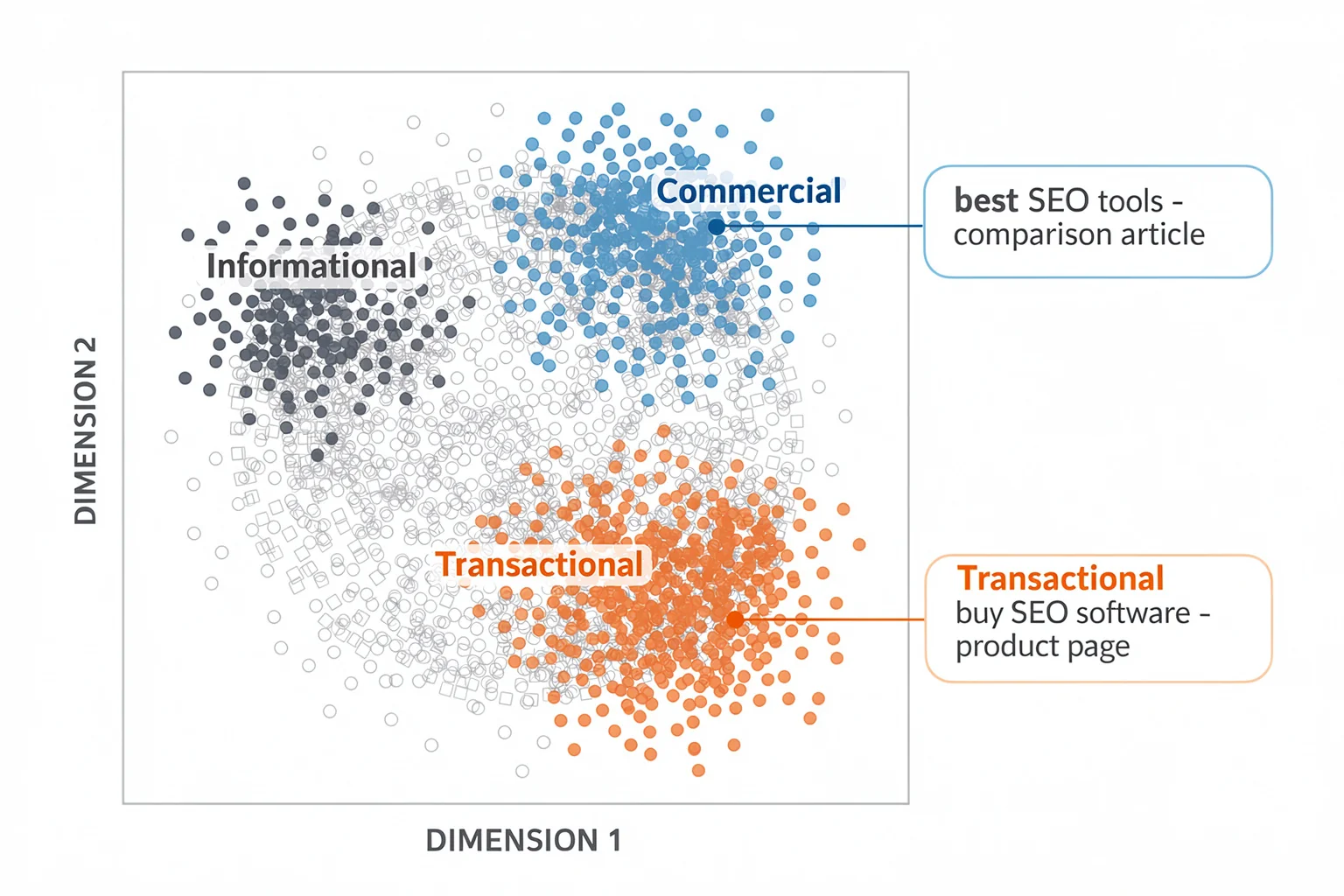
Intent clustering does more than prevent mismatched content assignments. It surfaces the content types a topic actually demands. A cluster of commercial-comparison keywords suggests a versus page or a buyer's guide. A cluster of "how to prevent" and "what causes" questions points to an educational deep-dive. An informational cluster with heavy "what is" variants may merit a glossary entry rather than a blog post. When AI content teams at SiaSEO structure a seven-day calendar from an ingested site, they map clusters to specific article templates based on these intent signals.
The rise of AI search has made intent clustering more important, not less. AI Overviews now appear on an increasing share of commercial intent SERPs, and LLMs decompose user prompts into many sub-queries before retrieving a document. A keyword list that ignores the sub-queries and long-form prompts behind a transaction will surface content that is invisible to the AI engines. Clustering by intent—and then expanding each cluster to include the full conversational trail—is the only way to build content that serves both traditional crawlers and generative models.
Layer 3: Competitive Filtering for Prioritization
A clean, intent-mapped keyword portfolio still needs a prioritization lens that eliminates terms the team cannot realistically win. The mistake most frameworks make is equating "priority" with "low keyword difficulty score" from a single tool. Keyword difficulty aggregates are lossy measures; they cannot see the specific authority gaps between your site and the top-ranked page for a niche term. Competitive filtering, by contrast, examines the domain authority, content depth, publishing recency, and topical authority of the ranking pages for each clustered keyword, then lifts the terms where your site has a proven track record in that subject area or where the incumbent results are thin enough to outrank with a better piece.
Open-source AI models have made this layer more accessible. Teams can run language models over the top-ranking content to score how comprehensively a page covers a topic relative to the cluster's intent. A high score for a competitor with a thin page signals an opening. A low score against a deeply authoritative site signals that the term belongs to the "nurture and revisit" list, not the next sprint. Formal metadata standards like the DCAT-US discoverability guidelines reinforce the general practice of tagging and prioritizing important topics for consistent governance, an approach that maps directly to maintaining a clean keyword stack where every prioritized term has an assigned page and a review cadence.
The output of this layer is a shortened, ranked list per cluster: Tier 1 terms to build content around this month, Tier 2 terms to monitor, and Tier 3 terms to park until the site has built more topical authority. This is the list that moves into a content calendar without further debate.
Tuning the Framework for AI Search Behavior
The framework as described works for traditional search, but AI-native search requires one additional tuning step: prompt expansion. Users typing into ChatGPT, Perplexity, or Google's AI Mode write sentences, not keywords. A search for "best project management software for distributed teams under 50 employees with SOC 2" is the modern equivalent of a head-term comparison query. The framework must generate these conversational long-forms for each cluster and evaluate which ones trigger AI citations. Teams do this by submitting a sample of prompts to the target engines, checking which clusters receive citations, and adjusting the content briefs to include the phrasing and authority signals that AI models weight.
This tuning step also feeds back into intent clustering. When an LLM decomposes a commercial query into half a dozen informational sub-queries, those sub-queries reveal the underlying needs the user expects the final answer to address. The framework absorbs those sub-queries back into the seed generation layer, enriching the cluster and sharpening the content brief. SiaSEO's approach to maintaining content quality across a growing library—with ongoing semantic drift tracking—is an operational response to the fact that the cluster definition itself can shift as AI engines retrain and user phrasing evolves.
Building Content Calendars from Keyword Clusters
A prioritized intention map only becomes a calendar when each cluster is assigned to a publication slot with a designated article type, a target word count, and a primary keyword. The shape of the calendar emerges from the clusters: a heavy commercial cluster might require three articles within the quarter, one targeting the head comparison, two addressing specific buyer objections. An informational "how to" cluster with high volume may deserve a pillar page plus a series of shorter supporting pieces.
Automation at this stage converts the framework's static lists into a living publishing schedule. When SiaSEO generates a seven-day calendar from a site scan, it performs exactly this conversion: mapping clusters to calendar slots, proposing article templates that match intent, and assigning secondary keywords to each piece. For teams running their own pipeline, a simple rules engine can assign cluster priority based on business goals and the tier rankings from competitive filtering, then drop those assignments into a CMS or project board.
Manual review remains necessary, but it shifts from "decide what to write" to "validate that the framework's output aligns with editorial judgment." The difference in cognitive load is large and becomes the difference between a team that can sustain high output and one that burns out at the planning stage.
Questions You're Likely Asking
How often should a keyword framework be refreshed?
Every quarter for core commercial clusters, monthly for informational clusters in fast-moving industries. The seed generation layer should be re-run whenever a major competitor launches new content or when Search Console shows new query themes emerging. The intent and competitive layers can update on an offset cadence because intent shifts slower than search volume patterns.
Can a small team implement this without an engineering team?
Yes, with a pragmatic tool stack. A combination of a keyword database, a spreadsheet, and an embedding-based clustering tool (even running locally via a Python script) can execute the framework at moderate scale. The friction rises when output exceeds 30–40 articles a month, at which point a platform that automates the pipeline—such as SiaSEO's site-to-calendar flow—reduces the manual handoff between layers.
What metric indicates the framework is working?
A reduction in the number of low-traffic, low-conversion pages published per quarter. A healthy framework filters out terms that would have become dead pages before they reach the calendar. A secondary metric is the cadence: when a team can generate a prioritized calendar in under an hour instead of a day, the framework is doing its job.
Does this framework work for local SEO or only national content programs?
Local SEO introduces a geographic modifier layer that multiplies the seed list. The same three layers still apply, but the seed generation must include city and neighborhood variations, and the competitive filter must compare against competitors in the same service area. The intent clustering remains the same, though commercial-intent clusters dominate.
More Frameworks and Tools for AI Content Teams
- AI Keyword Research: What Agencies Need to Know Now
- Keyword Research Tools for AI SEO Teams: What Actually Scales
- Your Biggest Questions About AI and Keyword Research, Answered
Review SiaSEO as the operating system for structured SEO content production. — Get started