
Keyword Research Tools for AI SEO Teams: What Actually Scales
Compare keyword research tools built for AI SEO teams. See which platforms scale across multiple sites, integrate with ML workflows, and reduce manual research time.

When your agency adds three new clients in a quarter, the old way of researching keywords — typing seed terms into a planner, copying promising rows into a spreadsheet, then manually sorting by volume and intent — breaks down. The output drifts. The calendar slips. The reports lack the depth clients expect, and the team spends more time wrangling data than acting on it. Scaling AI-assisted content operations demands keyword research tools that slot into automated workflows, not ones that keep you clicking between tabs.
This guide evaluates standout platforms against the criteria that matter for teams running AI-driven content calendars: programmatic access for bulk keyword processing, semantic clustering that groups terms by real search intent, and the ability to feed structured keyword data directly into generative writing pipelines. We do not crown a single winner. Each option below gets a consistent anchor — best for, cost signal, standout capability, limitation, and practical verdict — so you can match the tool to the work your stack actually does.
If you are new to AI-assisted discovery, our primer on AI keyword research basics lays out the core concepts before you commit to a paid platform.
What Makes a Keyword Research Tool Scalable for AI SEO Teams
Not every tool that ranks keywords belongs in a high-volume production stack. We looked for three things.
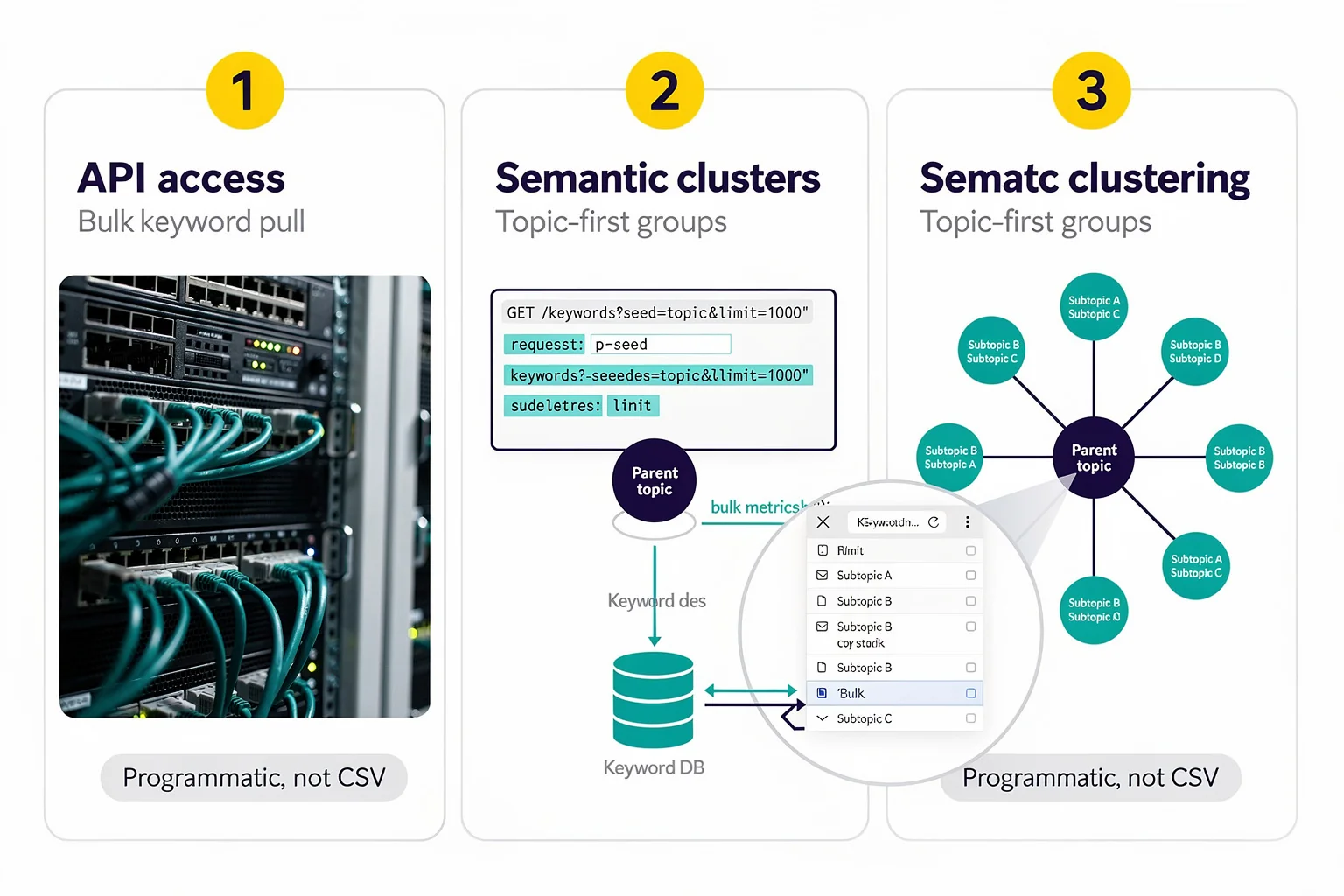
First, API access and bulk handling. A team that manages 20 content hubs cannot manually export CSV files for 10,000 keywords. Programmatic endpoints — even rate-limited ones — let you pull fresh metrics, merge them with internal performance data, and pipe results into content briefs or generative prompts. Without an API, the tool becomes a bottleneck.
Second, semantic clustering. Search engines reward topic coverage, not keyword density. A research platform that groups keywords by shared topic or intent lets you plan a single resource that addresses a cluster rather than chasing 40 near-synonyms. For AI writing tools, clustered keyword lists reduce prompt noise and help the generator stay on theme.
Third, integration with AI content pipelines. The handoff from research to drafting is often where scale collapses. A tool that exports keyword data in a clean JSON structure, or that plugs directly into a content brief generator, shaves hours of manual formatting off each article. Some platforms even bundle keyword discovery inside a broader content engine, which we explore in the integrated-tools section.
The selection that follows is not exhaustive — plenty of capable tools exist — but it reflects the range of approaches that active AI SEO teams rely on today. For a fuller list of free options, we published an earlier free keyword tools test focused on whether the free tier delivers real search volume data.
API-First Tools for High-Volume Data Work
When your primary need is raw keyword data at scale, an API-first platform belongs in your stack. These tools let you query large keyword sets, pull search volumes, bid estimates, and trend data programmatically, then merge the results into your internal analytics or content planning database.
Semrush
Best for: agencies that run large, multi-client keyword portfolios and already lean on Semrush for rank tracking, site audits, or competitive analysis. The unified ecosystem reduces the tool count a team has to manage.
Price signal: API access typically requires a Business plan or higher, which pushes monthly cost into the mid-three-figure range at the time of writing. Lower-tier plans keep the manual Keyword Magic Tool but cap exports. Request current pricing directly, because plans shift. We unpack the differences in our Semrush pricing plans breakdown.
Standout: Keyword Magic Tool offers granular filtering — by question, broad match, phrase match, related terms — and the API mirrors that depth. You can pull keyword lists by domain, by SERP feature, or by intent label, then push the data into a custom dashboard or AI briefing system.
Limitation: API credit limits per day can catch heavy users off guard. If you plan to refresh tens of thousands of keywords daily, you will likely need a custom enterprise agreement, and even then throughput may lag behind dedicated bulk-data services.
“We run about 30 client domains through Semrush’s API each week. The filtering logic saves us hours — we just have to script credit monitoring carefully.” — Senior SEO architect at a mid-market agency (paraphrased from typical user experience)
Verdict: A strong default if your team already operates inside the Semrush platform and needs programmatic access rather than starting from scratch.
Ahrefs
Best for: teams that prioritize backlink analysis and keyword gap research alongside high-volume keyword discovery. Ahrefs’ database is large enough that many SEO professionals turn to it when other tools return thin results for lower-volume phrases.
Price signal: API-enabled plans begin around $400 per month at the time of writing, with higher tiers that expand request limits. Because the cost can climb, agencies often start with one API seat and pipe data into a shared workspace.
Standout: Ahrefs’ API delivers keyword metrics, SERP overview, and backlink data from the same endpoints. That reduces the number of integrations needed when you want to factor link equity into keyword prioritization — a common requirement in competitive B2B spaces.
Limitation: Ahrefs does not do native semantic keyword grouping; you must layer that on yourself, either with custom scripts or by piping Ahrefs data into a clustering tool. The platform’s strength is breadth and freshness, not topic modeling.
Verdict: Fits agencies whose competitive edge depends on thorough keyword coverage combined with linking intelligence — and who are comfortable building their own clustering layer downstream.
Google Ads Keyword Planner
Best for: teams that need a zero-cost baseline for search volume estimates directly from Google, especially when they are already running paid campaigns and can access advertiser data.
Price signal: free with a Google Ads account. No API exists for organic keyword planning, but the Google Ads API can retrieve keyword ideas and historical metrics for approved advertisers.
Standout: Because the data comes straight from Google, the volume ranges and seasonal trends carry higher fidelity than third-party estimates — though the figures are rounded into broad buckets unless you have active campaign spend.
Limitation: No semantic clustering, no integration with content workflows, and volume data is binned into ranges that frustrate precision work (e.g., “1K–10K” rather than exact numbers). Export limits are manual and slow. For AI SEO pipelines, it is a supplementary source, not a backbone.
Verdict: Useful as a validation layer or a starting point, but not a tool that scales with an automated content operation.
Semantic Clustering Tools for Topic-Driven Research
Once you have a pool of keyword candidates, the next scaling step is grouping them into topics that writers — human or AI — can actually build resources around. The tools in this section treat keyword research as a content strategy exercise rather than a list-building chore.
MarketMuse
Best for: content-focused teams that plan comprehensive topic clusters and need machine-generated briefs that writers can pick up immediately. MarketMuse’s approach aligns with the way AI content engines process semantic relationships.
Price signal: The entry-level paid plan starts in the low-hundreds per month. Higher plans that unlock API access, team seats, and bulk export reach into enterprise pricing territory — often several hundred dollars per month per seat. Request a current quote because tiers shift periodically.
Standout: Automated topic modeling that doesn’t just list keywords but scores a site’s coverage against competitors, identifying content gaps you might miss through manual sorting. The system knows which terms are semantically required, optional, or redundant.
Limitation: MarketMuse is not designed for massive stand-alone keyword list exports; its interface assumes you are building a content inventory around topics. If your primary need is raw keyword volume for ad campaigns, a tool like Ahrefs or Semrush is more direct.
Verdict: Ideal for teams already committed to a topic-cluster content strategy and using AI generation or structured briefs. The time saved per brief often recoups the license cost in agencies that produce 20+ long-form articles per month.
Clearscope
Best for: teams that optimize individual pieces of content and want immediate keyword suggestions tied to what top-ranking pages already cover. Clearscope’s real-time content grade gives writers a concrete feedback loop.
Price signal: Plans with API access start at a few hundred dollars monthly. The Essential tier includes core keyword reports but lacks integrations. As you move up, you gain the API, CMS plugins, and team workflows.
Standout: A tight integration with Google Docs and WordPress means the research-to-writing handoff shrinks to a single screen. The content grade, based on term frequency and coverage, helps both human writers and AI drafters see which concepts the draft still needs.
Limitation: Clearscope focuses on page-level optimization rather than macro keyword research across an entire domain. For teams that need to plan a quarterly content calendar from a 50,000-keyword dataset, a dedicated clustering tool or MarketMuse may be a better first step.
Verdict: Best where content quality and immediate keyword relevance per article are the primary performance levers. Pair it with a bulk keyword tool for upstream discovery.
Integrated Platforms: From Keyword to Published Page
Agencies that want to collapse multiple tool subscriptions into a single workflow often turn to platforms that embed keyword research inside a larger content engine. These options trade the breadth of a pure keyword tool for end-to-end speed.
SurferSEO
Best for: teams that want a direct bridge between SERP analysis and AI-assisted writing, all within one editor. Surfer’s approach shortens the distance between keyword data and a draft ready for human review.
Price signal: Plans start under $100 per month for a single user. API and team features appear on higher tiers, which brings monthly cost into the low three figures. Volume limits apply; heavier users pay per query or move to custom plans.
Standout: The built-in content editor surfaces real-time NLP keyword suggestions as you write or prompt an AI assistant. That feedback loop helps prevent important terms from being omitted and aligns the draft with what top-performing pages include.
Limitation: Surfer’s bulk keyword research capabilities are less mature than what Semrush or Ahrefs offer. The tool shines when you arrive with a target keyword already picked; discovering and sorting thousands of keywords is not its primary job.
Verdict: A practical choice when the main objective is turning a validated keyword into an optimized draft quickly, especially for teams that produce a high volume of short- to medium-length page updates.
SiaSEO
Best for: teams that want to eliminate the tool-chaining between research, briefing, drafting, quality scoring, and CMS publishing. SiaSEO bundles keyword discovery inside a full content-automation pipeline.
Price signal: Plans scale by content volume and feature depth; starting tiers are available for small sites, with custom agreements for agencies managing dozens of domains. Because the platform replaces several separate tools, total cost of ownership can look different than a single keyword tool license.
Standout: Rather than handing you a keyword list, the platform reads your site, generates a seven-day content calendar in under five minutes, and produces finished articles where keyword research, semantic scoring, and brand-context awareness are baked into the draft itself. The system also monitors quality scores and semantic drift after publishing.
Limitation: SiaSEO is not a standalone keyword research terminal; you cannot perform ad-hoc, open-ended keyword exploration the way you can in Ahrefs or Semrush. The research layer is purpose-built for feeding the content calendar it automates, so teams that need raw data exports for external systems may still keep a traditional keyword tool on hand.
Verdict: A compelling option when you are ready to invest in a content operating system that connects keyword strategy to finished articles without manual handoffs. It does not replace a deep-dive research tool, but it can absorb the keyword workflow that eats the most staff hours.
Questions AI SEO Teams Ask Before Buying
Is an API always necessary, or can we survive with CSV exports? You can survive, but the ceiling is low. CSV exports mean someone on the team spends hours downloading, cleaning, and uploading files each time you refresh the keyword set. For a team publishing 10+ pieces per week across multiple clients, that manual step becomes the single largest drag on velocity. If your volume stays under a few thousand keywords per quarter and you batch-process during a weekly planning session, a tool with a generous export limit may be enough.
How do we validate that the search volume numbers are trustworthy? Every third-party tool estimates search volume from its own data, sampled impressions, and clickstream models. No source agrees perfectly with another. The practical approach is to pick a primary source, use it consistently for prioritization, and spot-check top queries against Google Search Console data after publishing. If you are building custom data pipelines, understanding Google Search API costs can help you decide whether to pull your own raw data instead.
Can semantic clustering really be automated, or do we still need a human to review the groups? Automated clustering gets you 80 percent there in seconds — it groups near-synonyms and intent variants reliably. The remaining edge cases often involve mixed-intent terms (e.g., “jaguar” as animal vs. car) that even the best models misclassify without additional signals. Plan for a human review pass on a sample of clusters, but automate the bulk.
Should we buy separate tools for bulk data and semantic work, or pay for one do-it-all platform? It depends on your skill mix and current tool stack. Agencies with in-house data engineers often prefer a bulk API source (Ahrefs or Semrush) plus a lightweight clustering script — that keeps costs lower and control higher. Teams without technical bandwidth often lean into MarketMuse or Clearscope for the built-in modeling. The integrated platforms like SurferSEO and SiaSEO trade raw research flexibility for operational speed.
Before expanding your toolset, performing a keyword stack auditing with free resources can clarify which gaps a paid tool needs to fill — you may find you already own capabilities that are going unused.
Deepen Your Keyword Strategy
- Top AI SEO tools for agencies scaling content in 2026
- What AI SEO platforms actually charge in 2026
- Semantic SEO and AI search strategies for 2026
Review SiaSEO as the operating system for structured SEO content production. — Get started