Automate Content Research: How AI Cuts B2B Marketing Costs
Automate content research with AI tools built for B2B marketing. Learn how URL ingestion and automated briefs cut research costs while keeping brand control intact.

Marketing teams at mid-market SaaS companies and agencies face a familiar tension: leadership wants more search content, faster, but scaling research without losing structure or brand accuracy remains stubbornly hard. Manual keyword lists, competitor audits, and brief assembly consume 40–60% of production time before a single draft appears. The result is either slower velocity or thinner briefs that force writers to guess at intent, structure, and differentiation.
AI-native research pipelines now close that gap. By ingesting a company's own URL, analyzing site context, and outputting structured briefs with SERP-backed headings and word-count benchmarks, these systems compress days of research into minutes. The critical question for B2B operators is not whether automation works in principle, but which workflow design preserves quality control while actually reducing cost per article.
This article answers that question directly: how automated content research functions end-to-end, where it saves money, what can go wrong, and how to evaluate platforms for your stack.
What Does "Automate Content Research" Actually Mean in Practice?
Automating content research means replacing the manual assembly of keyword lists, competitor outlines, and content briefs with a pipeline that ingests source data—typically your website URL and target topic—and outputs a structured brief without human intervention at each step.
The standard manual workflow looks like this: a strategist runs keyword research in one tool, copies results into a spreadsheet, opens three to five top-ranking pages to analyze headings and gaps, drafts a brief in a document, and passes it to a writer with loose instructions. Each handoff introduces delay and drift.
An automated workflow reverses that sequence. The system reads your site first, understands your existing content architecture and brand positioning, then queries SERP data, clusters related keywords, maps intent stages, and assembles a brief with recommended headings, target word counts, and competitor gap notes. Platforms like Frase structure this around four input locks—topic, goal, audience, and market—so the research output is anchored to what a specific piece needs rather than generic ranking data.
The output is not a finished article. It is a decision-ready brief that a strategist can review, modify, or route straight to drafting.
Why Does URL Ingestion Matter for B2B Brands?
Most AI writing tools treat every prompt as a blank slate. They generate content from general training data, which produces competent but generic prose. For B2B companies with specific product positioning, technical terminology, and established thought leadership, generic output creates more work: every draft needs heavy editing to sound like the brand.
URL ingestion solves this by making the AI site-aware before research begins. When a platform reads your website, it extracts your existing topic clusters, tone patterns, product descriptions, and competitive angles. That context then shapes the research phase: keyword suggestions favor gaps you are positioned to fill, not just high-volume terms any competitor could target. Brief recommendations reference your existing content architecture so new articles strengthen topical authority rather than duplicating it.
This matters for cost in two ways. First, it reduces revision cycles because the brief already reflects brand context. Second, it improves the probability that published content ranks and converts, which raises the return on each research dollar spent.
How Much Time and Money Does Automation Actually Save?
Time savings are the most immediate and measurable benefit. A 2026 benchmark analysis found that 88% of marketers now use AI daily for content tasks, and the share not using AI for blog creation dropped from 65% to 5% in two years. The shift reflects compounding efficiency gains: what once took a strategist four to six hours per brief now runs in under ten minutes for platforms with integrated URL ingestion and SERP analysis.
Cost savings follow from two structural changes. First, labor reallocation: senior strategists spend less time on mechanical research and more on brief review, creative direction, and distribution strategy. Second, error reduction: automated SERP analysis catches heading structures, featured snippet opportunities, and competitor content gaps that manual audits often miss, which reduces the cost of publishing content that fails to perform.
The precise savings depend on team size and output volume. A solo consultant producing four articles monthly might save six to eight hours of research time. An agency managing twenty clients with weekly publishing calendars can reallocate one to two full-time equivalents from research to higher-value work.
What Should a Structured Content Brief Include?
A brief that automation outputs should be decision-complete: a writer should need no additional research to draft the article. The minimum viable brief contains:
- Primary and secondary keywords with search volume, intent classification, and competitive difficulty
- SERP-derived heading structure showing how top-ranking pages organize the topic
- Word count benchmark based on what currently ranks for the target query
- Competitor gap notes identifying what existing content omits or underexplains
- Brand context anchors linking the topic to your existing content and positioning
- AI visibility signals indicating which competitor pages are cited by LLMs and where your entry point lies
Advanced platforms add programmatic layers. Keyword Insights, for example, offers a public API for content brief generation that returns SERP-based headings, title and description suggestions, and word count benchmarks programmatically. This lets teams integrate brief generation into larger workflows—triggering brief creation from a content calendar entry, routing outputs to project management tools, or batch-generating briefs for an entire quarter's keyword pipeline.
Where Do Automated Research Pipelines Break Down?
Automation is not self-driving. Three failure modes recur in B2B deployments:
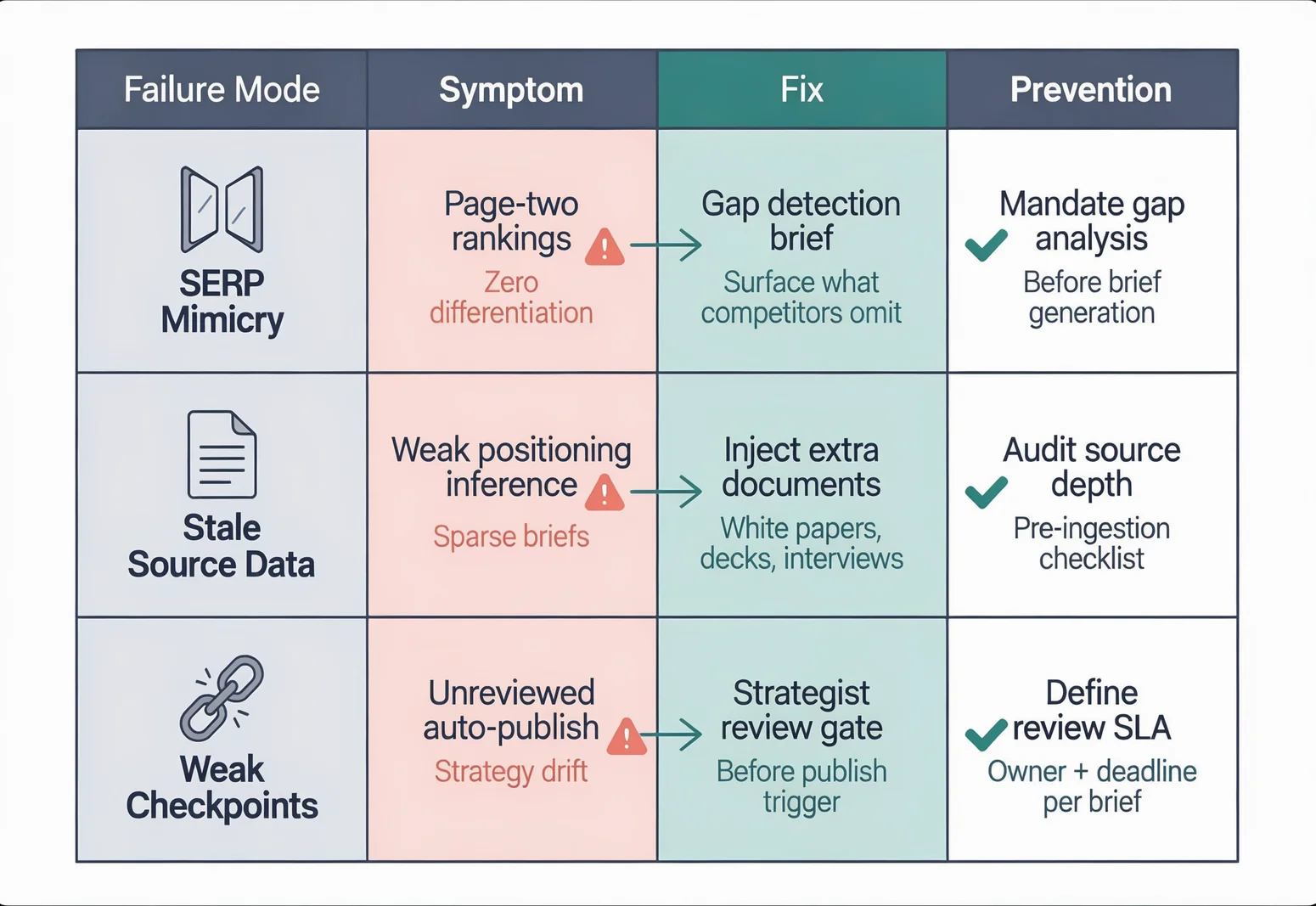
Over-reliance on SERP mimicry. Systems that copy top-ranking structures without gap analysis produce content that competes directly with established authorities on identical terms. The result is often page-two rankings and zero differentiation. The fix is explicit gap detection: the brief must highlight what competitors have not said, not merely replicate what they have.
Stale or thin source data. URL ingestion works only when the website contains sufficient structured content for the system to learn from. Early-stage companies with sparse blogs or single-page product sites may receive weaker briefs because the platform lacks material to infer positioning from. The fix is feeding additional source documents—white papers, sales decks, or recorded interviews—into the research phase.
Weak human review checkpoints. Fully auto-publishing briefs without strategist review risks tone drift, factual errors, or misaligned intent mapping. The most cost-effective implementations keep a human in the loop for brief approval while automating everything upstream. One agency operator described this as "five minutes of review for fifty minutes of saved research."
How Do You Evaluate an AI Research Platform for Your Stack?
Platform selection should test three capabilities against your actual workflow:
Site-awareness depth. Can the platform ingest your URL and produce briefs that reference your existing content architecture, or does it treat every brief as isolated? Test this by running identical topic briefs with and without URL ingestion and comparing the keyword and angle recommendations.
Research-to-brief continuity. Does the platform require manual export between research and brief creation, or does it maintain a live connection? Frase's workflow, for example, lets users run research first and then create briefs from those findings, or jump straight to brief creation with background research running automatically. Disconnected tools create friction that erodes time savings.
Quality scoring and drift tracking. Does the platform score brief quality before drafting begins, and does it track whether published content maintains semantic alignment with the original brief over time? This matters for teams scaling to high volume, where brief-to-draft drift compounds across dozens of articles monthly.
Which B2B Teams Benefit Most From Automation?
The cost-benefit calculus favors three profiles:
Agencies managing multiple clients with distinct positioning. Manual research does not scale across ten or fifteen brand voices. Site-aware automation preserves voice accuracy while increasing brief throughput.
Mid-market SaaS companies with technical products. These teams need content that reflects product nuance and industry terminology. Generic AI writing fails here; site-aware research that feeds specialized briefs succeeds.
Content operations leads building predictable publishing systems. Automation converts research from a variable creative task into a repeatable pipeline step, which makes capacity planning and cost forecasting possible.
Teams with highly idiosyncratic approval processes or regulatory constraints—healthcare, financial services—may need hybrid workflows where automation handles research assembly and humans manage compliance review.
What Role Does Content Marketing Research Play in AI Search Visibility?
The 2026 State of AI Content Report found that 77% of content marketers now create material primarily intended for LLMs to detect, reference, or surface. Among enterprise organizations, 32% identify LLMs as the primary audience for a majority of their content. This shifts what research must capture.
Traditional keyword research targets search engine ranking factors. AI search visibility research must additionally identify which sources LLMs currently cite for a topic, what citation patterns they prefer, and where gaps exist for new authoritative entries. Automated research platforms that include AI visibility tabs—showing which competitors are cited and where your content could intervene—address this directly.
The implication for B2B teams: your content marketing research process now needs to output not just "what ranks" but "what gets referenced by AI systems." Platforms without this layer leave you optimizing for the last generation of search.
How Do You Maintain Brand Control When Research Runs Automatically?
The fear of losing editorial oversight is the most common barrier to adoption. Effective implementations preserve control through three design choices:
Lockable brief parameters. Before research runs, the strategist sets non-negotiables: target audience segment, competitive frame, prohibited angles, and required messaging points. The automation operates within these constraints.
Pin-and-curate interfaces. Rather than accepting all automated suggestions, strategists pin selected keywords, headings, and evidence sources into the final brief. The system proposes; the human decides.
Versioned brief archives. Every brief generation is stored with its source parameters and output, creating an audit trail for why specific editorial choices were made. This matters for teams with multiple strategists or rotating freelancers.
What Integration Patterns Work for Automated Research?
Standalone research tools create new friction. The most efficient deployments connect research output directly to downstream systems:
- CMS publishing: Briefs route to draft creation, then to review, then to scheduled publication without manual file transfer
- Content calendars: Automated brief generation triggers from calendar entries, with due dates and assignees preset
- Quality scoring: Drafts are scored against brief parameters before publication approval
- Semantic drift tracking: Published content is monitored for divergence from original brief intent, with alerts for significant drift
SiaSEO's platform architecture reflects this pipeline design: URL ingestion feeds automated brand analysis, which generates a seven-day content calendar in under five minutes, with articles that can route through manual review or auto-publish to CMS sync, supported by ongoing quality scoring and semantic drift tracking.
When Should You Keep Research Manual?
Full automation is not universally optimal. Three scenarios favor hybrid or manual approaches:
Entering new markets with no existing content base. URL ingestion requires source material to learn from. A company launching in a new vertical with a blank website may need manual research to establish initial positioning before automation can take over.
Highly speculative or controversial topics. When content must navigate sensitive industry debates or emerging regulatory uncertainty, human judgment in research design remains essential.
Premium thought leadership with original data. Research briefs based on proprietary surveys or original analysis cannot be generated from SERP data. The automation role here is competitive gap analysis, not primary research design.
Reader Questions
How long does automated brief generation take? Most site-aware platforms produce a complete brief in two to ten minutes, depending on topic complexity and SERP depth. The strategist review adds another five to fifteen minutes.
Can automated research replace a content strategist? No. It replaces mechanical assembly work, freeing strategists for judgment calls on angle, differentiation, and distribution. The brief is a starting point, not a finished strategy.
What input does URL ingestion need? Typically your root domain or sitemap URL. Some platforms accept supplementary documents—PDFs, slide decks, or brand guidelines—to enrich the source context.
How do you prevent AI-generated briefs from sounding generic? By verifying that the platform uses your site content to shape recommendations, and by setting locked parameters for audience, tone, and competitive frame before research runs.
Is automated research cost-effective for small teams? Teams producing fewer than four articles monthly may not recoup platform costs through time savings alone. The break-even point rises with output volume and the cost of strategist time.
References
- Deep Research — The research experience begins with a question: what are you actually trying to do? Build a brief from a topic, explore a topic space, or find gaps your competitors have missed.
- Public Api Content Brief — # Public API: Content Brief ... > Generate AI-powered content briefs, retrieve SERP analysis, and create outlines via the API ... Generate comprehensive content briefs with
- Advertising and Marketing — Under the law, claims in advertisements must be truthful, cannot be deceptive or unfair, and must be evidence-based. For some specialized products or services, additional rules