How AI Platforms Analyze Competitor Content Without Manual Scraping
AI competitor content analysis automates gap detection, topic clustering, and quality scoring. Learn how SEO teams replace manual audits with structured intelligence.

The traditional competitor content audit has become a bottleneck. Marketing teams still spend hours in spreadsheets, manually copying URLs, counting headings, and guessing at topic coverage gaps. The work is tedious, the outputs are inconsistent, and by the time the analysis reaches stakeholders, the competitive landscape has already shifted.
AI platforms now automate this entire pipeline. They crawl competitor domains, cluster content by semantic meaning rather than URL structure, score quality against search intent, and surface actionable gaps — all without a single manual copy-paste operation. This whitepaper examines how these systems work, what standards govern their outputs, and where their limitations lie.
The Research Problem and Scope
Manual competitor audits suffer from three structural failures: they are non-reproducible, they cannot scale beyond a handful of pages, and they rarely account for how AI search engines now cite and rank content. A team of two might review fifty pages in a week. A mid-market SaaS competitor publishes that many in a month.
The scope of this analysis covers automated site-aware scraping, vector-based semantic clustering, quality scoring frameworks, and citation footprint mapping in AI search environments. The evidence standard draws on documented platform architectures, published methodology from the U.S. Government Accountability Office, and 2026 field reports on AI search visibility.
The U.S. GAO's foundational methodology for content analysis — selecting textual material, developing analysis plans, coding content, ensuring data reliability, and analyzing results — remains relevant even as the tools change. Modern platforms automate each step, but the logical structure persists.
From Crawler to Corpus: How Automated Scraping Works
Site-aware scraping begins with URL discovery. Unlike simple sitemap downloads, intelligent crawlers follow internal link graphs, handle redirects and trailing slashes automatically, and respect robots.txt while maximizing coverage. The Topical Audit approach from Floyi demonstrates this: their system discovers site architecture without requiring a pre-submitted sitemap, then maps every page into a hierarchical content model.
The critical advance is context preservation. Raw HTML extraction loses rendering state, dynamic content, and semantic structure. Modern platforms use headless browser emulation to capture the rendered DOM, extract text blocks with their surrounding heading hierarchy, and preserve metadata like publish dates, author attribution, and schema markup. This matters because a paragraph under an H2 titled "Implementation" carries different competitive weight than the same paragraph under "Case Studies."
Once collected, the corpus undergoes deduplication and normalization. Near-duplicate pages — common in e-commerce and tag-based archives — are flagged. Thin content below a configurable threshold is set aside. What remains is a structured dataset where each document retains its original URL, heading path, content blocks, and extracted entities.
Semantic Clustering: Moving Beyond Keyword Matching
Keyword gap analysis has dominated SEO tooling for a decade. It fails because it treats content as bags of terms rather than networks of meaning. Two pages ranking for "project management software" might address entirely different search intents: one compares vendors, the other explains implementation methodology. Keyword overlap obscures this distinction.
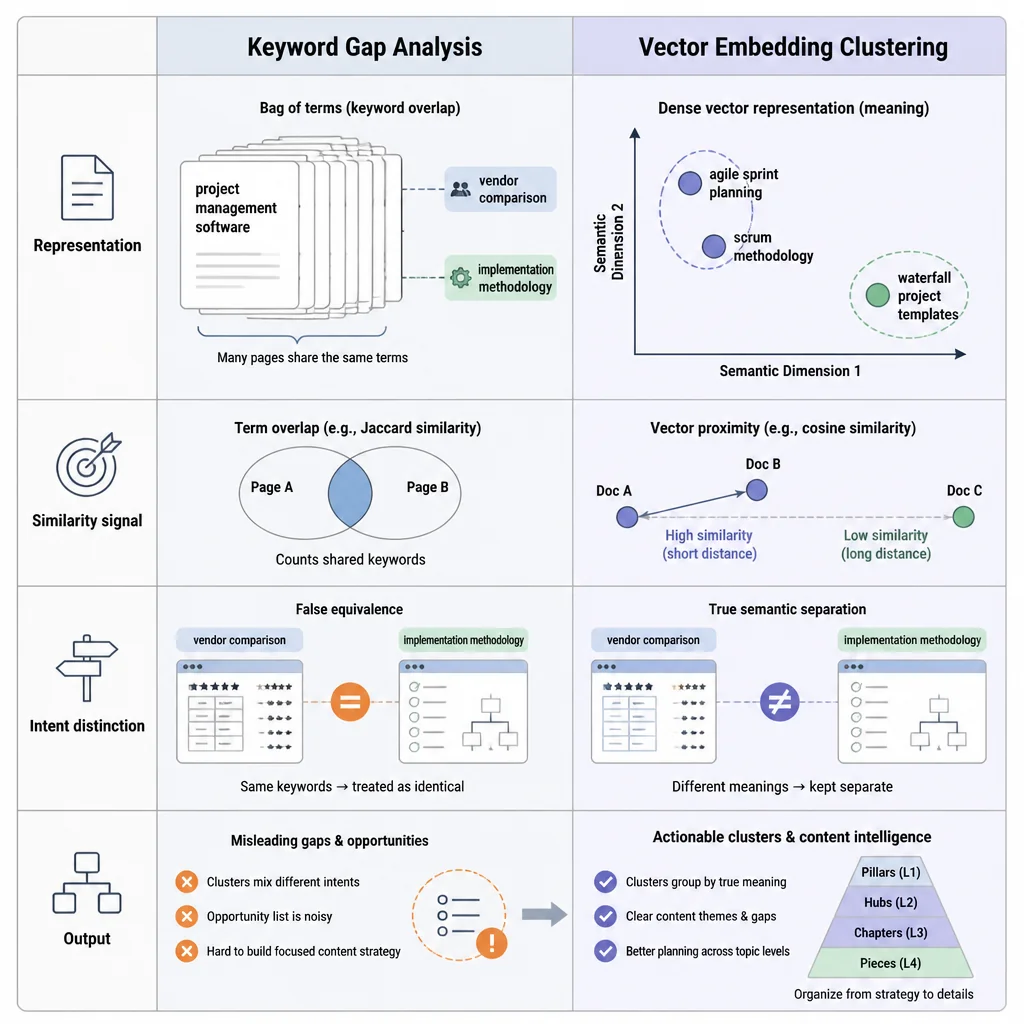
Vector embedding models changed the approach. Platforms now encode entire documents into high-dimensional vectors where semantic similarity corresponds to geometric proximity. Documents about "agile sprint planning" cluster near "scrum methodology" and distant from "waterfall project templates," even when keyword overlap is minimal.
The clustering architecture typically operates at multiple levels. Floyi's system, for example, organizes content into Pillars (L1), Hubs (L2), Chapters (L3), and Pieces (L4). This mirrors how search engines evaluate topical authority: a site with dense interlinking between related subtopics signals expertise more clearly than one with isolated keyword-targeted pages.
Clustering also reveals strategic intent. A competitor whose content clusters tightly around a central "Core Page" per topic demonstrates disciplined topical authority. Scattered clusters — what some auditors call "kitchen sink" blogs — suggest opportunistic publishing without editorial architecture. The Peer Group/Competitor Comparison frameworks developed by the Library of Congress for financial benchmarking apply analogously: you compare structure and concentration, not just presence.
Quality Scoring: From Heuristics to Intent Alignment
Raw content volume means little without quality assessment. Automated platforms score competitor pages across multiple dimensions:
Coverage depth measures how thoroughly a topic is addressed relative to identified search intent. A page targeting "competitor content analysis" that never mentions semantic clustering or citation footprinting scores lower on coverage than one that addresses the full decision journey.
Information gain evaluates whether the content adds novel value or merely restates common knowledge. This is computationally difficult — it requires comparing against a broad reference corpus — but emerging approaches use LLM-based summarization to estimate redundancy.
Structural integrity checks heading hierarchy, schema markup presence, internal link density, and mobile rendering performance. These technical factors correlate with search visibility even when they do not directly measure content quality.
Freshness and maintenance track update frequency, broken link rates, and whether stated statistics carry recent dates. A 2023 benchmark cited without context degrades a page's authority score.
AI citation potential is the newest dimension. With 40% of consumer buyers now consulting AI answer engines before traditional search, and fewer than 5% of brands actively monitoring this visibility, the ability to predict which content gets cited by ChatGPT, Perplexity, or Google AI Overviews has become a competitive advantage. Semrush's 2026 AI Visibility Index, scaled to 126 million U.S. prompts, provides baseline data for this assessment.
Quality scores aggregate these dimensions into composite metrics, typically 0-100 or 0-10 scales. The scoring is not arbitrary: platforms calibrate against known ranking outcomes, adjusting weights as search algorithms evolve.
Citation Footprint Mapping: The New Competitive Surface
Traditional competitor analysis stopped at organic rankings. AI search has added a second surface: citation in generative responses. When ChatGPT recommends a vendor, or Perplexity cites a source, that visibility operates on different logic than blue-link rankings.
Citation footprint mapping tracks every URL a competitor has cited across major AI engines, paired with the rationale snippet provided. This reveals which content earns AI trust and why. The technique emerged in mid-2026 as leading teams moved beyond simple citation counting to systematic competitive monitoring.
The strategic value is predictive. If a competitor's technical documentation consistently earns citations for implementation queries, their content team has likely optimized for information gain and structured data. If their thought leadership pieces dominate comparison queries, they have succeeded in framing the evaluative vocabulary. Mapping these patterns lets you prioritize content investments that address visible gaps rather than assumed ones.
Heatmap visualization across LLMs — comparing where competitors win citations and where your brand is invisible — has become standard in advanced competitive intelligence workflows. The AI-powered competitor research tools landscape now includes platforms specifically designed for this cross-engine monitoring.
Implementation: Building the Automated Pipeline
Deploying automated competitor analysis requires decisions at four layers:
Data collection frequency depends on competitive velocity. In fast-moving markets, weekly crawls capture content launches and updates. Stable industries may need only monthly cycles. The crawl schedule should align with your own publishing capacity — detecting a gap you cannot fill for six months produces noise, not signal.
Clustering granularity balances insight against actionability. Too many clusters fragment strategy; too few obscure meaningful distinctions. Most teams start with topic-level clustering (8-12 clusters per competitor), then drill into subclusters where opportunity concentration justifies focused investment.
Scoring calibration must reflect your search environment. A B2B SaaS company targeting "best search engine optimization tools" faces different quality standards than a local service provider. Calibrate scoring weights against your own highest-performing pages, not generic benchmarks.
Integration with editorial workflow determines whether insights become content. Automated gap lists that sit unread in dashboards waste the entire investment. The most effective implementations push clustered findings directly into content calendars with suggested briefs, as platforms like SiaSEO do when generating site-aware article drafts from competitive intelligence.
Limitations and Validation Requirements
Automated analysis carries specific failure modes that demand human oversight.
Temporal misalignment is common. Crawlers capture a snapshot; competitive content changes daily. A gap identified in March may close by April. Analysis timestamps must be visible, and conclusions should specify their observation window.
Intent misclassification persists despite embedding advances. Vector similarity captures semantic relatedness, not commercial intent. A page about "pricing strategy" might educate or sell; clustering alone cannot distinguish these. Human review of cluster exemplars remains necessary.
Quality scoring opacity risks false precision. Composite scores aggregate incommensurable dimensions. A page scoring 72 against another's 68 may reflect weighting choices, not objective superiority. Platforms should expose component scores and allow weight customization.
AI citation unpredictability is highest for emerging queries. Established topics have stable citation patterns; novel or rapidly evolving subjects show high variance between engines and even between model versions. Citation footprint mapping works best for mature competitive sets.
The Content Analysis: Methodology for Structuring framework from the GAO emphasizes data reliability checks — inter-rater agreement, coding consistency, and audit trails. Automated systems need analogous validation: spot-check clusters against manual review, verify score correlations with actual rankings, and maintain versioned crawl archives for reproducibility.
Model and Platform Considerations
The AI models powering these analyses vary in capability and cost. Frontier models (GPT-4-class, Claude 3.5 Sonnet, Gemini 1.5 Pro) offer superior semantic understanding and reasoning but at higher inference cost. Open-source alternatives (Llama 3, Mistral Large) reduce dependency and enable on-premise deployment for sensitive competitive data, with tradeoffs in instruction following and context window handling.
Platform selection should evaluate:
- Crawl scale and politeness (requests per second, proxy rotation, JavaScript rendering fidelity)
- Embedding model versioning and update cadence
- Scoring transparency (component weights, calibration methodology)
- Integration depth (CMS connectors, calendar APIs, workflow automation)
- AI citation monitoring coverage (which engines, which query sets, update frequency)
The AI SEO platform comparison landscape continues to evolve as vendors differentiate on these dimensions.
What Remains Manual
Automation does not eliminate human judgment. It reallocates it.
Strategic positioning decisions — which gaps to fill, which competitor strengths to avoid head-to-head, which emerging topics to preempt — require market understanding no algorithm possesses. Editorial voice calibration, controversial stance selection, and brand-differentiated framing remain creative functions.
The most productive division of labor assigns machines to pattern detection at scale and humans to pattern selection and narrative construction. Automated competitor analysis produces the map; strategists choose the destination and route.
When Automated Analysis Fits Your Operations
This methodology suits teams with specific characteristics: multiple competitors to monitor, publishing velocity above manual audit capacity, investment in AI search visibility, and editorial processes that can act on structured intelligence within weeks rather than quarters.
It offers diminishing returns for single-competitor situations, static markets, or teams without production capacity to address identified gaps. The tooling investment — platform subscription, integration engineering, validation overhead — must match competitive stakes.
Structured Intelligence for Content Decisions
AI-powered competitor content analysis replaces spreadsheet drudgery with reproducible, scalable intelligence. The core technologies — site-aware crawling, vector semantic clustering, multi-dimensional quality scoring, and citation footprint mapping — are now production-ready and commercially available.
Their value depends on implementation discipline: calibrated scoring, validated clustering, timestamped observations, and tight integration with editorial workflow. Teams that treat automation as a complete replacement for human judgment will find gaps in their own analysis. Those that use it to amplify strategic decision-making gain sustainable competitive advantage in both traditional and AI search environments.
For organizations evaluating how to operationalize this intelligence, the AI model comparison between open-source and frontier approaches informs infrastructure decisions that affect analysis quality and cost structure over time.