
AI SEO News: Open-Source vs. Frontier Models Compared
Compare how open-source Chinese AI models like Kimi K3 stack up against frontier models from OpenAI and Anthropic for SEO content, cost, and access — with the latest news on restrictions and performance.

On July 16, Moonshot released Kimi K3, a 2.8‑trillion‑parameter open‑weight model. Three days later Alibaba previewed Qwen 3.8 at 2.4 trillion parameters, and DeepSeek confirmed its V4 model would graduate from preview in the same window. Meanwhile, news broke that the Trump administration’s “Gold Eagle” program would centralize approval for access to the most advanced U.S. frontier models from OpenAI and Anthropic. This is not a distant policy debate. For B2B marketing leaders who run AI‑powered SEO automation, the same AI SEO news cycle directly shapes which models can be plugged into the content pipeline, what that will cost, and whose regulatory umbrella the pipeline sits under.
The core decision is whether to build around open‑source (and increasingly open‑weight) Chinese models like Kimi K3 or DeepSeek, or to stay with the frontier APIs—GPT‑5.x Pro, Claude Mythos 5, Gemini 3.2—that have anchored most enterprise content stacks since 2024. The right answer differs by team, and it shifts month‑to‑month with the news. This comparison pulls together the performance data, cost math, policy signals, and operational impact that B2B groups need to choose an AI stack—and to revise that choice as the ground moves.
Robert Hart at The Verge summarized the cadence this way:
Moonshot and Alibaba unveiled models they claim can go toe‑to‑toe with the best from OpenAI and Anthropic at a fraction of the cost. — Robert Hart, The Verge
Performance Parity Is Already in the SEO‑Relevant Zone
As recently as late 2025, open‑weight models trailed the frontier by double‑digit margins on the metrics that matter for content generation: language understanding, reasoning, and factual recall. That picture is outdated. A June 2026 benchmark snapshot from Presenc AI shows that the gap on multiple knowledge and coding tests has collapsed to single digits, and in some cases to less than two points.
| Benchmark | Top Closed Model | Top Open‑Weight Model | Gap |
|---|---|---|---|
| MMLU‑Pro | GPT‑5.6 Pro (84%) | DeepSeek V4.1 Pro (74%) | 10 pts |
| SWE‑bench Verified | Claude Mythos 5 (78%) | DeepSeek V4.1 Pro (69%) | 9 pts |
| GPQA Diamond | Claude Mythos 5 (88%) | DeepSeek V4.1 Pro (75%) | 13 pts |
| HumanEval (coding) | Claude Mythos 5 (98.8%) | DeepSeek V4.1 Pro (97.8%) | 1 pt |
| Chatbot Arena Elo (Hard) | GPT‑5.6 Pro (~1465) | DeepSeek V4.1 Pro (~1410) | ~55 Elo |
These numbers matter for SEO automation in specific ways. Generating a technical blog post or a product description does not require PhD‑level physics reasoning; the MMLU‑Pro differential matters less than the HumanEval or Arena Elo scores suggest. For SEO‑specific tasks—writing meta titles, structuring a content brief, extracting entities from a search results page—the open‑weight models now sit inside a margin that human editors often cannot distinguish. When a B2B team deploys AI‑based keyword research or evaluates AI writing tools rankings, the choice of underlying model is losing its predictive power over output quality.
The one area where closed models retain a meaningful edge is agentic task completion. Benchmarks such as WebArena and OSWorld, which measure a model’s ability to navigate websites and complete multi‑step tasks, still favor GPT‑5.6 Pro by 12–14 points. For SEO, this gap affects only the most automated workflows: a pipeline that scrapes product pages, compares data, and self‑corrects factual conflicts. Most content teams stopped short of full agentic pipelines in 2026 anyway, which means the practical parity zone is larger than the benchmark tables suggest.
The Cost Equation: Open Models Are Not Just Cheaper, They’re Strategic
A July 14 analysis by The New Stack captured the financial reality bluntly: open‑source models are “4 months behind” closed frontier systems and roughly 10× cheaper to operate at scale. Multiply that 10× across a content calendar of 200 articles a month and the savings reach five figures quickly. That math alone explains why agencies that run thin margins are already moving their bulk drafting workloads to self‑hosted DeepSeek or Kimi variants.
Cost, however, is not just an API‑invoice number. Running an open‑weight model on your own GPU infrastructure requires cluster management, queueing, monitoring, and model‑versioning code that does not appear on a Stripe receipt. A team that builds this in‑house will trade a predictable per‑token expense for a meaningful engineering commitment. In practice, many B2B groups land somewhere in the middle: they rent inference‑as‑a‑service from a provider that hosts DeepSeek, or they use a platform that abstracts the routing layer and lets them toggle between model families based on task complexity. SiaSEO, for example, generates content by routing each brief to the model best suited to that brief’s demands, so an operator pays frontier prices only for the small fraction of tasks that genuinely benefit from them.
The takeaway for budgeting: compare total cost of ownership, not token prices. If you already maintain a Kubernetes cluster for other workloads, adding an open‑weight inference node may be incremental. If your team’s DevOps bandwidth is maxed out, an API‑first or platform‑mediated approach makes the cost‑benefit analysis land differently. The AI SEO platform pricing page dives into what real vendors charge in 2026, but the principle holds regardless of the bill: open models shift spend from opex to capex, and they shift risk from a third‑party API dependency to an in‑house system you control.
Regulatory Headwinds: From the White House to the Code Editor
The single largest new variable in the model‑selection equation is government intervention. Reports from CNBC and Quartz detail how the Gold Eagle program would create a White House clearinghouse to approve which companies can access the newest OpenAI and Anthropic releases. The program’s full scope remains opaque, but even the possibility of intermediate licensing changes the calculus for a B2B SEO operation that relies on GPT‑5.x for high‑stakes content. If a policy shift tomorrow throttles your model tier, your pipeline falls back to a downgraded version—or stops.
At the same time, Chinese open‑weight models are not immune to cross‑border friction. Existing export controls can make U.S.‑based hosting of large Chinese models legally ambiguous, and future sanctions could affect model weights, datasets, or API endpoints. Organizations that handle data governed by NIST guidelines or sectoral regulations need to consult compliance counsel before routing content through servers operating under non‑U.S. legal jurisdictions.
Google’s own moves add another layer. On July 20, Google published a Search Console toggle that lets website owners exclude their content from AI Overviews, AI Mode, and Discover’s generative features. The control is rolling out to a subset of owners, and Google’s documentation makes clear that excluding a site prevents its content from being used to ground AI responses. For a brand that invests heavily in frontier‑model‑generated content, the decision to be or not to be in AI‑generated answers becomes a strategic one—and it interacts with the underlying model because the output quality of a grounded AI answer correlates with the quality of the source text. If you generate your source text with an open‑weight model that is 13 points weaker on GPQA Diamond, your content’s eligibility for AI Overviews may not change, but its likelihood of being cited might. Google’s own AI optimization guide says “These features rely on AI techniques to highlight content from our Search index,” and it confirms that “best practices for SEO continue to be relevant.” The foundation of that relevance is accurate, expert‑level material— something that model choice amplifies or dampens.
What the Model Choice Means for Daily SEO Workflows
For most B2B teams, the model choice filters into daily work through four recurring operations: content drafting, keyword and topic clustering, on‑page element generation, and link‑strategy suggestions. Each operation carries a different tolerance for the current gaps between open‑weight and frontier models.
Content drafting still rewards frontier models on the margin, particularly for opinion‑backed long‑form articles that require consistent voice and deep factual threading. However, with HumanEval parity at 1 point, open‑weight models can now serve as a capable first‑draft engine for mid‑funnel blog posts, user‑guides, and glossary pages. Several of the best AI SEO tools 2026 now support backend selection, so a single interface can push high‑stakes drafts to Claude while routing standard pages to DeepSeek.
Keyword and topic clustering leans on statistical NLP and embeddings, not long‑form reasoning. Open‑weight embedding models trained on multilingual web corpora match or exceed proprietary alternatives at a fraction of the cost, and they allow teams to run clustering jobs without sending proprietary domain data to a third‑party API. The trend toward AI‑powered content pipelines means this step increasingly happens inside the same system that generates the final article.
On‑page elements—meta titles, heading structures, schema markup, alt text—are the best candidates for full open‑weight delegation. These outputs are constrained in length and style, making them highly automatable. A mid‑tier model like DeepSeek‑Lite can generate 5,000 meta descriptions per hour for pennies, freeing a human editor to focus on strategic calls.
Link‑strategy suggestions require graph reasoning over a site’s existing architecture, a task that still shows a performance gap in agentic benchmarks. Many teams keep this step human‑led and use models only to surface candidate pairs. A platform that integrates AI‑driven internal linking offloads the computational work to a model, but the final decision remains editorial.
A lightweight Python snippet illustrates the routing logic that a growing number of teams are embedding in their pipelines:
if task_complexity < 0.3: response = open_source_client.generate(prompt) else: response = frontier_client.generate(prompt)
The threshold—wherever it is set—embeds a bet about parity. As the curves continue to converge, that threshold will move right. The practical move today is to instrument your pipeline so the threshold is configurable, not hard‑coded.
External Benchmarks and Recent Findings
Analysts and researchers are tracking the open‑vs‑closed dynamic with increasing granularity. Three pieces published in July 2026 capture the latest evidence B2B teams need for stack decisions.
The New Stack: “4 Months Behind, 10× Cheaper”
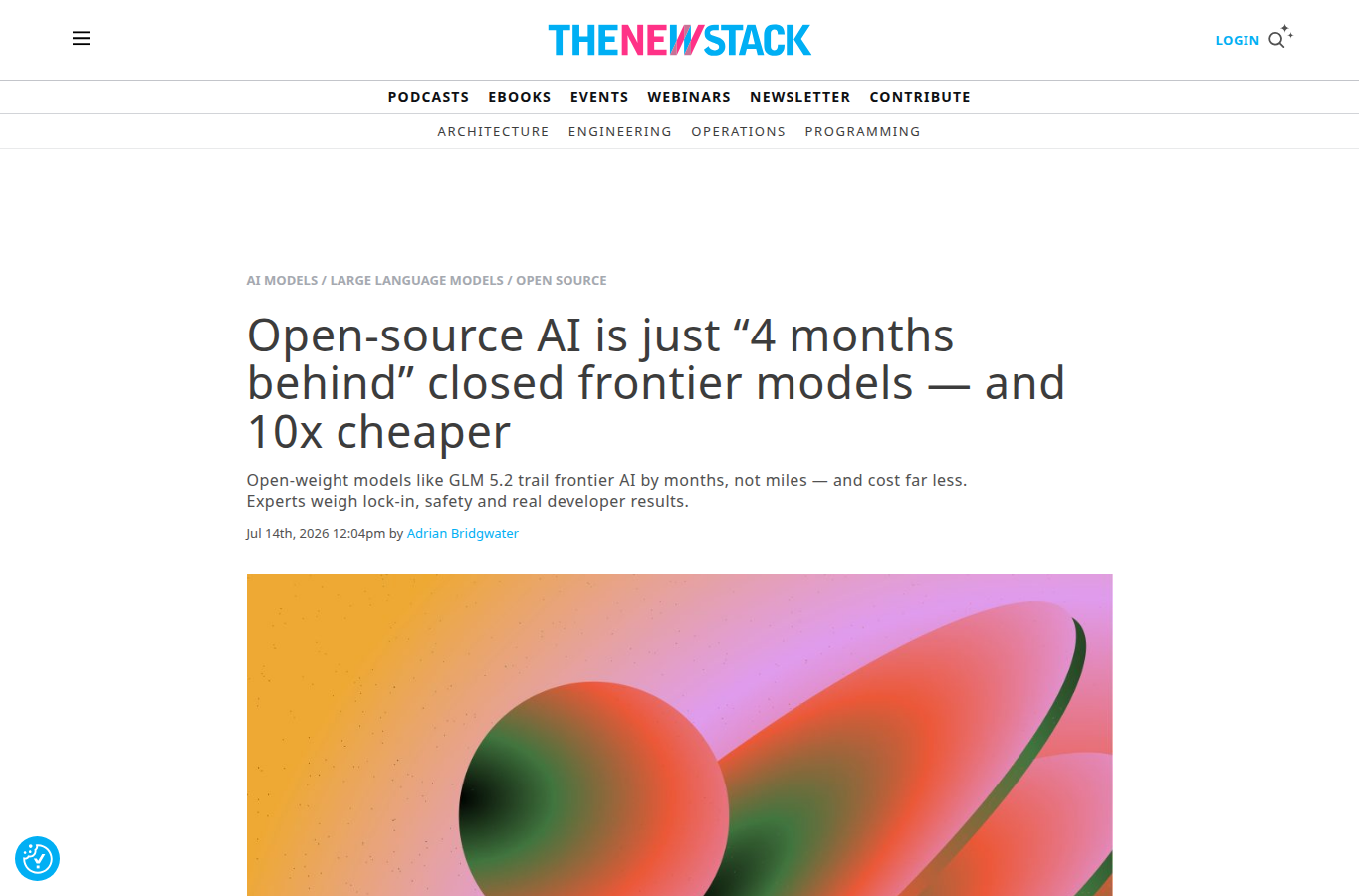
In a July 14 analysis, The New Stack argued that open‑weight models have closed the capability gap to roughly four months behind the best proprietary systems, while remaining an order of magnitude cheaper to operate. The article noted that this delta has persisted across multiple model generations, indicating a structural cost advantage rather than a temporary pricing blip. For an SEO content pipeline running at scale, that stability makes long‑term budgeting more predictable than a frontier API price schedule that shifts quarterly.
Presenc AI: Open‑Weight vs Closed Frontier Snapshot
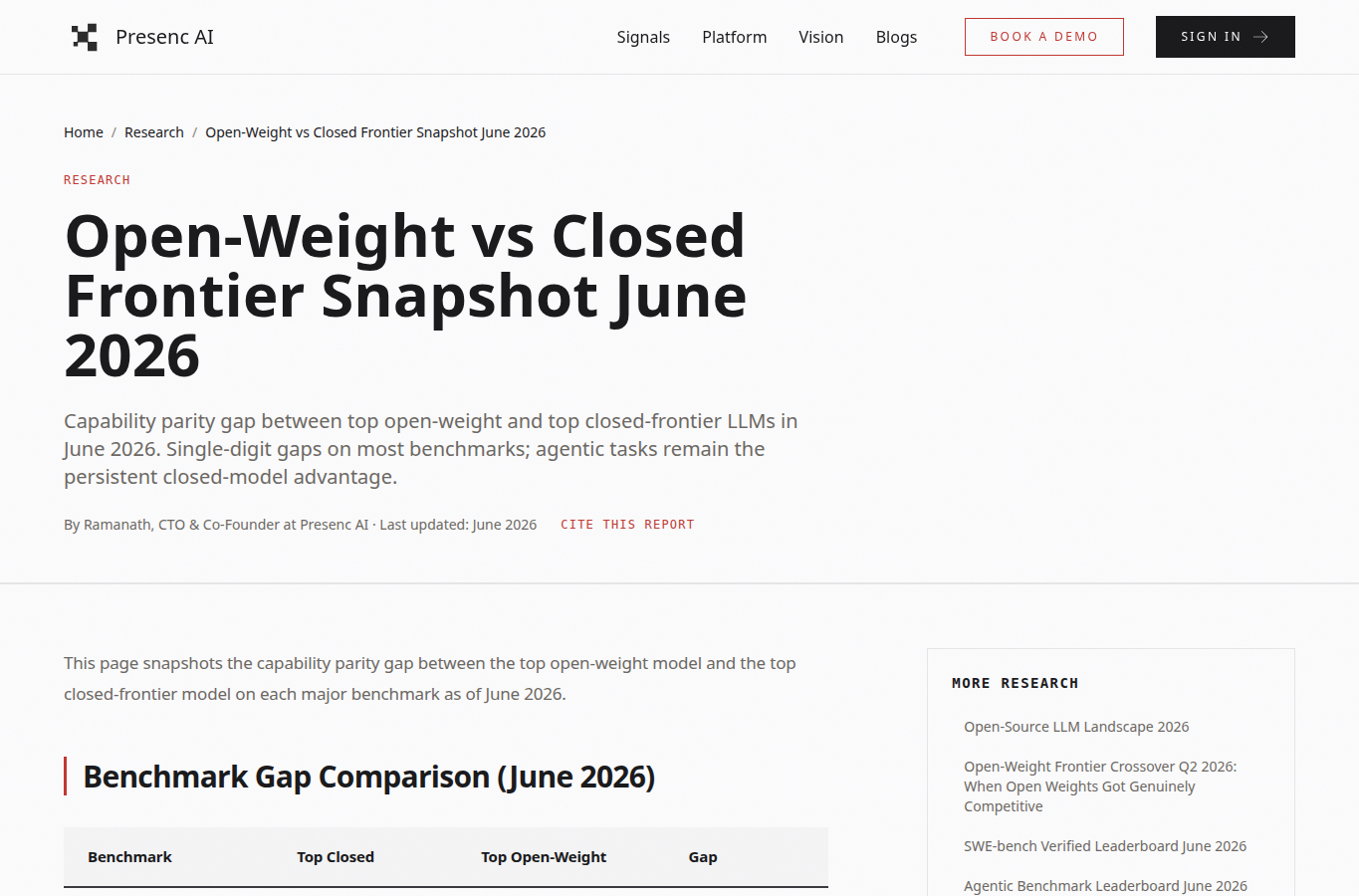
Presenc AI’s June 2026 snapshot provides the benchmark‑by‑benchmark table shown above. The report highlights that while open‑weight models are within single‑digit points on most static knowledge tests, the persistent advantage for closed models appears on agentic tasks—WebArena, OSWorld, TerminalBench. For SEO teams, the conclusion is that the models you choose for content generation should be evaluated on the static knowledge benchmarks you care about, not on a monolithic “best model” label.
Tomasz Tunguz: The Release Flurry Continues
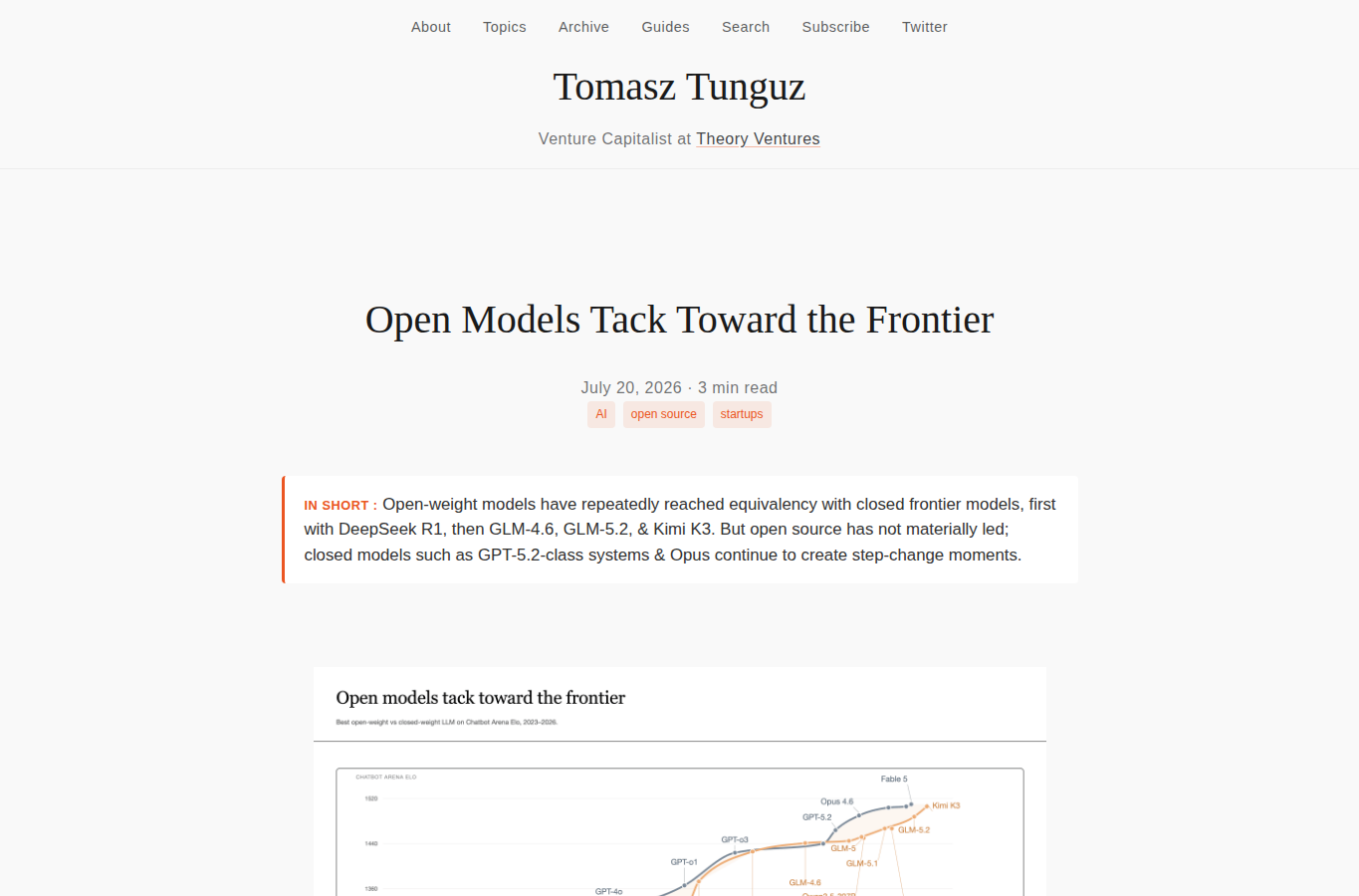
Venture investor Tomasz Tunguz published a July 20 post tracing the accelerating cadence of open‑weight launches. He notes that in 2023 closed models led by an enormous Chatbot Arena Elo margin; by mid‑2025 the two boatlines had converged; and the newest wave—Kimi K3, Qwen 3.8, DeepSeek V4, Thinking Machines’ Inkling—suggests the open‑source frontier may match or surpass closed systems on raw intelligence within a year. Tunguz’s series of Elo‑over‑time charts makes a visual argument that a purely “frontier‑only” strategy is increasingly a bet on policy continuity, not performance.
Building a Model Strategy for Your SEO Program
The evidence points B2B teams toward a hybrid model strategy, not an all‑or‑nothing choice. The core trade‑offs look like this in practice:
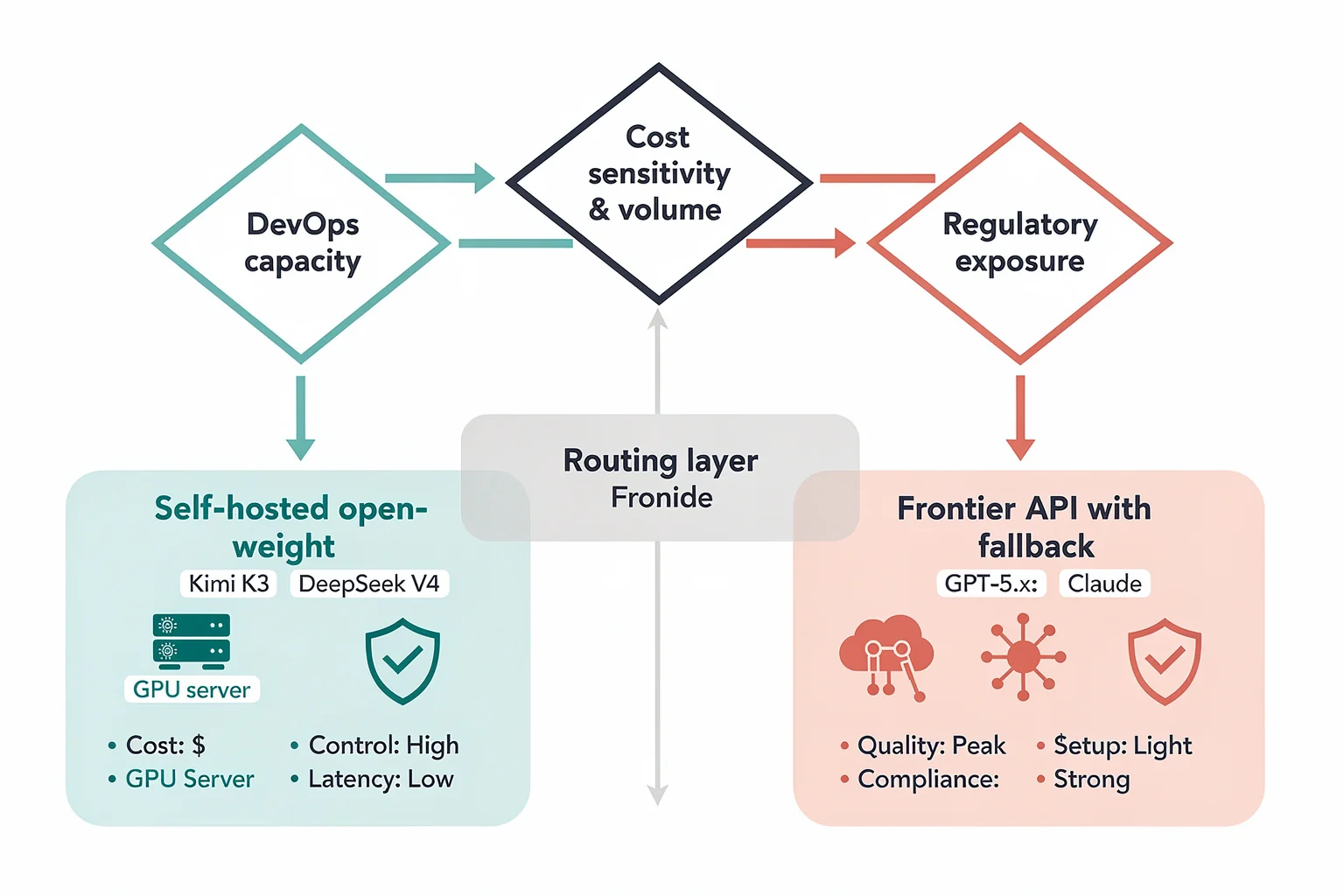
- Cost‑sensitive, high‑volume content: Open‑weight models running on rented inference handle meta descriptions, FAQ pages, and baseline blog drafts at 1/10th the token cost of GPT‑5.x Pro.
- High‑stakes pillar content: Frontier models still deliver better factual consistency and authoritative tone for thought‑leadership pieces—especially when Google’s AI features may surface those pieces in AI Mode.
- Regulatory‑exposed industries: A diversified pipeline that defaults to open‑source but can route to a U.S.‑based frontier API under compliance‑controlled conditions reduces the risk that a single government decision freezes your content operation.
- DevOps‑lean teams: A platform that abstracts both model selection and infrastructure—like a pipeline that reads your site, generates a content calendar, and routes generation across multiple backends—lets you capture the cost benefits without the Kubernetes overhead.
The shift in the AI SEO news cycle from speculative to actionable means the question is no longer whether open‑source models belong in the stack, but which workflows they power. As the Presenc AI data shows, the performance floor for open‑weight models is now high enough that the primary differentiator between stacks is not pure model quality but operational fit—how well the model integrates with your editorial process, your compliance posture, and your budget model.
Questions B2B Teams Ask About Model Choice
Do open‑source models produce content that ranks as well as GPT‑ or Claude‑generated text?
For mid‑funnel informational articles, output from DeepSeek V4 or Kimi K3, passed through a human editorial step, performs comparably in search to content drafted by frontier models. Enterprises that run split‑tests via an AI SEO services comparison can quantify the difference on their own domain. The thin gaps on MMLU‑Pro and HumanEval translate to editorial quality well within the margin of human variation.
What are the practical risks of using Chinese AI models like Kimi K3 for SEO content?
The primary risk is regulatory disruption. If U.S. policy restricts the use of certain model families, your pipeline may need to swap backends quickly. Additionally, organizations bound by data‑residency requirements should verify that model inference does not route sensitive text through servers in China. A hybrid configuration—open‑weight models hosted on U.S. cloud infrastructure, plus a fallback frontier API—hedges against the widest set of scenarios.
How much engineering effort does self‑hosting an open‑weight model really require?
A production‑ready inference cluster for SEO‑scale content generation demands at least one GPU‑equipped node, a container orchestration layer, load‑balancing, and monitoring for latency and drift. Many teams spend 4–6 weeks of senior engineering effort to reach a stable state. The total cost of ownership still ends up lower than frontier API charges for high‑throughput pipelines, but the upfront commitment is real. Options that provide inference endpoints remove most of this burden while preserving the per‑token cost advantage.
How do we decide when to use open vs. frontier models in a single pipeline?
Tag each SEO task with a complexity score. Keyword extraction, outline generation, and meta‑data fields map to low‑complexity tasks suitable for open‑weight backends. Full article drafting, competitor analysis narratives, and E‑E‑A‑T‑heavy content map to high‑complexity tasks that warrant a frontier call. A rules‑based router, or a platform that classifies briefs and selects models automatically, turns that taxonomy into an automated workflow.
Resources That Help Operationalize This Framework
- A Practical Playbook for AI Search Visibility in 2026
- GEO vs SEO: Generative Engine Optimization Difference Explained
- How to Build the Best AI Blog: RAG & Hallucination Fixes
Review SiaSEO as the operating system for structured SEO content production. — Get started