
SpyFu Alternatives: AI-Powered SEO Competitor Research for Agencies
Discover the best SpyFu alternatives for agencies, with a focus on AI capabilities, data accuracy, and pricing. Includes a detailed evaluation framework.

SpyFu has been a stalwart in the SEO competitor research toolkit for nearly two decades, offering deep historical Google Ads data and an affordable entry point. But for B2B agencies managing client campaigns across volatile search landscapes, its weekly rank tracking, Google-only focus, and minimal AI integration are starting to chafe. The team evaluating spyfu alternatives isn't abandoning competitive intelligence — it's demanding the daily cadence, cross-channel coverage, and AI-driven insight that modern client reporting requires. This guide examines what SpyFu does well, where it breaks down for agencies, and how to match your next tool to the workflow your team actually runs, not the demo version.
Where SpyFu Excels — and Where It Falls Short
SpyFu's core value proposition remains its decade-plus archive of competitor Google Ads keywords and ad copy. No other tool at a comparable price point gives you the same longitudinal view of paid search history. As the SpyFu Developer documentation notes, customers rely on it for “ad spend visibility, PPC forecasting, and deep competitive intel at a fair price.” For a solo PPC consultant with US-focused clients, that historical record is a genuine asset.
The cracks begin to show when your agency's needs extend beyond periodic snapshots of Google Ads. Several constraints surface repeatedly in practitioner testing:
Weekly rank tracking cadence. SpyFu updates ranking data on a weekly basis. In a year where AI-generated search results and daily algorithm adjustments can shift SERP makeup overnight, a tool that refreshes every seven days leaves blind spots. When a client loses a key position on Wednesday, waiting until Monday for the platform to catch up is not workable. The Best SpyFu Alternatives in 2026 review notes that this cadence is “a significant liability where daily fluctuations driven by AI search updates are the norm.”
Limited multi-channel PPC data. SpyFu's paid search intelligence sticks to Google. If your clients run campaigns on Microsoft Advertising, Amazon, or social platforms, you need a separate stack. That fragmentation eats into the efficiency gains SpyFu was supposed to provide.
Unreliable ad spend estimates below $5,000. The Best SpyFu Alternatives (2026) article reports that practitioners see significant discrepancies versus in-platform data for monthly budgets under $5,000. For agencies serving SMBs where ad spend often sits in that range, the estimates become noise.
No AI search visibility tracking. SpyFu was built for a blue-link world. It does not measure how often a domain appears in AI overviews, nor how those appearances affect traffic. As AI snapshots consume more SERP real estate, the gap widens.
Functional entry price. The Basic plan at $29–$39 per month is a demo tier: it provides no historical data, no AI tools, and a 10,000-row export cap. The real starting point is $89 per month, which narrows the cost advantage over tools that deliver more.
These limitations don't invalidate SpyFu; they define the scope of work it serves well. Many agencies keep a SpyFu subscription for ad copy archeology while layering a second platform beneath it. The decision to search for replacements comes when the disjointed toolchain costs more in reporting hours than the subscription difference.
How AI Rewrote the Competitive Research Playbook
The search landscape in 2026 is not an incremental update from 2020. AI overviews, semantic entity analysis, and dynamic personalization have turned competitor research from a keyword-matching exercise into a continuous, multi-signal operation. Traditional SEO tools that refresh weekly and output a flat list of keywords miss the structural shift. The AI SEO vs traditional SEO shifts bring a new layer of complexity.
Agencies now need to answer questions that didn't exist eighteen months ago: How much traffic does a competitor gain from AI-generated answer boxes? Which content clusters are losing visibility because an LLM has rearranged the intent behind a query? When a client's blog post drops from position three to “not appearing in AI snapshots,” what caused it?
This is where AI-powered research tools earn their premium. They detect semantic drift, surface content gaps across competitor domains, and feed that intelligence into a production pipeline that drafts, scores, and publishes. AI keyword research for agencies moves beyond volume numbers and starts anticipating the entity relationships that answer engines expect. Keyword research is no longer a standalone step; it threads through the entire content workflow.
The most effective SpyFu replacements embed AI not as a gimmick but as the connective tissue between monitoring and action. When you find a competitor ranking for a topic your client doesn't cover, the tool should not just flag it; it should help you build a comprehensive content brief that accounts for the entities, related questions, and citation patterns that AI search models demand.
What Agencies Should Demand from an Alternative
Evaluating tools is easier when you know which missing capabilities are actually costing you money. Here are six criteria that separate a cosmetic swap from a genuine upgrade for agency operations.
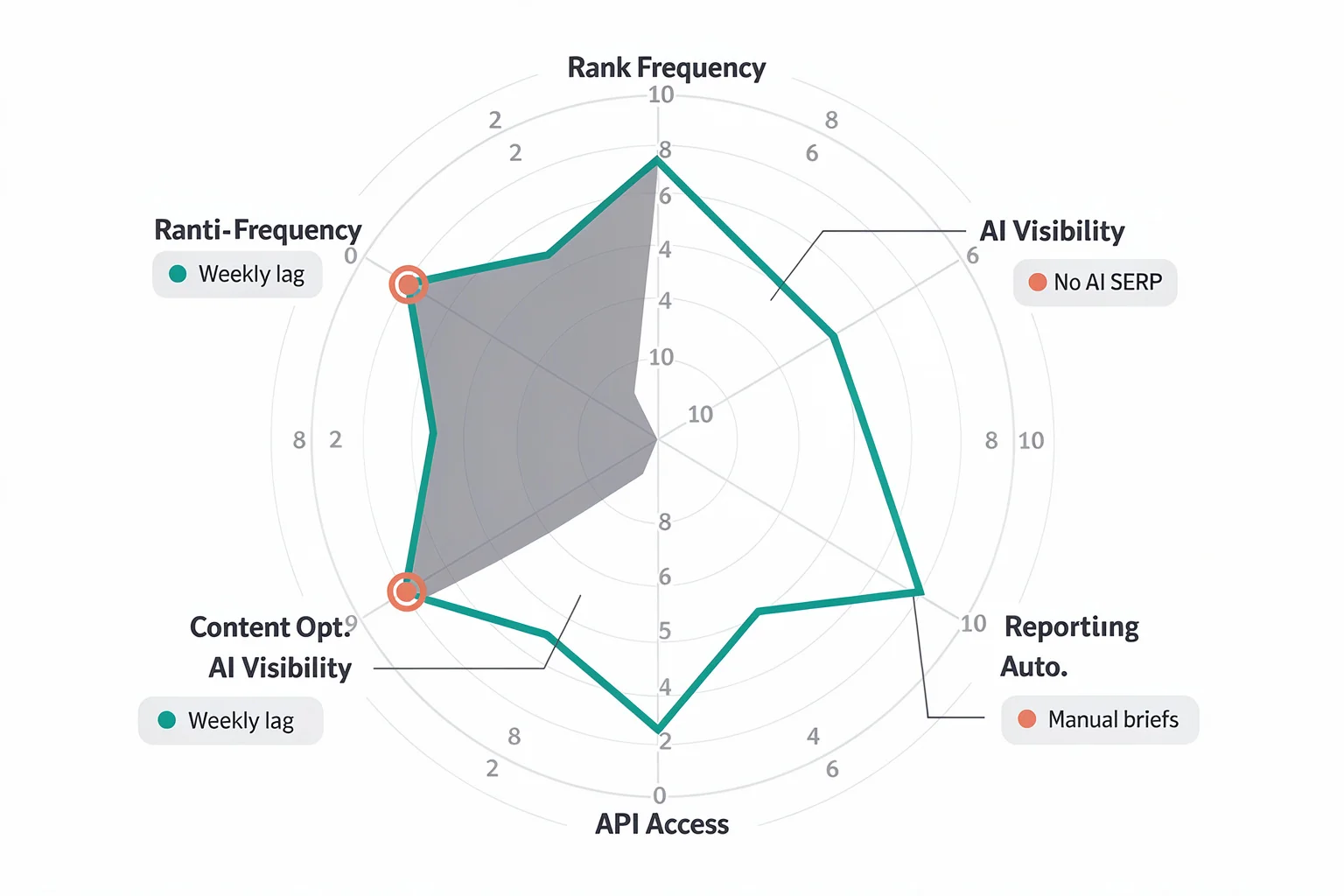
1. Daily or near-real-time rank tracking. The shift to daily updates is not a luxury. When your team manages paid campaigns whose bid strategies react to position changes within hours, a seven-day lag makes optimization reactive rather than proactive. SE Ranking and Semrush both provide daily updates; some tools even offer on-demand refreshes for priority keywords.
2. Cross-channel competitive intelligence. The best alternatives expand beyond Google Ads. Look for visibility into organic, paid, product listing ads, display, and social — especially Microsoft Advertising for B2B accounts. Similarweb provides broad traffic estimates across channels, while Semrush consolidates multiple ad types in one view.
3. AI search visibility and intent detection. A tool that can't report on AI overview appearances operates with an incomplete picture. SE Ranking's AI visibility module and Semrush's position tracking for AI results are early attempts to fill this gap. Agencies handling multiple clients need this data aggregated, not hidden in a separate report.
4. Content optimization and gap analysis. Finding a keyword gap is step one. The tool should also help you understand what content structure, entities, and media the top-ranking pages use so that your writers don't start from zero. Some platforms offer a content editor that scores your draft against competitors; others leave that to third-party integrations.
5. Client-ready reporting without extra labor. The Best SpyFu Alternatives (2026) article flags a 10,000-row export cap on the Basic plan. An alternative should provide white-labeled, automated reports that your account managers can send directly, not recompile in a spreadsheet every week.
6. API and workflow integration. The value of competitor data multiplies when it flows into your content production system, your internal dashboards, or your client portal. Tools that gate API access behind top-tier plans add hidden costs. Look for affordable API endpoints that let you pull rank data, keyword ideas, and competitor domains into platforms that consume them directly.
These criteria aren't a checklist to score tools against; they're a diagnostic. If your current tool fails three or more of them, the operational drag outweighs the subscription savings.
The Tools That Fill the Gaps
No single platform covers every agency use case at every price point. The data suggests that teams benefit more from matching a tool's core competency to the workflow it will run 80% of the time, then supplementing the edges with secondary tools or integrations.
For unified SEO and PPC with daily cadence: SE Ranking. The Best SpyFu Alternatives in 2026 review names SE Ranking as “the best all-around replacement if you want daily updates, SEO and PPC research, AI visibility tracking, and reports in one tool.” Its AI-driven content editor and local rank tracking make it practical for agencies with multi-location clients. The median agency that runs 10–20 client accounts often finds the platform's reporting automation shaves hours off each monthly cycle. SE Ranking's AI visibility module, while still maturing, lets you monitor how client domains appear in AI-generated answers — a metric that SpyFu cannot touch.
For backlink-first organic research: Ahrefs. When an agency's competitive edge depends on acquiring and auditing backlinks, Ahrefs remains the standard. Its crawler refreshes link databases more frequently than most, and its Content Explorer surfaces pages that have earned links for specific topics. An Ahrefs vs Semrush audit comparison reveals that Ahrefs lacks PPC ad monitoring and social media tracking, so it fits agencies that lean heavily on organic strategies and can afford a supplementary PPC tool. The starter plan also restricts access to Content Explorer and Batch Analysis, pushing the effective cost higher for teams that want those features.
For cross-channel traffic intelligence: Similarweb. Similarweb's panel-based traffic estimates provide a defensible view of desktop and mobile web activity across categories. Its strength is market-level analysis rather than granular keyword-level data, so it complements a traditional SEO tool rather than replacing it. Agencies that need to show a client how their digital share of voice compares to the broader industry often pair Similarweb with a keyword tool.
For budget-conscious organic work: Serpstat. Serpstat entered the market as a cost-effective SEO data provider, and its keyword research, rank tracking, and site audit features cover the fundamentals without the premium price of the top-tier suites. PPC data is more limited, and AI visibility tracking is absent, but for an agency whose primary concern is organic keyword discovery on a tight margin, Serpstat delivers.
When SpyFu still makes sense. If your work centers on historical Google Ads intelligence for US-only clients and you're comfortable with a weekly refresh cadence, SpyFu remains a legitimate part of the stack. The cost of switching is not zero. Some agencies keep SpyFu for ad copy research while using another tool for daily organic tracking and client reports — a multi-tool setup that works as long as the reporting integration doesn't become a manual exercise.
Connecting Competitive Intelligence to Content Production
Finding a competitor's keyword gap is only half the job. The other half is producing content that fills the gap with enough authority, structure, and semantic coverage to actually rank in an AI-informed SERP. This is where a platform built for site-aware, AI-driven content creation closes the loop.
When an agency uses SE Ranking or Ahrefs to pull a list of competitor domains and their top-performing pages, the next step is often a manual handoff: a strategist writes a content brief, a writer drafts the article, an editor checks for alignment. That chain introduces delay and inconsistency. Tools that sit among the best AI SEO tools for agencies compress the cycle by ingesting competitive insight alongside site context.
SiaSEO is one such platform. Input a competitor's URL and your own, and it generates a content calendar and drafts that account for the entity patterns, internal link structures, and quality benchmarks that modern search models reward. The quality scoring layer flags semantic drift between draft and target topic, while the visibility tracking, which connects to the principles of semantic SEO for AI search, monitors how published articles perform in AI-generated results over time.
For agencies that already use a mature research platform, the addition of an AI content engine turns competitor data into operational output. The difference between an agency that files a monthly report and one that ships 12 optimized articles per client per month often comes down to whether the intelligence gathered flows directly into a drafting pipeline. Tools like SiaSEO let you build that pipeline once instead of renegotiating it for every new campaign.
Questions Agencies Ask Before Switching
Is SpyFu still worth keeping for ad copy research?
For teams where manual ad copy analysis is a daily activity, yes. SpyFu's Ad History tool lets you view how a competitor's ad creative has evolved year over year — a capability that most alternatives treat as a secondary feature. If that history informs your bidding strategy and your clients value those insights, the subscription can coexist with another platform. The risk is paying for historical data you use sparingly while the tool you rely on for rank tracking and reporting still sits on a weekly cycle.
Which alternative has the most accurate ad spend estimates?
No platform offers perfectly accurate spend data, but Semrush's advertising research module draws on a large keyword universe and provides directional estimates that hold up better than SpyFu's below the $5,000 threshold. For agencies that need precision, neither tool replaces direct access to client Google Ads accounts. The estimates should validate trends, not set budgets.
How critical is AI visibility tracking for agencies right now?
In 2026, it is not a universal KPI for every client, but it is becoming one fast. Google's AI overviews now occupy the top of the page for a significant portion of informational queries, and appearing in those snapshots can drive traffic even when the organic blue link sits below the fold. If your clients' content is informational — tutorials, definitions, comparison guides — tracking AI visibility gives you an early signal about whether your content strategy is aligned with how Google synthesizes answers. Ignoring it is comparable to ignoring featured snippets five years ago.
Can I use free tools to fill the gaps?
Free tools can supplement but rarely replace a paid competitor research platform. Google Search Console provides query-level performance data for your own site, and Google Ads Keyword Planner offers search volumes, but neither gives you competitor intelligence. Some free backlink checkers exist, but they provide limited domain-level data and no historical trends. For agency work, a free-only stack tends to increase the manual effort of cleaning and cross-referencing data across disparate sources, which eats into the billable hours you're trying to protect.
Continue Building Your Agency's SEO Stack
- Semrush plan pricing tiers
- Free keyword stack audit tools
- AI writing tools for rankings
- Agency AI blog writing automation
Review SiaSEO as the operating system for structured SEO content production. — Get started