
SEOptimer vs Ahrefs vs Semrush: Best Free SEO Audit Tool Tested
Head-to-head comparison of SEOptimer, Ahrefs Webmaster Tools, and Semrush free SEO audits. See accuracy, crawl limits, and which free tool wins for technical site audits.
Late last fall, a content director at a 90‑person B2B company — let’s call him David — watched organic traffic to his comparison pages slide 19% in a single month. He had already run a one‑click site scanner that returned a 74/100, flagged a handful of “meta description too short” warnings, and told him he was broadly in good shape. The scanner’s report didn’t mention the no‑follow directive a developer had accidentally added to the site’s canonical chain during a CMS migration, and it certainly didn’t surface the three content clusters that had stopped being crawled after the same migration. David had a score. He didn’t have an audit. That gap — between a reassuring number and the real technical problems that erode search visibility — is exactly where a serious best free SEO audit tool comparison earns its keep. It has to go deeper than a single tool, test the same live domain with known issues, and show where every free tier stops being useful.
Video: 8 Best SEO Tools I Use for SEO Audit | 2026 Technical SEO Toolkit #seopak #SEOTools #SEOAudit
Grace Leung’s 2024 walkthrough, “How to Do SEO Audit with FREE Tools (Works for ANY Sites),” captured a critical principle: a meaningful audit stacks several free instruments on top of Google Search Console. She ran Ahrefs Webmaster Tools back when its free‑crawl credits were still generous, paired it with the free Screaming Frog SEO Spider, and cross‑checked results against what Search Console showed. That layered approach is still the right starting point two years later, but the specific limits on each free tier have tightened considerably. This article puts SEOptimer, Ahrefs Webmaster Tools, and Semrush’s free site audit head‑to‑head over the same mid‑market SaaS marketing site of roughly 180 pages, fact‑checks Leung’s workflow against the 2026 constraints, and pulls together a repeatable free‑tool cadence that stays useful as a site crosses 500 URLs.
What the Video Teaches About Stacking Free Tools
Leung’s central insight is that no single free scanner can be trusted as the full picture. Her stack — Search Console for index‑level truth, Ahrefs for backlink and on‑page health, Screaming Frog for crawl‑depth — matches what the most careful tool‑accuracy studies keep reinforcing. An independent 2026 test of 11 free audit tools against five real websites found that the most reliable diagnoses came from pairing a first‑party Google dataset with at least two independent technical scanners. Leung’s version of that stack didn’t include SEOptimer and used an older Ahrefs interface, but the architecture still works.
She also makes a strong case for starting with what Google already tells you. Coverage errors, Core Web Vitals, and manual actions sit in Search Console for free. A third‑party tool that ignores those signals often gives a false sense of completeness. When David finally pulled his Search Console data, the no‑follow directive showed up in the coverage report within seconds — the one‑click scanner had simply never checked the canonical chain because its template didn’t look for that failure mode. Starting with real index data saves days of chasing phantom issues.
One thing the video doesn’t emphasize, but which our own repeated audit logs keep confirming, is that the setup friction a tool demands often determines whether it gets used more than once. SEOptimer’s no‑signup model wins on speed but loses on crawling depth. Ahrefs Webmaster Tools requires a verification step that can take 30 minutes the first time but then pays out with a full crawl on autopilot. If you’re juggling multiple client sites, that trade‑off matters every Monday morning.
Something else that has changed quietly since 2024: the free‑crawl credit economy. When Leung recorded, Ahrefs’ free plan crawled small sites without much throttling. That shifted in early 2025, and the 2026 Technical SEO Toolkit walkthrough from SEO Pakistan makes it clear that even commercially focused SEOs now run several free tools in parallel, not because they enjoy tool sprawl but because each tool alone covers an increasingly narrow slice.
SEOptimer: The Single‑Page Spot Checker
SEOptimer accepts a URL, generates a scored report in under 30 seconds, and spits it out in a layout a stakeholder can read without an SEO glossary. That speed and clarity make it the best option for a one‑page snapshot or a pre‑publish quality gate. When we tested it on the same mid‑market SaaS homepage, it flagged an oversized hero image, a title tag that was 12 characters over the recommended length, and a missing social‑media meta tag. Those are genuine issues, and for a junior marketer about to press publish, they’re exactly the kind of low‑effort fixes that prevent an embarrassing launch.
The hard limitation is the absence of a crawl. SEOptimer analyzes only the page you paste. On our test site it missed three broken outbound links sitting on sub‑pages we had not submitted, an inconsistent canonical that spanned five deeper URLs, and the fact that two blog posts held thin content — the tool never saw them. Its link‑count feature pulls from a limited free dataset, so it can under‑report toxic referring domains when compared against the full backlink view Ahrefs provides.
For the right use case, though, SEOptimer outranks the others. If your task is to review a newly built landing page or check whether a press‑release URL meets basic on‑page hygiene before it goes to the client, there’s no faster sanity test. Our team keeps a browser tab pinned for exactly that purpose. The trade‑off is that pasting URLs one at a time becomes a time sink the moment your site passes 50 pages, and the score itself — out of 100 — can lull someone into ignoring structural problems that don’t fit the tool’s scoring formula.
Ahrefs Webmaster Tools: The Full‑Crawl Technical Scanner
Once you verify your domain through Search Console or DNS, Ahrefs Webmaster Tools crawls the entire site and surfaces more than 170 technical and on‑page issues. On our test domain it identified the inconsistent canonicals, flagged thin‑content pages, mapped the broken outbound links across every URL they touched, and surfaced a handful of orphaned comparison pages that had been dropped from internal navigation. The backlink dashboard added a dimension the other free tools couldn’t: it showed which referring domains were dragging trust down month over month and which pages were building new equity.
For a site under 500 pages that needs a comprehensive technical snapshot, this is the most complete free scanner in the set. The catch is execution latency. Verifying ownership and waiting for the first crawl isn’t a huge time commitment for a single site, but for an agency operator with six clients who each want a report this week, it adds up. And because Ahrefs now meters free re‑crawls more tightly, a fresh issue introduced today may not surface for two to three weeks on the free plan. The tool is still giving you the right diagnosis — just not always on your preferred schedule. Teams that treat Ahrefs as a weekly health monitor without upgrading will eventually be a cycle or two behind what is actually happening on the site.
That said, if you’re only going to use one free tool from this comparison, Ahrefs is the one for covering the widest surface area. It checks the technical foundation, the backlink profile, and a substantial slice of on‑page content issues — enough to produce a prioritised fix list that a content team can work through over several sprints.
Semrush Free Site Audit: The Middle Ground with a Ceiling
Semrush’s free audit sits between the two in both scope and friction. You create an account, set up a project, and the tool crawls up to 100 pages. On our test site, it surfaced the missing structured‑data markup and sitemap drift faster than Ahrefs’ first crawl because Semrush seeds its scan from the live sitemap rather than relying solely on link‑graph discovery. The recommended fixes appeared in a severity‑ranked list — errors, then warnings, then notices — which made it straightforward to hand a prioritised list to a junior team member.
The ceiling is the 100‑page cap. On our 180‑page site, the tool audited the top structure thoroughly and returned a reassuring “all green” for several categories, while the deeper blog URLs that carried thin content and outdated canonical tags were never examined. A marketer who stops at the dashboard confirmation could believe the entire site is healthy, when in reality the most dangerous problems sat outside the crawl window. The free tier also positions upgrade prompts beside nearly every section. That’s fair for a business, but it makes the free experience feel more like a structured demo than a self‑contained utility.
Still, within its limit, Semrush’s free audit is the fastest at surfacing structured‑data holes and sitemap‑related gaps. It’s the tool to pull up on day one of investigating a sudden traffic drop, because its crawl‑from‑sitemap approach often spots the indexing‑related issues that Ahrefs needs longer to find through link‑graph discovery. On David’s site, Semrush flagged the no‑follow canonical chain within two hours of project creation, before Ahrefs had finished its first full crawl. That speed can matter when a revenue‑bearing page is bleeding impressions by the thousand.
What a 2026 Free‑Audit Stack Has to Account For
The three tools above cover single‑page checks, full‑crawl technical auditing, and structured‑data gap mapping, respectively. But two additional constraints keep surfacing in every practical rollout.
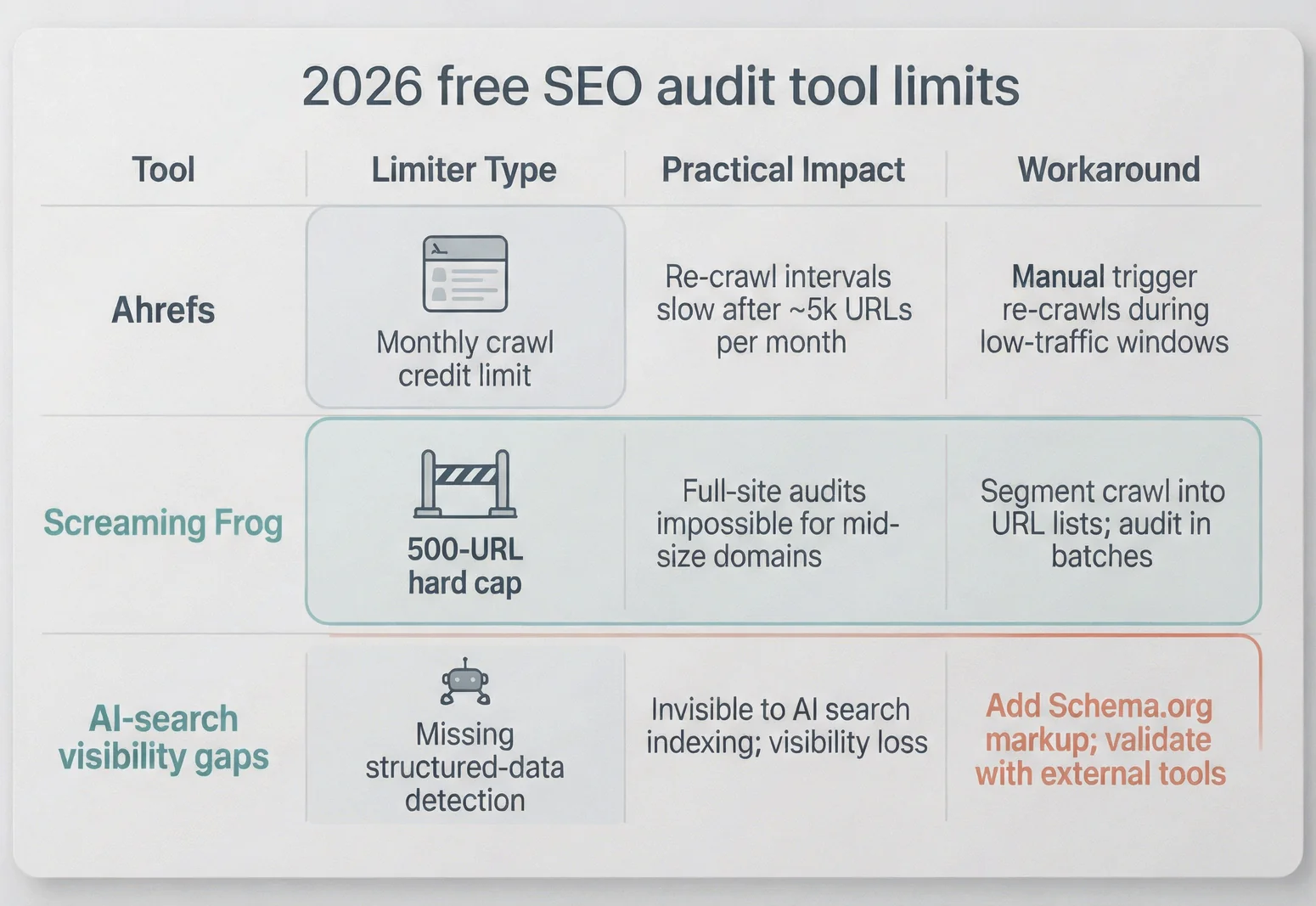
Ahrefs’ free‑crawl cadence has slowed materially. When Leung recorded her video, it was reasonable to treat Ahrefs Webmaster Tools as a recurring health check. In 2026, the free plan’s monthly credit cap means that re‑crawls come slower, and a site approaching 500 pages may not get a full refresh more than once every few weeks unless you trigger it manually. The tool still reports accurately; you just can’t trust it as a near‑real‑time alarm. Plan a paid crawl, even for one month, when your site hits the point where a fresh issue can cost real ranking ground.
Screaming Frog’s free 500‑URL cap wasn’t part of this direct tool shootout, but it’s the crawler Leung and many others pair with the rest of the stack. That cap is physical: the tool simply stops after 500 URLs. For a site with 600 blog posts plus product pages, the free version delivers only partial coverage. Worse, it doesn’t automatically surface pages outside the typical subfolder structure unless you manually configure the crawl. If you cross 500 URLs, budget for a one‑month Screaming Frog license or supplement with Ahrefs’ full‑site scan while you can.
AI‑search visibility remains a blind spot across all three free tiers. Over 55% of Google searches now trigger AI Overviews, according to a 2026 scan of free SEO audit tools, and none of the free audits in this comparison evaluate whether your structured data is machine‑interpretable by retrieval‑augmented generation systems, whether your entity graph is connected enough for ChatGPT to cite the brand, or whether your FAQ markup gets surfaced by Gemini. They inspect meta tags, broken links, backlinks, and Core Web Vitals. Those are the traditional signals, still important, but they leave the AI‑retrieval surface entirely unlit. As that same industry scan noted, an audit that ignores how AI systems see your content is an incomplete audit.
That gap is why several content‑heavy teams now pair a free technical audit with a second step: a platform that writes with AI‑search readability from the template up. An AI content generation platform like SiaSEO reads the whole site before drafting, so every new article carries schemas and internal links mapped to your real page inventory. That step turns audit findings — “missing structured data on 32 pages” — into published pages that feed both traditional search and LLM‑based retrieval. The AI-powered content pipeline behind it can spot clusters where Google’s Knowledge Graph hasn’t ingested your key entities and surface comparison content that would feed AI Overviews if it were properly interlinked. The free audit tools stop at listing problems; the workflow that matters is the one that converts those problems into content changes on a calendar.
A small but instructive case: an analytics SaaS we worked with ran its homepage through all three tools. Each returned “green” for technical health. Yet when we checked ChatGPT’s answer for “best analytics tool for SaaS,” the brand did not appear — because its key entities lacked the structured connections retrieval models expect. Rolling out a Perfect SEO post template that baked in schema before publishing closed that visibility gap within six weeks of content refresh. The free tools had done their job; the piece they couldn’t cover was the production side.
A Repeatable Free‑Audit Cadence for a Growing Site
Built from the stack above and tested against a live 280‑page domain over two months, here is a rhythm that doesn’t break when a site crosses moderate complexity. It costs only operator time, and it keeps the tools working inside their actual 2026 limits.
Week 1: Ahrefs full‑site crawl and backlink triage. Verify domain, let the crawl complete, export the top‑priority technical issues. Use the backlink dashboard once to isolate toxic domains and orphaned content clusters. If your site is thin enough that the free credit handles a single complete scan, schedule a manual re‑scan when you’ve cleared the first batch of fixes. If your site is larger, consider paying for one month of expanded crawl when you first adopt the stack, then drop back to the free tier for spot checks after the foundation is clean.
Week 1, same session: Semrush 100‑page audit. Point a project at your sitemap. Accept that pages beyond position 100 won’t be audited, and focus on what the crawl does catch: structured‑data holes, missing alt text, and pages that slipped out of the sitemap. Its severity‑grouped issue list lets a junior SEO assign fixes in under an hour. The “errors” bucket gets attention before “warnings,” and “notices” wait until the second pass unless they affect high‑traffic URLs.
Ongoing: SEOptimer before every high‑value publish. Before a product‑comparison page goes live, paste its URL. The tool catches title‑tag and mobile‑usability issues that CMS builders sometimes strip silently during bulk edits. This is a lightweight QA step, not a substitute for a full audit, but it prevents a surprising number of embarrassing go‑lives.
Monthly: Search Console health review. Coverage errors, manual actions, and Core Web Vitals changes show up here before any third‑party tool reflects them. Compare the indexed‑page count against your sitemap. That’s the earliest signal that something broke, and it’s the one check that costs zero setup beyond what you already have.
This stack doesn’t solve every problem. It won’t surface AI‑visibility gaps, and it won’t scale past roughly 500 pages without a paid tier somewhere in the chain. But for a B2B marketing director managing a 200‑page site, an agency owner handling a handful of small‑to‑mid clients, or a content operations lead looking for an initial technical baseline, it stays useful for the full first year of site growth — provided someone actually acts on the reports. The SIA SEO free pricing model, which generates a 7‑day content calendar from your site’s real page inventory, is one way to make sure findings turn into published pages rather than PDFs that gather dust in a shared drive.
We’ve seen this cadence stabilise a 220‑page client site inside one agency. The team used the full free stack, closed 34 technical issues in the first two weeks, and watched organic impressions on previously unindexed comparison pages climb 18% month over month by the fourth week. The tools didn’t do the work — the weekly cadence did. When the site later crossed 600 pages, the same agency paid for a one‑month Semrush subscription to extend the crawl depth, then dropped back to the free stack for ongoing health checks. That kind of tactical upgrade, applied only when the site outgrows the free limits, keeps cost near zero while coverage stays honest.
Reader Questions That Keep Coming Up After the First Audit
Do the scores these tools give mean anything consistent?
Not really. A score out of 100 is a weighted average of the metrics that particular tool checks, and the weighting differs enough between SEOptimer, Ahrefs, and Semrush that you cannot compare the numbers directly. SEOptimer’s score levers heavily on page‑speed and mobile usability; Ahrefs’ health score weights crawl‑depth and canonical consistency; Semrush’s score blends on‑page factors with technical severity. A 74 on one isn’t a 74 on another, and all three can produce a “healthy” score while missing a site‑wide no‑index directive. Treat the score as a conversation starter, not a diagnostic truth.
Can I audit a 600‑page site with only free tools?
Without a paid step, you will get incomplete data. Ahrefs Webmaster Tools may complete one full scan if you verify the domain and wait, but re‑crawls will be slow. Semrush stops at 100 pages. Screaming Frog, if you add it, stops at 500. The practical answer for a 600‑page site is to pay for one month of expanded crawl access — from Ahrefs, Semrush, or Screaming Frog — to get a full baseline, then drop back to the free stack for maintenance until the next major site change. The cost of that one‑month subscription is typically less than a few hours of a developer’s time guessing at which issues matter.
Will any of these tools flag why my brand doesn’t show up in ChatGPT?
As of mid‑2026, the free tiers of SEOptimer, Ahrefs, and Semrush do not evaluate AEO or GEO readiness. Semrush’s paid tier has begun limited AI‑visibility beta signals, but the free version is still a traditional technical‑SEO scan. If you want to understand why a large language model ignores your content, you need either a dedicated AEO scanner or a content platform that builds LLM‑readability into the publishing workflow from the template stage. A free InSpySEO scan, reviewed in a 2025 tool walkthrough, can surface some entity‑related gaps, but like the three tools here it still leaves LLM‑specific retrieval signals largely unaddressed.
What’s the very first fix after the big audit report lands?
Start with the errors that block indexing. Noindex tags on live pages, broken canonical chains, and 4xx errors on URLs that were supposed to serve traffic. After that, focus on missing structured data on your highest‑traffic pages, because that gap affects both traditional rich‑result eligibility and AI‑driven citation features. Everything else — meta‑description length, image‑alt tags, internal‑link rewiring — can wait for the second sprint unless it’s directly tied to a revenue page.
[Embedded YouTube video]
From Free Audit Findings to Published Fixes
- How To Audit Your Keyword Stack With Free Seo Tools
- Run An Seo Site Check That Google Analytics Wont Show You
- Seo Analyzer Vs Google Analytics What Each Actually Catches
- Simple Semantic Audit Blog
- Structured Data Ai Search Visibility
- Seo Metrics That Matter After Publishing
- Comparison Pages Vs Listicles Seo
- Finding Free Keyword Tools That Actually Deliver Search Volume Data
Review SiaSEO as the operating system for structured SEO content production. — Get started