SEO Agency Pricing Models Benchmarked Against AI Content Costs
Benchmark data on SEO agency pricing models — retainers, per-article rates, and performance fees — measured against the real cost of AI content production.

Marketing leaders evaluating an SEO agency in 2026 face a pricing problem that looks simple on the surface and is not. Quotes for the same scope of work routinely differ by a factor of five, the pricing models behind those quotes measure different things, and a new cost baseline — AI-assisted content production — has changed what the underlying deliverables actually cost to produce. This report benchmarks the three dominant agency pricing models against published survey data, derives a cost-per-ranked-page model that makes quotes comparable, and states where the evidence runs out. It is written for marketing directors, agency operators, and content operations leads who need to defend a budget line, not for readers looking for the lowest number.
The research problem and evidence standard
The question this report answers is narrow: given the published range of what agencies charge, how should a buyer compare a retainer, a per-deliverable quote, and a performance-based agreement on equal footing, and where does AI production shift the floor?
The evidence standard matters more than usual here, because most "SEO pricing" content is written by agencies selling the thing being priced. Three tiers of source are used:
- Survey data with stated methodology. The primary anchor is the Ahrefs pricing survey, which polled 439 SEO providers and reported an average monthly retainer of roughly $3,209, with the most common hourly band at $100–$150.
- Marketplace and directory benchmarks. Clutch's pricing guide places typical monthly fees between $2,000 and $20,000, with wide hourly spreads by service type. These figures reflect listed provider rates rather than closed contracts, so they read high.
- Agency-published rate cards. Sources such as SEO Sherpa's 2026 pricing analysis, 1Digital's pricing explainer, and Rankite's published benchmarks are used to illustrate how models are packaged, with the caveat that each is a vendor document.
Where figures conflict, the survey number wins. Where a claim cannot be tied to one of these tiers, it is marked as analysis. All figures are in US dollars as of the sources' 2026 publication dates, and European buyers should treat them as directional rather than local rate cards.
How the three pricing models actually work
Agency pricing conversation tends to collapse into "how much per month." That hides the mechanism. Each model transfers risk and incentives differently, and the mechanics determine whether a quote is fair long before the number does.
Monthly retainers
The retainer bundles a recurring scope — technical maintenance, content production, link acquisition, reporting — into a fixed monthly fee. Per the Ahrefs survey, the $2,501–$5,000 band is the most common retainer range, and the average sits near $3,209. Retainers dominate because SEO work compounds: technical fixes, content, and authority building interact over months, and agencies price the continuity.
The structural weakness is opacity. Two retainers at $3,000 can deliver four articles and a dashboard, or twelve articles, a technical sprint, and digital PR. Without a deliverables schedule, the retainer is a trust instrument. Buyers should treat any retainer quote that does not enumerate monthly outputs as incomplete.
Per-deliverable and project pricing
Project pricing covers defined scopes: audits, migrations, content batches. 1Digital's breakdown describes the typical split of retainer, project, and hourly engagements, and hourly consulting across surveys clusters between $75 and $200. Per-article content pricing, which matters most for the AI comparison below, runs from under $200 for commodity copy to $1,000 or more for expert-reviewed, research-backed long-form, per the ranges Pepper's 2026 benchmark roundup compiles by scope.
Project pricing is honest about outputs but silent about outcomes. A batch of ten articles is a deliverable; whether any of them rank is not in the contract.
Performance-based pricing
Performance agreements tie fees to rankings, traffic, or leads. They are rare in established agencies, and the survey data reflects that: most providers bill retainers or hourly. The model concentrates risk on the agency, which sounds buyer-friendly, but it inverts incentives toward keywords that are fast to rank rather than valuable to the business, and it creates measurement disputes over attribution. Where performance pricing does appear, it usually caps upside rather than replacing the base fee — a hybrid retainer plus bonus.
Benchmark summary
| Model | Typical range (2026) | Risk borne by | Main weakness |
|---|---|---|---|
| Monthly retainer | $2,500–$5,000/mo median band; ~$3,209 average | Buyer (outputs not guaranteed) | Scope opacity |
| Project / per-deliverable | $500–$5,000+ per project; $200–$1,000+ per article | Shared | No outcome commitment |
| Hourly consulting | $75–$200/hr | Buyer | Open-ended cost |
| Performance-based | Hybrid: base fee plus bonus | Agency | Keyword selection skew |
A cost-per-ranked-page model
Comparing models requires a common unit. The one that maps to business value is cost per ranked page: total spend divided by the number of pages that reach a defined threshold (say, top-10 for a target query with commercial intent). The inputs are estimable from the benchmarks above.
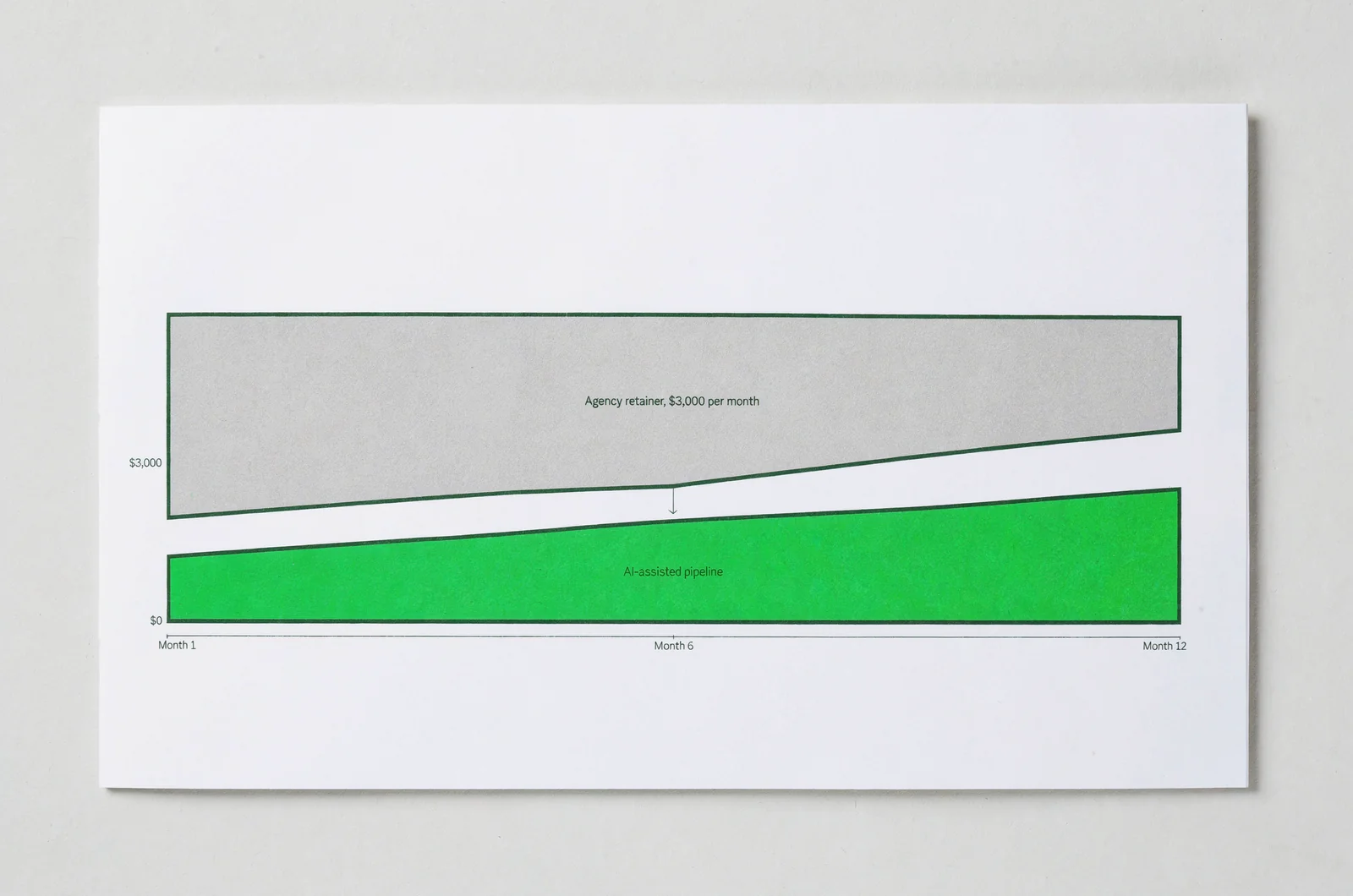
Take a $3,000 monthly retainer producing eight optimized articles plus maintenance. Assume, conservatively, that 10–20% of well-targeted, well-executed content reaches the threshold within six to nine months — a rate consistent with the long-documented finding that the large majority of published pages earn no meaningful organic traffic. That yields roughly one to two ranked pages per month of retainer output, or a cost per ranked page of $1,500–$3,000 in direct spend, before internal management time.
Now the AI-assisted baseline. Platforms that automate keyword research, drafting, QA scoring, and publishing — SiaSEO is one example, generating a structured content calendar from a site's own context and scoring each draft before it goes live — compress the per-article production cost to a small fraction of agency copy rates. A realistic fully-loaded figure for AI-produced, human-reviewed content is $50–$150 per article when subscription costs, review time, and editing are counted honestly. Producing the same eight articles per month at that cost, with the same 10–20% success rate, puts cost per ranked page in the $200–$1,200 range.
Two qualifications keep this model honest. First, the success rate is not model-independent: unedited, un-targeted AI output fails at much higher rates than 80%, which is why the review and QA layer is a cost line, not an optional extra. Second, a retainer buys more than articles. Technical remediation, authority building, and strategy are in the $3,000 and not in the $150. The models are comparable only for the content-production component, which is typically 40–60% of retainer scope.
A worked example makes the trade concrete. Say a mid-market SaaS team spends $36,000 a year on a retainer, roughly 60% of which ($21,600) funds 96 articles, yielding perhaps 12–18 ranked pages at roughly $1,200–$1,800 each. The same 96 articles produced on an AI-assisted pipeline with disciplined human review might cost $8,000–$12,000 fully loaded, freeing $10,000 or more for the parts of SEO that do not automate well — link earning, technical work, and positioning. That reallocation, not raw savings, is the actual decision.
What the AI shift does to agency economics
The trend data suggests agencies are already absorbing this. The 2026 AgencyAnalytics benchmarks report found that SEO for AI-driven search engines became the most-requested service addition in 2026, and 64% of agencies report Google AI Overviews affecting client traffic. Industry reporting compiled by Pepper and the SEO Industry Intelligence Report 2026 shows a bifurcating service model: about 55% of agencies fold generative-engine optimization into existing retainers, while only about 27% sell it as a standalone line.
The implication for buyers: if an agency's retainer price has not moved while its production costs have fallen, the saving is being retained as margin unless the scope has visibly expanded — more articles, AI-visibility tracking, deeper technical work. That is not inherently wrong; expertise and accountability have value. But it is a question worth asking in a renewal conversation, with numbers attached.
There is also a measurement shift. Semrush's AI Visibility Index 2026 found that only 13% of branded AI answers link to the official brand website, and Ahrefs' 75,000-brand analysis found brand mentions correlate with AI Overview visibility at 0.664 versus 0.218 for backlinks. An SEO agency pricing conversation in 2026 that covers only blue-link rankings is measuring a shrinking share of the surface.
Decision criteria for buyers
For teams comparing quotes, the evidence supports five tests:
- Demand a deliverables schedule. Convert every retainer into units: articles, technical hours, links, reports. Quotes that resist unit conversion are priced on trust.
- Compute cost per ranked page, not cost per article. A $1,000 article with a 20% success rate costs the same per outcome as a $200 article at 4%.
- Ask what changed since 2024. A credible agency answer names AI-assisted production, AI Overviews impact, and where the savings or added scope went.
- Match the model to the work. Retainers for compounding programs, projects for defined scopes, hourly for diagnosis. Performance terms only as a bonus layer on top of a base fee.
- Price the hybrid. Many teams now pair an AI production pipeline — SiaSEO, for instance, handles keyword research through CMS publishing with quality scoring built in — with a smaller advisory retainer. Benchmarks support this: the content component is where the cost curves diverge most.
Limitations of this benchmark
Three limits apply. First, survey self-reporting skews toward providers willing to disclose rates, and the 439-respondent Ahrefs sample is global, so it flattens regional differences; Southern European rates sit below US medians. Second, agency-published benchmarks (SEO Sherpa, Rankite, 1Digital) are marketing documents, used here for packaging structure rather than price truth. Third, the 10–20% content success rate is an assumption drawn from long-standing traffic-distribution findings, not a measured constant; teams with strong domains and disciplined keyword selection beat it, and new sites fall short. The cost-per-ranked-page model is a comparison tool, not a forecast.
Pricing questions buyers ask most
What is a fair monthly retainer for a mid-market company in 2026? Survey data centers on $2,500–$5,000 for a substantive program. Below $1,500, scope is usually thin; above $10,000, you are paying for enterprise scale or a strong brand name.
Is per-article pricing ever the better deal? Yes, when your strategy and technical base are already sound and you only need production capacity. It fails when nobody owns the outcomes.
Does AI content production make agencies obsolete? No. It reprices one component of their scope. Strategy, authority building, and technical remediation still resist automation, and the QA layer around AI output is itself skilled work.
References
- Pepper — SEO agency pricing in 2026: real benchmarks by model and scope Pepper Content
- Ahrefs — SEO Pricing: How Much Does SEO Cost? 439 People Polled
- Seosherpa — SEO Pricing: How Much Does SEO Cost in 2026? • SEO SHERPA™
- 1digitalagency — SEO Pricing Explained: Retainer, Project & Hourly 1Digital®
- Rankite — SEO Pricing in 2026: Real Benchmarks + Our Rates