Showing Up in AI Search Results Requires Direct Answer Syntax
Learn how retrieval engines evaluate web pages, extract authoritative claims, and choose which domain sources to cite in conversational search answers.

Showing up in AI search results gives marketing teams a precise editorial challenge: make a useful answer understandable when it appears outside its original page. Direct answer syntax means putting the subject, answer and qualifying conditions together. For B2B founders, agencies and content leaders, the practical work spans passage structure, evidence management, technical access and measurement. Each layer needs its own checks.
Separate discovery, citation and recommendation
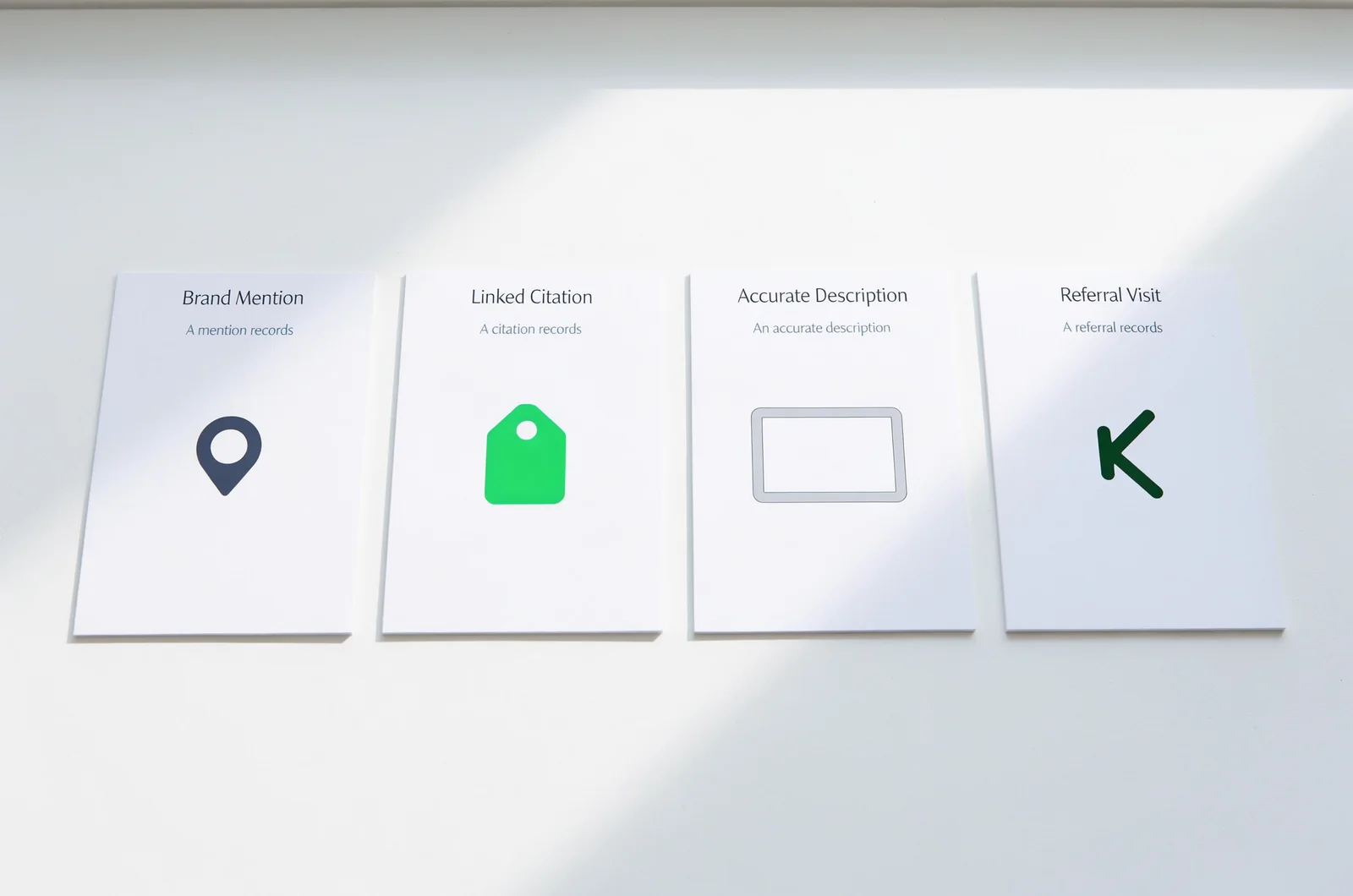
AI search visibility needs a more precise definition before it becomes a production target. A brand mention, a linked citation and a recommendation represent different outcomes. Record them separately.
Use a working model with four layers: an accessible source, a relevant question, a usable passage and a composed answer. This is a planning framework. Platform-specific requirements should come from the platform’s documentation.
The framework helps distinguish different editorial problems. A page may need technical attention before its prose matters. An accessible page may answer the wrong question. A relevant answer may leave essential qualifications elsewhere in the article.
Citation introduces another question: what does the cited passage actually support? A domain appearing beneath an answer does not establish that every statement in the response came from that domain. During review, match the attributed statement to the destination page.
Separate these outcomes in reporting:
- A mention records whether the response names the organisation or product.
- A citation records whether the response links to the target domain or page.
- An accurate description records whether the answer preserves the relevant facts and limitations.
- A referral records a visit attributable to the search experience.
Define which outcome matters for each topic. An implementation guide may justify a citation target; a product comparison may also require accurate positioning. Keep both measures visible when assessing the same response.
Build each answer around a named subject
Direct answer syntax gives AI visibility work a concrete editorial standard: write a passage whose meaning survives extraction. Test its effect on citations separately from its usefulness to readers.
Put the answer before the explanation
Start a substantive section with the answer to its heading. Name the relevant product, process or category, then explain the conditions.
Consider a hypothetical SaaS product that lets administrators retry CSV imports after correcting validation errors. A vague opening might read:
The platform gives teams greater flexibility when managing their data.
A more useful opening would read:
Administrators can retry a failed CSV import after fixing the validation errors listed in the import report.
The second version identifies the actor, action, object and condition. Its meaning can be checked against the assumed product behaviour. The explanation can then cover where administrators find the report and which errors require changes.
Use this pattern where the reader has a specific question. A section about organisational trade-offs may need a longer argument.
Keep limits attached to the claim
Write conditions in the same sentence or paragraph as the statement they constrain. Check for restrictions involving account permissions, product versions, geography, integrations or contract terms.
In the hypothetical import example, remove ambiguity about who can retry the import. If only administrators have permission, retain that qualification whenever the capability appears.
Apply the same discipline to comparisons. A statement about lower operating costs needs a defined workload, comparison basis and included expenses. Without those details, an extracted passage leaves the reader with an incomplete claim.
A useful editing exercise is to copy the opening paragraph into a blank document. Ask whether its subject, answer and limitations remain clear. Replace ambiguous pronouns and reconnect qualifications before approving it.
Make evidence travel with the answer
An answer intended for citation needs a traceable basis. Build the evidence record before polishing the prose, especially when several writers or automated drafts contribute to the same page.
Keep a record for consequential claims
Maintain a claim record alongside the draft. For each material assertion, record the supporting source, the exact proposition it supports and any limits on its use.
A practical record can include:
- The sentence proposed for publication.
- The original source and relevant passage.
- The population, product version or conditions covered.
- The person responsible for approval.
- The event or date that should trigger another review.
Separate reported findings from editorial interpretation. If a source reports a result for one sample, keep that sample attached to the finding. Present a broader application as a proposal to evaluate.
For quantitative claims, preserve the denominator, measurement period and method. An impressive percentage without those details provides little basis for a decision.
Attach dates to changing statements
Place validity information beside claims that can change. Product availability, integration behaviour and commercial terms deserve particular attention.
Distinguish a page’s editing date from the validity of its evidence. A revised headline cannot establish that an older capability statement remains accurate.
Assign maintenance according to the claim. A product statement can have a release-triggered review; a reported statistic can require checking when its source publishes a replacement.
Write hypothetical examples explicitly as illustrations. Keep them outside the evidence record for observed results, and never convert an illustrative outcome into a customer success claim.
Give the answer a readable technical home
Answer structure belongs inside a technical publishing review. For Google Search, use Google’s AI search optimisation guidance as the primary reference when checking access, indexing, content presentation and structured data requirements.
Review the published page
Inspect the page readers and crawlers receive. Confirm that the main answer appears in accessible text, headings follow a sensible hierarchy and links resolve to the intended destinations.
Check sections that depend on client-side interactions. If an answer appears only after a user opens a control, verify how the published implementation exposes that content.
Include canonical URLs, indexing directives and language targeting in the same review. Those checks answer different questions from whether a paragraph is well written.
Give each page a clear editorial role. An overview should introduce the subject and link to deeper material. An implementation page should own the detailed answer to its implementation question.
Keep structured data faithful to the page
Use structured data to describe the content actually published. Consult the platform’s supported types and requirements before adding markup.
Treat visible text and markup as two representations that need to agree. Review author names, organisation details and dates against the page itself.
Avoid attaching unsupported credentials or capabilities to an otherwise careful article. The same evidence standards should apply to markup and prose.
After publication, compare the approved draft with the live page. Check that headings, qualifications and citation links survived the CMS transformation, then record the URL that contains the approved answer.
Map answers to decisions and markets
An AI visibility plan should organise content around the questions readers need resolved. Build the page map from decisions, dependencies and differences in audience context.
For a B2B software topic, distinguish category understanding from implementation and evaluation. A reader asking what a workflow does has a different need from someone asking whether it fits an existing stack.
Give each page a defined question set. Keep substantial supporting answers together where they serve the same decision. Create a separate page when the audience, task or required evidence changes materially.
Review overlapping drafts before publication. If two articles promise the same answer, decide which page owns it and how the other contributes distinct detail. This gives editors a concrete way to manage repetition.
Geography requires similar precision. For an English-language site serving Italy, make language and commercial scope explicit in the brief. Identify whether the reader needs general technical guidance or information specific to the Italian market.
Keep research geography attached to findings. If evidence concerns a US sample, preserve that qualification and assess whether the proposed application suits the Italian audience. Do not silently substitute one market for another.
For translated pages, check capabilities, conditions and evidence dates across versions. Translation review should cover factual consistency as well as phrasing. Assign ownership for updating each version when the underlying claim changes.
Scale drafting with explicit approval gates
Content automation needs approval rules that preserve the answers it produces. Define those rules around claims and reader decisions before increasing publication volume.
Give drafting a controlled evidence set
When using SiaSEO for site-aware drafting, include approved product descriptions, source records and page ownership decisions in the editorial brief. Make the boundaries of each answer explicit.
A draft can then be reviewed against a concrete question: does this passage accurately answer the assigned reader need using the approved evidence?
Separate review tasks so problems remain identifiable. One pass can check topical relevance. Another can examine consequential claims. A technical review can verify the published output.
Avoid asking a single overall score to replace those decisions. Establish which defects require human approval or correction regardless of the draft’s broader assessment.
Give publishing a named owner
For teams using SiaSEO’s CMS publishing, assign responsibility for claim approval before enabling automatic publication. Decide which content categories can proceed under established rules and which need individual review.
A product capability change, an unsupported comparison or a newly introduced statistic can each trigger a review. Define the trigger and responsible person in advance.
Include a correction route after publication. Editors should know how to amend a claim, update related pages and confirm that the live version contains the correction.
Judge production capacity by the complete workload. Account for evidence review, technical checks, maintenance and revisions when planning the calendar. Record approval status and correction ownership alongside every publication scheduled for release.
Measure citation quality alongside business value
AI search measurement needs a repeatable sample and a clear denominator. Build both before attributing a change in visibility to answer syntax.
Preserve the conditions of each observation
Create a stable question set covering the decisions your pages address. Include relevant constraints such as geography, language, product category and implementation context.
For each recorded response, retain the exact question, platform, date and available settings. Save the answer and its cited destinations so reviewers can inspect the result later.
Define citation rate as responses citing the target domain divided by eligible recorded responses. Specify eligibility in advance. For example, a monitoring exercise can include completed, search-enabled responses and report failed requests separately.
Also record factual accuracy. Check whether the response attributes the right capability to the right organisation and preserves the conditions attached to it. Keep a citation with an inaccurate description visible as its own outcome.
Evaluate changes against a baseline
When testing answer structure, document the passages changed, the evidence retained and the technical changes made during the same period.
Preserve a comparison group where practical. If several variables change together, limit the causal interpretation of the result. Report the observed association and the uncertainty that remains.
Track business outcomes separately: attributable visits, relevant enquiries and downstream actions. Leave attribution gaps explicit.
A useful interactive review checklist could accept an answer paragraph and its source record. It would flag missing subjects, detached qualifications, unsupported numbers and absent validity information. An editor would then resolve each flag.
Set the measurement window before making the edit, retain the original passage and compare repeated observations against that baseline.
Questions about answer structure and citation eligibility
Editorial teams need clear answers to several recurring decisions before applying these standards across a content library.
Does every section need a short answer?
Use a concise opening where the heading asks a specific question. Allow more space when the answer depends on competing constraints or a chain of reasoning. Preserve the condition that changes the recommendation, even when it lengthens the paragraph.
Should FAQ markup be part of every article?
Choose structured data according to the actual page content and current platform guidance. A set of reader questions can be useful without becoming the organising structure of the whole article. Review any markup against the visible questions and answers before publication.
What should change when a page earns no citations?
Investigate in sequence: technical access, question fit, evidence strength, passage clarity and the measurement sample. Select the next edit according to the problem identified. Record that change so a later result can be assessed against a known baseline.
How much repetition helps an extracted answer?
Repeat the subject where a pronoun creates ambiguity. Keep terminology consistent across passages, and remove repeated claims that add no context. Review the passage on its own to decide whether another explicit subject reference is necessary.