Choosing the Best Keyword Research Tools for a Small Team
How to choose the best keyword research tools for your site: a practical selection framework covering data quality, workflow fit, and real query coverage.

Choosing the best keyword research tools for a small team starts with a practical question: which candidate can turn your actual search opportunities into a reviewed content plan? Run a controlled trial using your own queries, target market and publishing process. The outcome should be a documented choice, with evidence of relevant coverage, interpretable metrics and a workable handoff. This guide walks through that trial, from building a query sample to checking the recurring cost.
Set a purchase decision your team can verify
Define the tool’s job before opening a trial account. Write one sentence that names the user, the recurring task and the required output.
For example: “Our content lead needs to turn German-market software queries into approved page briefs, with demand estimates and existing-page matches preserved.” Treat this as a hypothetical requirement and adapt it to your team.
Bring recent query and page-performance exports, a list of existing URLs, priority products and your current brief template. Include enough historical context to recognise seasonal changes. If the site has little search data, build the sample from product terminology, customer questions and current content gaps.
Set three constraints before evaluating candidates:
- Specify the target country and query language. For an English-language site targeting Germany, keep English and German query samples separately labelled.
- Set a recurring budget that includes required seats and usage allowances.
- Name the person who will review keyword choices and the person who will receive the resulting brief.
Then agree on success checks. Require the candidate to preserve market settings, produce relevant suggestions and carry selected terms into your working format. Decide which failures would disqualify it.
Save these requirements in the evaluation sheet. They should remain fixed while each candidate completes the same tasks.
1. Build a query set around actual buying journeys
Create a query sample that represents the work your team expects to repeat. This gives each candidate the same opportunity to demonstrate useful coverage.
Use a proposed starting sample of 30 seed queries, divided into five groups of six:
- Product and category terms tied to what the business sells.
- Problems and tasks that a suitable customer wants to solve.
- Comparison and purchase questions.
- Integration and use-case queries.
- Specialist terms and longer questions from your target market.
Keep the sample relevant to the business. A broad term with little connection to your product should not outweigh a specific question that could support a useful page.
For each seed, record the intended audience, country, language, likely page type and any existing URL that addresses it. Add an expected intent before accepting a tool’s classification.
Use AI-assisted long-tail research as one discovery route for the longer questions. Review each proposed query before adding it to the test.
Include awkward cases deliberately: a narrow technical phrase, an ambiguous abbreviation and a question whose wording differs between English and German. These test whether suggestions remain relevant under your actual constraints.
The finished sample should have 30 labelled rows. Check that every row has a business reason for inclusion.
2. Shortlist tools by the work they must complete
Select candidates that represent plausible ways to complete your task. Keep the shortlist manageable enough to finish the trial with the same level of attention.
Start with the workflow you need: dedicated keyword analysis, discovery across several platforms, or keyword selection connected to content production.
Ahrefs describes keyword idea discovery at scale through Keywords Explorer. Use that stated scope to frame a discovery test, then check the relevance of its output against your sample.
KeywordResearchPro describes multi-platform keyword suggestions from 11 platforms, including Google, YouTube and Amazon. Confirm which platforms matter to your business before giving this breadth any weight. A software content programme may require a different channel mix from an ecommerce catalogue.
For an advertising-oriented baseline, consider the workflow described in Google’s keyword planning overview. Document the outputs you would need for your organic content decisions.
Include an integrated production candidate, such as SiaSEO, when your required task extends into content calendars and article drafting. Apply the same query and review checks to that route.
Read the current plan conditions before starting. Record access restrictions, export allowances and required seats without assuming that a trial matches the eventual subscription.
Finish with a shortlist whose differences correspond to your requirements. Remove candidates whose main strengths have no place in the task you defined.
3. Run every candidate through the same trial
Give each candidate identical inputs and instructions. Consistent conditions let you compare the resulting work without confusing tool differences with test differences.
Set the target country to Germany where the workflow supports it. Record query language separately, along with the date, available database settings and any defaults you changed.
Process the same 30 seeds. Save the initial suggestions before filtering them, then apply an agreed relevance rule across every candidate. Avoid changing the rule because one output looks more impressive.
Capture the evidence you will need later:
- The suggestions returned for each seed.
- Available demand, difficulty, intent and trend fields.
- Missing values and stated data limitations.
- The selected query cluster and its export.
- Time spent configuring, reviewing and correcting the output.
Use a fixed time allowance that fits your team’s capacity. This is a trial constraint you choose, rather than a claim about how long research should take.
Keep active working time separate from waiting time. Record manual corrections immediately so they do not disappear into a favourable overall impression.
Repeat one narrow query and one broad query to check whether settings and outputs remain understandable across sessions. Save both runs if they differ.
You should finish with comparable evidence folders and a completed activity log. Verify that every candidate used the same sample and market settings.
4. Audit relevance before interpreting volume
Evaluate each tool’s suggestions before allowing numerical estimates to drive selection. The first question is whether the output helps you plan content for the intended reader.
Count usable suggestions and record omissions
Mark a seed as covered only when its suggestions include terms suitable for the intended audience, task and page type. Set that rule before counting results.
Keep omissions visible. Separate “no suggestion returned” from “suggestions returned but irrelevant”. These outcomes point to different problems in the workflow.
Also count review burden. If a candidate produces many variants, record how many required rejection, merging or correction before you could form a usable cluster.
As a hypothetical calculation, coverage of 24 out of 30 seeds equals 80%. That figure describes performance on your chosen sample. Record the sample composition beside the percentage so another reviewer can understand its limits.
Inspect the failures by query group. A candidate that handles broad category terms but misses specialist questions may require a narrower role in your process.
Check what each metric can support
Record the market, period and stated basis of each numerical field. Keep unknowns marked as unknowns.
Compare demand estimates with your site’s query evidence where terms overlap. Treat your own impressions as evidence about your site’s exposure, and assess each provider’s estimate on its stated scope.
When two estimates disagree, check the location, wording, period and documented methodology before changing the content priority. Preserve both values if the discrepancy remains unresolved.
Keep difficulty scores within each provider’s system unless its documentation establishes a valid cross-provider comparison. Judge whether the score helps you prioritise the sample consistently.
Finally, review the proposed intent and page format against search results for representative queries. Save the terms whose classification you changed and the reason for each correction.
5. Carry one keyword cluster into a reviewed brief
Test the handoff by moving a selected cluster into the format your team actually uses. This reveals whether the research output survives the next stage of work.
Choose a cluster containing a primary query, supporting questions and at least one possible match to an existing page. Export it or transfer it through the intended integration.
Require the receiving brief to retain the country, language, intent, source date and existing-page relationship. The reviewer should be able to trace the recommendation back to its evidence.
For a hypothetical software integration cluster, the brief might recommend updating an existing integration page and creating a separate troubleshooting article. Check whether that distinction survives the transfer.
For SiaSEO’s site-aware drafting and CMS publishing workflow, examine the same handoff from selected topic to draft. Verify whether the resulting article addresses the approved intent and whether the reviewer can correct the plan before publication.
Before connecting a production publishing destination, confirm the permissions involved. Run the publishing portion of the trial in a draft or staging destination.
Count the fields that need manual repair and the decisions that need to be reconstructed. Include that time in the evaluation.
Ask a colleague to review the brief without attending the research session. If they cannot identify the audience, page purpose and supporting evidence, revise the handoff requirements and repeat this task.
6. Score the evidence and check the recurring cost
Score candidates after completing the trial. Your purchase decision should reflect the agreed task, including the effort needed to correct and use the output.
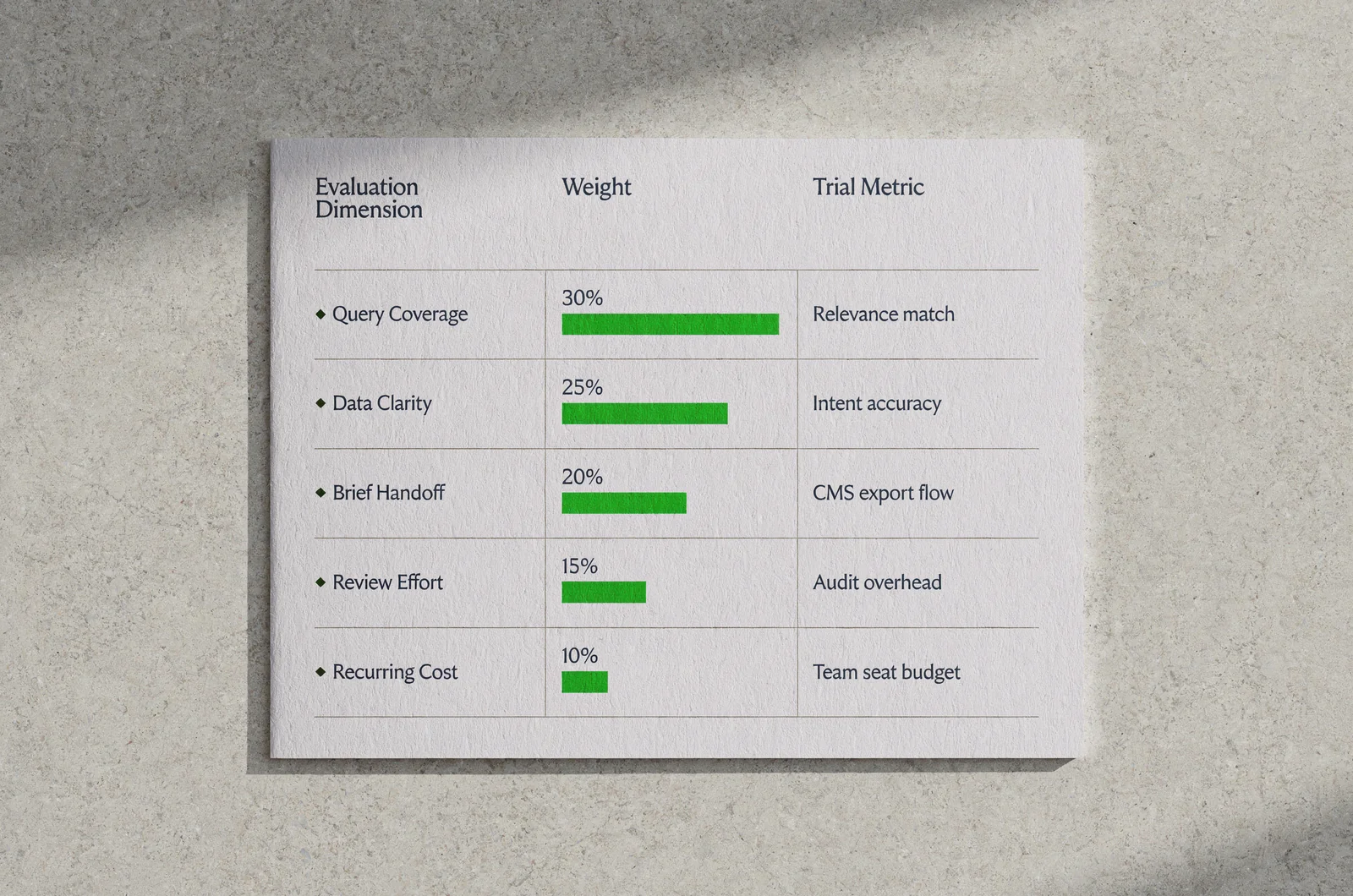
Weight the requirements before calculating a score
Use the following proposed weights as a starting framework:
- Assign 30% to relevant query coverage.
- Assign 25% to data clarity and validation.
- Assign 20% to export and brief handoff.
- Assign 15% to review effort and publishing control.
- Assign 10% to cost fit.
Adjust the weights before scoring if your main constraint differs. An agency with several reviewers may give collaboration more weight; a specialist publisher may prioritise narrow query coverage.
Score each dimension from zero to five using written descriptions. For example, zero can mean the requirement failed, three can mean it passed with documented manual work, and five can mean it passed without correction during the trial.
Calculate the total by multiplying each score by its percentage weight, adding the results and dividing by five. The result is a score out of 100.
Keep mandatory checks outside that calculation. A high aggregate score should not cancel a failed language requirement or an unusable export.
Calculate the cost of completing the work
Record the subscription, required seats and allowances for the tested workflow. Check billing currency and the price of any access required after the trial.
Then estimate monthly working cost: expected operator hours multiplied by your chosen internal hourly rate, plus the subscription cost. Label the hours and rate as planning assumptions.
Divide that total by the number of approved briefs you expect to complete. Keep revision time within the estimate so the calculation reflects the full task.
A useful interactive selector would accept these costs, weights and trial scores. It should exclude candidates that fail mandatory checks and show how the result changes when review time increases.
Choose the candidate with acceptable coverage, a usable handoff and a sustainable recurring cost. Record the decision, unresolved limitations and a date to review actual usage.
Resolve questions that can stall the purchase
Use the trial evidence to settle the remaining selection questions. Keep answers tied to the task your team agreed to complete.
Can a free tool be sufficient?
Yes, if its current limits support your query sample, recurring workload and handoff requirements.
Test the expected weekly task within those limits. Record any work that needs another tool or a manual process, then include that effort in the cost estimate.
If the workflow passes, document the workload at which you would reconsider it. A future need for more access does not require an immediate subscription upgrade.
Which search-volume estimate should determine the choice?
Give preference to estimates whose scope you can interpret and use consistently. Avoid selecting a provider solely because it reports larger numbers.
Check whether disagreements change the actual page decision. If several estimates still support the same priority, preserve the uncertainty in your brief and proceed with the content task.
When the disagreement would change resource allocation, investigate the methodology or gather more evidence before approving that page.
Should AI-search data influence the score?
Include it when AI visibility is an explicit requirement of the content programme.
Require documentation of the measured platform, geography, observation period and estimation method. Keep Google keyword demand and AI-assistant demand in separately labelled fields.
For a programme targeting Germany, require evidence relevant to that market before accepting estimates from another country. Mark undocumented coverage as unresolved.
Assign weight only after defining how the data would change a content decision. Otherwise, leave it outside the purchase score and record it as a possible future test.