How AI Marketing Agencies in Toronto Differ on Price and Output
AI marketing agencies in Toronto vary widely on pricing, deliverables, and reporting. Compare engagement models and costs before signing a contract.

Choosing AI marketing in Toronto means deciding which agency should own strategy, production and commercial reporting. A monthly retainer gives you one number. You still need to establish who does the work, what reaches publication and how much review stays with your team.
The available evidence does not establish current Toronto retainer ranges or comparable packages from named providers. This comparison therefore examines engagement models and clearly labelled hypothetical quotes. All illustrative prices use Canadian dollars (CAD).
For a B2B marketing leader, the decision starts with scope: compare proposals against the same deliverables, acceptance standard and internal workload.
Separate production, channel strategy and wider campaign ownership
Put each Toronto agency proposal into a clearly defined engagement category before comparing its price. A content production contract and a broader acquisition programme need different measures of value.
The following categories are purchasing models for evaluating proposals, rather than verified descriptions of particular local agencies.
A retainer centred on content production
Use this model when your team already owns positioning, channel priorities and campaign strategy. Ask the agency to price a defined production workflow: briefs, drafts, editorial review, revisions and publication.
Its strongest fit is a team with clear direction and insufficient production capacity. Its limitation is the strategy and supervision that remain inside your organisation.
Compare these proposals through accepted assets, revision requirements and publishing responsibility. Establish whether an “article” means a first draft, an approved document or a live page with links and metadata checked. Those are separate contractual milestones.
Choose this scope when you can supply direction and appoint someone to approve the work.
A specialist engagement around one channel
Consider this structure when the central problem concerns organic search, paid acquisition or another clearly bounded channel.
Ask for the diagnostic work, execution responsibilities and reporting standard to be specified together. For search engine optimisation, that could mean separate commitments for technical recommendations, content production and implementation support.
The fit depends on the problem being sufficiently defined. A specialist contract becomes difficult to assess when the proposal promises broad growth while charging for a narrow set of tasks.
Request a sample deliverable and a report for the proposed scope. Check whether the agency will implement its recommendations or hand them to your developers.
A coordinated engagement across several channels
Evaluate a wider programme when one partner needs to coordinate content, campaign messaging, paid distribution and measurement.
Price the coordination explicitly. Identify the person responsible for resolving conflicting priorities and the work that person will produce.
This model deserves consideration when your internal team lacks capacity to manage several delivery partners. Its limitation is the difficulty of tracing a combined fee to individual responsibilities.
Ask for a channel-by-channel breakdown, named owners and exclusions. If the proposal includes both advertising and content, require separate lines for media spend, campaign management and editorial production.
Put every proposal on the same cost basis
An agency quote becomes comparable once you can identify the work, expenses and internal effort attached to its monthly fee. Request the same breakdown from every shortlisted Toronto provider.
Separate recurring delivery from additional charges
Ask each agency to distinguish:
- Initial discovery, audits and account configuration.
- Recurring strategy, production and account management.
- Software, data, media and other separately billed expenses.
- Work outside the agreed scope, including additional revisions.
For each additional charge, request its approval process and billing basis. A proposal should explain whether a change requires a fixed quotation, hourly billing or a revised retainer.
Specify how unused capacity works. If your team delays approvals, determine whether deliverables move forward, expire or require another payment. Put the answer in the agreement.
Include the workload retained by your team
Assign an internal owner to estimate review, coordination and implementation time. Use your own labour-cost assumptions consistently across proposals.
A useful comparison formula is:
Monthly operating cost = agency fee + separately billed costs + internal delivery and review cost.
Keep setup costs visible alongside this calculation. Compare the first month separately from an ongoing month, or spread setup costs across the same evaluation period for every bidder.
For repeat procurement, an internal quote calculator could accept these inputs and display total cost, accepted output and cost per accepted asset. Keep the assumptions editable.
Also request the quotation currency, billing schedule, minimum commitment and cancellation terms. A Europe-based buyer should specify how CAD invoices will enter its procurement budget. Record any currency-conversion assumption beside the calculation.
Compare three hypothetical retainers by accepted output
Suppose three proposals cover the same article specification and acceptance standard. The figures below represent a hypothetical month, including assumed acceptance results.
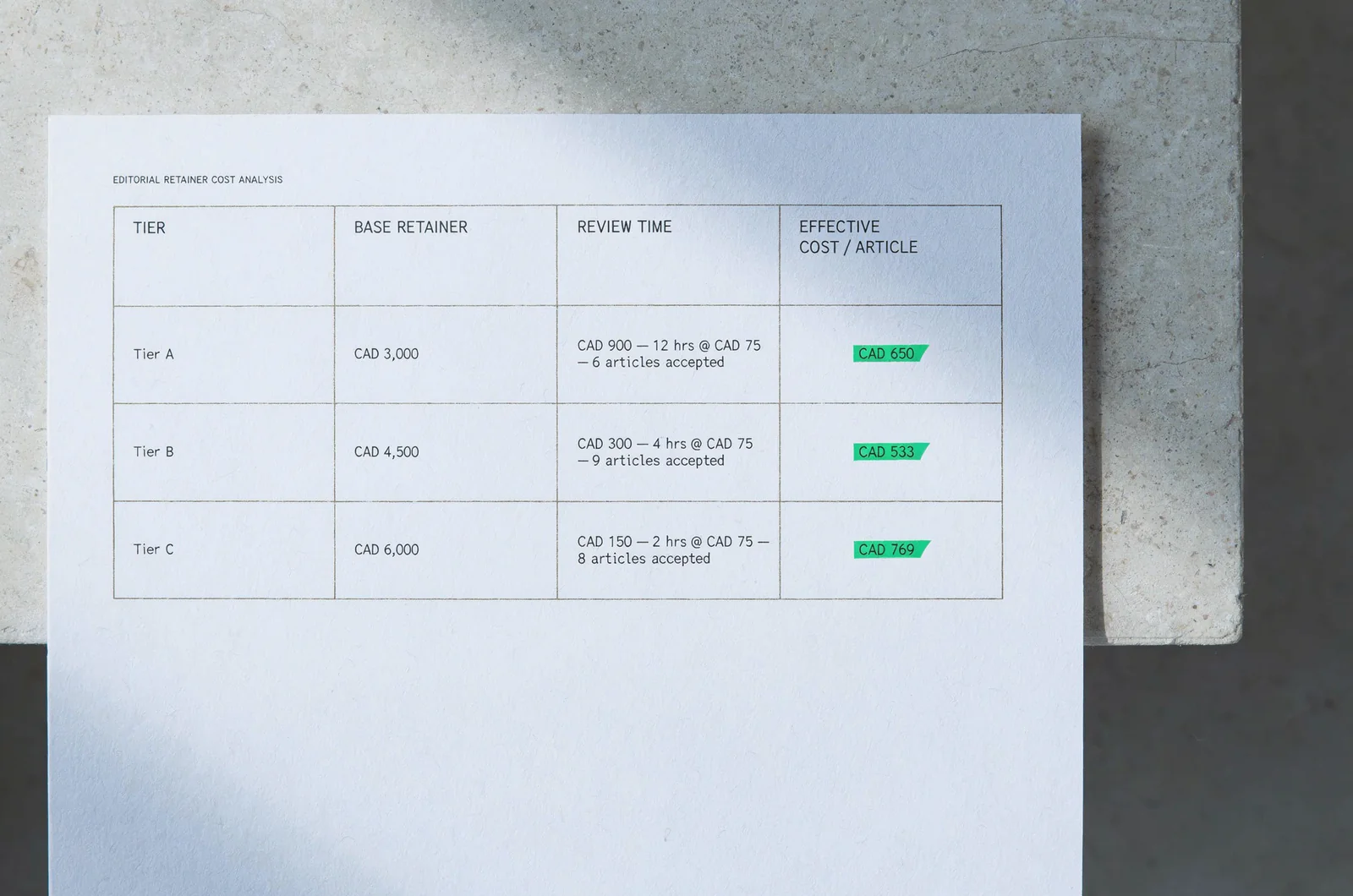
For this illustration, internal review costs CAD 75 per hour. There are no separate setup, software or other charges.
| Hypothetical quote | Monthly agency fee | Drafts delivered | Articles accepted | Internal review | Cost per accepted article |
|---|---|---|---|---|---|
| A | CAD 3,000 | 12 | 6 | 12 hours | CAD 650 |
| B | CAD 4,500 | 10 | 9 | 4 hours | About CAD 533 |
| C | CAD 6,000 | 8 | 8 | 2 hours | About CAD 769 |
The calculation includes internal review. Quote A’s monthly operating cost is CAD 3,900: its CAD 3,000 fee plus CAD 900 in review time. Divide that total by six accepted articles.
The equivalent totals are CAD 4,800 for B and CAD 6,150 for C. The per-article figures are rounded.
Read the trade-offs behind the totals
Under these assumptions, B has the lowest cost per accepted article. C requires the least internal review and achieves acceptance for all eight drafts. A has the lowest invoice and the largest draft count, alongside the greatest review burden.
Choose according to the constraint you need to resolve. A team with limited editorial capacity should examine review hours closely. A team with a fixed publication commitment should examine accepted volume and delivery dates.
These assumed results do not establish how any Toronto agency performs. Before using this calculation in procurement, obtain comparable evidence through a paid pilot or documented delivery records.
Keep the denominator tied to the purchase
Cost per accepted article suits an article-production decision. For a broader engagement, assess the separately priced responsibilities as well.
If a retainer includes technical implementation, campaign management and analytics configuration, record those outputs independently. Dividing the entire fee by article count would leave substantial contracted work out of the assessment.
Use one unit consistently within each comparison: accepted articles, approved landing pages or another explicitly defined deliverable.
Check the editorial work and the people responsible
For a Toronto content engagement, the acceptance standard should describe the work your team will approve. Put that standard beside the promised monthly volume.
Define what publication-ready means
Give every shortlisted agency the same sample brief, audience description and approved source material. Ask it to demonstrate how the finished asset will be checked.
Your acceptance criteria might require:
- Claims that can be traced to approved evidence.
- Correct product descriptions and audience assumptions.
- A structure that answers the intended search query.
- Checked links, metadata and publication formatting.
- A named reviewer who resolves factual or brand concerns.
For search-led work, include target-page ownership and examine how long-tail keyword selection matches the intended buyer.
Also define revision boundaries. Separate corrections needed to meet the brief from changes caused by a new direction. Assign responsibility for both before the first delivery.
If a proposal mentions retrieval-augmented generation, ask which approved documents enter retrieval, how evidence reaches the editor and who resolves conflicting material. Request an example of that process applied to your brief.
Identify who makes the judgement calls
Request the delivery team by role and responsibility. Establish who writes briefs, reviews drafts, checks specialist claims and authorises publication.
A senior person’s appearance in a sales meeting does not establish their involvement in delivery. Ask for their contracted responsibilities, review cadence and replacement arrangements.
For outsourced work, request the same clarity about subcontractors. Identify who can access source documents, customer information and CMS accounts. Ask how access is removed when a person leaves the engagement.
If your gap is specifically content production, a platform such as SiaSEO can enter a separate assessment of software, editorial labour and publishing control. Keep subscription costs and human review costs visible. Assign a person accountable for publication whichever production arrangement you choose.
Finish the staffing review with a named owner for each approval stage.
Require reporting that connects delivery with commercial results
Specify reporting requirements when comparing agency proposals. Ask each bidder to show how its proposed report will answer your operational and commercial questions.
Inspect what was delivered
Request a delivery register with briefs, URLs, publication dates, approval status and revision history. Include planned work, completed work and blocked work.
Ask for the reason behind each blockage and the person responsible for resolving it. This makes the reporting useful for managing the next delivery period.
For content engagements, request visibility into refreshes and replacements as well as new articles. Define whether each activity counts towards the monthly commitment.
Assess outcomes against an agreed baseline
Choose measures that match the engagement: qualified enquiries, target-page conversions, relevant search visibility or attributable pipeline.
Require the report to state its data source, measurement period and attribution assumptions. Establish how the agency will distinguish completed work from observed outcomes when discussing performance.
If showing up in AI search results is included, ask for the prompt set, systems checked, observation dates and scoring method. Require any change to that method to appear in the report.
Have the agency explain what it will do when delivery targets are met and commercial results remain below the agreed threshold. Record the review process and the decisions it can trigger.
Decide what Toronto presence must contribute
Treat local presence as a specific requirement in the agency comparison. Identify the work that benefits from a Toronto-based relationship and ask bidders to explain who will perform it.
You might need in-person workshops, Canadian customer interviews, local campaign coordination or a delivery lead available during particular working hours. Write those requirements into the brief.
Clarify what the agency means by “Toronto-based.” Ask where the account lead and delivery team work, which meetings can happen in person and whether travel attracts additional charges.
For a team buying from France or Benelux, specify working-hour overlap, approval deadlines, invoice currency and the language of deliverables. Keep the intended customer market separate from the agency’s address.
A Toronto supplier serving your European campaign should receive an explicit regional brief covering terminology, audience assumptions and approval responsibility.
If local proximity is optional, assign it an appropriate weight in your evaluation. If it is necessary for interviews or workshops, request named staff and scheduled availability. Verify those commitments in the proposal.
Questions to settle in the agency agreement
Use these questions to resolve differences that remain after the scope, staffing and cost comparison.
What monthly budget should you set?
Build the budget from the work you need accepted and the internal capacity available to support it. Request dated quotations against one brief.
Set separate limits for the agency fee, launch work, other expenses and internal review. Then compare total cost over the same period.
The hypothetical retainers above are calculation examples. Use actual quotations to establish a defensible budget for your Toronto shortlist, and document which responsibilities each quotation includes.
Does AI use justify a lower agency fee?
Assess the price against the contracted work, accepted output and responsibilities transferred to the agency.
Ask which stages use automation, what human review remains and how the proposal prices that work. Request an explanation of any anticipated production savings.
If two proposals promise comparable accepted output, compare total cost and the review burden on your team. Keep the acceptance standard constant throughout the evaluation.
How should a paid pilot work?
Agree on a bounded assignment with a fixed price, delivery date and written acceptance criteria. Give each participating agency equivalent source access and briefing material.
Record revisions, internal review hours, missed requirements and publication readiness. Ask the agency to resolve defects within an agreed period.
Before the pilot begins, document how its results will affect the purchasing decision. Specify the continuing scope, payment terms and access arrangements you would require.
Retain the approved brief, delivered files and acceptance record as the basis for the ongoing agreement.