How Many Long Tail Keywords Should One Page Target?
A practical answer to how many long tail keywords a single page should target, based on intent coverage, page depth, and query clustering.

For planning purposes, start with one primary query and three to eight supporting long tail keywords that serve the same reader task. Treat that range as a briefing convention, then adjust it to the page’s scope. For B2B content teams, the useful decision is which questions one page can answer fully, where another page deserves ownership, and what the writer needs to cover. A focused brief should make those boundaries clear before drafting begins.
How many phrases should a single page deliberately target?
Choose one primary query and a manageable supporting set; three to eight phrases is a suggested starting range for the brief, rather than an evidence-based ranking threshold.
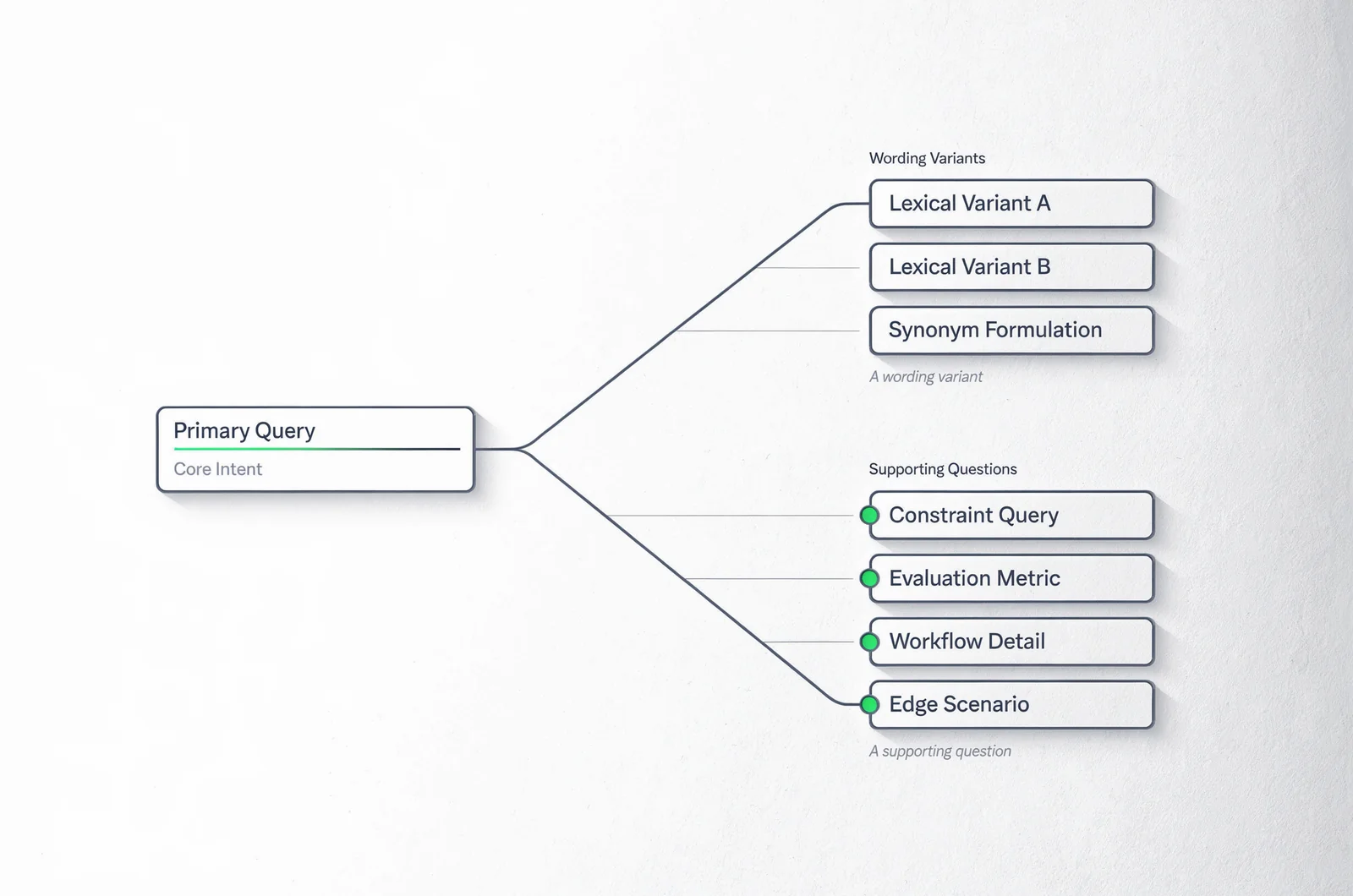
The primary query should express the page’s central promise. Supporting phrases should help the writer identify relevant questions, terminology and constraints. Count them as research inputs, then decide which require distinct answers.
Distinguish two kinds of phrase in the brief:
- A wording variant expresses substantially the same question using different language.
- A supporting question adds a detail the reader needs to complete the same task.
Several wording variants might belong in one paragraph. A supporting question might deserve its own section. Giving every phrase a separate heading would make the phrase count control the article’s structure.
Keep the initial set small enough that an editor can explain every inclusion. If the writer needs twelve phrases to understand the scope, group them by the answers they require. You may discover that several are duplicates, while others belong in separate briefs.
Record the reason for the chosen scope. “One primary question, four supporting questions and three wording variants” is more useful than “eight keywords”. It tells the writer what to answer and gives the reviewer something concrete to check.
What makes a query part of the long tail?
Low search demand is the defining characteristic; phrase length alone is an unreliable way to classify a query.
Ahrefs’ definition of the long tail describes queries with relatively few monthly searches, which tend to be longer and more specific. Backlinko’s guide to lower-volume queries also characterises these terms through relatively low search volume and competition.
That distinction matters when choosing supporting phrases. A long question can still describe a broad task. A short technical expression can describe a narrow one. Counting words will not tell an editor whether either belongs on the proposed page.
Assess each candidate through its meaning. Identify what the reader wants, which constraints change the answer, and whether your business has something useful to contribute.
Keep demand estimates separate from editorial fit. A low-volume phrase should earn its place because it helps define a relevant question. Avoid treating its classification as evidence that the proposed page will rank or convert.
In the brief, retain the demand estimate and its market beside the phrase. An English-language estimate for one country should not quietly become evidence of demand across every market the business serves.
How do you decide whether phrases belong on the same page?
Group phrases when one coherent answer can satisfy their shared task and any meaningful differences between them.
Semrush describes these terms as highly specific search queries. For page planning, specificity gives you a useful test: does a modifier change the answer, or merely clarify the wording?
Consider a hypothetical B2B article about choosing content approval software. Its candidate phrases might include “content approval software for marketing teams”, “marketing content approval workflow” and “content approval software with audit trails”.
The first phrase names a purchasing task. The second could ask for a process explanation. The third introduces a product requirement. Their shared vocabulary is a reason to examine them together, but each still needs an intent decision.
Ask three questions:
- Would the same page type satisfy each query?
- Can the same opening promise accommodate each answer?
- Would answering the additional phrase help the intended reader finish the original task?
If the planned article explains how to choose software, a short explanation of approval workflows may provide necessary context. A detailed implementation tutorial may need a separate page.
Use search results as another input when reviewing an ambiguous grouping. Compare the tasks and page types represented, then document your editorial decision. Before approving the cluster, write its scope in one sentence without resorting to “and everything else about”.
Does a longer article justify targeting more queries?
A longer article justifies additional queries only when the extra space supports questions within the same reader task.
Set the scope before setting the length. Adding words to accommodate unrelated phrases reverses that order and leaves the writer with several competing promises.
For the hypothetical approval-software article, discussing audit trails could support the selection decision. A substantial section about managing social media accounts would require a separate justification. Both concern marketing operations, but their connection does not establish a shared task.
Use an answer-depth test for every proposed addition. Specify what a satisfactory answer requires: a definition, a worked example, an implementation detail, a comparison or original evidence.
Then allocate space according to that requirement. A wording variant may need no additional words. A supporting question may require several paragraphs. A separate decision may require its own brief.
Avoid word-count formulas such as assigning a fixed number of phrases to every thousand words. They leave the underlying question unresolved: what does this reader need from this page?
Before increasing the target length, identify the unfinished answer. If the existing draft already resolves the promised task, put the additional topic into the content backlog with its own proposed intent.
When should a supporting query get its own URL?
Create a separate page when the query requires a materially different promise, audience, format or depth of answer.
Apply that test to the reader’s task. A software comparison and an implementation tutorial can concern the same product category while requiring different evidence and structures.
A separate brief becomes more defensible when you can specify what it will contain that the original page cannot accommodate naturally. That might be configuration instructions, a purchasing comparison or an explanation written for a different operational role.
Check whether the new page can stand on its own. It should have a clear opening answer, sufficient useful material and a reason for a reader to choose it over the existing page.
Geographic modifiers deserve the same scrutiny. For an English-language audience in Spain and Portugal, adding a country name should prompt a review of the actual differences in the answer. Identify any relevant language, availability or operating conditions before commissioning another page.
If those differences are absent, reconsider whether another URL is justified. Preserve the phrase as a research note rather than manufacturing a localised article around it.
Assign the proposed page a distinct reader outcome before assigning its primary query. That outcome gives the editor a practical boundary for the new brief.
How do you prevent two pages from competing for the same intent?
Assign an owner page to each reader task, then review proposed briefs against that ownership map.
The map can be a simple content inventory. Record the URL, audience, central question, page type, supporting questions and intended outcome. The purpose is to make overlapping promises visible before another draft is commissioned.
Shared vocabulary should trigger examination. Look at what each page actually answers and why a reader would need both.
When reviewing existing coverage, distinguish between two situations. One page may answer the task fully while another repeats a narrower version. Alternatively, two pages may use similar language to support different decisions.
For an apparent duplicate, decide whether to improve the established page, narrow the proposed page or consolidate the material. For distinct decisions, make the boundaries explicit in their titles, openings and internal links.
Use query and URL performance data to investigate ambiguous cases. Ask whether the page receiving impressions is suited to the underlying question. Avoid making a consolidation decision from phrase overlap alone.
For a SiaSEO-assisted workflow, use the website’s existing pages as the first constraint on the proposed cluster. Require the brief to identify existing coverage and explain what the new page adds.
Give each approved brief an owner URL or a clearly documented reason for creating one.
Should every supporting phrase appear exactly as written?
Use exact wording when it communicates the meaning clearly; otherwise, write the answer in natural language and preserve the relevant detail.
A research export is an input to the writer. It should not dictate every sentence. Singular and plural forms, reordered words and close paraphrases may all point to the same editorial question.
For each supporting phrase, identify what must survive in the draft. A modifier such as “with audit trails” introduces a requirement that needs an answer. A minor wording variation may contribute no additional substance.
Check the finished page against its questions rather than a repetition tally. Can a reader find the answer? Does the text explain the relevant constraint? Has the writer supplied enough detail to support the page’s promise?
Avoid treating a particular density as a publication gate without evidence that it serves the reader’s task. A draft can repeat a phrase while leaving its question unanswered.
Keep the primary query visible in the title and opening where it reads naturally. Use section headings for the questions that deserve separate answers.
During review, remove repetitions that add no information. Retain technical terms and meaningful qualifiers even when doing so changes the wording of the original research phrase.
How should AI answer engines change the keyword brief?
For AI-search planning, organise the brief around explicit questions, related meanings and supported answers rather than expanding its phrase quota.
A semantic cluster is a planning group: different wording can express the same problem, while an additional constraint can require a new answer. Use that distinction to decide which material belongs together.
For the approval-software example, audit trails, access permissions and approval stages could support the same selection task. Each deserves coverage only to the extent that it helps the buyer evaluate the workflow.
Make those relationships explicit in the writing. Name the subject, state the answer and explain any condition that changes it. Avoid paragraphs whose meaning depends on a distant heading or an undefined pronoun.
Do not convert the suggested phrase range into a forecast of AI citations. A claim about how a particular answer engine retrieves, groups or cites content would require evidence about that system.
Likewise, avoid claiming that a page will receive a citation because it contains a certain number of related questions. Keep retrieval assumptions separate from editorial requirements.
Build the brief around answers you can substantiate. For each question, specify the supporting evidence, the relevant entity and any qualifier the reader needs. Review uncertain claims before treating them as part of the page’s promise.
What should an automated keyword brief preserve?
An automated brief should preserve the page’s intent, existing coverage, evidence requirements and scope boundaries throughout drafting and review.
A phrase list alone leaves substantial editorial work unresolved. Require the brief to state what the reader should be able to decide or do after reading. Add the supporting questions and explain which adjacent topics belong elsewhere.
For every question, identify the evidence needed for a satisfactory answer. A product capability may require documentation. A quantitative claim needs a source and context. An illustrative example should be labelled as hypothetical.
The distinction matters when reviewing research-grounded generation tools: assess whether the proposed process preserves evidence and page scope alongside fluent prose.
A SiaSEO draft should receive the same scope review as any other draft. Compare its sections with the approved reader task, inspect added claims, and check whether existing pages already own the supporting questions.
A useful interactive aid would be a scope selector that accepts candidate queries and an existing-page inventory. It could ask editors to classify each phrase as a wording variant, supporting question or separate intent. Its output would show proposed groups and unresolved decisions.
Require a reason for each unresolved grouping before approving the draft. Keep that decision visible to the person responsible for publication.
How should you revise the target set after publication?
Revise the target set when performance data and page review reveal an unanswered relevant question, an intent mismatch or duplicated coverage.
Review queries alongside the URLs receiving impressions. Examine whether the page answers those queries clearly and whether the visitors they describe fit the intended audience.
Return to the ownership map before adding sections. A newly visible question may belong on the current page, or an existing article may already be better suited to answer it.
For the hypothetical approval-software article, an implementation query would prompt a scope decision. Check whether a concise answer supports software selection or whether the reader needs a separate setup tutorial.
Record the proposed revision, its evidence and the expected reader benefit. Make the same record when deciding to leave the page focused and create another brief.
Assess business relevance alongside visibility. Use the engagement and conversion measures available for the site to examine whether the page helps the intended audience. Keep observed outcomes separate from assumptions about what caused them.
Also review the draft itself. A query may already be within scope but answered vaguely, supported weakly or buried beneath unrelated material.
Choose a review interval suited to the site’s publishing cadence and available data. At each review, approve a specific content change or document why the page’s current scope remains appropriate.