Reality Augmented Generation vs RAG: 6 Differences That Matter
Reality augmented generation vs RAG: six differences in data sources, freshness, and fact checks that shape how AI content stays grounded.

Reality augmented generation needs a careful definition before it can guide an SEO content workflow. Usage varies, so this comparison uses it for a process that checks changeable claims against current operational evidence before publication. The practical decision is which claims deserve those checks and where to place them.
Retrieval augmented generation (RAG) supplies retrieved material to a model as context for its response. Here, the baseline retrieves from an approved content collection. The second configuration adds explicit checks against sources such as a product catalogue or an availability service. A RAG system can perform those checks too; the approaches overlap.
Treat the phrase as a working description, with the underlying implementation open to inspection. A label alone establishes nothing about freshness, verification or publishing controls.
The six differences below follow implementation dependency: choose evidence sources first, set freshness and verification rules, then assess latency, cost and remaining error. This order puts decisions about reader trust before decisions about throughput.
Consider a hypothetical SaaS comparison article for buyers in Italy. Its product explanation might come from approved documentation. A statement about a currently available plan needs evidence that covers the relevant territory and purchase conditions. That distinction provides a useful test throughout the list.
1. Data sources: identify what can support the claim
The first difference concerns the evidence each workflow accepts. An approved collection might contain documentation, editorial guidelines and previously reviewed pages. Under our working definition, the added operational check consults a source designated to answer a particular current-state question.
This belongs first because every later control depends on selecting an appropriate source. For the hypothetical SaaS article, a documentation page could support an explanation of a capability. The plan catalogue would be the designated source for which subscription includes it.
For an agency managing several clients, define source authority separately for each account. One client's published blog should never become evidence for another client's product claims. Within an account, assign authority by subject: product documentation for behaviour, approved commercial records for plan conditions.
Operational access also has limits. A record may describe an internal configuration, a restricted customer segment or an unpublished change. Access to that record does not establish permission to publish it.
The best fit is a team producing content with claims that map to identifiable business records. Teams writing stable educational material can begin with a curated collection and introduce operational checks selectively.
Choose sources by the claim they can establish. For every source, record its owner, subject coverage, permitted audience and publication status. Reject evidence that falls outside those boundaries, even when its wording closely matches the draft.
2. Freshness: set an expiry rule for each claim
The second difference is the freshness rule applied to retrieved evidence. A document collection can support an explicit update schedule. A workflow with operational checks can instead require a new observation at a defined point before publication.
Neither configuration establishes an acceptable age by itself. Set that requirement according to the claim.
For an enduring explanation of a technical concept, the relevant question might be whether the approved documentation has changed. For a statement about current availability, specify how close to publication the source must be checked.
This distinction best fits content operations teams responsible for both evergreen education and changeable commercial pages. Apply different rules to those content classes. Rechecking every sentence against an operational service would create work without a corresponding editorial purpose.
Freshness has a further limit: retrieval time and validity time can differ. A record obtained today could describe an earlier reporting period. A recently updated page could retain an obsolete condition.
For the hypothetical Italian-market article, keep the market and applicable conditions beside the availability claim. Avoid treating a recent timestamp as evidence that the statement applies to every reader.
The practical verdict is to define freshness at claim level. Store when the evidence was retrieved, which period it describes and what event invalidates the claim. Where validity is unknown, hold the statement for review or remove the time-dependent wording before publication.
3. Verification: separate retrieved evidence from approval
The third difference concerns whether the workflow explicitly checks that evidence supports the proposed wording. Retrieving relevant text and approving a claim are separate decisions.
Suppose the hypothetical catalogue lists a capability for one subscription tier. The draft must preserve that restriction. A sentence claiming that every subscription includes it exceeds the evidence, even if the catalogue was retrieved correctly.
A verification rule should examine the full relationship: product, capability, tier, market and applicable conditions. Ask whether the source supports the sentence as written, including its qualifiers.
This entry best fits teams publishing comparisons, product explainers and landing pages with specific commercial assertions. Their review process needs a clear answer to a narrow question: can this wording be approved from this evidence?
The limitation is the verification method itself. A second model's agreement does not establish independent confirmation when both models rely on the same ambiguous passage. Deterministic comparisons can help with structured fields, while interpretation-heavy claims may still need editorial judgement.
A useful review record would keep:
- The proposed claim and its supporting passage.
- The conditions that limit the claim.
- The check performed and its result.
- The reviewer responsible for unresolved ambiguity.
Choose explicit verification when a wording error would materially change the reader's decision. If the source establishes only a narrower statement, narrow the draft. If two authorised sources disagree, stop that claim's publication until the responsible owner resolves the conflict.
4. Latency: decide where waiting belongs
The fourth difference is where source checks sit in the publication schedule. A workflow that requires additional sequential checks must allow time for those checks before approval.
For scheduled SEO articles, that waiting can occur before the publishing window. Draft stable explanations from approved material, then check changeable claims during final review. This gives the editor a defined point at which evidence becomes current enough for release.
That arrangement best fits teams with a content calendar and predictable review capacity. A page assembled for a reader's immediate request has a different timing requirement. Its design must account for checks within the response path or define an acceptable cached result.
Avoid assuming that every external lookup requires the same treatment. Independent checks may run together. A dependent check must wait for the result it needs. Measure the actual sequence before deciding which operation creates the delay.
The limitation is failure behaviour. An unavailable service leaves a decision unresolved. Quietly substituting an older observation would change the evidence standard unless the workflow explicitly permits it.
For the hypothetical article, an unavailable plan catalogue could trigger removal of the availability claim while the educational sections continue through review.
Place checks according to publication urgency and claim dependency. Specify a deadline for each required check, an acceptable fallback where justified, and the person who receives unresolved failures. Keep the article unpublished when a failed check affects its central promise.
5. Cost: measure the whole publication path
The fifth difference concerns what you count as the cost of producing an approved article. Retrieval, generation, operational checks and editorial review each need a place in that accounting.
For a collection-based workflow, include source preparation, updates and retrieval maintenance. For the configuration with current-source checks, include connector maintenance, failed requests, exception handling and any additional review those checks require.
These are categories to measure, rather than assumptions about which configuration will cost less. No universal cost ranking follows from the terminology.
This distinction best fits agency operators and marketing leaders evaluating automation across a portfolio. Their decision should reflect the work required to reach a publishable result. The same accounting belongs in an assessment of AI blog generation costs.
Keep a consistent approval standard during the comparison. Record review time, rework, rejected claims and maintenance effort alongside generation expenses. Otherwise, a workflow with fewer checks might appear more efficient simply because it leaves more work outside the measurement.
The limitation is shared infrastructure. A connector used across many articles has a different allocation problem from a one-off integration. State how you distribute that maintenance cost before comparing article-level figures.
The practical verdict is to measure the full route to publication. Start with one recurring claim type, such as plan inclusion, and record its checking and correction effort. Expand the integration only after that record supports the operational case.
6. Hallucination risk: define what the system must withhold
The sixth difference concerns how the workflow handles claims it cannot establish. Additional evidence creates an opportunity to constrain a draft, but the publishing rule determines what happens when support is missing.
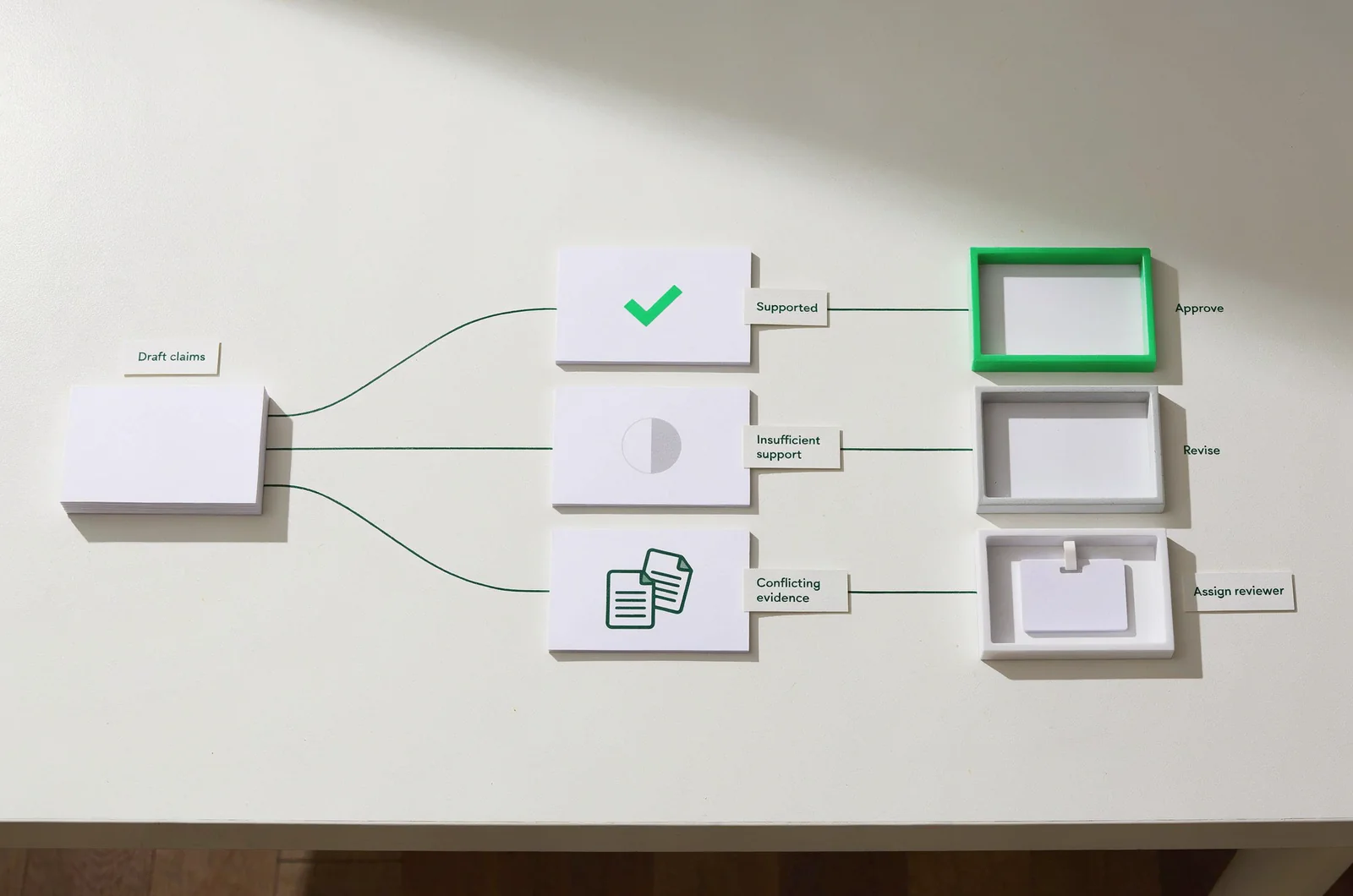
For this comparison, assess two failure paths. One is an unsupported assertion with no adequate source. The other is an assertion that misstates available evidence, perhaps by dropping a qualification or attaching a capability to the wrong plan.
Both configurations need controls for these failures. A current-source check addresses the particular state it observes. It cannot establish unrelated explanations or conclusions elsewhere in the article.
This entry best fits teams deciding how much publishing autonomy to grant. Define which claim categories require approval, which can be narrowed automatically, and which must be withheld when evidence is absent.
The limitation is that an approved source can contain an error. Record-level agreement therefore needs a route for reporting suspicious evidence and correcting affected content.
In the hypothetical SaaS article, confirming a plan's availability would support that availability statement. A claim that the plan delivers better business results would require its own evidence.
Choose a workflow with explicit behaviour for missing, conflicting and insufficient support. Make withholding an unsupported sentence a valid outcome. Evaluate the draft claim by claim, and require the reviewer to inspect whether the evidence supports the exact wording before permitting publication.
Turn the six differences into publishing rules
The most useful choice between these configurations is a set of rules your team can apply to actual articles. Begin with one content category and identify which claims require which evidence.
Match checks to recurring claims
For an educational article, define the approved documentation and its review owner. For a product comparison, add checks for the commercial conditions that affect the recommendation. For a page containing availability statements, define when those statements must be rechecked.
A useful internal tool would be a claim selector. Editors would enter the claim type, authoritative source and acceptable evidence age. The selector would return a review route with the reason for that result.
Keep the first version narrow enough that editors can inspect every decision. Use disagreements to revise the rules before widening its scope.
Preserve the evidence behind publication
For each checked claim, retain the wording, supporting evidence, applicable conditions and approval result. Keep that record attached to the published version so a later correction can identify affected statements.
Apply the same evaluation standard when considering SiaSEO for structured content production. Ask how the proposed workflow preserves evidence, handles unresolved claims and controls publication.
An overall quality score needs a defined consequence for individual failures. Specify which unsupported claims block publication, who can resolve them and when a change to the source requires another review.
Questions to settle before choosing a workflow
Can RAG use current operational data?
Yes. Retrieval can be configured to consult current operational sources. That is why the distinction in this article concerns workflow configuration and approval rules.
Ask what the system retrieves, when it retrieves it and how it uses the result. Those answers establish the practical difference more clearly than the terminology. Require an example that traces one claim from source selection through publication approval.
Does a current-source check establish that a claim is true?
It establishes only what the designated source supports within its scope. Review the source's authority, applicable conditions and the relationship between its contents and the sentence.
A successful request establishes that data was returned. Approval requires checking what that data means for the proposed claim. Preserve unresolved ambiguity in the review record and assign it to an owner.
Which configuration should a smaller content team start with?
Begin with a curated collection for stable material and a defined editorial approval process. Add a current-source check where a recurring claim has a clear authoritative source and a meaningful correction burden.
Choose one claim category for the initial implementation. Record its failures, review effort and publication decisions before expanding coverage. Keep manual approval for exceptions until the team has a rule it can explain and apply consistently.